Your Car''s Odometer: How It Works and What It Tracks
Every driver sees the number, but few truly understand its full significance. The reading on your car''s odometer is one of the most critical data points your...

Every driver sees the number, but few truly understand its full significance. The reading on your car's odometer is one of the most critical data points your vehicle possesses, directly influencing its value, maintenance schedule, and history. Yet for many owners, the technology behind this number is a black box. If you've ever felt concerned about terms like 'clocking' when buying a used car in the UK, or simply wondered how a modern digital display differs from the old mechanical tumblers, you are not alone. This core component is often misunderstood, leaving drivers vulnerable to misinformation and fraud.
This guide provides the definitive explanation of the car odometer. We will break down the precise mechanics of both analogue and digital systems, revealing how modern vehicles record mileage across multiple ECU modules. You will gain a clear understanding of why an accurate mileage reading is fundamental to your car's value and learn to recognise the signs of illegal tampering. By the end, you will have the technical knowledge to appreciate the importance of your odometer and protect yourself from costly mistakes.
Key Takeaways
- A vehicle's mileage is the single most critical factor determining its value, maintenance needs, and legal compliance in the UK.
- Learn how mileage recording has evolved from simple mechanical counters to complex digital systems integrated into multiple vehicle modules.
- Recognise the specific factors, such as tyre size changes, that can cause discrepancies in your car's odometer reading.
- Understand the future of mileage tracking and how data is increasingly stored and secured within advanced vehicle electronic systems.
What Is an Odometer? A Core Component of Your Dashboard
At its core, an odometer is a crucial instrument in your vehicle's dashboard that measures and displays the total distance a vehicle has traveled since it was manufactured. Its name provides a direct clue to its function, originating from the Greek words 'hodos' (meaning path or way) and 'metron' (meaning measure). This non-resettable counter provides a permanent and vital record of the vehicle's usage. This figure is fundamental for scheduling maintenance, determining resale value, and assessing the overall wear and tear on mechanical components. While it's a simple concept, the modern Odometer is a sophisticated device deeply integrated into the vehicle's electronic control units (ECUs).
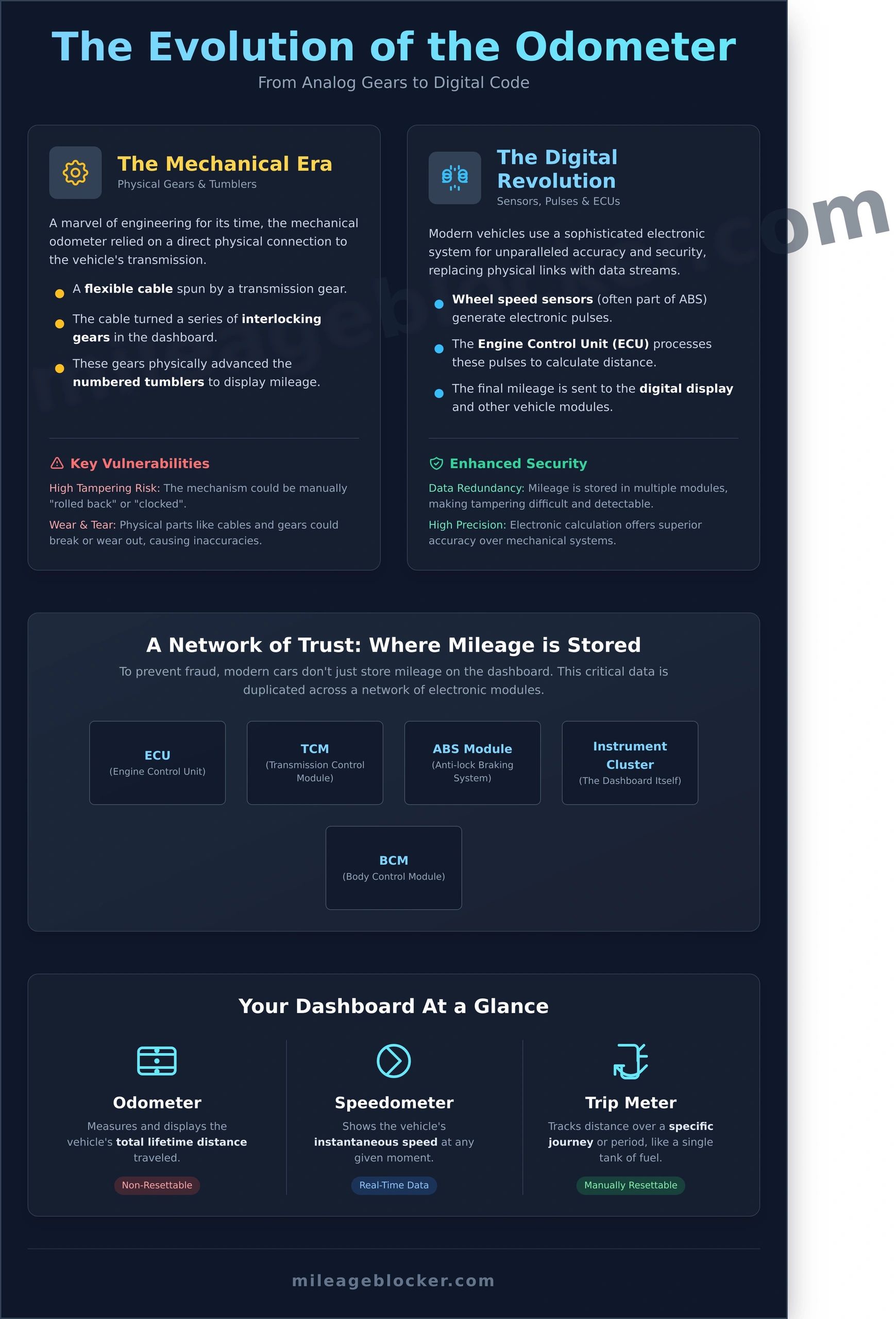
It is critical not to confuse the odometer with the speedometer. Although they are typically located next to each other in the instrument cluster, they serve entirely different purposes. The speedometer shows your vehicle's instantaneous speed-how fast you are travelling at any given moment. The odometer, in contrast, provides a cumulative total of the distance you have covered over the vehicle's entire lifespan.
This animation helps to visualise how these dashboard components work together:
The Odometer vs. The Trip Meter
Most modern vehicles also feature a secondary, resettable distance counter known as the trip meter. Unlike the main odometer, the trip meter can be zeroed at any time by the driver. This is usually done by pressing and holding a button on the dashboard or via a menu in the vehicle's infotainment system. Many cars offer two trip meters (Trip A and Trip B), allowing you to track separate journeys simultaneously. Common uses include:
- Calculating fuel efficiency (miles per gallon) on a single tank of petrol.
- Tracking mileage for business expense claims.
- Measuring the exact distance of a specific route or holiday journey.
Crucially, resetting the trip meter has no effect on the main odometer reading, which continues to record the vehicle's total lifetime mileage.
How to Read Your Odometer Correctly
Reading your car’s mileage is straightforward on both older mechanical and modern digital displays. The number shown represents the total distance covered. In the United Kingdom, this is almost always displayed in miles, often identified by an "MI" or "MPH" label nearby. The display typically shows six main digits for the total miles. The final digit, often in a different colour or separated by a decimal point, represents tenths of a mile. For example, a reading of 123456.7 indicates the vehicle has travelled one hundred twenty-three thousand, four hundred fifty-six and seven-tenths miles.
The Evolution of the Odometer: From Mechanical Gears to Digital Sensors
The journey of the odometer mirrors the evolution of the automobile itself-from a simple mechanical counter to a deeply integrated component of a vehicle's complex electronic network. This transition was not merely a cosmetic upgrade to a digital display; it was a fundamental shift driven by the need for greater accuracy, security, and integration with the advanced systems that define modern cars. Understanding this evolution is key to appreciating how mileage data is recorded and protected today.
How Mechanical Odometers Worked
For decades, the odometer was a marvel of mechanical engineering. A flexible cable, physically connected to a gear in the vehicle's transmission, would rotate in direct proportion to the rotation of the wheels. This cable snaked its way to the dashboard, where it turned a series of small, interlocking gears. These gears would then physically advance the numbered tumblers you saw on the display, slowly ticking over the miles. While ingenious, this system was vulnerable. The cables could break, the gears could wear, and most significantly, the mechanism could be manually "rolled back," a practice that led to widespread issues with Odometer Fraud.
The Modern Digital Odometer Explained
Today's digital odometer operates on a completely different principle. Instead of a physical cable, modern vehicles use magnetic or optical wheel speed sensors, often as part of the Anti-lock Braking System (ABS). These sensors generate electronic pulses as the wheels turn, sending a constant stream of data to the car's primary computer, the Engine Control Unit (ECU). The ECU processes this high-frequency data, calculates the distance travelled with incredible precision, and then sends the final mileage value to the digital display on your instrument cluster. This information is typically broadcast across the vehicle's internal network, known as the CAN bus, allowing other systems to access it.
Where Mileage Data is Stored in Modern Cars
A crucial advancement in digital systems is data redundancy. The mileage figure you see on your dashboard is not the only record of your vehicle's distance travelled. To enhance security and prevent tampering, this critical data is stored in multiple electronic control modules throughout the car. Examples include:
- The Engine Control Unit (ECU)
- The Transmission Control Module (TCM)
- The Anti-lock Braking System (ABS) module
- The Body Control Module (BCM)
- Even the electronic key fob in some models
This distributed storage makes illicitly altering a vehicle's mileage exceptionally difficult. Any mismatch between the modules can be flagged during a diagnostic scan, which is why specialised tools are required to accurately test and verify a vehicle's electronic systems.
Why Your Odometer Reading is Critically Important
More than just a number on your dashboard, a vehicle's odometer reading is the primary indicator of its life story. This single figure provides a direct, quantifiable measure of usage, which has significant implications for the car's value, maintenance requirements, and even its legal standing. For buyers, sellers, and technicians alike, the mileage is a critical data point that dictates financial decisions and essential vehicle care.
Determining Vehicle Resale Value
In the UK used car market, there is a direct and powerful correlation between mileage and value. A vehicle with lower-than-average mileage for its age will consistently command a higher resale price. Buyers perceive high mileage as a significant risk factor, associating it with increased wear and tear on crucial components like the engine, transmission, and suspension. Industry valuation guides, such as CAP HPI, use mileage as a core metric to calculate a vehicle's precise market value.
Guiding Maintenance and Service Schedules
Vehicle manufacturers engineer service schedules based on specific mileage intervals to ensure longevity and performance. An accurate odometer reading is therefore essential for proper vehicle maintenance and safety. Understanding the mechanics of how these devices track distance, as explained in guides on How Odometers Work, highlights why this data is so integral to a car's lifecycle. Key service milestones are almost always triggered by mileage, including:
- Engine Oil and Filter Changes: Typically required every 8,000 to 12,000 miles.
- Timing Belt Replacement: A critical service often due between 60,000 and 100,000 miles.
- Spark Plugs and Fluid Flushes: Major services for transmission and coolant systems are scheduled at higher mileages.
Impact on Warranties and Lease Agreements
The mileage displayed has direct contractual and financial consequences. Manufacturer warranties are typically limited by both time and distance (e.g., "3 years or 60,000 miles"). Exceeding the mileage limit can void coverage for critical repairs. Similarly, Personal Contract Hire (PCH) and other lease agreements in the UK include strict annual mileage allowances. Exceeding these limits results in financial penalties, with excess mileage charges often ranging from 5p to 30p per mile, potentially costing hundreds or thousands of pounds (£) at the end of the contract.
Odometer Accuracy and Potential Discrepancies
A common question drivers ask is, 'Can my car's odometer be wrong?' The short answer is yes, but typically not by a significant amount. Modern digital systems are highly accurate, but certain factors can introduce minor discrepancies. It is crucial to distinguish between these unintentional inaccuracies-often within an acceptable variance of 1-4%-and deliberate, illegal tampering.
Common Causes of Odometer Inaccuracy
The most frequent cause of an inaccurate reading is a change in tyre size. Fitting larger or smaller tyres than the manufacturer's specification alters the wheel's rolling circumference, which directly affects mileage calculation unless the vehicle's Engine Control Unit (ECU) is recalibrated. In much older, classic cars with mechanical systems, physical wear and tear on gears can lead to errors over time. While rare, modern vehicles can also experience faults with wheel speed sensors or the ECU itself, leading to incorrect data.
Odometer Rollback: Understanding Mileage Fraud
A far more serious issue is odometer fraud, commonly known as 'clocking'. This is the illegal act of deliberately winding back a vehicle's mileage to make it appear less used than it is. The motivation is purely financial-a car with lower mileage can be sold for thousands of pounds more than its true value. In the United Kingdom, this is a criminal offence prosecuted under The Fraud Act 2006, carrying severe penalties.
How to Spot Potential Tampering on a Used Car
When buying a used vehicle, it's vital to check for signs of clocking. Look for discrepancies between the mileage and the car's overall condition.
- Excessive Wear: Check for a worn-out driver’s seat, steering wheel, or pedals that seem inconsistent with a low mileage reading.
- History Reports: Run a full vehicle history check (e.g., HPI check). Look for mileage figures that decrease between MOTs or service records.
- Physical Inspection: Examine the instrument cluster for scratches, loose panels, or misaligned digits, which could indicate the dashboard has been disassembled.
Any device that interacts with a car's complex electronics requires expert knowledge; professional installation is always recommended to prevent causing irreversible damage to sensitive modules.
The Future of Mileage Tracking and Advanced Diagnostics
As vehicle technology advances, the simple car odometer has evolved into a highly integrated data point within a complex digital ecosystem. Modern vehicles rely on a network of electronic control units (ECUs) communicating over systems like the CAN-Bus. Furthermore, the rise of telematics and connected car services means that mileage and other vehicle data are often transmitted and stored remotely, adding another layer of complexity and tracking. This shift brings enhanced security but also creates new challenges and requirements for automotive professionals.
Digital Security and Anti-Fraud Measures
To combat mileage fraud, manufacturers have implemented sophisticated security protocols. Mileage data is no longer stored in a single location; it is distributed across multiple modules, including the engine control unit (ECU), transmission controller, and even the key fob. These systems often use cryptographic checksums-a digital signature that validates the data-to ensure integrity. Attempting to alter the mileage in one module without updating the others creates a data conflict, a digital red flag that advanced diagnostic tools can easily detect, exposing any tampering.
Legitimate Uses for Mileage Data Control
While security is paramount, there are legitimate, professional scenarios where controlling mileage accumulation is necessary. Vehicle developers and tuning specialists, for instance, conduct extensive dynamometer (dyno) testing where a vehicle can simulate thousands of miles while stationary. Adding this to the official odometer would be misleading for future service intervals and valuation. Similarly, for dedicated off-road vehicles, tracking mileage that doesn't occur on public roads is often irrelevant. These niche applications require specialized tools designed purely for testing and development purposes. You can learn more about these specialized applications in our comprehensive Mileage Blocker FAQ.
The takeaway is clear: modern vehicle electronics are deeply complex. Whether for diagnostics, security analysis, or specialised testing, working with a vehicle's mileage data requires an in-depth understanding of its communication systems. As vehicles become more connected and their systems more secure, the demand for high-quality, reliable solutions for professionals will only grow. Modern vehicles require smart solutions, and understanding these systems is key to effective vehicle management and development.
Your Odometer: The Final Word on Mileage Tracking
From its mechanical origins to today's sophisticated digital displays, the odometer remains a fundamental component of your vehicle. It serves as the definitive record of your car's operational life, influencing everything from its resale value to its crucial maintenance schedule. Understanding how this vital device works is the first step toward gaining complete control over your vehicle's diagnostics and performance data.
Modern vehicles require smart solutions, especially during performance testing and diagnostic work. For professionals who demand precision, our tools provide unparalleled control. Each device is built with genuine automotive-grade components to guarantee reliability and offers a completely untraceable effect for testing purposes. With worldwide shipping and dedicated lifetime support, you are investing in a superior, professional-grade solution.
Ready to take your vehicle diagnostics to the next level? Shop our range of premium quality diagnostic tools and gain the professional advantage you need.
Frequently Asked Questions About Your Car's Odometer
What is the difference between an odometer and a speedometer?
The speedometer and odometer are two distinct instruments on your dashboard. The speedometer displays your vehicle's instantaneous speed, typically in miles per hour (MPH). In contrast, the odometer records the total cumulative distance the vehicle has travelled over its lifetime. While both may use data from the same wheel speed sensors, they serve fundamentally different functions: one measures current velocity, and the other measures total distance covered.
Can a digital odometer be rolled back or changed?
Yes, altering a digital odometer is technically possible, but it is a complex process. Unlike older mechanical units, digital mileage is stored electronically in multiple control modules within the vehicle's network, such as the instrument cluster and Engine Control Unit (ECU). Changing this data requires specialised diagnostic equipment to access and reprogram these modules. It is far more sophisticated than simply winding back numbers and can often be detected during advanced vehicle diagnostics.
Is it illegal to change the mileage on a car's odometer?
In the United Kingdom, it is a criminal offence to alter a vehicle's odometer reading with the intent to misrepresent its history and then sell it without full disclosure. This practice, known as 'clocking', is prosecuted under the Fraud Act 2006. While adjusting mileage for a legitimate repair, such as replacing a faulty instrument cluster, is permissible, doing so to deceive a buyer is illegal and carries severe penalties, including significant fines and potential imprisonment.
What happens if my odometer stops working?
A non-functional odometer is a serious issue that requires immediate professional attention. In the UK, a vehicle will automatically fail its MOT test if the odometer is inoperative or cannot be clearly read. The fault could be caused by a failed speed sensor, a wiring problem, or a defect in the instrument cluster itself. Driving without a working odometer makes it impossible to track service intervals and creates a discrepancy in the vehicle's official record.
Does replacing the engine reset the odometer?
No, replacing a vehicle's engine does not reset the odometer. The mileage is tied to the vehicle's chassis and is recorded in electronic modules like the instrument cluster, which are separate from the engine. The odometer will continue to display the total distance the car has covered, regardless of engine changes. It is standard practice to document the engine replacement and the mileage at which it occurred in the vehicle's service history for transparency.
How accurate is a car's odometer reading?
Modern odometers are generally very accurate, calibrated from the factory to be within a small margin of error. However, slight deviations of a few percentage points can occur over long distances. Factors such as tyre wear, tyre pressure, and using non-standard tyre sizes can alter the wheel's rolling circumference, which in turn affects the distance calculation. Despite these minor variables, the reading is considered a highly reliable and legally accepted measure of vehicle usage.
About the author
Pav TomaszeviczChief Editor, MileageBlocker.com
Pav is Chief Editor at MileageBlocker.com and works with the MileageBlocker Technical Team to publish practical information about vehicle compatibility, CAN/CAN-FD electronics, installation and MileageBlocker products.
View author profile →