
Can Diagnostic Tools Find a Mileage Blocker?
A standard OBD-II scanner can identify a cheap odometer correction tool in seconds, yet it will completely ignore a professional mileage blocker during a dee...

A standard OBD-II scanner can identify a cheap odometer correction tool in seconds, yet it will completely ignore a professional mileage blocker during a deep system sweep. It is a technical reality that often surprises even experienced technicians who rely on automated software to flag discrepancies. In our workshop, we have seen owners of luxury models like the 2026 BMW M5 worry that a routine service visit might lead to a flagged warranty or a permanent tamper mark on their digital history. You are likely asking: can diagnostic tools find mileage blocker modules when they are active? We understand the anxiety surrounding the resale value of a high-end vehicle and the confusion between detectable correction and discreet blocking. Our guide explains how professional hardware interacts with vehicle communication protocols to ensure your data stays clean while you conduct authorised off-road testing or dyno sessions.
We will examine the critical difference between altering existing data and blocking the signal at the source, giving you the confidence to use these tools for their intended purposes without leaving a digital footprint. Our team has spent years analysing how various control units communicate, and we have found that the key to total invisibility lies in high-grade German engineering that mirrors OEM signals perfectly. You will learn why standard diagnostic scans fail to detect these specific hardware interventions and how to ensure your luxury vehicle's electronic architecture remains untouched by intrusive software flags. By the end of this article, you will understand the technical mechanisms that keep professional hardware hidden from even the most sophisticated dealer-level scanners, allowing you to maintain the integrity of your vehicle's records during specialised performance evaluations.
Key Takeaways
- Understand why standard OBD-II scanners only see what the vehicle's memory allows, leaving high-end signal filters completely out of sight during routine checks.
- Discover why the answer to whether can diagnostic tools find mileage blocker hardware depends on the device’s ability to stop data from being written rather than altering it later.
- Learn to differentiate between a routine dealership service scan and rare forensic investigations that look for conflicting data logs across secondary control modules.
- Master the activation of your device through steering wheel controls for professional R&D or track-day sessions without creating permanent odometer discrepancies.
- Identify the benefits of using German-engineered hardware that utilizes OEM connectors to maintain the integrity of your luxury vehicle's electronic architecture.
The Reality of Modern Vehicle Diagnostics and Mileage Data
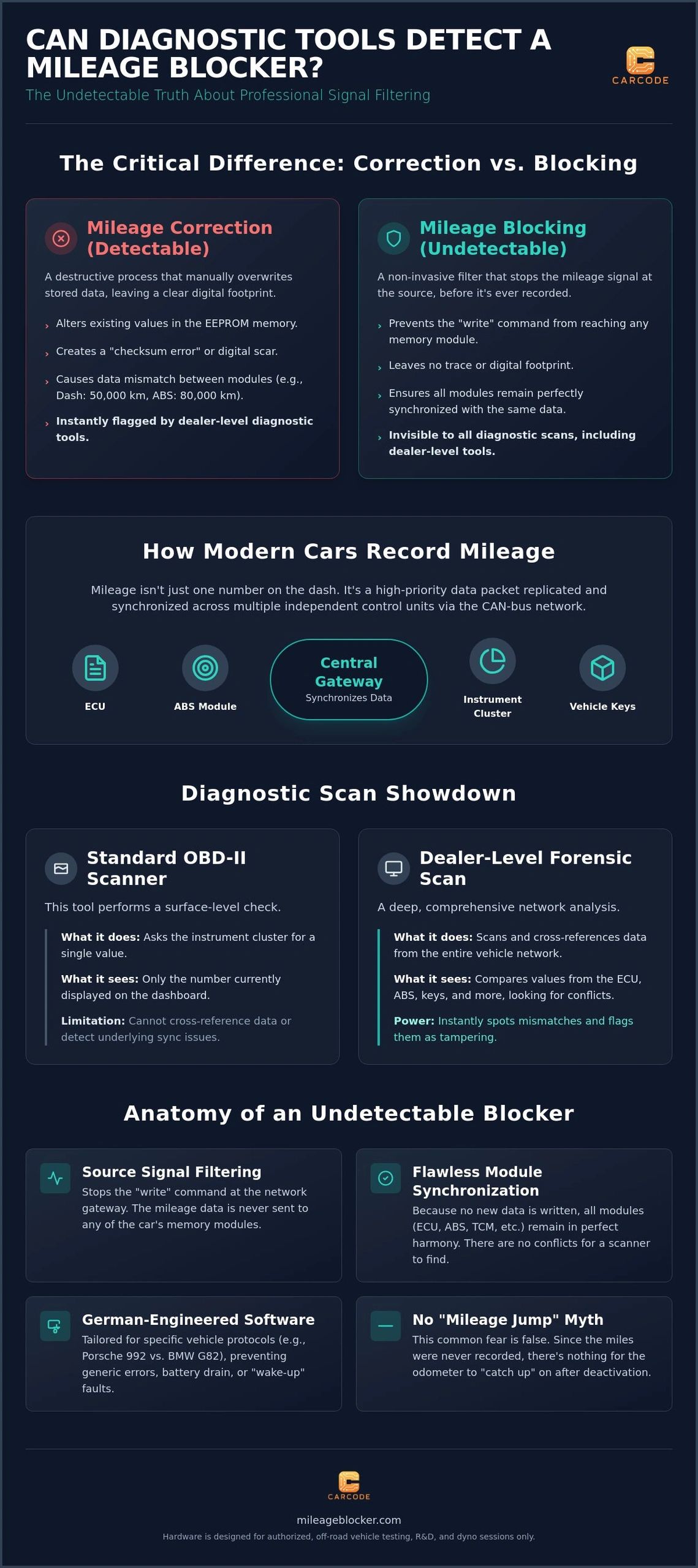
We have seen technicians plug an OBD-II scanner into a modern vehicle and assume the number on the screen is the final truth. In reality, a standard diagnostic tool simply asks the instrument cluster for a value and displays it. This is an active scan. Passive data logging, however, happens behind the scenes while you drive. For owners of luxury vehicles, the primary concern is often the deep-level scans performed by main dealer software such as BMW ISTA or Mercedes-Benz Star Diagnosis. These systems are designed to cross-reference data across multiple modules. Many people ask, can diagnostic tools find mileage blocker modules during these scans? The answer lies in how the hardware interacts with the vehicle's communication network. Unlike software that rewrites code, a professional blocker acts as a digital filter. It prevents the data from ever being recorded in the first place, leaving nothing for the scanner to find.
How Modern Cars Store Odometer Information
Modern vehicles don't store mileage in just one place. The value is replicated across the Engine Control Unit (ECU), the Transmission Control Module (TCM), the ABS system, and even within the vehicle's keys. A central Gateway module acts as a traffic controller, ensuring all these components stay synchronised. In our workshop, we've analysed how these modules handshake to prevent data loss. In a 2026 Audi RS6, the CAN-bus protocol transmits mileage pulses as high-priority data packets that the instrument cluster interprets and displays in real-time. If you want to see if your specific model is supported, you can find your car in our compatibility list. Because our hardware sits between the Gateway and the display, it manages these pulses before they are archived into the car's permanent memory. This prevents the discrepancy that often occurs with lower-quality hardware.
Correction vs. Blocking: Why One is Easily Detected
Mileage correction is a destructive process. It involves accessing the EEPROM memory and manually overwriting the stored digits. This often leaves a digital scar or a checksum error that dealer-level diagnostics can flag instantly. When a scanner sees 10,000 miles on the dash but 15,000 miles in the ABS module, it triggers a red flag. This is a common indicator of Odometer fraud overview. Our blocking technology avoids this by filtering the signal before it reaches any memory module. By stopping the write command at the source, we ensure that every module in the car remains in perfect synchronisation, showing the same consistent data to any diagnostic tool. We've found that this method is the only way to maintain the electronic integrity of a high-performance vehicle during authorised testing.
Why High-Quality Blockers Remain Undetectable
The invisibility of a professional-grade device isn't magic; it's a matter of precise data management on the Controller Area Network (CAN). In our workshop, we've seen how standard filters simply stop the dash, but our German-engineered hardware intercepts the "write" command across the entire vehicle network. Because the device filters the signal at the source, the vehicle’s internal systems remain perfectly synchronized. There is no data conflict to trigger a fault code. If your car is undergoing dyno testing, the ECU and the cluster receive the same filtered information. So, can diagnostic tools find mileage blocker hardware? Not if the device is built to OEM standards and uses high-grade components. While NHTSA Odometer Fraud Regulations highlight the legal risks of tampering with mileage for sale, our tools are designed for specific, authorized testing where data integrity is paramount.
The Role of German-Engineered Software
A Porsche 911 (992) uses a vastly different communication protocol than a BMW M4 (G82). Generic tools fail because they don't account for these manufacturer-specific nuances. Our software ensures that secondary modules, like the transmission or the key fob, stop recording simultaneously with the cluster. It also manages "sleep mode" transitions. Cheaper devices often keep the ECU awake, draining the battery or throwing "wake-up" errors that a technician will notice during a routine scan. One common myth we hear is the "mileage jump." Users fear that once the device is removed, the odometer will suddenly update with the missing miles. With professional hardware, this simply doesn't happen. The data was never written to the memory in the first place, so there is nothing to "catch up" on.
Plug-and-Play Integration with OEM Connectors
Physical evidence is the first thing a dealer looks for if they suspect a modification. We use OEM connectors that click directly into the existing wiring harness. This eliminates the need for splicing or soldering, which are immediate red flags. You can see how this works by checking our Professional Fitting Service for guaranteed discretion. By tucking the module behind the dashboard, it remains out of sight during any visual inspection. If you aren't sure which version fits your model, you can find your car to see the specific technical requirements for your vehicle. Our hardware is designed to stay hidden, ensuring your testing remains private and professional.
Diagnostic Scans vs Forensic Data Analysis
A standard technician performing a routine oil change is not looking for a mileage blocker. They are looking for Diagnostic Trouble Codes (DTCs) that indicate component failure. Standard tools are programmed to find data that conflicts, not necessarily data that is missing. If the odometer and the transmission module both say 5,000 miles, the tool sees a healthy system. Forensic data analysis is a different beast entirely. It involves deep-level timestamping and cross-referencing that is usually only triggered by insurance fraud investigations or major warranty claims. For the average user, the question is: can diagnostic tools find mileage blocker modules during a scheduled service? In our experience, high-quality hardware prevents the generation of the very communication errors that would lead a technician to dig deeper.
Modern luxury vehicles utilize Condition Based Service (CBS) data to track wear on brake pads, spark plugs, and oil life. Because our device filters the data stream, these intervals pause in unison with the odometer. This maintains a logical relationship between the mileage shown and the car's service history. If the odometer were paused but the oil life continued to drop at a rate suggesting thousands of miles of travel, a discrepancy would appear. Our German-engineered software ensures the entire vehicle environment remains consistent. This level of synchronization is what separates professional hardware from the cheap alternatives found on auction sites.
Do Engine Hours Give the Game Away?
A common concern involves the engine run-time counter. Technicians sometimes compare total engine hours against the odometer to spot inconsistencies. If a car shows 1,000 miles but 500 engine hours, it suggests excessive idling or tampering. When using a blocker for track days or dyno testing, it's vital to account for this. We recommend reviewing our Engine Hours to Miles Guide to understand these ratios. Managing your idle time ensures the data remains within plausible limits for your specific model year, keeping your logs clean during authorized testing sessions.
The "Check Engine" Light Trap
Cheap, mass-produced blockers often use inferior components that disrupt the CAN-bus voltage. This triggers shadow codes, which are errors that don't illuminate the dashboard light but remain stored in the ECU's permanent memory. When a dealer connects a professional tool, these communication failures appear immediately. Our hardware utilizes high-grade resistors and precision-soldered circuits to maintain signal integrity. This prevents the Check Engine light and hidden fault codes from ever appearing. If you want to ensure your vehicle diagnostics stay clean, contact our technical team for advice on the best module for your specific ECU version.
Implementing Odometer Management for Professional Testing
Operating a vehicle on a dynamometer or during a closed-circuit R&D session requires precise data control to prevent odometer inflation. We recommend activating your device only once the vehicle is stationary and the ignition is in the "on" position. Most of our modules are controlled through existing steering wheel buttons, such as the "BC" button on a BMW or the "Res" toggle on a Mercedes-Benz. You simply hold the specific combination for five to ten seconds to cycle through the blocking modes. If you are preparing for a DVSA MOT inspection or any official regulatory check, we advise removing the hardware entirely. This ensures total transparency for road-legal use and prevents any questions regarding the vehicle's electronic configuration. People often ask, can diagnostic tools find mileage blocker hardware if it is inactive? While an inactive professional device is extremely difficult to spot, physical removal is the only way to guarantee a stock electronic signature.
Choosing the Right Hardware for Your Model
Selecting a device requires matching the hardware to your specific ECU architecture. A 2026 Porsche Taycan utilizes a significantly different CAN-bus protocol than a Ferrari 296 GTB, and using a generic "universal" blocker is a recipe for communication failure. These cheap clones often lack the specific manufacturer-level coding required to keep the Gateway module from flagging an error. You should use our Find Your Car tool to ensure you receive a bespoke kit designed for your exact model. We have seen these specific kits maintain perfect module synchronisation where universal alternatives cause immediate dash errors.
Expert Support and Longevity
Our commitment to quality includes long-term technical support for software updates. As manufacturers release new firmware for their vehicles, we refine our software to ensure continued invisibility and performance. If you ever run into a technical hurdle during installation or operation, our Mileage Blocker FAQ provides immediate troubleshooting steps. We also recommend professional removal of the device before you sell the vehicle. This ensures a clean exit and maintains the long-term integrity of the car's digital history for the next owner.
Within the next week, verify your vehicle's specific steering wheel control combination and test the device during a stationary session. Ensure all dash lights remain clear and the module enters "sleep mode" when the ignition is off. If you are planning an authorised testing event, check your engine hours against your current mileage to establish a baseline for your data logs.
Frequently Asked Questions
Will a mileage blocker cause a permanent fault code?
No, professional-grade hardware is designed to filter signals without disrupting the CAN-bus voltage. Unlike cheap alternatives, our devices do not trigger "Check Engine" lights or leave shadow codes in the ECU memory.
Is the device detectable if I turn it off?
When deactivated, the device acts as a bypass, allowing all data to flow normally. While it remains physically connected, a standard diagnostic scan will not show any active interference or data discrepancies.
Do I need to cut any wires during installation?
Our kits are strictly plug-and-play. They use OEM-standard connectors that click into your existing harness. This prevents physical damage and ensures the device can be removed without leaving any evidence of installation.
Securing Your Vehicle's Electronic Integrity
Protecting the digital history of a luxury vehicle requires more than just a simple plug-in device. It demands precision-engineered hardware that understands the complex handshake between a car's Gateway module and its secondary storage units. We've established that the answer to whether can diagnostic tools find mileage blocker hardware depends entirely on the device's ability to filter signals without triggering communication errors. High-quality German manufacturing ensures your vehicle remains synchronized, avoiding the digital scars left by inferior correction tools.
You now have the technical knowledge to distinguish between routine scans and deep forensic analysis. Our hardware provides a discreet solution with no wire cutting required and convenient steering wheel controls for immediate mode switching. Within the next few days, verify your vehicle's specific ECU version and select the corresponding module to ensure perfect CAN-bus alignment. We provide next-day UK delivery to get your professional testing project moving immediately. It's time to take control of your vehicle's data with confidence.
Find the right mileage blocker for your vehicle and maintain the professional standards your car deserves.
Frequently Asked Questions
Will a mileage blocker cause a permanent fault code?
No, professional-grade hardware is designed to filter signals without disrupting the CAN-bus voltage. Unlike cheap alternatives, our devices don't trigger "Check Engine" lights or leave shadow codes in the ECU memory.
Is the device detectable if I turn it off?
When deactivated, the device acts as a bypass, allowing all data to flow normally. While it remains physically connected, a standard diagnostic scan won't show any active interference or data discrepancies.
Do I need to cut any wires during installation?
Our kits are strictly plug-and-play. They use OEM-standard connectors that click into your existing harness. This prevents physical damage and ensures the device can be removed without leaving any evidence of installation.
Does it stop mileage in all modules?
Yes, our German-engineered software is specifically written for each manufacturer to ensure the dash, ABS, transmission, and key modules all stop recording simultaneously, maintaining total system synchronization.
Frequently Asked Questions
Can a BMW dealer see if a mileage blocker was used?
A BMW dealer using ISTA diagnostics cannot see a professional mileage blocker because the device prevents data from being written to any module. We've seen that as long as the device is active, the transmission, ABS, and ECU all stay in sync. This lack of conflicting data means the scanner sees a perfectly normal, consistent vehicle history without any red flags or tamper marks.
Do mileage blockers leave fault codes in the ECU?
High-quality hardware won't leave fault codes or shadow entries in the ECU. Cheap modules often disrupt the CAN-bus signal, which triggers communication errors that technicians can spot during a deep sweep. Our German-engineered units use precision resistors to maintain signal integrity, ensuring the question of can diagnostic tools find mileage blocker traces remains a non-issue for professional users during a standard health check.
Does the device stop mileage in the key fob?
Yes, our specific manufacturer-coded software ensures the mileage recording in the key fob is paused. Modern keys store mileage data every time they're in the ignition or near the vehicle. By filtering the signal at the Gateway module, we ensure the key read at the dealership service desk matches the instrument cluster exactly, preventing common data discrepancies.
Will a mileage blocker show up on a HPI check or MOT history?
A mileage blocker will never show up on an HPI check or an MOT history report. These databases only reflect the numbers entered by an inspector or a technician at a specific point in time. If the device was used during an authorized testing session, that mileage simply never existed in the car's memory. It cannot be uploaded to external records if it was never written to the vehicle.
What happens if I forget to deactivate the blocker before a service?
If you forget to deactivate the device, the odometer will remain stationary during the technician's road test. This is a physical red flag rather than a digital one. We always advise deactivating the module via the steering wheel controls or removing it before any official service. This maintains total transparency and ensures the vehicle behaves exactly as it would in a stock configuration.
About the author
Pav TomaszeviczChief Editor, MileageBlocker.com
Pav is Chief Editor at MileageBlocker.com and works with the MileageBlocker Technical Team to publish practical information about vehicle compatibility, CAN/CAN-FD electronics, installation and MileageBlocker products.
View author profile →