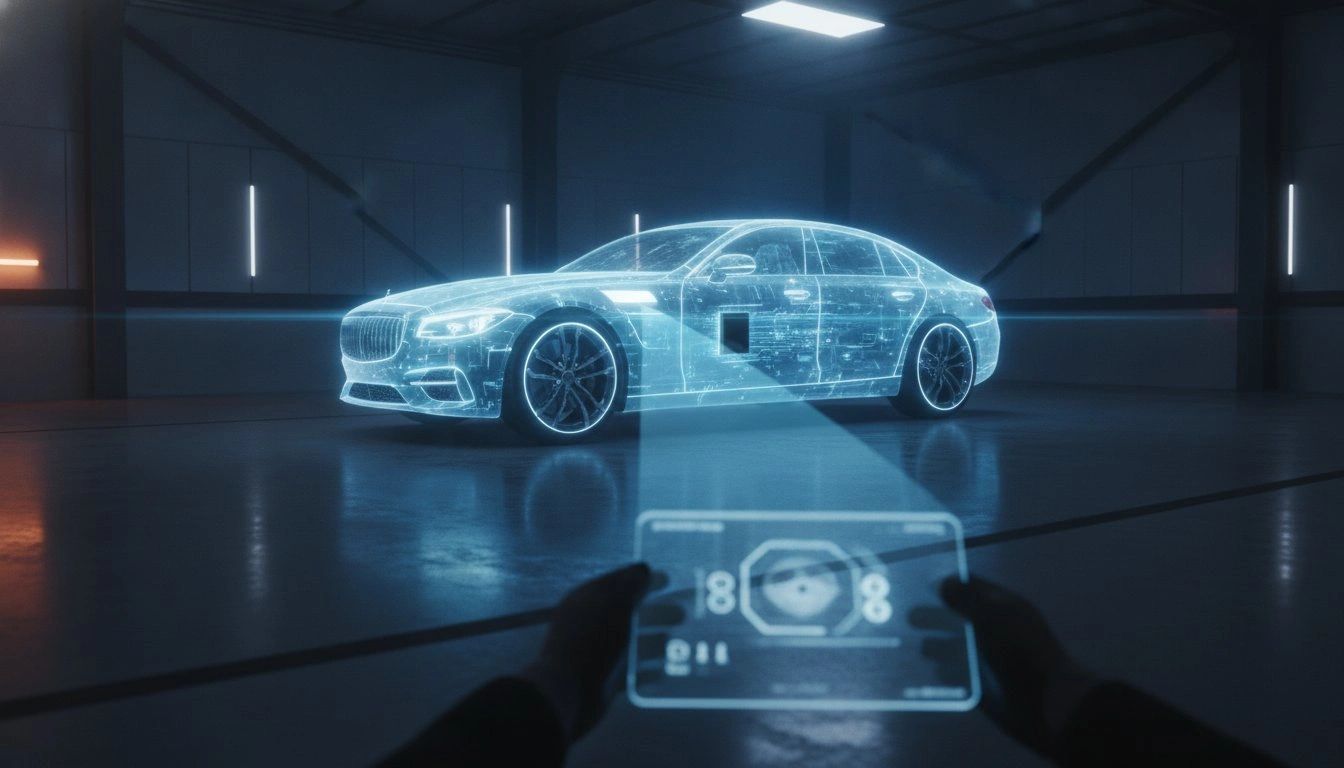
How a Mileage Blocker Actually Works
A plain-English explanation of CAN-bus interception, why mileage blockers leave no trace, and what separates a quality unit from a cheap imitation.

If you've ever wondered what actually happens inside a mileage blocker — beyond the marketing language — this guide is for you. We'll walk through the CAN-bus protocol, explain exactly how the interception works, and cover what separates a well-engineered unit from a cheap knock-off.
What is the CAN-Bus?
CAN stands for Controller Area Network. It's the communication backbone of every modern vehicle — a two-wire network that lets the engine control unit (ECU), gearbox, ABS module, instrument cluster and dozens of other components talk to each other in real time.
Think of it like a very fast internal messaging system. Every module on the network broadcasts short data frames at regular intervals. The instrument cluster listens for the speed signal and uses it to increment the odometer counter.
A mileage blocker sits on this network and intercepts that specific signal before it reaches the cluster.
The Interception: How It Works
A Carcode unit connects in-line between the vehicle's wiring harness and the instrument cluster. It uses OEM-style connectors — the same type the factory uses — so no cutting or splicing is ever required.
Once plugged in, the unit monitors the CAN-bus traffic and identifies the odometer increment message. When the blocker is active, it either:
- Drops the mileage increment frames entirely (Mode 1 — 100% blocking), or
- Modifies the value before passing it on (Mode 2 — 90% blocking)
In bypass mode (Mode 3), all signals pass through completely unmodified. The vehicle behaves exactly as standard.
Why It Leaves No Trace
This is the question we get asked most often. The answer comes down to how CAN-bus communication works.
The ECU doesn't keep a log of which modules are connected to the network. It simply broadcasts messages and expects other modules to respond. A Carcode unit is CAN-bus transparent — it responds correctly to all network queries and never introduces unexpected signals.
When you remove the unit and reconnect the original harness, there is nothing in the vehicle's memory to indicate the unit was ever there. No fault codes, no diagnostic flags, no stored event data.
Important: This is only true of properly engineered units. Cheap devices that splice into wires or use resistors to fool sensors can leave diagnostic traces and may trigger warning lights.
Operating Modes
Most Carcode units support three modes, selectable via an existing vehicle button or switch — no additional controls are needed.
Mode 1 — 100% Blocking The odometer does not increment at all while the unit is active. Used for dyno testing, rolling road sessions and off-road development work where you need a clean baseline.
Mode 2 — 90% Blocking The odometer increments at 10% of the actual distance travelled. Useful for extended R&D programmes where some mileage recording is required for internal records.
Mode 3 — Bypass Full pass-through. The unit is present but inactive. Switching to this mode before a service or MOT is good practice.
What Makes a Quality Unit
Not all mileage blockers are equal. Here's what to look for:
- OEM-style connectors — keyed, factory-matched plugs that can't be forced in the wrong way
- Vehicle-specific firmware — generic units often fail on newer CAN-FD networks; a proper unit is programmed for your exact make, model and year
- No wire splicing — any unit that requires you to cut wires is not a plug-and-play device
- No fault codes — test with a professional OBD scanner after installation; a quality unit produces zero codes
- Reversibility — you should be able to remove the unit in under five minutes with no evidence it was ever fitted
Carcode units are designed and tested against each vehicle's specific CAN-bus implementation before they ship. Every unit in our catalogue has been validated on the actual vehicle, not just on a bench simulator.
Common Questions
Will it affect my vehicle's performance? No. The unit only intercepts the odometer signal. Engine management, traction control, ABS and all other systems operate normally.
Does it work on a rolling road? Yes. The unit intercepts the speed signal from the cluster, so it works whether the vehicle is moving under its own power or being driven on a dyno.
Can I switch modes while driving? Yes. Mode switching is instantaneous and safe to do at any speed.
A Note on Legal Use
Carcode mileage blockers are sold for off-road, testing, tuning and R&D use only. Using a mileage blocker to misrepresent the recorded mileage of a road-going vehicle is unlawful in the UK under the Consumer Protection from Unfair Trading Regulations 2008, and equivalent legislation applies in other jurisdictions.
If you have any questions about whether your intended use is appropriate, contact our support team before ordering.
About the author
Pav TomaszeviczChief Editor, MileageBlocker.com
Pav is Chief Editor at MileageBlocker.com and works with the MileageBlocker Technical Team to publish practical information about vehicle compatibility, CAN/CAN-FD electronics, installation and MileageBlocker products.
View author profile →