Electric Vehicle Odometer Management: The 2026 Shift in Testing
The most advanced 2026 electric vehicles possess more lines of code than a modern fighter jet, making the prospect of a mileage blocker for electric cars ins...
The most advanced 2026 electric vehicles possess more lines of code than a modern fighter jet, making the prospect of a mileage blocker for electric cars installation feel like performing open-heart surgery with a sledgehammer. We've seen owners of high-end EVs hesitate to use testing hardware because they fear a single wrong signal might brick a battery management system worth tens of thousands of pounds. It's a valid concern. When you're dealing with a Porsche Taycan mileage blocker or similar hardware, you need to know the virtual cockpit will stay clear of error codes. Precision matters.
We understand that your primary goal is to maintain the car's electronic health while conducting professional performance trials or track sessions. You want accuracy without interference. This article explains exactly how our hardware interacts with the sophisticated CAN bus systems of the latest electric models. We'll show you why a professional-grade blocker is safe for 2026 releases and walk you through the straightforward plug-and-play process that keeps your vehicle's warranty-sensitive electronics untouched.
Key Takeaways
- Understand why EV odometer data is vital for battery management and range estimation beyond the dashboard display.
- Learn how a mileage blocker for electric cars installation uses CAN bus filtering to stop distance recording without triggering error codes.
- Explore the non-intrusive installation process for 2026 models, including those with advanced curved glass cockpits.
- Discover how high-grade hardware resists over-the-air (OTA) updates to maintain consistent performance during authorised testing.
- Identify the critical differences between professional-grade preventative tools and illicit alteration devices for vehicle data integrity.
Why Electric Vehicle Testing Demands Specific Odometer Solutions
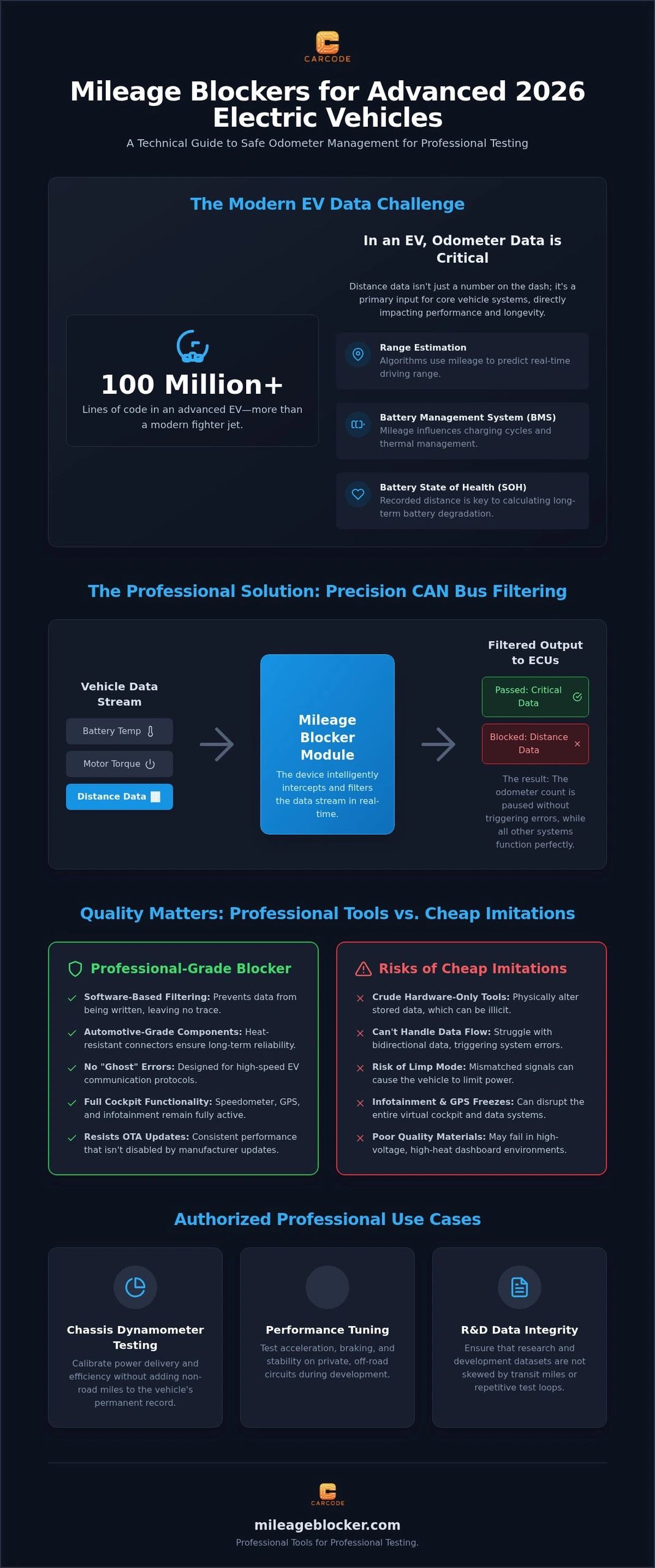
In a traditional petrol car, the odometer is essentially a simple counter. Electric vehicles are far more complex. They treat distance data as a primary input for calculating State of Health (SOH) and real-time range estimation. Every mile recorded impacts the battery management system's predictive algorithms. An EV mileage blocker is a CAN bus filter that prevents distance data from reaching the odometer during authorised testing.
The surge in EV track days and intensive R&D testing throughout 2026 has made mileage management a necessity. If you're running a Honda Prologue mileage blocker during high-speed stability trials, you ensure the vehicle's long-term data integrity remains intact. This is vital for preserving the accuracy of the battery's degradation logs during off-road performance evaluations. A mileage blocker for electric cars installation ensures that testing data remains clean and relevant for engineers.
The Problem with Standard Mileage Stoppers
Legacy hardware often struggles with the high-speed communication protocols found in modern EVs. We've seen basic devices trigger "ghost" errors in the regenerative braking systems because they don't account for the bidirectional data flow. Modern 2026 models, such as the GMC Sierra EV, require specific software filters. These filters prevent the dashboard from lighting up with warnings when the odometer signal is paused. Without these specific filters, the car's computer may detect a mismatch between motor revolutions and wheel speed, leading to a limp mode state.
Authorised Use Cases for EV Blockers
Professional testing often involves repetitive cycles that don't reflect real-world road use. Testers use these tools to maintain the professional detachment required for high-level engineering. Common scenarios include:
- Chassis Dynamometer Testing: Calibrating power delivery without adding non-road miles to the system.
- Performance Tuning: Testing acceleration and braking on private, off-road circuits.
- Data Integrity: Ensuring that R&D datasets aren't skewed by transit miles or repetitive test loops.
The Technical Integration of EV Mileage Blockers
Modern EV architectures are built on high-speed CAN bus networks. In these systems, every electronic control unit (ECU) talks to the battery management system (BMS) in real-time. Our hardware functions as a sophisticated bridge within this network. It selectively filters only the distance-related telegrams. This allows safety-critical data, such as battery temperature and motor torque, to pass through without interruption.
A high-quality mileage blocker for electric cars installation ensures that the virtual cockpit remains fully functional. Cheap alternatives often cause the infotainment screen to freeze or the GPS to lose its position. By focusing on software-level filtering, we maintain the integrity of the vehicle's internal communication. If you have specific questions about how this affects your vehicle's data systems, you can find detailed answers in our mileage blocker FAQ.
Managing the Regenerative Braking Data Stream
Regenerative braking introduces a unique challenge for odometer management. The car calculates distance by looking at motor revolutions and wheel speed sensors. Our device manages this complex relationship by allowing the speedometer to function normally while pausing the odometer increment. This stops the car from entering a limp mode state. It's a delicate balance. Precise software calibration is required to ensure that the traction control and energy recovery systems don't detect a data mismatch during testing.
High-Grade Components vs. Cheap Imitations
The interior of an EV dashboard is a high-voltage environment with limited space. When considering a mileage blocker for electric cars installation, the quality of the internal chipset is the most important factor. We use heat-resistant connectors and automotive-grade wiring to ensure long-term reliability. Software-based blocking is vastly superior to hardware-only tools because it doesn't physically alter any stored data. Instead, it prevents the data from being written during your authorised testing session. If you need help choosing the right hardware for your testing fleet, feel free to reach out to our technical team for guidance.
How to Install a Mileage Blocker on an Electric Car
Modern hardware for electric vehicles is designed for a non-intrusive setup. You typically only need access to the space behind the instrument cluster or the OBD port area. For an experienced technician, the entire process takes less than 40 minutes. Confident DIYers can often manage the task in a similar timeframe. Precision is key. Proper cable routing is the most critical part of a mileage blocker for electric cars installation. You must ensure the loom doesn't interfere with the vehicle's high-voltage shielding or internal cooling vents.
Step-by-Step DIY Installation Guide
Start by identifying the main harness behind your digital dashboard. We provide vehicle-specific guides to help you locate the exact connector for your model. If you're working on a Honda Accord mileage blocker, the access is relatively straightforward. Once you have access, connect our plug-and-play loom between the factory wiring and the instrument cluster. It clicks into place just like a factory part. Secure the module using cable ties to prevent rattling during driving. Finally, test the activation using your steering wheel buttons to ensure the system is communicating correctly with the CAN bus.
When to Choose Professional Fitting
Some 2026 models feature complex interior architecture. Performance models like the McLaren 720s mileage blocker require specialised knowledge for safe dash removal. We've seen that high-value electric fleets require consistent results across every vehicle. Our mileage blocker fitting service provides expert technicians who understand these specific nuances. This is a reliable way to ensure the hardware is integrated without risk to the cabin trim. If you're unsure about the complexity of your specific model, contact our support team to book an appointment with a certified installer.
Future-Proofing EV Mileage Management for 2026 Models
As we move through 2026, the way electric vehicles handle software is changing. Over-the-air (OTA) updates are now the standard. They can alter how a car's computer interprets CAN bus data overnight. Because of this, a high-quality mileage blocker for electric cars installation must include update-resistant software. We've developed our hardware to remain stable even when manufacturers push new firmware to the vehicle's gateway. You can find your car on our compatibility list to see the latest supported 2026 models.
Over-the-Air (OTA) Updates and Hardware Stability
Software-driven EVs require flexibility. You need a device that you can easily deactivate before taking the car for a dealer visit. Our latest modules feature flashable memory. This allows the hardware to be updated if a manufacturer's patch changes the communication protocol. It ensures your investment doesn't become obsolete. This stability is essential for long-term R&D projects where vehicle software is refreshed often. We focus on providing tools that adapt to the vehicle's lifecycle rather than fighting against it.
The Shift Toward Discreet, Modular Solutions
The minimalist interiors of 2026 EVs leave very little room for bulky hardware. We've responded by shrinking our modules significantly. These smaller units fit easily behind the slim panels of modern cockpits without altering the aesthetic of the cabin. When performing a mileage blocker for electric cars installation on a vehicle with a minimalist dash, size is everything. Integration with existing steering wheel controls means you don't need extra buttons. Everything is handled through the factory interface for a hidden user experience. This ensures that the vehicle remains in its original condition while providing the testing functionality you require.
Secure Your EV Testing Data for the 2026 Era
Managing an electric vehicle's odometer requires more than a basic filter. It's about protecting the battery management system's long-term accuracy during rigorous testing cycles. The shift toward software-defined vehicles means your hardware must be resilient against over-the-air updates and complex bidirectional data streams. A successful mileage blocker for electric cars installation depends on using high-grade components that speak the specific language of your car's CAN bus without triggering ghost errors.
We provide worldwide express delivery for all our EV modules to keep your project on schedule. If you're based in the UK, our professional fitting service ensures your hardware is integrated safely behind the most complex 2026 dashboards. It's a small investment to maintain the professional detachment required for high-level engineering and performance trials. Find the perfect mileage blocker for your electric vehicle by speaking with our technical team this week. Taking the right steps now will protect your vehicle's electronic health and data integrity for years to come.
Frequently Asked Questions
Do these devices work on Tesla models with the latest software?
Our hardware is designed to work with most Tesla models, including the Model 3 and Model Y, even with the latest 2026 software versions. We update our firmware regularly to keep pace with manufacturer changes. You should deactivate the device before performing any official over-the-air updates to ensure the system remains stable. This preventative tool is specifically engineered for testing environments where data integrity is the primary priority.
Will installing this myself void the warranty on my new electric car?
A mileage blocker for electric cars installation is designed to be non-intrusive and uses plug-and-play connectors. You don't have to cut or solder any factory wiring, which is a major concern for new car owners. While the hardware itself doesn't physically damage the car, we always recommend removing it before taking your vehicle to a main dealer for service. This maintains the car's original condition for any official inspections.
Does the speedometer still show my actual speed while the blocker is on?
The speedometer will continue to show your actual driving speed while the blocker is active. Our hardware uses sophisticated CAN bus filtering to stop only the distance-related telegrams. It doesn't interfere with the speed signal required for the dashboard or the battery management system. This allows you to conduct performance trials on private tracks safely while maintaining full visibility of your vehicle's current velocity throughout the test.
Can the mileage blocker be detected by standard diagnostic tools at the garage?
Standard diagnostic tools typically cannot detect the blocker because it doesn't alter the car's internal memory modules. Unlike mileage correction tools that rewrite data, our device simply pauses the recording process during authorised use. Once you remove the hardware, the vehicle's systems continue to operate as if it were never there. It is a discreet solution designed for professionals who need to manage data recording during specific testing windows.
How do I know if I need a professional to fit the blocker for me?
You should consider a professional if your vehicle features a complex interior or a curved glass cockpit. If your dash requires specialised trim removal tools to prevent scratches, our fitting service is the safest route. Confident DIYers can usually handle a mileage blocker for electric cars installation on models with standard digital clusters. If you feel any uncertainty about accessing the wiring harness, booking a certified technician ensures the job is done correctly.
About the author
Pav TomaszeviczChief Editor, MileageBlocker.com
Pav is Chief Editor at MileageBlocker.com and works with the MileageBlocker Technical Team to publish practical information about vehicle compatibility, CAN/CAN-FD electronics, installation and MileageBlocker products.
View author profile →