Why Modern Cars Store Mileage in Multiple ECUs
Can cars record mileage in more than one control module? Discover how modern ECUs store vehicle distance, why discrepancies happen, and what diagnostics show.
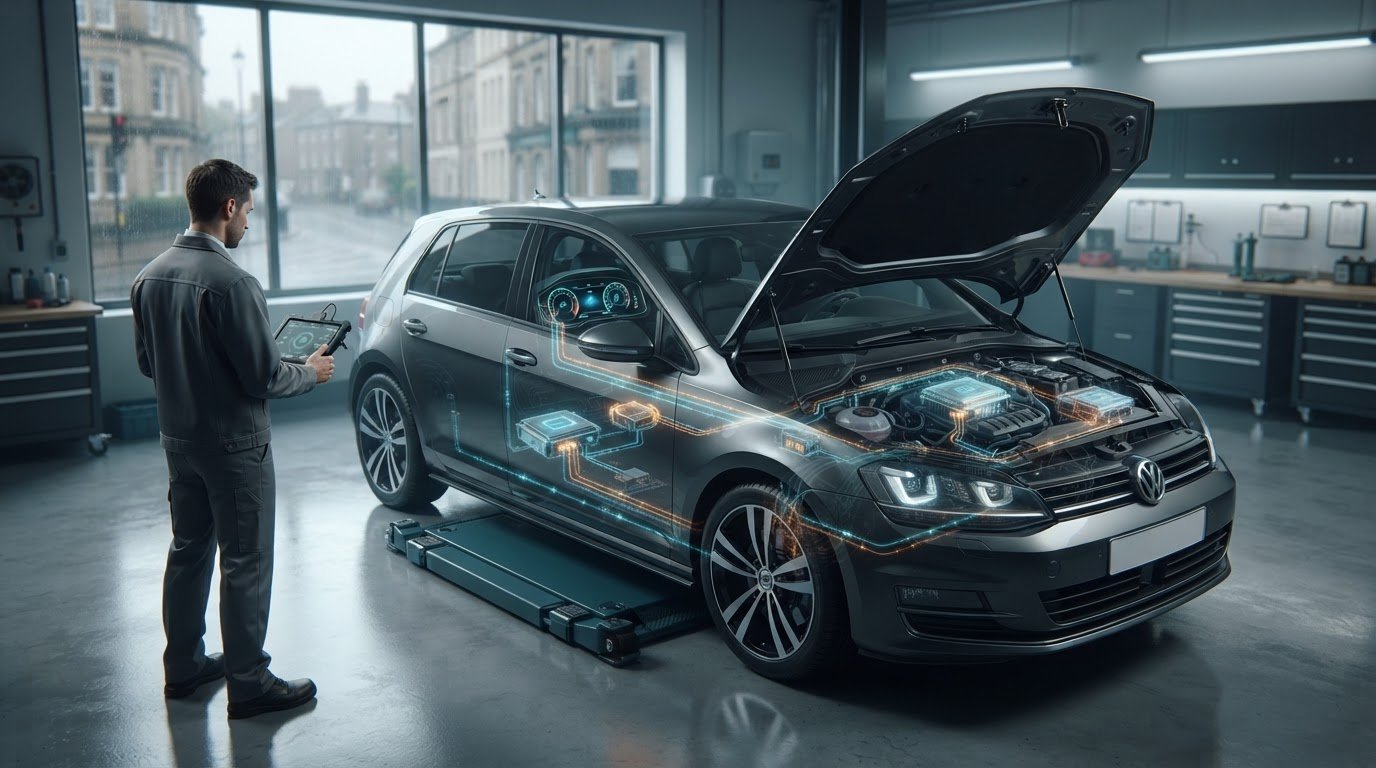
Could the number on your dashboard be only part of a car’s mileage record? Can cars record mileage in more than one control module? In some vehicles, yes, although the arrangement depends on the manufacturer, model and generation. The dashboard odometer is the visible reading, but it may not be the only mileage-related information available during diagnosis.
If a diagnostic scan reports a different value, it’s reasonable to wonder whether the car has a fault or whether its mileage has been altered. A mismatch alone proves neither. A replaced component, a synchronisation issue or a system fault may be relevant, so each reading needs to be interpreted in the context of the specific vehicle.
This article explains the difference between the displayed odometer and other mileage data, why records may not match, and how to document a discrepancy without jumping to conclusions. It also distinguishes recording mileage, correcting a stored value and preventing mileage accumulation for vehicle testing or off-road track use.
Key Takeaways
- Can Cars Record Mileage in More Than One Control Module? Some vehicles may hold mileage-related information in multiple modules, but the architecture varies.
- Vehicle networks can communicate data between modules, but this does not mean each module stores a complete odometer reading.
- Treat a mismatch as a reason to investigate, not proof of tampering. Component replacement or repair may provide relevant context.
- Record the dashboard reading, note symptoms and gather service history so each diagnostic value can be interpreted in context.
Can a Car Record Mileage in More Than One Control Module?
Yes, some vehicles may hold mileage-related information in more than one electronic module, but that doesn’t mean each module stores an identical, complete odometer reading. Vehicle electronics vary by manufacturer, model and generation, so there is no universal list of modules that contain mileage data.
The displayed odometer is the driver-facing value shown on the instrument panel. Other information available from the vehicle’s electronics may be stored, calculated, received or reported for a different purpose. A diagnostic reading from a module should not automatically be treated as a second odometer. Its meaning depends on what that module records and how the information is presented.
Modern vehicles use a network of electronic control units (ECUs) to manage and monitor different functions. Data can pass between units over this network, but that alone does not show where a particular vehicle stores mileage or whether a given module retains it.
What does “mileage in a control module” mean?
A control module is an electronic unit responsible for managing or monitoring vehicle functions. In this context, “mileage in a module” might mean a value saved there, data received from another unit, or information calculated or reported during diagnosis. These are not necessarily equivalent. Unless the vehicle-specific information explains the value, don’t assume a reported figure is a separately stored odometer reading.
Does every module keep a second odometer?
No. There is no universal module list, and modules may contain different mileage-related records or none at all. The useful question is not simply how many readings appear, but what each one represents. For a broader explanation of digital odometer storage, see Digital Odometers Explained: How Mileage Is Stored.
In short, the answer to Can Cars Record Mileage in More Than One Control Module is sometimes, but multiple records don’t necessarily mean multiple identical odometers. Vehicle-specific context is essential when interpreting them.
How Mileage Information Can Move Between the Odometer and Control Modules
Vehicle data can be communicated between electronic units over an in-car network such as CAN. Depending on the vehicle’s design, mileage-related information may be passed between modules, retained by a module or made available for diagnosis. Network communication alone does not show which of these applies to a particular car.
A module that receives or displays a value hasn’t necessarily measured distance independently. It may use information supplied elsewhere, or report data with a different purpose or reference point. To understand how mileage data moves, identify the architecture for the exact vehicle and generation; a network connection by itself does not show where mileage is stored.
What role can the instrument cluster and ECU play?
The instrument cluster presents the driver-facing odometer reading. An ECU may be involved in processing or communicating vehicle data, but its relationship to mileage depends on the specific design. Don’t assume every ECU stores a complete odometer value or that modules automatically synchronise identical figures. For broader context, see Why Car Makers Store Mileage Across Multiple Modules.
Why vehicle generation and network design matter
Electronic architecture can change between model generations and years, including the networks used to connect modules. CAN and CAN FD are network terms, but their presence doesn’t establish a particular mileage-storage arrangement. Interpret a diagnostic result using information for the relevant vehicle, rather than inferring storage from the network name alone. For a focused discussion of network-specific complexity, see Why CAN FD Makes Vehicle Mileage Correction So Complex.
Accurate mileage records also matter to vehicle history and consumer protection. The US National Highway Traffic Safety Administration explains the issue in its own jurisdiction: Odometer fraud is a crime. This reference does not establish how a UK vehicle stores or shares mileage data, which remains vehicle-specific.
Why Mileage Readings Can Differ, and What a Discrepancy Does Not Prove
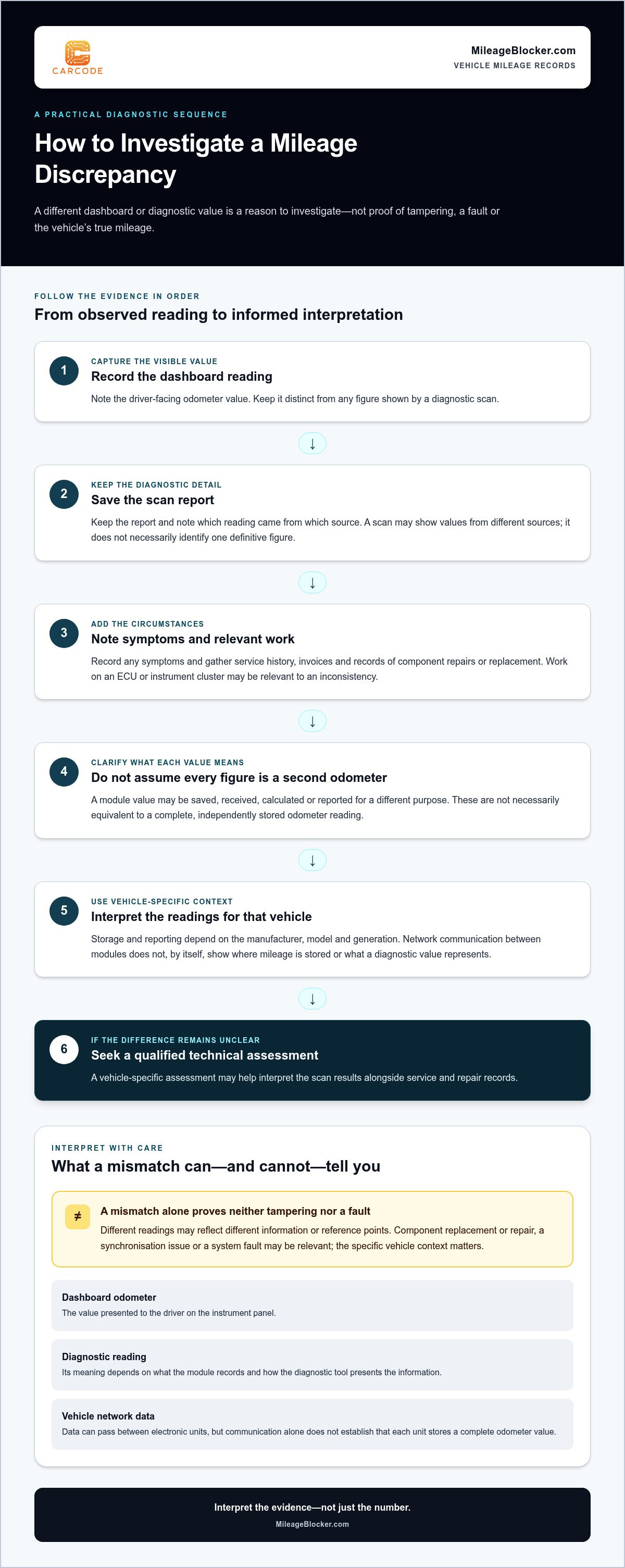
Different mileage figures can appear because modules may report different types of information or use different reference points. A displayed odometer value and a diagnostic reading are not automatically equivalent. Their meaning depends on the vehicle’s design and on what the diagnostic tool has accessed.
A mismatch alone does not establish tampering, a fault or the vehicle’s true mileage. Diagnostic data needs vehicle-specific interpretation and supporting evidence. Treat a discrepancy as a reason to investigate, not as a conclusion.
Could a replacement ECU or instrument cluster affect the readings?
It may be relevant. Replacing or repairing an ECU or instrument cluster can leave an inconsistency that needs diagnosis, but the effect depends on the vehicle. Don’t assume which value a particular car retains, displays or reports. Service invoices and records of component work can help put the readings in context. For this specific scenario, see ECU Replacement & Mileage Discrepancies Explained.
Can a diagnostic scan reveal the vehicle’s exact mileage?
Not necessarily. Scan results depend on the vehicle’s electronic design and the information available to the diagnostic tool. A scan may show readings from different sources, but that doesn’t guarantee it can identify one definitive figure. Keep the scan report and compare its details with available service and repair records. If the discrepancy remains unclear, a qualified technical assessment may help interpret it.
The question “Can Cars Record Mileage in More Than One Control Module” has a vehicle-specific answer. The presence of multiple readings is not, by itself, proof of their cause. The US National Highway Traffic Safety Administration provides information on federal law on odometer fraud. That US resource does not determine the legal position in the UK or explain a particular vehicle’s data architecture.
How to Investigate Multiple Mileage Records Responsibly
Start by recording what you can observe, rather than trying to reconcile the figures yourself. A clear record gives a technician useful context:
- Note the dashboard odometer reading and the date.
- Document relevant symptoms and when they began.
- Gather service records, diagnostic reports and details of any module or instrument-cluster replacement or repair.
Keep the original documents and recorded information unchanged. A diagnostic assessment should identify the source of each reading and what it represents. The vehicle’s make, model, generation and repair history help provide context, but they do not guarantee that every discrepancy can be resolved from the available data.
What information helps a technician assess a discrepancy?
Provide the exact vehicle details, the displayed mileage, any symptoms and records of relevant work. Preserve scan reports with the information showing where each reading came from, if available. This helps distinguish a reported value from the dashboard odometer and assess possible explanations without treating one figure as definitive in isolation.
How does mileage recording differ from mileage blocking?
Recording and diagnosis concern information the vehicle displays, stores or reports. A mileage blocker is a separate type of device intended to prevent mileage accumulation in specific contexts, not to diagnose a discrepancy or correct a stored value. MileageBlocker.com by Carcode devices are intended for vehicle testing or off-road tracks, not public-road journeys.
If you’re asking, “Can Cars Record Mileage in More Than One Control Module?”, the practical next step is careful, vehicle-specific interpretation, not altering or concealing records. For vehicle testing or off-road track use, explore MileageBlocker.com by Carcode's vehicle-specific technology and mileage blocker information.
Use the Right Evidence for Your Next Step
Some vehicles hold mileage-related information across more than one module, but those records may not be identical or serve the same purpose. Can Cars Record Mileage in More Than One Control Module? Yes, in some cases, although the vehicle’s design determines what each reading means. Assess a difference alongside diagnostic context and service history, rather than treating it alone as proof of tampering or a fault.
Keep the dashboard reading, diagnostic reports and relevant repair records together. This gives a technician a clearer basis for interpreting the information without changing or concealing records.
Recording or diagnosing mileage is distinct from preventing mileage accumulation. MileageBlocker.com sells vehicle-specific mileage blocker devices intended for vehicle testing or off-road tracks, and offers a fitting service for the devices it sells. To discuss a vehicle-specific product or fitting, contact our team.
Frequently Asked Questions
Can a car store mileage in more than one ECU?
Yes, some cars may hold mileage-related information in more than one electronic control unit. This doesn’t mean every unit has a complete, identical odometer value. The arrangement depends on the vehicle’s design, including its model and generation, so a general answer cannot identify which modules contain relevant information.
Which control module stores the mileage in a car?
There isn’t one answer that applies to every car. The instrument cluster shows the driver-facing odometer reading, while other modules may store, receive or report different mileage-related information, depending on the vehicle. A module reporting a figure doesn’t necessarily mean it independently measures distance or holds the main odometer value. Identifying the source requires vehicle-specific information and careful interpretation.
Can a diagnostic scan show different mileage readings?
Yes. A scan may return different mileage-related figures if the vehicle provides information from more than one source. Those values might represent different data or reference points, rather than duplicate odometers. The result also depends on the vehicle’s design and the diagnostic tool. Keep the scan report and compare its details with the dashboard reading and available service history.
Does replacing an ECU or instrument cluster change the recorded mileage?
It can be relevant to a difference in readings, but the effect depends on the vehicle and the repair. A replacement or repair may leave information that needs further diagnosis; it doesn’t establish which figure the car will display or report. Keep invoices and service records, and interpret the readings in the context of that vehicle’s system rather than assuming a standard outcome.
Does a mileage discrepancy prove that an odometer has been tampered with?
No. A mismatch alone doesn’t prove tampering, a fault or the vehicle’s true mileage. Readings can refer to different information, and repair or component replacement may be relevant context. Establish where each figure came from and assess it alongside diagnostic reports and service records. A vehicle-specific technical assessment is more reliable than drawing a conclusion from one scan result.
About the author
MileageBlocker TeamThe MileageBlocker Technical Team covers vehicle electronics, CAN and CAN-FD systems, mileage blocker compatibility, installation and product developments.
View author profile →