Why Car Makers Store Mileage Across Multiple Modules
Discover why vehicle manufacturers store mileage across multiple modules, how diagnostic data differs from odometers, and how to interpret module mismatches.

What if two mileage-related figures in the same vehicle describe different things? A diagnostic scan may show the dashboard odometer reading alongside distance or operating data from another module. A difference between those figures does not automatically indicate a fault or interference. Why Vehicle Manufacturers Store Mileage Across Multiple Modules becomes clearer when each value is considered in the context of the vehicle’s electronic systems.
It is reasonable to expect one definitive mileage figure, especially when a diagnostic report lists readings from several modules. Manufacturers may distribute information so different systems can use data relevant to their functions, or to support service and diagnostic processes. However, not every module stores an exact copy of the dashboard odometer. Similar-looking values can represent different types of data.
This article explains why mileage information may appear across multiple modules, how to distinguish an odometer reading from other distance-related records, and why storage arrangements vary by manufacturer, model and generation. It also explains how to approach a mismatch without treating it as a diagnosis.
Key Takeaways
- Why Vehicle Manufacturers Store Mileage Across Multiple Modules depends on the vehicle’s system design. There is no universal layout for mileage-related data.
- Separate the displayed odometer reading from other distance-related records before comparing scan results.
- Use the vehicle’s make, model, generation and module details to establish what each reported value represents.
- Treat a difference as a reason to investigate the data, not as proof of a fault, component replacement or tampering.
Why do vehicle manufacturers store mileage across multiple modules?
Modern vehicles use interconnected electronic modules, but the way mileage-related information is stored depends on the vehicle’s design. The instrument cluster presents the odometer reading to the driver. Other systems may use or retain distance-related data for their own functions or for service and diagnostic processes. Those records are not necessarily additional versions of the displayed odometer.
Why Vehicle Manufacturers Store Mileage Across Multiple Modules has no single answer that applies to every vehicle. Different systems may need information relevant to their operation, and records may also support servicing or diagnosis. The exact purpose depends on the vehicle’s architecture. It would be inaccurate to assume that every manufacturer stores identical readings in identical places, or that every additional distance value is a deliberate copy of the dashboard figure.
Distributed mileage storage means mileage or related distance information may be held or used by more than one electronic module. The meaning of each record depends on the vehicle’s design.
The displayed odometer value and a distance-related counter are not automatically equivalent. A counter may record or calculate distance for a particular system or process, rather than provide another figure for the vehicle’s total displayed mileage. A diagnostic tool’s label may not, by itself, explain what the value measures.
What does ‘stored across multiple modules’ actually mean?
Think of the instrument-cluster display as the figure presented to the driver. Data in other modules may be separate records relating to distance, rather than duplicate odometer values. When reading a scan, establish what each figure represents before comparing it with the dashboard. For background on odometers and their operation, see How Odometers Work.
Understanding how digital odometers store information can help distinguish the displayed total from other distance-related records held within a vehicle’s electronics.
How do vehicle modules handle mileage-related information?
Vehicle modules exchange information over in-car networks such as CAN. This communication allows systems to share relevant data, but it does not mean every connected module stores an odometer reading. A diagnostic report may show fields from different parts of the vehicle, and their labels do not always clarify whether a value represents total mileage or another type of distance-related data.
Which modules may contain mileage or distance-related data?
Possible examples include the instrument cluster, engine ECU, transmission control module, ABS module and gateway. Their general roles differ: the cluster presents information to the driver, the engine ECU manages engine functions, the transmission module manages transmission functions, the ABS module supports braking functions, and the gateway routes communication. These general descriptions do not establish whether any of those modules stores mileage on a particular vehicle.
No single module list applies to every make, model and generation. Treat a module name as a starting point, not proof of what its data field means. Vehicle-specific documentation and diagnostic information are needed to interpret the reported value accurately.
Why are related records not always identical?
A module may use or retain distance information for a system-related process instead of storing a copy of the displayed odometer. Modules can also handle different data and update it through different processes. Without verified information for the vehicle, a scan result alone cannot establish whether two values are intended to match or explain a difference.
For general context on odometer integrity, the NHTSA overview of odometer fraud describes the subject from a United States perspective. It does not explain the architecture or data storage of a specific vehicle, and it is not UK legal guidance. The practical point is to interpret each reading in the context of the exact vehicle and the field reported.
Why does mileage storage vary between vehicle makes and generations?
Manufacturers do not use one fixed electronic layout across every vehicle. A new generation or platform update can change the network architecture, the modules used and the way information is arranged. A module with a particular role on one vehicle may not have the same role on another, even within the same manufacturer’s range.
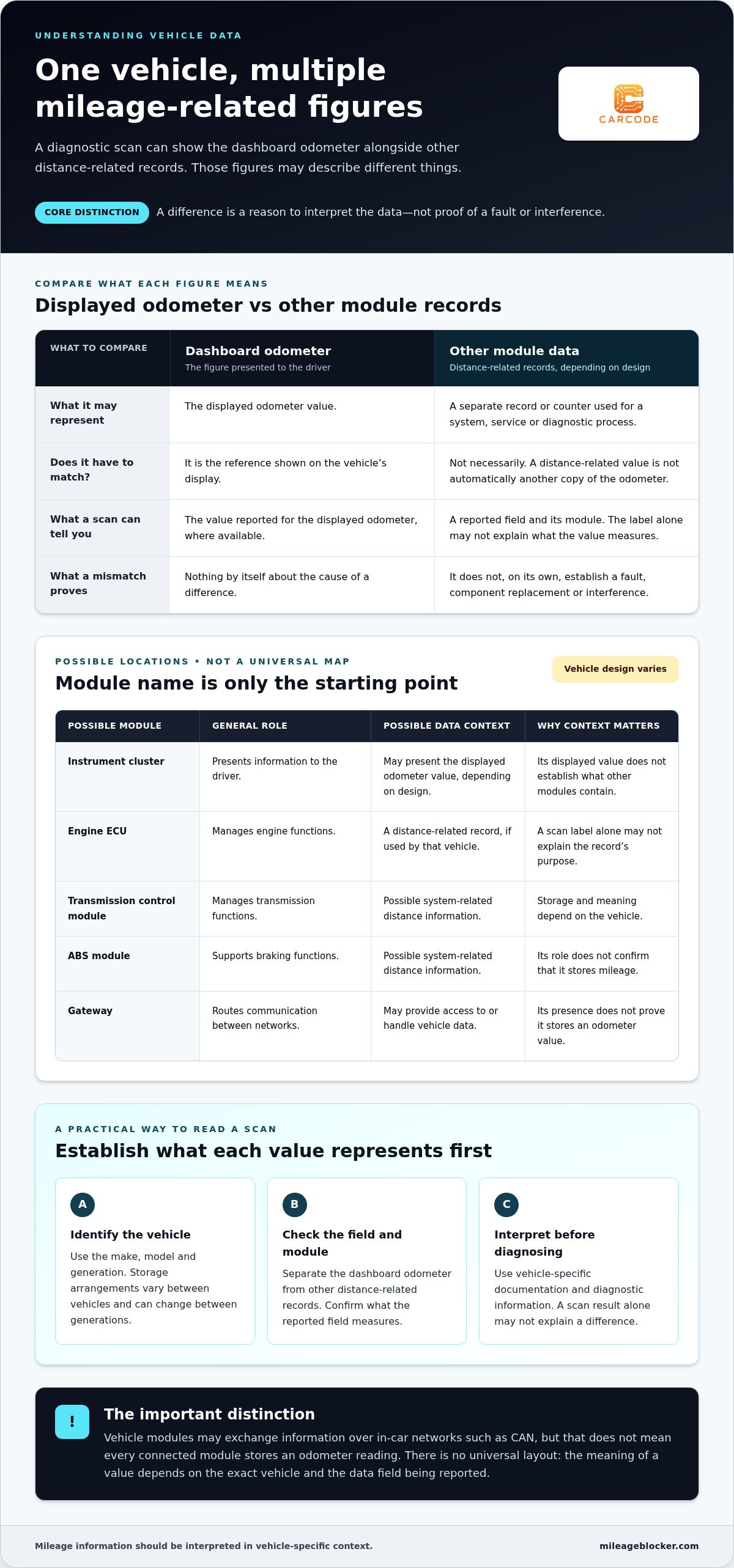
This variation is central to understanding Why Vehicle Manufacturers Store Mileage Across Multiple Modules: there is no universal map of mileage-related data. The table and diagram below show general possibilities only. They do not confirm the configuration of any specific vehicle.
| Possible module | General role | Possible mileage-related information | Why context matters |
|---|---|---|---|
| Instrument cluster | Displays information to the driver | Displayed odometer value, depending on design | A displayed value does not establish what other modules contain. |
| Engine ECU | Manages engine functions | A distance-related record, if used by the vehicle | A scan label alone may not explain its purpose. |
| Transmission or ABS module | Manages transmission or braking functions | Possible system-related distance information | Storage and data meaning depend on the vehicle. |
| Gateway | Routes communication between networks | Possible access to or handling of vehicle data | Its presence does not prove it stores an odometer value. |
Why can two models from the same manufacturer differ?
Platform updates and generation changes can alter a vehicle’s electronic architecture. Do not transfer a module layout or behaviour from one model year to another without vehicle-specific evidence. A change in network design between generations does not, on its own, establish where mileage is stored.
What can a general module diagram tell you?
Conceptual only: Instrument cluster ↔ vehicle network ↔ possible ECU, transmission, ABS or gateway modules
The diagram indicates possible connections, not confirmed storage locations or data pathways. Only verified information for the exact vehicle can establish a particular module’s role.
How should you interpret mileage information from multiple modules?
A difference between readings is a reason to establish what each value represents, not a diagnosis by itself. Use a vehicle-specific process before drawing conclusions:
- Identify the vehicle and module. Record the make, model, generation and relevant vehicle details, alongside the module that reported each value.
- Record the readings as reported. Keep the displayed odometer figure separate from values returned by other modules. Note the labels and units shown.
- Verify each value’s meaning. Use vehicle-specific diagnostic information to establish whether a value is an odometer reading or another distance-related record.
This process helps prevent unlike data from being treated as directly comparable. A discrepancy alone does not establish a fault, a replaced component or tampering, and it does not show intent. Any cause needs to be assessed against the vehicle’s design and relevant history.
Can a different reading identify the cause by itself?
No. The figures alone do not explain why they differ or confirm that a fault exists. Component replacement and instrument-cluster problems are separate possibilities that need their own evidence, not assumptions based on a scan result. For background on these topics, see the guide to ECU replacement mileage discrepancies and the guide to failed instrument clusters.
If the reason remains unclear, vehicle-specific diagnosis is the appropriate next step. A general module list cannot substitute for an assessment based on the exact vehicle and its electronic architecture.
Where does MileageBlocker.com fit into this technical topic?
MileageBlocker.com supplies technical testing hardware for legitimate automotive testing, tuning and diagnostics in controlled environments. The hardware does not establish what a particular vehicle’s module readings mean.
Carcode mileage blockers are sold strictly for legitimate automotive testing, tuning and diagnostic purposes. They are intended for use on private property, rolling roads and controlled test environments only. It is illegal to use a mileage blocker to misrepresent a vehicle’s true mileage when selling or advertising a vehicle. Carcode Ltd accepts no liability for misuse. By purchasing, customers confirm they will use the product lawfully and responsibly.
For product enquiries, contact MileageBlocker.com.
Make the next mileage check vehicle-specific
For a future review, keep the vehicle’s identifying details, service history and diagnostic records together. Note which module reported each value and retain the labels and units shown in the scan. This gives a qualified technician useful context to assess the data rather than treating one reading in isolation.
The practical lesson behind Why Vehicle Manufacturers Store Mileage Across Multiple Modules is that a module reading needs to be interpreted within the architecture it belongs to. A general explanation can frame the question, but the vehicle’s exact make, model and generation matter when moving from theory to assessment.
For legitimate automotive testing, tuning and diagnostic work in controlled environments, MileageBlocker.com offers technical testing hardware designed, manufactured and supported by Carcode Ltd: no middlemen, no white-labelling, no compromises. The units are designed, assembled and tested in the United Kingdom, with a full warranty and lifetime technical support. To discuss the hardware, send a product enquiry to MileageBlocker.com.
Keep the records clear, interpret each value in vehicle-specific context, and contact MileageBlocker.com to discuss technical testing hardware for controlled environments.
Frequently Asked Questions
Do all vehicle control modules store the same mileage?
No. A module may not store mileage at all, and a distance-related value it reports may refer to a different quantity or process. A scan showing several figures does not mean each is a separate odometer reading. Check the labels and units, then use information for the specific vehicle to understand what the diagnostic data describes.
Is mileage stored in the engine ECU on every car?
No. The engine ECU manages engine functions, but that role alone does not establish whether it stores or reports odometer mileage. The answer depends on the vehicle’s electronic design and the diagnostic information available for it. Treat an ECU reading as an identified data field, not automatically as the vehicle’s definitive mileage, and refer to information for the exact model and generation.
Can different modules show different mileage readings?
Yes, a diagnostic scan can present different distance-related figures. Before comparing them, check whether the values use the same units and represent the same kind of measurement. For instance, an operating-hours record is not a distance reading, even though both may help describe vehicle use. A difference needs interpretation, not an assumption that every value is an odometer reading.
Does a mileage discrepancy between modules always mean there is a problem?
No. A mismatch is an observation, not a confirmed diagnosis or proof of anyone’s intent. Record which module reported each figure, the scan date and the displayed labels. That gives a qualified technician a clearer starting point for vehicle-specific assessment. Do not conclude that a fault, replacement or tampering has occurred based on the readings alone.
Why might a vehicle record distance outside its instrument cluster?
A vehicle may use or retain distance-related data for purposes beyond showing the driver an odometer figure. Depending on the design, records elsewhere may support a system’s operation or service and diagnostic processes. This is one reason Why Vehicle Manufacturers Store Mileage Across Multiple Modules must be understood in context: a record’s presence does not necessarily make it a second odometer reading.
About the author
MileageBlocker TeamThe MileageBlocker Technical Team covers vehicle electronics, CAN and CAN-FD systems, mileage blocker compatibility, installation and product developments.
View author profile →