Why CAN FD Makes Vehicle Mileage Correction So Complex
Why mileage correction is becoming more complicated on CAN FD vehicles comes down to network architecture and module sync. Learn the technical reality here.

Why mileage correction is becoming more complicated on CAN FD vehicles is not simply a question of the odometer. The vehicle network, its generation and the configuration of its control modules all affect how information is shared and recorded. CAN FD allows more data to move across a network, but that alone does not explain how a particular vehicle handles mileage.
If you are unclear about how CAN FD differs from classic CAN, or why explanations of mileage storage can conflict, the practical point is that vehicles do not share one universal layout. A module replacement or repair can also leave records that need careful, vehicle-specific assessment. The protocol describes communication, not how each vehicle stores or interprets mileage information.
This article explains why network design matters, what to organise when a mileage discrepancy appears, and why information from one vehicle cannot automatically be applied to another. It also distinguishes a documented record discrepancy from mileage-blocking technology, which has a separate purpose and is intended for vehicle testing or off-road use.
Key Takeaways
- CAN FD’s communication capabilities do not, by themselves, show how a particular vehicle handles mileage information.
- Network layout, software, control modules and vehicle generation can all affect how mileage data is interpreted.
- A timeline of repair history, replaced-module details and existing records can help clarify a discrepancy.
- A mileage blocker has a different purpose: MileageBlocker.com devices prevent odometer mileage accumulation for vehicle testing or off-road-track use. They do not correct existing records.
Why Is Mileage Correction More Complicated on CAN FD Vehicles?
CAN FD changes how vehicle modules communicate, but it does not define a standard method for handling mileage. The protocol describes how information can be transmitted, not how each vehicle structures its mileage records. Knowing that a vehicle uses CAN FD is not enough to identify where mileage information is held or how its modules relate to one another.
What does CAN FD change compared with classic CAN?
CAN FD is a development of classic CAN. It supports larger data fields and can use a faster data phase. These capabilities allow more information to move across a vehicle network, as outlined in this overview of the CAN FD protocol. They do not, on their own, make mileage records centralised or identify which modules contain relevant data. Network design and mileage handling depend on the vehicle’s architecture, software and generation.
What does “mileage correction” mean in a repair context?
In a repair context, the phrase may refer to resolving an evidenced inconsistency after a legitimate repair or module replacement. The aim is to establish an accurate, supportable vehicle record, not to conceal use or create a misleading history. Assess any discrepancy alongside the repair evidence rather than drawing conclusions from the network protocol alone.
A changed display does not, by itself, establish that the underlying record is accurate. Keep relevant invoices, repair notes and previous readings together so the discrepancy can be assessed in context. For background on how mileage information may be stored in vehicle electronics, see our digital odometer storage guide.
How CAN FD Networks Complicate Vehicle Mileage Data
More capable communication does not mean that mileage data is held in one central place or handled consistently across vehicles. CAN FD describes how information can move across a network. The vehicle’s design determines which modules communicate, how software processes information and how different records relate to one another. For this reason, the complexity of mileage correction on CAN FD vehicles depends less on the protocol name than on the vehicle-specific electronics built around it.
Why do vehicle generation and module design matter?
A model name is not a reliable guide to its electronic architecture. A new generation or facelift may use different network layouts, control modules or software, even if the vehicle name remains familiar. Those differences can affect how mileage-related information is recorded and interpreted. Details from one generation should not automatically be applied to another.
Cause and effect: when network design and module responsibilities vary between vehicles, the same apparent mileage discrepancy can have different explanations. The assessment needs to account for the vehicle’s generation and repair history.
Why can diagnostics reveal an inconsistency without resolving it?
A diagnostic assessment may identify that records or displayed information do not agree. That finding does not, by itself, prove which figure represents the vehicle’s accurate historical mileage. Establishing the context requires information such as service records and details of any module replacement or repair. Keep those documents together so the technical findings can be considered alongside the vehicle’s history.
Identifying a mismatch and establishing a reliable history are separate tasks. Where records conflict, preserve the available evidence and make any uncertainty clear rather than treating one reading as definitive. A careful assessment considers both the technical findings and the documented history.
What Should Be Checked When a CAN FD Vehicle Has a Mileage Discrepancy?
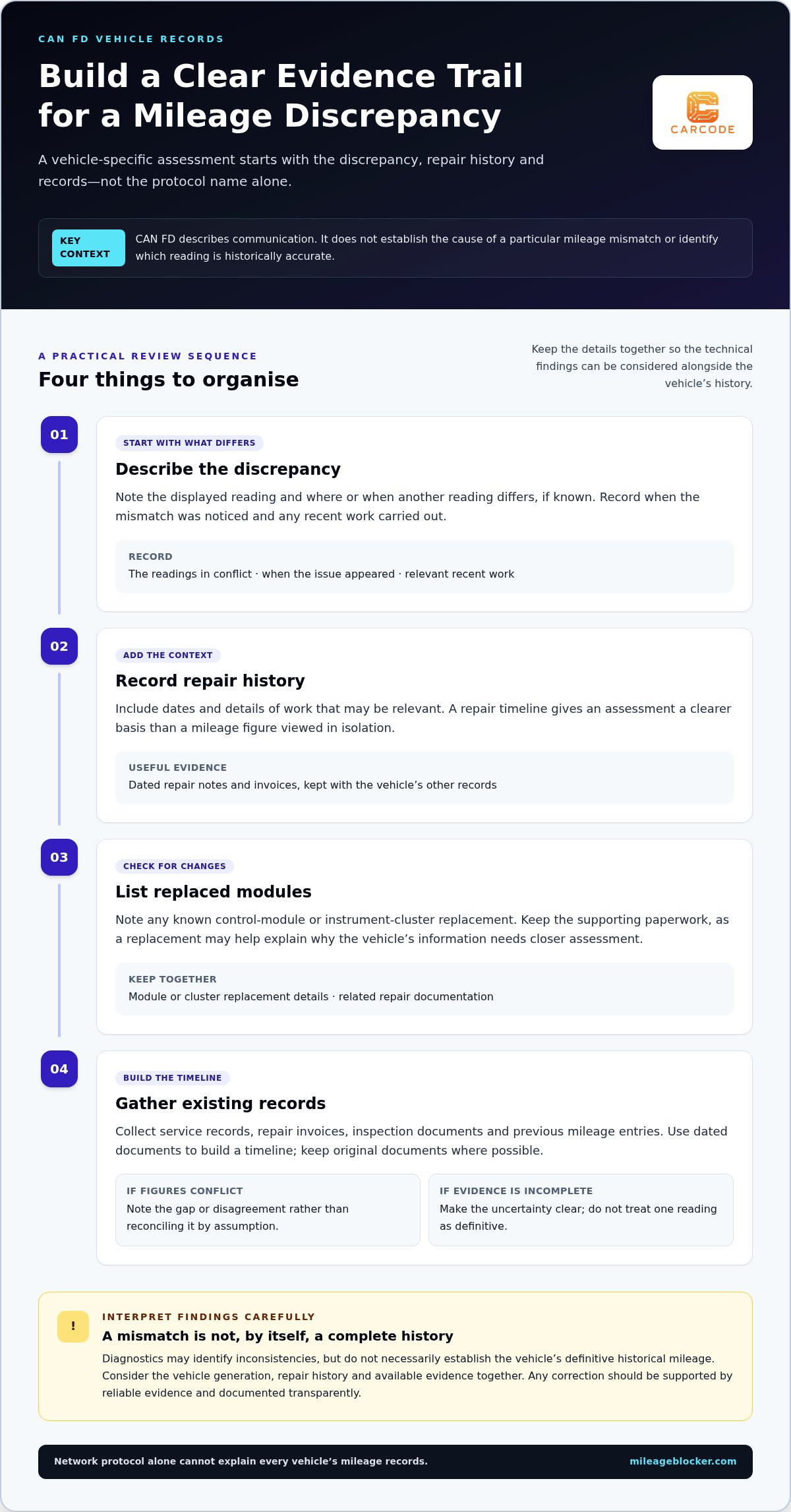
Start by noting what appears inconsistent, when it was noticed and what work had recently been carried out. A structured history gives a vehicle-specific assessment a clearer basis than a mileage figure viewed in isolation. The CAN FD protocol cannot establish the cause of a particular mismatch, so the vehicle’s records and repair history matter.
- Describe the discrepancy: note the displayed reading and where or when another reading differs, if known.
- Record repair history: include dates and details of work that may be relevant.
- List replaced modules: note any known control-module or instrument-cluster replacement and keep the supporting paperwork.
- Gather existing records: collect service records, repair invoices, inspection documents and previous mileage entries.
Which records help explain a mileage mismatch?
Build a timeline from dated documents rather than relying on memory. A service entry, repair invoice or inspection document may help establish a reading at a particular point. A module-replacement record can also explain why the vehicle’s information needs closer assessment. Keep original documents where possible, and note gaps or conflicting figures instead of trying to reconcile them by assumption. See this guide to mileage after instrument-cluster failure for related context.
When is further technical assessment needed?
Conflicting records, an unexplained change in the displayed reading or a recent module replacement are reasons for a vehicle-specific technical assessment. Diagnostics may help identify inconsistencies, but they cannot be assumed to establish a definitive historical mileage in every case. The vehicle’s generation, repair history and available evidence all need to be considered.
Any correction should be supported by reliable evidence and documented transparently, in line with applicable professional requirements. If the history cannot be established confidently, keep that uncertainty clear rather than presenting an unsupported figure as fact.
How Is Mileage Correction Different from a CAN FD Mileage Blocker?
These terms describe different functions. Addressing an evidenced mileage discrepancy means establishing and documenting an accurate record after a repair. A mileage blocker prevents odometer mileage from accumulating while it is in use. Neither the CAN FD network nor the word “blocker” makes these functions interchangeable.
| Aspect | Mileage correction | Mileage blocker |
|---|---|---|
| Purpose | Address a documented inconsistency in a vehicle’s mileage record. | Prevent mileage accumulation for a defined use, such as vehicle testing or off-road-track use. |
| Effect on recording | Relates to an existing record and must be supported by reliable evidence and transparent documentation. | Prevents odometer mileage from being recorded while the device is operating. |
| Appropriate context | Assessing a genuine discrepancy after repair, with the vehicle’s history taken into account. | Testing or off-road-track use, with the application specific to the vehicle. |
Does a mileage blocker correct an existing mileage discrepancy?
No. A blocker prevents mileage recording; it does not correct an existing record or establish the vehicle’s historical mileage. MileageBlocker.com devices are designed for vehicle testing or off-road-track use, not for correcting mileage records. For a broader explanation of the category, read this mileage blocker technology guide.
Where can readers find vehicle-specific product information?
Compatibility and product details depend on the vehicle application, so the model and generation matter. The network label alone cannot explain how mileage information is handled on a particular vehicle. For testing or off-road-track use, review the vehicle-specific product information before selecting a device. A blocker is not a solution for a mileage discrepancy, which requires evidence-led assessment and clear records.
Use the Vehicle’s Architecture as Your Starting Point
CAN FD changes how vehicle networks communicate, but it does not provide a universal map of mileage records. The vehicle’s generation, module design and repair history all matter when assessing a discrepancy. Any correction should be supported by reliable evidence and documented transparently.
A mileage blocker has a separate function: it prevents odometer mileage accumulation and does not correct an existing record. MileageBlocker.com by Carcode specialises in vehicle-specific mileage blocker technology for vehicle testing or off-road-track use. We also offer a fitting service for the devices we sell.
If you are considering a vehicle-specific blocker for those purposes, contact MileageBlocker.com about your vehicle.
Frequently Asked Questions
Is CAN FD the same across every vehicle?
No. CAN FD is a communication protocol, but its use within a vehicle depends on the system design and the vehicle’s generation. Two cars using CAN FD may have different network layouts, modules and software. The protocol name alone cannot establish how mileage information is managed or whether details from one vehicle apply to another.
Can diagnostics reveal a vehicle’s correct mileage after an ECU replacement?
Diagnostics may help identify inconsistent information, but they cannot be assumed to establish the vehicle’s definitive historical mileage. After an ECU replacement, the assessment should consider the repair details and available records, such as service entries or invoices. The evidence may not resolve every uncertainty.
Does a mileage blocker correct mileage on a CAN FD vehicle?
No. A mileage blocker prevents the odometer from accumulating mileage while the device is in use; it does not correct an existing record or establish a vehicle’s past mileage. MileageBlocker.com devices are intended for vehicle testing or off-road-track use. A mileage discrepancy is a separate matter and should be assessed using relevant records and vehicle-specific judgement.
Can information about one vehicle generation be applied to another?
Not without confirming that the relevant details apply to both generations. A model name can continue across a redesign or facelift while the electronic architecture, modules or software change. Treat each generation as a distinct application when assessing mileage information or product compatibility. Vehicle-specific details are more reliable than assumptions based only on a shared model name.
About the author
MileageBlocker TeamThe MileageBlocker Technical Team covers vehicle electronics, CAN and CAN-FD systems, mileage blocker compatibility, installation and product developments.
View author profile →