What is the History of the Odometer? From Ancient Greece to Digital Precision
Ever wonder what is the history of the odometer? Discover its journey from ancient Greek wheels to the digital precision in today's supercars like Ferrari.
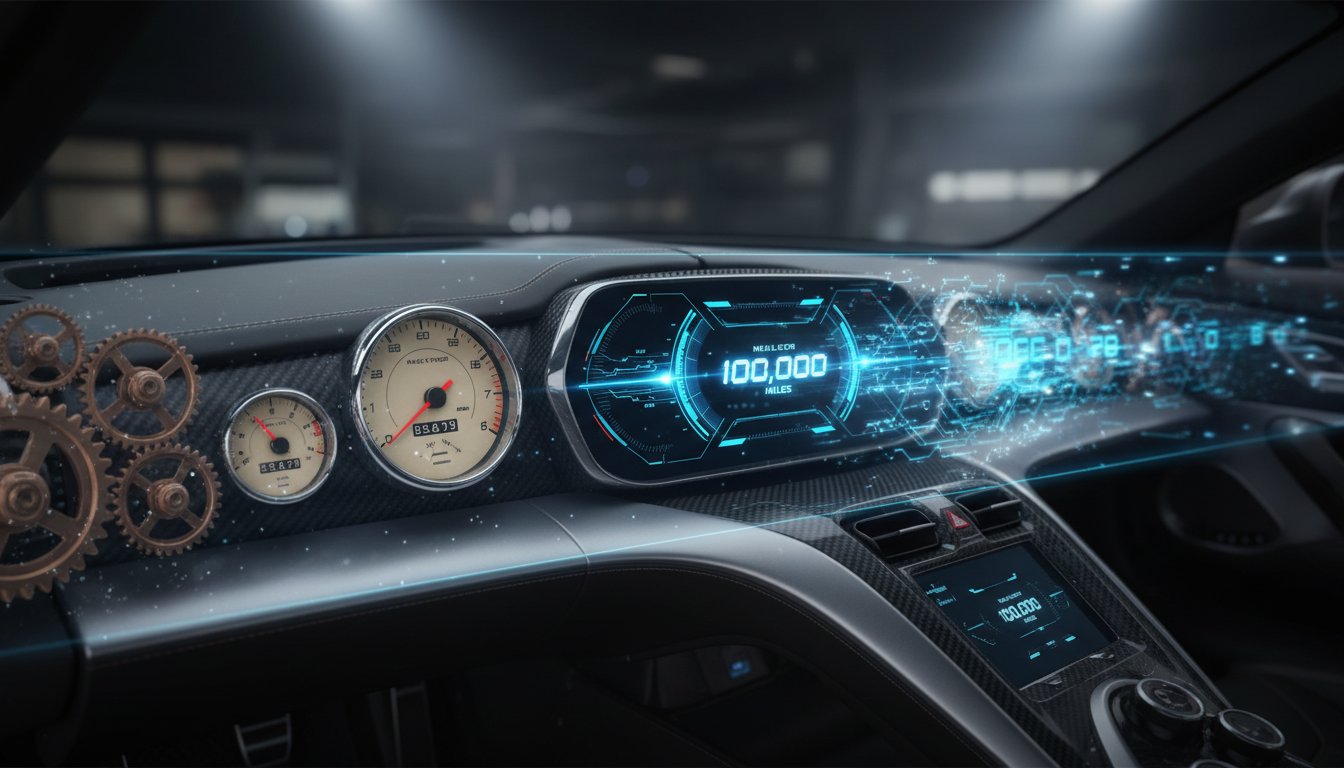
What if the sophisticated system tracking your McLaren’s mileage actually started with a bucket of stones in Ancient Greece? It’s a long journey from Vitruvius’s early wheels to the digital precision found in a modern Bugatti or Lamborghini. If you’ve ever asked what is the history of the odometer, you’re likely looking for clarity in a world of complex electronics. Many owners feel confused by the transition from mechanical dials to digital storage across multiple Electronic Control Units. With an estimated 2.45 million vehicles in 2026 having suspected odometer rollbacks, understanding how this data is stored has never been more critical.
We recognise that maintaining data integrity during vehicle testing is essential for high-performance cars like a Ferrari or a Range Rover. This article provides a concise timeline of how mileage tracking evolved into the sophisticated internal systems used today. You’ll discover the lineage of these devices and learn why modern data storage is so complex. We also explain how Carcode Mileage Blockers from MileageBlocker.com provide a discreet solution for protecting your vehicle's data during off-road testing and diagnostic procedures. From a BMW to the world's fastest supercars, understanding your odometer’s heritage is the first step in mastering its data.
Key Takeaways
- Trace the origins of mileage tracking and discover what is the history of the odometer, from ancient Greek mechanical concepts to modern digital precision.
- Understand the mechanics of the analogue era, where physical gears and drive cables recorded distance in classic BMW and Range Rover models.
- Learn how modern supercars like the Ferrari and McLaren store mileage data across multiple internal control modules rather than just the dashboard.
- Explore the shift to CAN bus network integration in vehicles like the Bugatti and Lamborghini, making mileage storage more complex than ever before.
- Recognise how Carcode Mileage Blockers from MileageBlocker.com serve as essential tools for maintaining data integrity during professional vehicle testing and diagnostics.
The Ancient Roots of Mileage Tracking: What is the History of the Odometer?
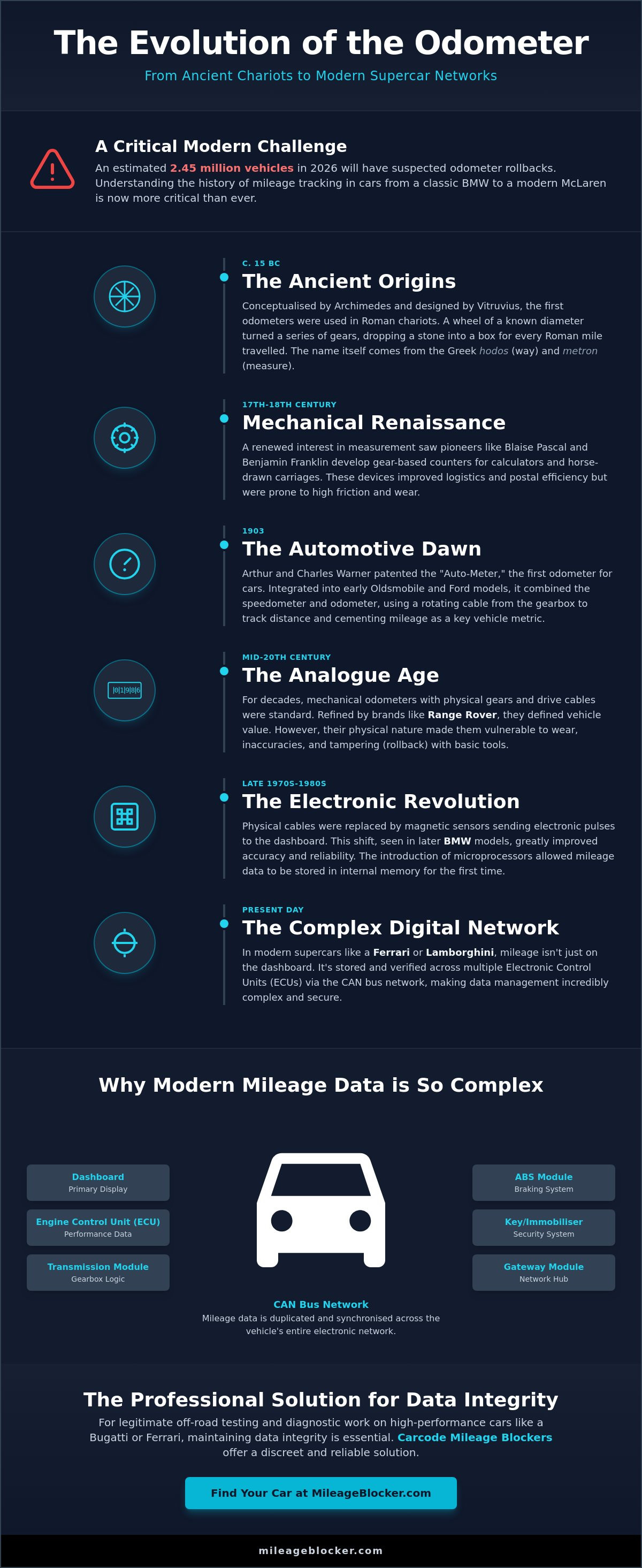
An odometer is a precision device designed to measure the total distance travelled by a vehicle. To understand what is the history of this essential tool, we must look at its linguistic roots. The term originates from the Greek words hodos, meaning way or road, and metron, which translates to measure. While modern drivers in a Range Rover or BMW rely on liquid crystal displays, the fundamental concept hasn't changed for millennia. Human interest in tracking distance has always been driven by a need for navigation, logistics, and value assessment.
Archimedes of Syracuse first conceptualised the device, but the Roman architect Vitruvius provided the most famous early practical design around 15 BC. This system used a chariot wheel of a specific diameter connected to a series of gears. The first recorded odometer was a device that dropped a stone into a box for every Roman mile travelled, allowing the driver to count the pebbles at the end of the journey. This ancient history of the odometer showcases how human ingenuity sought precision long before the existence of the internal combustion engine.
From Chariots to Horse-Drawn Carriages
The 17th century saw renewed interest in distance measurement. Blaise Pascal developed the Pascaline, an early mechanical calculator that influenced gear-based counters, while Thomas Savery improved mechanisms for ships. In the United States, Benjamin Franklin created a carriage odometer to track postal routes for efficiency. These early mechanical counters were prone to friction and wear. They offered significantly lower accuracy compared to the digital precision found in a modern Ferrari or McLaren.
The Birth of the Modern Automotive Odometer
The transition to the automotive era happened in 1903 when Arthur P. and Charles H. Warner patented the "Auto-Meter." This device combined a speedometer and odometer into a single unit. Early Oldsmobile and Ford models integrated these mechanical gears, which used a rotating cable driven by the gearbox. If you are researching what is the history of vehicle instrumentation, you'll find that these early devices paved the way for the sophisticated, multi-module dashboards in a modern BMW. Today, Carcode Mileage Blockers from MileageBlocker.com represent the next stage of this evolution, helping owners manage data integrity in controlled testing environments across various makes and models.
The Mechanical Era: How Gears Defined Vehicle Value
The mechanical odometer served as the industry standard for decades. To understand what is the history of vehicle valuation, one must look at the intricate assembly of worm gears and drive cables that once dominated every dashboard. These systems relied on a physical connection; a flexible cable linked the vehicle's gearbox output directly to a series of rotating drums in the instrument cluster. As the gears turned, the drums advanced, physically recording every mile travelled. This direct mechanical link meant the dashboard was a live reflection of the transmission's rotation.
Mechanical systems had inherent limitations that modern drivers rarely encounter. Friction caused significant wear and tear over thousands of miles, sometimes leading to cable snaps or gear slippage that resulted in inaccurate readings. Despite these flaws, by the mid-20th century, mileage became the primary metric for determining a car's market value. Whether it was a luxury saloon or a utilitarian workhorse, the number on the dial dictated the price. This reliance on a physical counter created a need for more robust engineering to prevent premature failure of the tracking components.
The Standardisation of Mileage Tracking
Manufacturers like Range Rover and Mercedes-Benz refined these components to ensure mechanical durability over long lifespans. They introduced the "trip meter", allowing drivers to track short distances independently of the total count. However, these mechanical odometers were susceptible to physical tampering before the digital age, as the gears could often be manually wound back with basic tools. This vulnerability eventually pushed the industry toward more secure, electronic solutions.
The Transition to Electronic Speedometers
The late 1970s and 80s marked a pivotal shift toward electronic speedometers. Magnetic sensors replaced physical cables, sending electronic pulses to the dashboard instead of relying on mechanical rotation. This transition improved accuracy and reduced the mechanical failure points common in older BMW models. The introduction of the first microprocessors allowed for more reliable data storage, paving the way for modern digital odometers. Unlike their gear-driven predecessors, these systems began to store data in internal memory modules. If you're looking to protect the data integrity of a newer vehicle during authorised testing, you can find your car and explore compatible Carcode Mileage Blockers at MileageBlocker.com.
The Digital Revolution and Modern Mileage Complexity
The transition from mechanical gears to digital systems redefined how we answer what is the history of vehicle data. In the late 1990s, simple LCD displays began replacing analogue drums. However, the real revolution was the integration of the Controller Area Network (CAN bus). This protocol allows different components of the vehicle to communicate seamlessly. In a modern Bugatti or Lamborghini, mileage isn't a single number on the dash. It's an encrypted data point stored simultaneously across multiple electronic control units (ECUs).
Many owners hold the misconception that mileage only exists in the speedometer cluster. In reality, the Engine Control Unit (ECU) and the Built-in Systems Interface (BSI) act as a redundant network. They constantly synchronise data to ensure accuracy. If one module is replaced, the others often update it with the highest recorded value. This complex web of digital storage is a far cry from the stone-dropping mechanisms found in the early history of the odometer. Modern systems are designed to be tamper-resistant, creating a permanent digital footprint of the vehicle's life.
Mileage Storage in Premium Vehicles
High-performance brands like Ferrari and McLaren use mileage data for more than just resale value. These systems track distance to manage precise engine health parameters and service intervals. Modern telematics and GPS systems often cross-reference this data in real-time. To protect this sensitive information, manufacturers implement high-level encryption protocols. This makes the data nearly impossible to access or modify without leaving clear evidence of a breach.
The Challenges of Vehicle Testing in the Digital Age
Professional testing environments, such as dyno runs or track-based performance tuning, present a unique challenge. Recording mileage during these non-road scenarios can lead to inaccurate vehicle history records. Technicians require specialised tools to halt recording during these sessions. Carcode Mileage Blockers provide a high-quality hardware solution for these authorised environments. These devices allow for the temporary suspension of mileage tracking across all relevant modules, ensuring data integrity is maintained during rigorous testing. You can explore the full range of professional hardware at MileageBlocker.com to find a solution for your specific model.
Protecting Data Integrity: The Role of Carcode Mileage Blockers
Understanding what is the history of distance tracking allows us to appreciate the complexity of modern vehicle electronics. We've moved far beyond the simple mechanical gears of the 20th century. Today, mileage management is a technical necessity for professionals operating in authorised testing environments. Carcode Mileage Blockers represent the modern evolution of odometer management. These devices don't alter existing data; instead, they act as a preventative tool to temporarily suspend mileage recording during specific, controlled scenarios. This is a critical distinction from illicit mileage correction tools, which we don't provide.
MileageBlocker.com supplies high-performance hardware designed for durability and precision. When a vehicle like a Lamborghini or Bugatti undergoes dynamometer testing or performance tuning on a private track, recording those miles can create an inaccurate representation of the car's road history. Our hardware allows technicians to maintain data integrity by pausing the synchronisation between various control modules. These devices are engineered with high-grade components to ensure discreet operation without triggering error codes or interfering with the vehicle's complex CAN bus communication protocols.
Why Quality Components Matter for Your Vehicle
Modern vehicles like a Range Rover or BMW feature highly sensitive electronic architectures. Using low-quality clone devices poses a significant risk to these expensive systems, potentially causing data corruption or hardware failure. Carcode Mileage Blockers are designed to integrate seamlessly with the vehicle’s existing wiring, using original-style connectors for a secure fit. For those looking to ensure a professional setup, our installation guide provides the necessary technical requirements for fitting these devices correctly. High-quality hardware ensures that the sophisticated memory modules in your vehicle remain protected during every test session.
The Future of Mileage Management
As we look at what is the history of the odometer, it's clear that technology will continue to advance alongside electric and hybrid systems. Future vehicles from brands like Ferrari and McLaren will likely store even more granular data across cloud-based platforms. Maintaining a clean and accurate data trail remains essential for vehicle history reports and long-term valuation. We recommend that owners check our mileage blocker FAQ to confirm specific model compatibility and learn more about how our hardware supports data integrity. Whether you're testing a high-performance supercar or a premium SUV, using specialised tools is the only way to manage digital data with professional precision.
The Future of Mileage Integrity
From the mechanical pebble-drop systems of Ancient Rome to the encrypted CAN bus networks in a modern Lamborghini, tracking distance has evolved into a complex science. Understanding what is the history of the odometer reveals a clear shift from physical gears to decentralised digital data stored across multiple control units. Today, maintaining the integrity of this data during professional testing is paramount for owners of high-performance vehicles like a Ferrari or McLaren. A Range Rover or BMW requires the same level of technical precision to ensure internal modules remain synchronised and error-free.
Carcode Mileage Blockers provide a sophisticated, hardware-based solution to manage this data during authorised off-road use. We offer specialised software developed specifically for premium brands, including Bugatti and Lamborghini, ensuring seamless integration with the vehicle's factory electronics. With worldwide delivery on all high-performance hardware and professional fitting services available across the UK, you can protect your vehicle's data with confidence. Find the right Carcode Mileage Blocker for your vehicle at MileageBlocker.com and take control of your car's digital records today. Your vehicle's history is its most valuable asset; ensure it remains accurate.
Frequently Asked Questions
Is the history of the odometer linked to ancient Greece?
Yes, the origins of distance tracking are rooted in ancient Greek mathematics and engineering. Archimedes first conceptualised the measurement of distance, which led to the practical pebble-dropping mechanisms described by Roman engineers. If you're investigating what is the history of these devices, you'll find that these early principles of gear ratios remain the foundation for all distance measurement tools used today.
How did mechanical odometers work in older cars?
Mechanical systems relied on a physical drive cable linked directly to the vehicle's gearbox. This cable rotated as the car moved, turning a series of worm gears that advanced the numbered drums on the dashboard cluster. This setup was the industry standard in older Range Rover and BMW models for decades before the automotive shift to electronic sensors and microprocessors.
Can a digital odometer be stopped for testing purposes?
You can temporarily suspend mileage recording using a Carcode Mileage Blocker from MileageBlocker.com. These devices are specifically designed for authorised testing environments, such as performance tuning on a dynamometer or track-based diagnostics. They allow technicians to halt the data flow to the instrument cluster and other internal control modules during non-road use to maintain accurate service records.
What is the difference between a mileage blocker and a correction tool?
A mileage blocker is a preventative hardware device used to stop future mileage recording during testing, while a correction tool is used to change data already stored in the memory. We only provide blockers and professional fitting services. Our hardware is designed for professional discretion and data integrity, whereas correction tools are used for illicit alterations which we don't support.
Are mileage blockers detectable by modern diagnostic tools?
High-performance Carcode Mileage Blockers are designed to be undetectable by standard diagnostic equipment. By using specialised software developed for premium brands like Bugatti and Lamborghini, these devices ensure that mileage is paused across all relevant modules simultaneously. This prevents the data discrepancies or error codes often associated with low-quality clones found elsewhere on the market.
Where is mileage data stored in a modern supercar like a Ferrari?
In a modern Ferrari or McLaren, mileage data is stored across several redundant electronic control units, including the Engine Control Unit (ECU) and the central body module. This multi-layered storage is a significant part of what is the history of modern vehicle security. It ensures that the total distance remains synchronised across the entire electronic architecture of the car, even if the dashboard cluster is replaced.
About the author
MileageBlocker TeamThe MileageBlocker Technical Team covers vehicle electronics, CAN and CAN-FD systems, mileage blocker compatibility, installation and product developments.
View author profile →