How Mileage is Stored in Modern Cars: The Digital Truth Behind Your Dashboard
Wondering how mileage is stored in modern cars? Your dash is just a display. Learn how data is mirrored across the ECU, transmission, and even your key.
If you think the number glowing on your digital speedometer is the definitive record of your vehicle's history, you are only seeing a fraction of the total data set. It's a common misconception. Most owners believe that the dashboard is the primary storage point for the odometer, but the digital reality is far more complex. Understanding how mileage is stored in modern cars requires looking past the instrument cluster and into the deep architecture of the vehicle's internal network. We recognize the technical concerns that arise when a module fails or requires professional testing. You fear data corruption. Our engineers have analyzed communication protocols like CAN FD to identify every hidden bit of data buried within various electronic control units. The results are definitive. This article will show you exactly how your car distributes its mileage across multiple secret modules, from the transmission to the ABS controller, and how to manage this data during diagnostic procedures.
Key Takeaways
- Realize your dashboard is just a display. You will learn how mileage is mirrored across multiple hidden electronic control units to ensure data integrity.
- Explore the digital network. Discover exactly how mileage is stored in modern cars by examining the data frames that circulate through the CAN-bus architecture.
- Redundancy is standard now. We explain why high-end manufacturers like Porsche store odometer records in the transmission and the ignition key.
- Secure your testing process. High-quality mileage blockers are required to navigate the encrypted gateways found in 2026 vehicle models to ensure professional results.
The Distributed Odometer: Why Your Dashboard is Just the Tip of the Iceberg
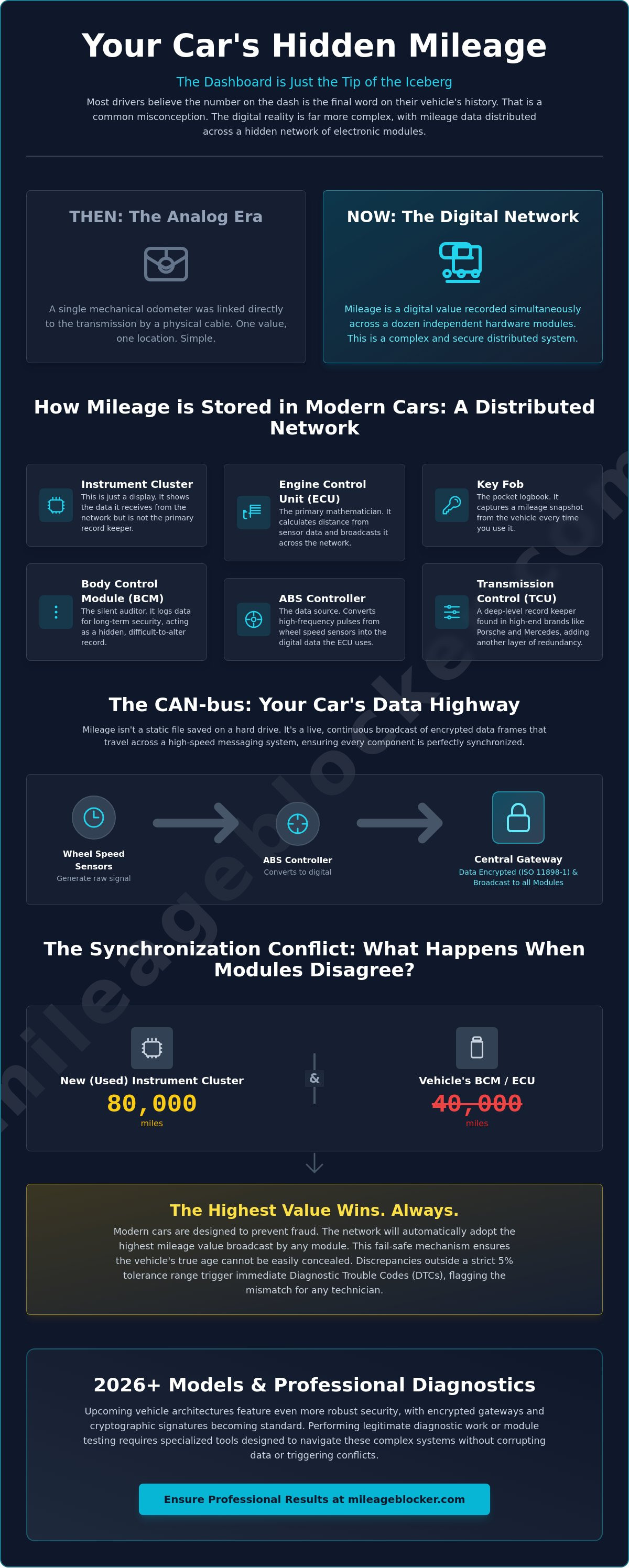
The numbers on your dash are merely a projection. In the past, an Odometer was a straightforward mechanical device linked to the transmission by a physical cable. Today, the process is virtual. Modern 2026 digital architecture has moved far beyond the simple gear-driven systems of the nineties. If you drive a 2024 BMW G30 or a late-model Audi Q7, your mileage isn't a single file sitting in a single folder. Instead, the vehicle utilizes distributed memory. This means the exact same distance value is recorded simultaneously across a dozen independent hardware modules. You can find your car on our compatibility list to see how these modules interact in your specific make and model. Understanding how mileage is stored in modern cars is essential for anyone performing legitimate diagnostic testing or module replacement.
The Role of the Instrument Cluster vs. the Engine Control Unit
The Body Control Module (BCM) as the Silent Auditor
CAN-bus Architecture: The Central Nervous System of Vehicle Data
How Data Frames Travel Through Your Car’s Wiring
The Synchronization Conflict: What Happens When Modules Disagree
Discrepancies lead to immediate consequences. If you install a used instrument cluster from a salvage yard that has 80,000 miles while your car actually has 40,000, the BCM and ECU will typically adopt the higher number. Modern cars prioritize the highest value. If module values fall out of a strict 5% tolerance range, the vehicle will trigger diagnostic trouble codes. It's a fail-safe mechanism that defines how mileage is stored in modern cars today. We see these issues when owners skip proper installation steps for diagnostic hardware. Diagnostic tools will flag the mismatch immediately.
Redundancy and Tamper-Proofing: Mileage Storage in Keys, ABS, and Gearboxes
Redundancy is the industry standard. Manufacturers have moved away from centralized storage to ensure that even if a specific module is damaged or replaced, the vehicle maintains a verifiable record of its total distance traveled. In our workshop, we see this most clearly with high-end German engineering. Porsche and Mercedes-Benz, for instance, record odometer data within the Transmission Control Unit (TCU). This creates a digital trail that is difficult to erase. If you want to understand the relationship between different metrics, check out our Engine Hours to Miles Guide for more detail. Read How Odometers Work for more on the technical shift. This demonstrates how mileage is stored in modern cars through these complex, high-tech networks.
Why Your Key Fob Knows More Than You Think
The ABS Module: The Primary Source of Distance Truth
The ABS module is the primary source of truth. Because distance is a direct calculation of wheel rotations measured by magnetic sensors, the ABS unit holds the "ground truth" regarding exactly how far the chassis has moved. Professional diagnostic tools prioritize this. During a forensic audit, investigators query the ABS module first because it is less likely to be affected by cluster-specific software glitches. If you're testing these modules, you need a Mileage Blocker Device that communicates correctly across all these points.
How Mileage is Stored in Modern Cars During Professional Testing
Professional testing requires a surgical approach to data management. In our workshop, we utilize a Mileage Blocker Device specifically to manage how mileage is stored in modern cars during stationary dynamometer sessions or closed-circuit R&D. These devices filter data. They work by intercepting the mileage data frames on the CAN-bus before they reach the various storage modules we discussed earlier. This is a preventative measure. It ensures that testing hours do not skew the long-term service data in the BCM or TCU. For the best results, we always recommend Professional Installation to maintain the integrity of the vehicle's factory wiring.
Signal Interception vs. Data Alteration
Ensuring CAN-bus Integrity During Off-Road Use
Frequently Asked Questions
Q: Does replacing my dashboard reset the mileage to zero?
A: No. In modern vehicles, the instrument cluster is just a display. Once you plug in a new cluster, it will perform a digital handshake with the ECU and BCM, which will then push the stored mileage back to the display.
Q: Can a dealer tell if the mileage has been tampered with?
A: Yes, usually by checking secondary modules. Even if the dashboard is altered, discrepancies in the Transmission Control Unit, the ABS module, or the service history stored in the key fob will flag the vehicle for a data mismatch.
Q: Is mileage stored in the car key?
A: Most modern cars from 2015 onwards store the current mileage and service data on an EEPROM chip inside the key. This allows service advisors to read your vehicle's status instantly using a key reader at the dealership.
Q: What is the most accurate place to find true mileage?
A: The ABS module is generally considered the ground truth. It calculates distance based on physical wheel rotations, making it the most reliable source for forensic mileage verification during a professional audit.
Secure Your Diagnostic Data Today
Understanding the decentralized nature of modern automotive networks is the first step toward professional data management. The dashboard is merely a display. The complex reality of how mileage is stored in modern cars means that any diagnostic testing or dynamometer work must account for the synchronized data frames moving across the CAN-bus. Integrity is non-negotiable. Our German-engineered hardware provides the precision needed for these high-stakes environments, utilizing plug-and-play OEM connectors that integrate directly with your vehicle's factory wiring to prevent any permanent error codes or data corruption. We offer dedicated technical support for 2026 models to ensure your hardware remains compatible with the latest encrypted gateways. Take control of your testing. Find the right mileage blocker for your professional testing needs and protect your vehicle's digital history. We look forward to helping you maintain the highest standards of vehicle integrity.
Frequently Asked Questions
Where exactly is the mileage stored in a car made in 2026?
Mileage is recorded across a distributed network including the Engine Control Unit (ECU), the Instrument Cluster, the Body Control Module (BCM), and the Transmission Control Unit (TCU). Redundancy is key. High-end vehicles sync this specific data to the key fob and the ABS module to prevent data loss during hardware failures. This multi-point storage architecture defines how mileage is stored in modern cars and ensures that the vehicle history remains verifiable even if the primary dashboard display fails.
Can a dealership detect if the mileage has been managed during testing?
Detection depends entirely on hardware quality. A high-quality mileage blocker intercepts the signal on the CAN-bus before it reaches any memory modules, meaning the data was never actually recorded. It leaves no trace. Low-quality tools often trigger "freeze frame" error codes within the ECU. Dealership diagnostic platforms like ODIS or ISTA can identify these discrepancies immediately during a routine service scan or warranty inspection.
Does replacing the dashboard cluster reset the car's mileage?
Replacing the cluster will not reset your mileage. Modern vehicle architecture uses a "highest value wins" synchronization protocol. Once you plug in a new instrument cluster, the car automatically pulls the stored odometer value from the BCM or ECU via the CAN-bus. This ensures the display remains accurate. If the replacement unit has higher mileage than the car, the entire vehicle will likely adopt that higher number immediately.
Do electric cars store mileage differently than petrol cars?
Does the key fob store my car's mileage?
About the author
MileageBlocker TeamThe MileageBlocker Technical Team covers vehicle electronics, CAN and CAN-FD systems, mileage blocker compatibility, installation and product developments.
View author profile →