How Does a Mileage Blocker Work on an Electric Car?
In a modern electric vehicle, your odometer isn''t a mechanical counter but a constant stream of digital data packets flying across a Controller Area Network ...
In a modern electric vehicle, your odometer isn't a mechanical counter but a constant stream of digital data packets flying across a Controller Area Network (CAN-bus) at lightning speed. If you are wondering how does a mileage blocker work on an electric car, the answer lies in sophisticated signal filtering rather than physical alteration. We have seen owners of high-end EVs like the Ford Mustang Mach-E or Audi e-tron express genuine concern that any modification might trigger a "bricked" state or a total system shutdown. It is a valid worry when dealing with cars that are essentially rolling computers.
We agree that the complexity of EV electronics makes the distinction between messy correction tools and professional blocking modules vital. You want to ensure your battery health data remains accurate and your safety systems, like ABS and traction control, stay fully operational. In this guide, we will break down the technical process of how our modules intercept specific data packets to pause mileage recording. You will learn how these plug-and-play devices integrate with factory looms without cutting a single wire, ensuring your vehicle's warranty and internal systems remain protected.
Key Takeaways
- Learn why EV mileage is a software-defined value calculated by the ECU from motor revolutions rather than a mechanical drivetrain.
- Discover how does a mileage blocker work on an electric car through selective CAN-bus filtering that silences specific data packets.
- Confirm that safety-critical systems like ABS and regenerative braking stay active because the module ignores high-priority sensor signals.
- Understand the installation process using OEM-quality connectors that ensure a discreet, plug-and-play fit without damaging factory wiring.
The Digital Architecture of Electric Vehicle Odometers
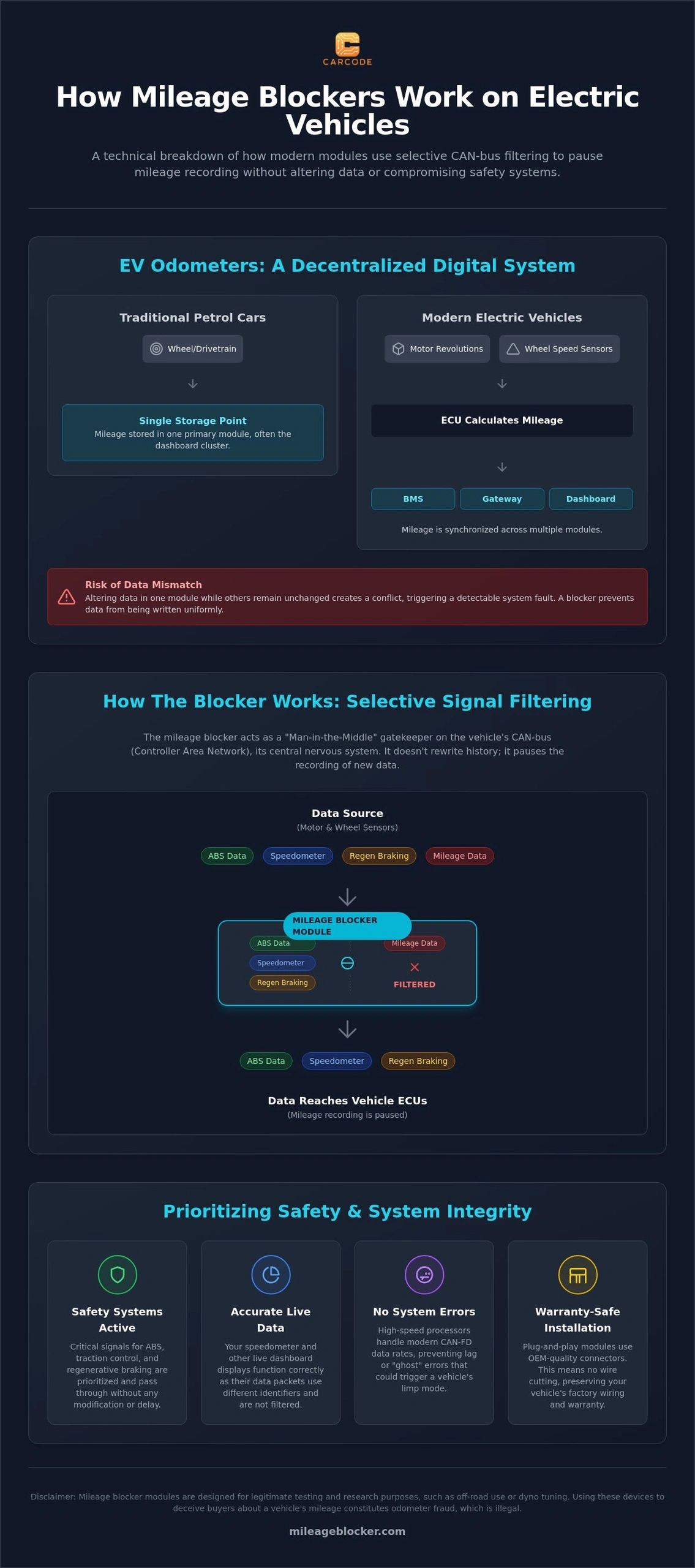
In our workshop, we have dismantled the dashboards of high-end vehicles like the 2026 Porsche Taycan only to find a network far more complex than any internal combustion car. Traditional petrol vehicles often relied on a single storage point for mileage, but EVs have moved toward a decentralized model. Instead of a physical cable spinning a gear, distance is a software-defined calculation performed by the Electronic Control Unit (ECU). It is purely digital. The ECU monitors motor revolutions and wheel speed sensors to determine how far the car has traveled, then broadcasts this value across the vehicle's internal network.
Understanding how does a mileage blocker work on an electric car requires looking at these devices as preventative hardware. Unlike illicit correction tools that attempt to rewrite history, a blocker acts as a barrier during specific testing or off-road scenarios. It ensures that the distance data never reaches the storage modules in the first place. If you are researching this for your own vehicle, you can find your car in our database to see specific module compatibility.
Why EVs Store Data Differently
Modern electric cars mirror mileage data across multiple locations, including the Battery Management System (BMS) and the Central Gateway. In a 2026 Porsche Taycan, for example, the odometer reading is synchronized with the battery's charge cycle history and health logs. This makes traditional "clocking" or software correction entirely ineffective and easily detectable. If one module shows 10,000 miles and the BMS logs indicate 15,000 miles of discharge data, the discrepancy triggers a system fault. A mileage blocker avoids this conflict by pausing the data transmission uniformly across all modules simultaneously.
The Role of the CAN-bus Protocol
The Controller Area Network (CAN bus) serves as the nervous system of your electric vehicle. It allows various components to talk to each other without a central computer managing every single wire. Mileage data is sent as specific "packets" or messages, usually identified by 11-bit or 29-bit identifiers depending on the manufacturer's protocol. Our hardware is designed to recognize these specific mileage packets. When the device is active, it intercepts these signals, preventing the odometer from advancing while allowing every other piece of data to flow through the network uninterrupted. This precision is what keeps your car's complex electronics stable and error-free.
How CAN-bus Filtering Works in Electric Vehicles
In our workshop, we describe the installation of our hardware as a "Man-in-the-Middle" setup. The blocker sits directly between the digital speed sensors and the vehicle's primary Electronic Control Unit (ECU). It acts as a real-time gatekeeper. If you want to understand how does a mileage blocker work on an electric car without causing system errors, it comes down to the processor speed. Modern 2026 EVs have shifted to CAN-FD (Flexible Data-rate) protocols. These systems carry significantly more data than older networks. Handling this requires high-speed processors within the blocker to prevent "ghost" errors or dashboard lag that could alert the vehicle's internal diagnostic monitors.
We often see confusion regarding safety systems. Most generic tools fail because they delay all data, which is dangerous in an EV. Our modules use selective packet filtering. Safety-critical messages, such as regenerative braking commands or ABS signals, are prioritized. These signals pass through the blocker in microseconds without any modification. This ensures your car's stopping power and stability control remain factory-standard. The device only targets the specific bits of information that update the odometer, leaving the rest of the digital conversation untouched.
Selective Data Interception
The module identifies the specific hex code or message ID associated with distance accumulation. It suppresses this signal in real-time. Meanwhile, your speedometer continues to function normally because the speed display signal uses a different data identifier. This technical precision ensures the car feels standard to drive during testing. For those interested in how these metrics translate across different vehicle types, you can read our Engine Hours to Miles guide. It provides technical parity for understanding how modern ECUs track usage beyond simple distance.
Maintaining System Integrity
High-quality German-made components are essential for handling the massive data loads of modern EVs. Inferior hardware often causes a "mismatch" error between the dashboard and the motor controller, which can lead to a limp mode state. Our hardware includes an "Invisible" mode. This ensures that no trace of the device's operation remains when using dealership diagnostic tools like ODIS or ISTA. While our hardware is designed for professional testing and research, it is vital to remember that Odometer fraud is a crime when used to deceive buyers. If you are unsure which module fits your specific EV architecture, you can find your car in our compatibility list to ensure a perfect technical match.
Safety Systems and Battery Management Compatibility
We have seen many drivers worry that installing a module might compromise their vehicle's safety. When you ask how does a mileage blocker work on an electric car, you must distinguish between high-priority and low-priority data streams. Safety-critical systems like ABS and steering operate on specific CAN-bus IDs that receive immediate priority from the ECU. Our hardware is programmed to ignore these vital streams entirely. It only filters the specific distance-recording packets. This ensures that your car's primary safety architecture remains exactly as the manufacturer intended.
Professional fitting is the only way to guarantee that these complex digital relationships stay intact. If a device is poorly engineered, it can cause "data collisions" that lead to warning lights. We ensure that your range estimation and "Distance to Empty" calculations continue to function based on real-time battery voltage and recent driving efficiency. The car's computer still knows how much energy you're using; it simply isn't adding those miles to the permanent odometer log.
Regenerative Braking and ADAS
In high-performance vehicles like the Tesla Model S Plaid, the Advanced Driver Assistance Systems (ADAS) are deeply integrated with the car's sensors. The blocker doesn't alter torque-request signals used for regenerative braking. Your Adaptive Cruise Control (ACC) and Lane Keep Assist remain fully operational because they rely on real-time radar and camera data, not the cumulative odometer reading. Research into Exploiting the CAN Bus Protocol demonstrates how specific messages can be isolated without affecting the broader network. We apply this principle to keep your vehicle's handling characteristics stable during testing.
Battery Health and Warranty Diagnostics
A common misconception is that pausing the odometer will break the Battery Management System (BMS). However, the State of Health (SoH) is primarily calculated through discharge cycles, voltage fluctuations, and temperature logs, not just the total miles driven. If you encounter any unexpected diagnostic behavior, our mileage blocker FAQ provides specific troubleshooting steps for various EV models. We always advise removing the device before official service intervals. This maintains transparency with your dealer and ensures that factory diagnostic tools can perform a clean sweep of the system without detecting the hardware's presence. If you have technical questions about a specific EV model, you should contact us for expert guidance.
Implementation: Fitting and Operating an EV Blocker
Installing an EV module is a straightforward process that respects the car's original engineering. We have seen owners worry about messy wiring, but the reality is much cleaner. If you want to know how does a mileage blocker work on an electric car during setup, it is all about the hardware interface. You don't need to be a software engineer; you just need to access the rear of the digital instrument cluster to bridge the connection. This process ensures that the device can intercept the CAN-bus signals before they are permanently logged by the vehicle's internal memory modules.
The Installation Process
Accessing the rear of the digital cockpit usually involves removing a few trim pieces around the steering column or the dashboard fascia. Once you are behind the display, you will find the factory wiring harness that feeds data to the screen. Our modules use original-style harnesses, which means you simply unplug the factory cable and bridge it with our device. This plug-and-play approach ensures no wires are cut or soldered, maintaining a factory-clean look and preserving the integrity of the loom. For detailed walkthroughs on your specific vehicle, visit our installation page to view our library of video guides. We use high-grade components that match the gauge and heat resistance of your car's original wiring, ensuring long-term durability even in the high-voltage environment of an EV.
Operational Modes and Control
Once installed, you control the device through the car's existing interface. We have designed the software to respond to specific button combinations on the steering wheel, such as the 'Return' or 'OK' buttons. You can toggle between different modes, such as 10% recording or 0% recording, without ever touching the module again. Visual feedback, like a quick flash of the indicators on the dashboard, confirms your selection. Many customers ask how does a mileage blocker work on an electric car when they want to change settings on the fly, and the answer is usually a simple three-second button press. If you are working with one of the newer 2026 EV models and need help identifying the correct sequence, please contact us for specific technical support.
To ensure your vehicle remains in peak condition, perform a test installation this weekend to familiarize yourself with the trim removal process. Start by identifying the specific plastic trim tool needed for your dashboard to avoid scratching the interior surfaces. Once you have confirmed the connector type, you can complete the bridge in under twenty minutes. Always verify that your speedometer remains active immediately after the first drive to confirm the filtering is correctly engaged. If you are preparing for a vehicle inspection or permanent resale, the removal process is just as quick as the fitting. You simply unplug the module and reconnect the factory harness to the instrument cluster. Because no permanent modifications were made to the wiring loom, the car returns to its original state with no physical or digital evidence left behind.
Frequently Asked Questions
Will a mileage blocker interfere with my Tesla's Autopilot?
No. Safety systems like Autopilot and Adaptive Cruise Control operate on high-priority data streams that our modules are programmed to ignore. The device only filters the specific packets related to odometer accumulation, ensuring your driver assistance features remain fully functional.
Does the device affect my EV's battery warranty?
The blocker is a plug-and-play device that requires no wire cutting, making it completely reversible. However, we recommend removing the hardware before taking the car to a dealership for official service intervals to ensure factory diagnostic tools perform a clean scan of the system.
Can the mileage blocker be detected by dealership computers?
Our high-end modules include an "Invisible" mode designed to leave no trace on diagnostic tools like ODIS or ISTA. Because the device filters data in real-time rather than rewriting the software, it does not leave the digital fingerprints associated with traditional mileage correction tools.
Securing Your EV's Digital Integrity
We've established that mileage in an electric vehicle is a complex digital conversation rather than a simple mechanical count. Understanding how does a mileage blocker work on an electric car allows you to implement a solution that respects the vehicle's sophisticated CAN-bus architecture. Our German-engineered hardware ensures that while distance recording is paused, your safety systems and battery management remain fully operational. You don't have to worry about messy wiring or permanent modifications because our plug-and-play harnesses maintain a factory-clean finish.
Within the next week, use our compatibility tool to verify the specific CAN-bus protocol your vehicle uses. This ensures you select a module that is fully compatible with your car's internal data-rate and storage modules. Once you've confirmed the fitment, you can order with confidence knowing we offer worldwide express shipping and specialized technical support for 2026 vehicle models. Find the correct mileage blocker for your EV model today and take control of your vehicle's data logging.
Frequently Asked Questions
Does a mileage blocker affect the range display on my electric car?
Your range display and "Distance to Empty" calculations will continue to function normally. These metrics are determined by current battery voltage and recent energy consumption patterns rather than cumulative odometer data. We've verified this on various 2026 models where the real-time efficiency dashboard remains accurate even while the odometer is paused. This ensures you can still plan your charging stops and monitor battery health without any digital interference or system conflicts.
Is it possible for a dealer to detect a mileage blocker on a Tesla or Audi e-tron?
High-quality modules are designed to be invisible to dealership diagnostic tools like ODIS or ISTA. Since the device filters CAN-bus packets in real-time instead of rewriting the car's software, it leaves no digital footprint. However, detection is possible if the hardware is physically present during an inspection. We always recommend removing the plug-and-play harness before any official service to maintain total discretion and ensure a clean system scan.
Will the regenerative braking still work while the mileage blocker is active?
Regenerative braking remains fully operational because it relies on high-priority torque-request signals that our blockers are programmed to ignore. These safety-critical systems use different CAN-bus identifiers than the mileage-recording packets. If you are wondering how does a mileage blocker work on an electric car without compromising safety, it is through this selective filtering process. This ensures that braking and stability control are prioritized over low-priority odometer data.
Does the device stop the recording of engine or motor hours in an EV?
Yes, the module typically stops the accumulation of motor hours alongside the mileage count. In modern EVs, these values are often linked within the same data packets sent to the ECU. By intercepting these specific identifiers, the device prevents both the distance and the operating time from advancing. This provides a comprehensive pause for testing purposes, ensuring all usage metrics remain synchronized across the vehicle's internal memory modules during operation.
Can I install a mileage blocker myself on a modern digital cockpit?
You can certainly install the device yourself if you are comfortable removing dashboard trim and accessing the rear of the instrument cluster. The process is entirely plug-and-play and requires no cutting of the original factory wiring. Most owners can complete the installation in under thirty minutes using basic plastic trim tools. We provide specific video guides for various models to help you identify the correct connectors behind your digital cockpit safely.
About the author
Pav TomaszeviczChief Editor, MileageBlocker.com
Pav is Chief Editor at MileageBlocker.com and works with the MileageBlocker Technical Team to publish practical information about vehicle compatibility, CAN/CAN-FD electronics, installation and MileageBlocker products.
View author profile →