Failed Cluster: What Happens to Vehicle Mileage?
What happens to vehicle mileage when a dashboard or instrument cluster fails? Discover how data is stored, repair risks, and how to document discrepancies.
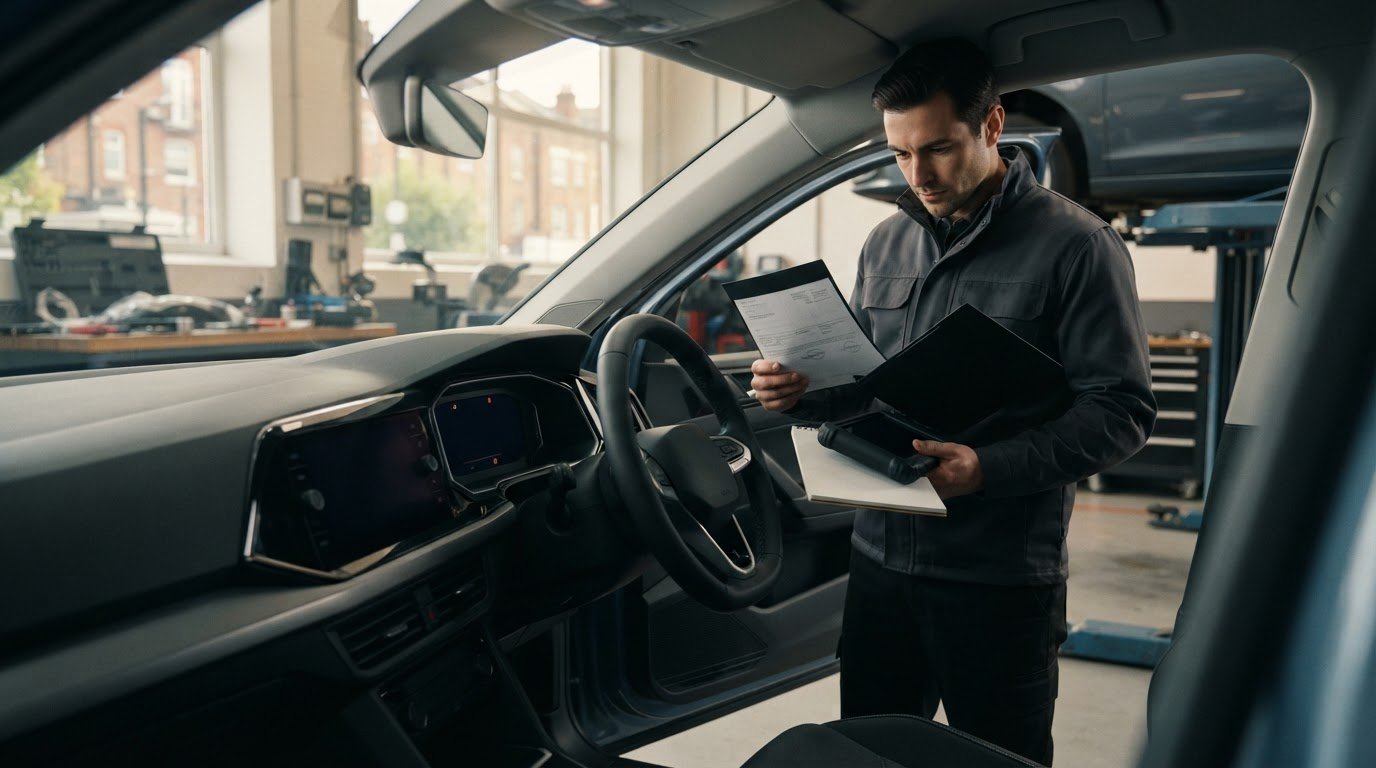
What Happens to Vehicle Mileage When a Dashboard or Instrument Cluster Fails? The answer depends on the vehicle and the fault. A failed display can make the odometer reading unavailable, frozen or unreliable, but it does not by itself establish how far the vehicle has travelled. Mileage information may be retained elsewhere, while a replacement cluster may show a different figure or no usable reading.
It is understandable to worry that mileage information has been lost or that a replacement will display a different figure. If readings no longer match an MOT or service record, the difference may need explaining later. A dated record of what you saw and what work was carried out can help put the figures in context.
This guide explains what a cluster failure can and cannot tell you about mileage, why replacement readings vary, and what information to gather before and after repair. It also covers how to keep the diagnosis, readings and repair documents together so you can describe any discrepancy accurately.
Key Takeaways
- What Happens to Vehicle Mileage When a Dashboard or Instrument Cluster Fails? A blank or frozen display alone does not prove that the vehicle’s mileage information has been erased.
- Mileage handling varies by vehicle. Do not assume where information is stored or how a replacement cluster will behave.
- Before authorising work, record the symptom, the last known reading and the date, and gather the vehicle’s service history.
- Keep diagnosis and repair documents with old and new readings so any later discrepancy can be explained with a clear timeline.
What happens to vehicle mileage when an instrument cluster fails?
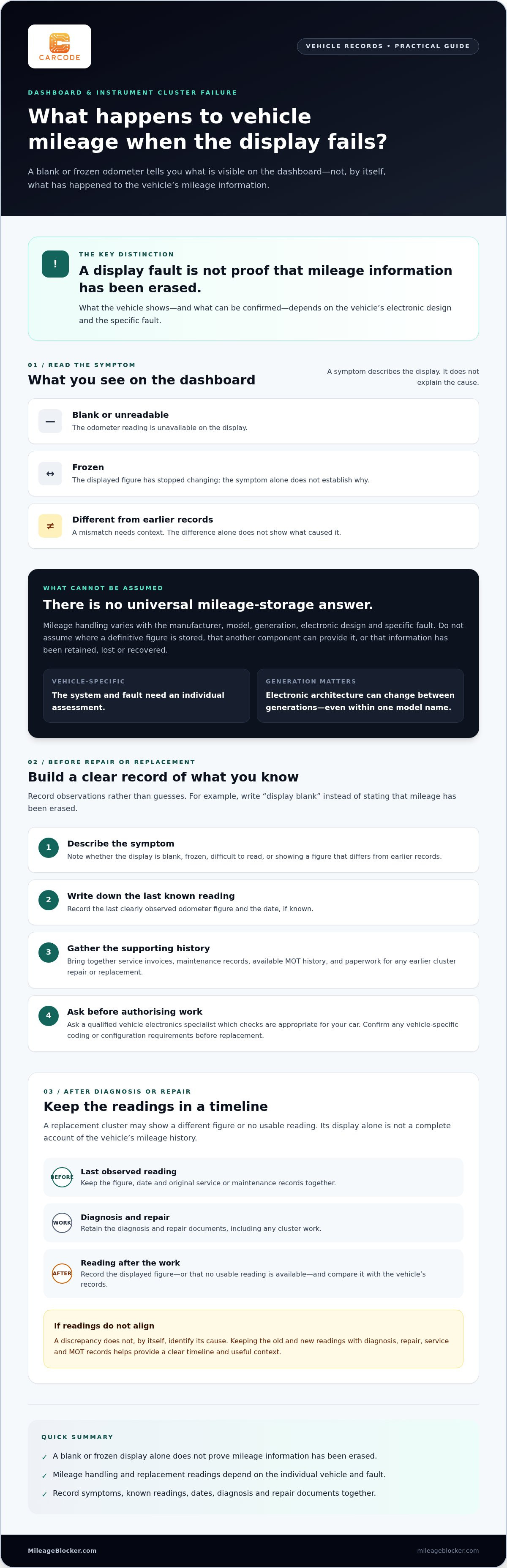
A failed display does not, by itself, prove that the vehicle’s mileage information has been erased. A blank, frozen or unreadable odometer describes what is visible on the dashboard. It does not establish what information may remain elsewhere or whether it can be confirmed. The answer to “What Happens to Vehicle Mileage When a Dashboard or Instrument Cluster Fails?” depends on the vehicle’s electronic design and the specific fault.
An odometer indicates distance travelled. The Odometer entry gives general background on how odometers have developed, but it cannot determine how a particular vehicle handles mileage information. A reading that has stopped changing is also different from one that has changed. The display symptom alone does not explain the cause.
Does a failed dashboard automatically reset the odometer?
No. A display fault and a mileage reset are not necessarily the same event. If a cluster is replaced, the replacement may show a different reading or no usable reading, depending on the vehicle. Do not assume that mileage information has been retained, lost or recovered from another component. A vehicle specific assessment is needed to establish what happened in an individual case.
Why does the displayed reading matter beyond the dashboard?
The odometer reading helps place service records and MOT history in sequence. For example, a reading on a repair invoice can be compared with an earlier service entry and a later MOT record. If the figures do not align, a garage or future buyer may ask why. A difference does not, on its own, show what caused it, but a clear explanation and supporting records can provide useful context.
Where is vehicle mileage stored when the instrument cluster stops working?
There is no universal answer. Mileage handling depends on the vehicle’s manufacturer, model, generation and electronic design. The cluster may be involved in displaying or handling mileage information, but it is not safe to assume that every vehicle stores a definitive figure in the same place, or that another module will provide it if the display fails.
The question “What Happens to Vehicle Mileage When a Dashboard or Instrument Cluster Fails?” can only be answered for an individual vehicle after its system and fault have been assessed. A communication or configuration issue may be one possibility, but a symptom alone cannot confirm the cause. For general background, see Digital Odometers Explained: How Mileage Is Stored.
Why mileage storage differs between vehicles
Electronic architecture can change between model generations, including within the same model name. A general description of how one vehicle handles mileage is not proof that another version uses the same arrangement. Without verified, vehicle specific information, avoid assumptions about whether the cluster, ECU or another component holds or communicates a mileage value.
What a replacement cluster can and cannot tell you
A replacement cluster’s displayed figure is not, by itself, a complete account of the vehicle’s mileage history. Consider it alongside the vehicle’s records and the results of a qualified assessment. Any coding or configuration requirements depend on the vehicle, so confirm the correct process before replacement. ECU Replacement & Mileage Discrepancies Explained covers a related replacement scenario.
If you have a product specific question for MileageBlocker.com, use the contact page. MileageBlocker products are not cluster diagnostic or repair tools.
What should you do if your dashboard fails or shows the wrong mileage?
Make a record before any repair or replacement. A precise account of what you saw is more useful than guessing whether the mileage information has been erased or altered. The answer to “What Happens to Vehicle Mileage When a Dashboard or Instrument Cluster Fails?” is vehicle specific, so ask a qualified vehicle electronics specialist what checks are appropriate for your car before authorising work.
What information should you record before repair?
Describe the symptom as precisely as possible. Note whether the display is blank, frozen, difficult to read or showing a figure that differs from earlier records. Then gather:
- The last clearly observed odometer reading and the date, if known.
- Service invoices, maintenance records and available MOT history.
- Paperwork for any previous cluster repair or replacement.
Describe what happened without presenting an assumption as fact. For example, record “display blank” rather than stating that the mileage has been erased. A general explanation of where mileage may be stored can offer background, but it cannot confirm the arrangement or condition of a particular vehicle.
Repairing or replacing the instrument cluster
Whether the existing unit can be repaired or needs replacement depends on the diagnosis, vehicle design and condition of the unit. Before approving work, ask the specialist what vehicle specific checks are available, how the proposed repair or replacement may affect the displayed reading, and what documentation you will receive. Do not assume a particular test or outcome applies to every model.
If another module is being replaced as part of the work, ECU Replacement & Mileage Discrepancies Explained covers related considerations. Keep the diagnosis, invoice and recorded readings together. Add dates where possible so the sequence is clear.
For a product specific enquiry, contact MileageBlocker.com. Its mileage blocker products are not cluster diagnostic or repair tools.
How can you explain a mileage discrepancy after cluster repair?
A clear, dated record connects the cluster fault, the work carried out and the readings shown before and after repair. It cannot change a vehicle’s history, but it can help explain why records differ rather than leave the discrepancy without context. The practical follow up to “What Happens to Vehicle Mileage When a Dashboard or Instrument Cluster Fails?” is to preserve the evidence and keep the account factual.
What records help establish an accurate timeline?
Keep relevant documents together in date order. Include:
- Invoices, technician findings and any written explanation of the fault or work.
- The last known reading before repair and the reading shown afterwards, with dates and photographs if available.
- Details of any replacement unit, including its description and the date it was fitted.
- Service invoices and MOT records that help show the vehicle’s mileage history over time.
Use plain descriptions such as “odometer display blank” or “cluster replaced, reading recorded after fitting”. Do not state a suspected cause as confirmed unless the technician’s findings support it. A timeline makes the sequence easier to follow, but it does not independently verify the vehicle’s true mileage.
When should you seek further vehicle-specific advice?
If the reading still conflicts with the records after repair, ask the workshop to explain its assessment and identify the evidence supporting that explanation. If a document contains a factual error, contact the organisation that issued it and ask about its correction process. The relevant provider will determine what evidence it needs, and a correction cannot be guaranteed.
Keep any response or amended record with the rest of the file. For product specific questions about vehicle electronics, contact MileageBlocker.com about vehicle-specific electronics. This contact route is for product enquiries, not instrument cluster diagnosis or repair.
Keep the mileage history clear and documented
A failed or unreadable cluster does not, by itself, establish whether a vehicle’s mileage information has been erased. How mileage is handled varies by vehicle, so avoid assumptions about storage, replacement readings or the cause of a discrepancy without a vehicle specific assessment.
Record the last known reading and date, describe the symptom accurately, and keep diagnosis, repair and replacement paperwork with service and MOT records. A dated timeline gives garages and anyone reviewing the vehicle’s history useful context if figures differ. If a record appears factually wrong, contact the organisation that issued it and ask about its correction process.
MileageBlocker.com by Carcode supplies vehicle specific automotive electronics for authorised testing and off-road use. These products are not tools for diagnosing or repairing a failed instrument cluster. For product enquiries or to ask about fitting assistance, contact MileageBlocker.com.
With careful records and vehicle specific advice, you can explain the work clearly and make the vehicle’s mileage history easier to follow.
Frequently Asked Questions
Can a faulty instrument cluster make the odometer show the wrong mileage?
Yes, a cluster fault or communication issue can affect the figure shown, but the behaviour depends on the vehicle. A blank or incorrect display does not establish whether mileage information has been erased or changed. Record what appears, when it began and any previous reading you can confirm. Before assuming the cause, arrange an assessment for the specific make, model and generation.
Does replacing an instrument cluster reset the vehicle’s mileage?
Not necessarily. The result depends on the vehicle’s electronic design, the replacement unit and any configuration work required. A replacement could show a different figure, no usable reading or another inconsistent value. There is no single outcome for every car. Before authorising the work, ask the repairer how the reading will be assessed and what documentation you will receive.
Can a vehicle’s mileage be recovered if the dashboard stops working?
It may be possible to establish relevant mileage information, but this cannot be guaranteed without knowing the vehicle and fault. The answer to “What Happens to Vehicle Mileage When a Dashboard or Instrument Cluster Fails?” depends on the model and generation because data handling differs. A qualified vehicle electronics specialist can explain which checks are appropriate. A failed display alone cannot show what information remains available.
What should I do if my replacement dashboard shows a different mileage?
Keep the paperwork and establish a dated sequence. Record the last reading you observed, then retain the repair invoice, replacement unit details, workshop findings and relevant service and MOT records. Ask the workshop to explain the difference and document its findings. Avoid guessing at the cause or changing records without evidence. This gives anyone reviewing the history a factual account of why readings differ.
Does a mileage discrepancy after cluster failure prove odometer tampering?
No. A discrepancy is a reason to investigate, not proof of deliberate alteration. A fault, cluster replacement or vehicle specific configuration issue may be relevant, but the cause must be established for that particular car. Keep supporting records and request a documented assessment from a qualified specialist. Do not rely on assumptions drawn from a different make, model or generation to explain the reading.
About the author
MileageBlocker TeamThe MileageBlocker Technical Team covers vehicle electronics, CAN and CAN-FD systems, mileage blocker compatibility, installation and product developments.
View author profile →