Can Diagnostics Reveal Real Mileage? Modern Car Data
Can diagnostic tools reveal a vehicle's real mileage? What modern cars actually record requires careful technical context, history checks, and proper scans.
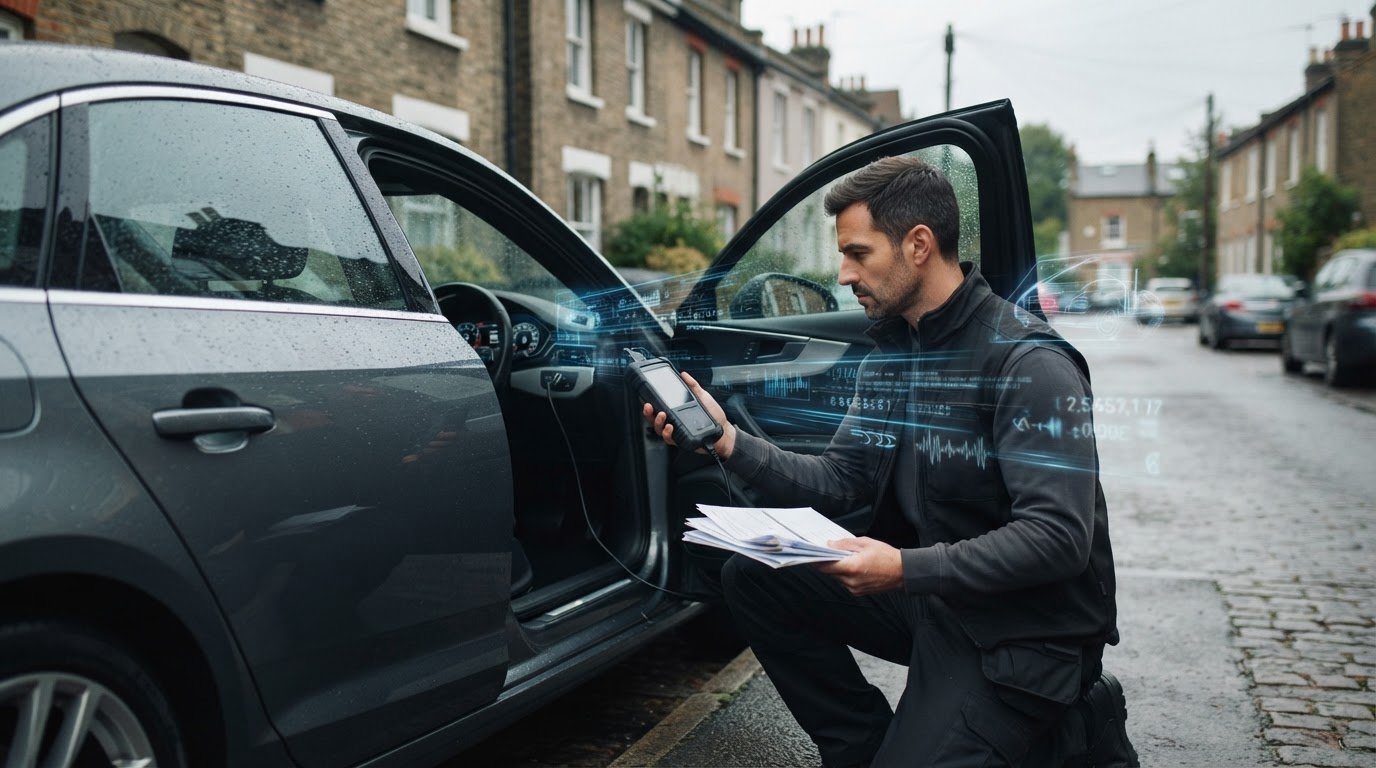
Can Diagnostic Tools Reveal a Vehicle’s Real Mileage? What Modern Cars Actually Record is a question with a qualified answer. A diagnostic scan may uncover useful clues, but it cannot provide a universal mileage verdict. If a scan shows a different mileage-related figure from the dashboard, that is a reason to investigate, not automatic proof that the vehicle has been clocked.
Modern cars can make mileage-related or operating data available through electronic systems beyond the instrument panel. What a scan tool can access, and what a particular figure means, varies by make, model, generation and tool. A difference may have an explanation that requires vehicle-specific context.
This article explains what scans may reveal, why results differ between vehicles and how to assess findings alongside service records and vehicle-history documents. It also explains why technical data needs careful interpretation before anyone draws a conclusion.
Key Takeaways
- Can Diagnostic Tools Reveal a Vehicle’s Real Mileage? What Modern Cars Actually Record: scan results can provide clues, but they are not a definitive mileage verdict.
- Record which vehicle system and diagnostic tool produced a reading, then interpret it for that specific make, model and generation.
- Compare scan findings with service records and vehicle-history documents. Gaps or differences need context and are not proof on their own.
- Diagnostic tools read accessible vehicle data. Mileage-blocking hardware is for controlled testing only and must not be used to alter the recorded mileage of a vehicle being offered for sale.
Can diagnostic tools reveal a vehicle’s real mileage?
A diagnostic scan may reveal mileage-related clues, but it cannot guarantee a definitive reading of a vehicle’s total distance travelled. A scan reports information that a compatible tool can access from a particular vehicle system. That information is not automatically the same as the figure shown on the dashboard odometer.
The odometer is the driver-facing distance display. A scan may retrieve other vehicle information, depending on the system and tool, but each reading needs to be understood in context. A difference between figures is a reason to investigate, not proof by itself that the displayed mileage is false. Odometer fraud involves misrepresenting a vehicle’s mileage, but a scan finding alone does not establish that this has happened.
What can a diagnostic scan tell you?
Available information depends on the vehicle’s design, the system being accessed and the diagnostic tool’s capabilities. A compatible scan may return mileage-related information, or it may not provide a useful distance figure at all. Treat a result as evidence to assess rather than assuming it represents the vehicle’s complete lifetime mileage. The tool shows what it can access, not necessarily every relevant record.
Why is one scan not a definitive answer?
Vehicle designs and diagnostic access differ by make, model and generation. A tool that retrieves useful information from one vehicle may not access equivalent data from another. Findings should not be generalised across a manufacturer’s range. Even when figures appear inconsistent, they need to be considered alongside the vehicle’s circumstances and other available evidence.
In practice, a scan is one part of an assessment. Record which tool and vehicle system produced the information, then compare the result with relevant documentation. If the data is unclear, vehicle-specific expertise may be needed before reaching a conclusion.
Why diagnostic mileage data varies between modern vehicles
Modern vehicles use interconnected electronic systems to manage and exchange information. That does not mean every system holds the same data or that a scan tool can access it all. The information available, and what it represents, can differ by make, model, generation and diagnostic tool. The question “Can Diagnostic Tools Reveal a Vehicle’s Real Mileage? What Modern Cars Actually Record” therefore needs to be answered for the specific vehicle, not by applying a universal rule.
Digital odometer design is part of the wider picture, but it does not guarantee that a scan will uncover a complete distance history. The useful distinction is between how a vehicle records information and what a particular scan tool can retrieve.
Why the same scan may not work the same way on every car
A diagnostic tool may communicate with a vehicle without providing the same coverage across every system or model. General access is not the same as vehicle-specific coverage: the tool’s functions and the vehicle’s electronic design affect what information can be retrieved and how it is presented. A reading available on one generation may not be available, or may not have the same meaning, on another.
What module differences mean for interpreting results
If accessible readings differ, treat the discrepancy as a prompt to investigate rather than a standalone conclusion. It may relate to what each system records, the scan tool’s coverage or the vehicle’s maintenance history. A replaced instrument or control component is one possible circumstance, but the effect on readings depends on the vehicle and cannot be diagnosed from the difference alone.
Whatever the source of a reading, consider its meaning in relation to the particular vehicle and the evidence available. Do not assume that a figure explains itself simply because it appears in a scan report.
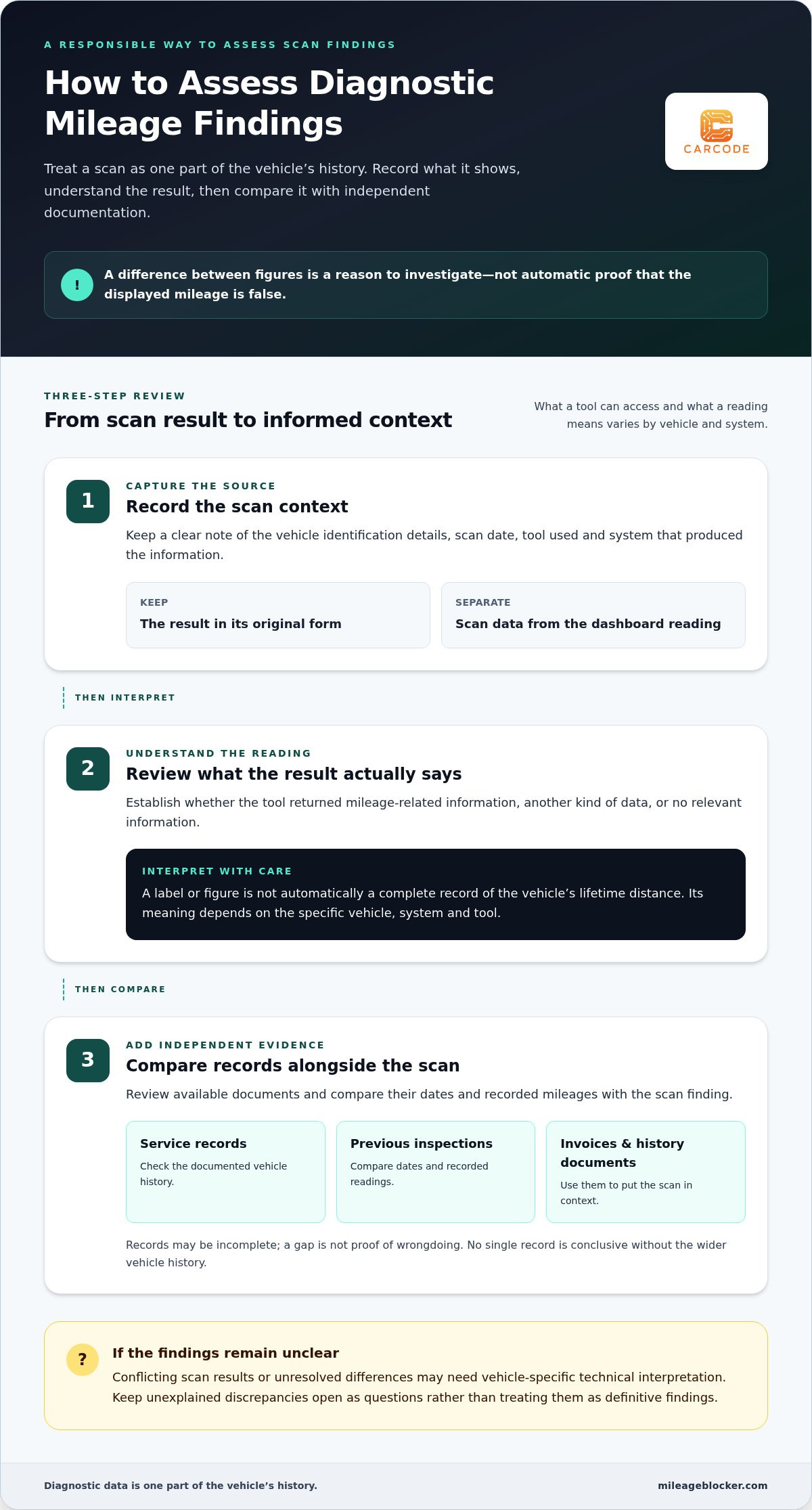
How to assess diagnostic mileage findings responsibly
Interpret a scan as one part of the vehicle’s history, not a verdict. Keep a clear record of what was scanned, then compare the result with independent documentation. An inconsistency calls for careful investigation; it does not, by itself, establish why the figures differ.
- Record the scan context. Note the vehicle identification details, scan date, tool used and system from which the information came. Keep the displayed result in its original form so it is not confused with the dashboard odometer reading or a later interpretation.
- Review what the result actually says. Establish whether the tool returned a mileage-related value, another kind of data or no relevant information. Do not treat a label or figure as a complete distance history without understanding what it means for that vehicle.
- Compare independent evidence. Review available service records, previous inspections, invoices and vehicle-history documentation. Dates and recorded mileages can help put a scan result in context.
What evidence should be considered alongside a scan?
Service documentation and earlier vehicle records can help show how recorded mileage has changed over time. Records may be incomplete, however, and a gap is not proof of wrongdoing. Compare dates and figures across the documents and scan, while remembering that no single record is conclusive without the wider vehicle history.
When does a discrepancy need specialist interpretation?
Seek vehicle-specific technical interpretation if scan findings conflict with each other or remain unclear after you have reviewed the paperwork. The meaning of a reading depends on the vehicle and the system that produced it. If you are assessing a used car, keep unresolved differences open as questions rather than treating them as definitive findings.
For a vehicle-specific mileage-blocking product intended for controlled testing, see the contact options for your application. These products are for legitimate testing, tuning and diagnostics in controlled environments, not to misrepresent a vehicle’s mileage when selling or advertising it.
Responsible diagnostic use and the limits of mileage-blocking hardware
Diagnostic scan tools and mileage-blocking hardware serve different purposes. A scan tool retrieves information it can access from a vehicle system; its findings require interpretation and do not automatically establish the vehicle’s true mileage. Mileage-blocking hardware is not a diagnostic scanner or a mileage-verification tool. This distinction matters when considering what modern cars record and what a diagnostic scan can reveal.
What is Carcode mileage-blocking hardware designed for?
Carcode mileage blockers are designed for off-road, testing, tuning and R&D use. They are sold strictly for legitimate automotive testing, tuning and diagnostic purposes, and are intended for use on private property, rolling roads and controlled test environments only. They should not be used to alter the recorded mileage of any vehicle being offered for sale.
It is illegal to use a mileage blocker to misrepresent a vehicle’s true mileage when selling or advertising a vehicle. By purchasing, customers confirm they will use the product lawfully and responsibly. Carcode Ltd accepts no liability for misuse.
Where to take the next step
For legitimate controlled testing, choose vehicle-specific hardware for the intended application and keep its use within the stated limits. It should not be used to alter the recorded mileage of any vehicle being offered for sale. This is separate from the question of what a diagnostic scan may reveal: a mileage blocker does not verify a vehicle’s true mileage, and its use cannot establish the vehicle’s mileage history.
For a technical enquiry about a vehicle-specific application, contact Carcode about your requirements.
Make the next decision with clear evidence
The practical value of asking “Can Diagnostic Tools Reveal a Vehicle’s Real Mileage? What Modern Cars Actually Record” is knowing how to handle the information. Treat scan output as one technical input, preserve its context and avoid turning an unexplained difference into a definite claim. If the evidence remains unclear, vehicle-specific interpretation is more reliable than assumption.
Diagnostic equipment and mileage-blocking hardware have separate roles. Carcode’s Mileage Blocker is designed, manufactured and supported by Carcode Ltd - no middlemen, no white-labelling, no compromises. It is designed for off-road, testing, tuning and R&D use in controlled, legitimate testing environments. It does not verify a vehicle’s true mileage.
For a technical enquiry about a legitimate controlled testing or diagnostic application, contact MileageBlocker.com. A careful, vehicle-specific approach keeps the evidence and its interpretation in the right context.
Frequently Asked Questions
Can diagnostic tools show a car’s real mileage?
A scan may show mileage-related information, but it cannot guarantee the vehicle’s total distance travelled. There is no universal answer because the result depends on the vehicle and equipment. Note the scan’s source and date, then compare its result with the available records rather than treating it as an exact lifetime figure.
Can a diagnostic scan find mileage discrepancies between vehicle systems?
Sometimes, if the vehicle makes relevant information accessible and the scan tool can retrieve it. This does not mean every car holds comparable mileage data in multiple systems or that every scanner can access it. If readings differ, preserve the results and note which system and tool produced each one. A mismatch merits contextual review, but does not identify a cause or establish the car’s complete mileage history.
Why might a diagnostic tool show a different mileage reading from the dashboard?
The vehicle’s electronic design, the information accessible to the tool, its coverage and the vehicle’s past repairs may all affect the result. These are possibilities, not a diagnosis of a particular car. If a scan figure conflicts with the dashboard, compare dates and mileage entries on service invoices or inspection documents. If the difference remains unexplained, seek qualified, vehicle-specific interpretation before making a judgement.
Does a diagnostic tool prove a used car’s mileage is genuine?
No. A scan can contribute technical evidence, but it cannot alone prove that a used car’s displayed mileage is genuine. Assess it alongside available service documentation and vehicle history, checking whether recorded figures form a coherent timeline. Records can be incomplete, so an unexplained gap or inconsistency calls for further investigation. Neither a matching scan result nor a discrepancy is conclusive on its own.
About the author
MileageBlocker TeamThe MileageBlocker Technical Team covers vehicle electronics, CAN and CAN-FD systems, mileage blocker compatibility, installation and product developments.
View author profile →