Can-Bus Odometer Stopper: Everything You Need to Know
Learn how an odometer stopper device works on modern CAN-bus systems. Discover compatibility factors, cluster types, and lawful testing applications today.

An odometer stopper device is vehicle-specific, not a universal fit. It is designed to pause mileage recording during controlled testing, rather than rewrite mileage already recorded. Before choosing one, match the product to the vehicle and its intended test application.
This article explains the device’s role and what to consider when assessing a product, including the vehicle’s make, exact model year and instrument-cluster type. These details matter because compatibility can differ between generations, even within the same model range.
Carcode mileage blockers are sold strictly for legitimate automotive testing, tuning and diagnostic purposes. They are designed for off-road, testing, tuning and R&D use, and are intended for use on private property, rolling roads and controlled test environments only. It should not be used to alter the recorded mileage of any vehicle being offered for sale. It is illegal to use a mileage blocker to misrepresent a vehicle’s true mileage when selling or advertising a vehicle. Carcode Ltd accepts no liability for misuse. By purchasing, customers confirm they will use the product lawfully and responsibly.
Key Takeaways
- An odometer stopper device is intended to pause mileage recording during defined testing and diagnostic work, not to change mileage already recorded.
- Before choosing a unit, identify your vehicle’s make, model, exact year and instrument-cluster type. Support for 45+ car makes does not mean one unit fits every generation.
- CAN bus is part of the vehicle’s electronic communication system, but product fitment and behaviour are specific to the vehicle application.
- MileageBlocker.com by Carcode offers 375+ products. Units are UK-built and bench-tested, with OEM-spec connectors. The site has 90+ reviews and a 4.9★ average rating.
What Is an Odometer Stopper and What Is It Designed For?
An odometer stopper device is a piece of technical testing hardware designed to pause odometer recording in defined testing contexts. It is not a mileage rollback tool. Mileage blockers are designed for off-road testing, tuning and R&D, with their use limited to controlled environments. A vehicle’s CAN bus is its in-vehicle communication network; this overview of CAN bus technology provides further background.
Carcode’s mileage blockers are intended for use on private property, rolling roads and controlled test environments only. They should not be used to alter the recorded mileage of a vehicle being offered for sale. The legal and responsible-use conditions are set out earlier in this article.
Who uses an odometer stopper device in controlled testing?
Dyno operators may use a unit during rolling-road testing. Tuners and remappers may use one for defined tuning work, while workshops may use the technology during diagnostics. Vehicle-development professionals may use it in R&D settings. In each case, the relevant question is how the tool fits the planned technical work, not whether it is a general-purpose vehicle accessory.
What does the term odometer stopper mean?
“Mileage stopper” and “odometer freezer” are alternative names for this category. These labels can be used loosely, so the product description and intended application are more useful than the name alone. Look for a product described as pausing mileage recording for testing, and assess its fitment against the specific vehicle.
Fitment is application-specific. The Ford Super Duty mileage blocker listing describes one defined application; its details should not be assumed to apply to other models.
How Does a CAN-Bus Odometer Stopper Fit into Vehicle Testing?
A vehicle’s CAN bus is a communication network that allows electronic systems to exchange information. In a testing context, a CAN-bus odometer stopper device is designed to pause odometer recording during testing, diagnostics, tuning and dyno runs. That describes the product’s stated purpose, not a universal account of how every vehicle’s electronics behave.
The product is designed to pause odometer recording during defined testing; compatibility and behaviour depend on the specific vehicle application. Vehicle makes, model years and instrument-cluster types can have different electronic configurations. A product matched to one application should not be assumed to suit another vehicle simply because it shares a model name.
Why vehicle electronics make compatibility application-specific
Model year helps identify the vehicle’s generation and relevant electronics, while the instrument-cluster type is another key matching detail. A facelift or production change can mean that an application differs even when the model badge stays the same. Start with the exact vehicle details rather than relying on broad claims about a manufacturer or model family.
For consumer context, the NHTSA guidance on odometer fraud explains why accurate mileage information matters. It does not establish how a particular product behaves on a particular vehicle, which must be assessed for its own application.
What controlled testing contexts does the product address?
The stated settings include rolling roads, private property and other controlled test environments. These contexts define the product’s role in testing and diagnostics; they do not make it suitable for general road use. Before planning a test, identify the vehicle’s exact year and cluster type, then refer to the information for the matching application.
Product-specific guidance for a testing application is available through the contact page.
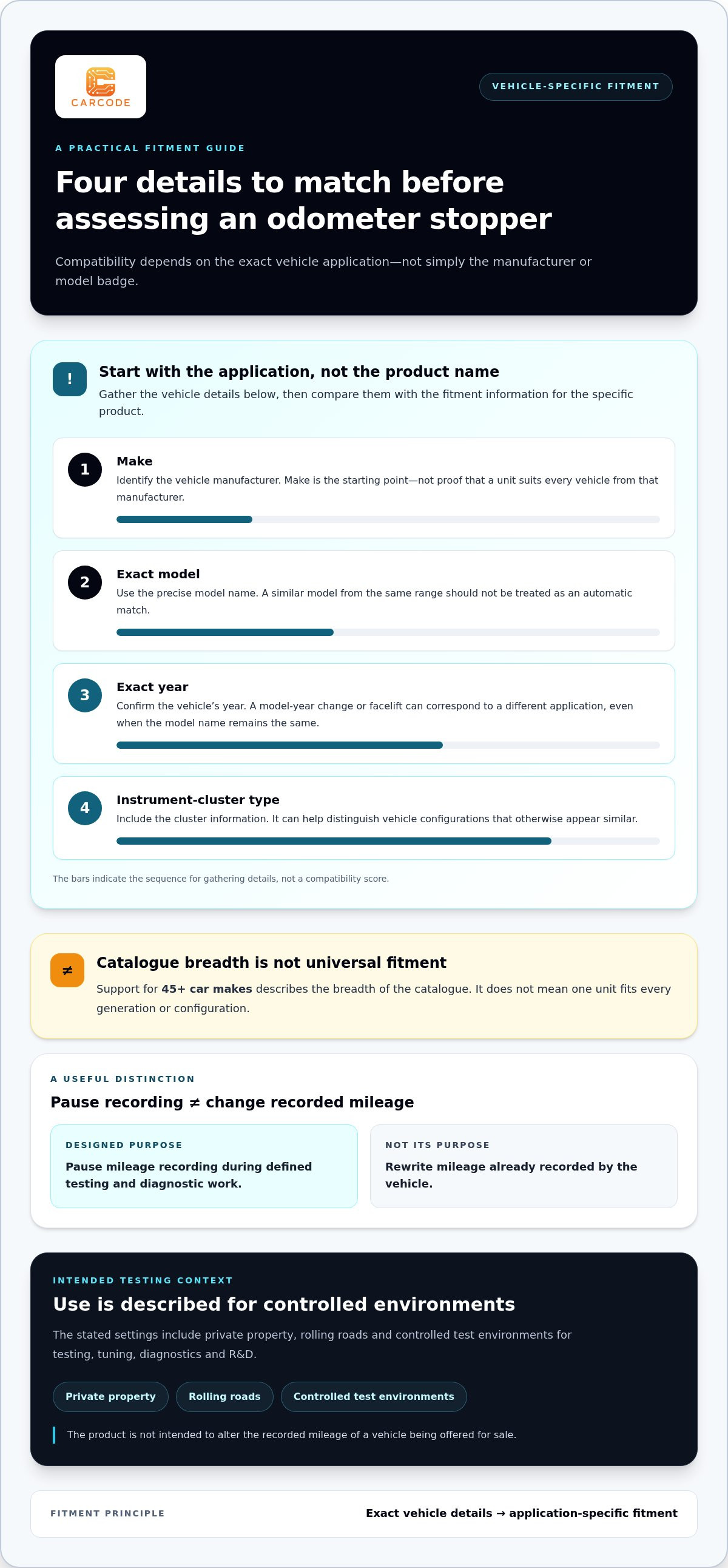
How to Assess an Odometer Stopper Device for Your Vehicle
Compatibility is determined by the vehicle application, not by a broad claim that a product works across a manufacturer’s range. Gather the details below, then compare them with the product’s stated fitment.
- Identify the make. Start with the vehicle manufacturer.
- Record the model. Use the exact model name, not a similar model from the same range.
- Confirm the exact year. A model-year change or facelift can correspond to a different vehicle application.
- Identify the instrument-cluster type. Cluster details help distinguish configurations that may otherwise appear similar.
Which vehicle details should you gather first?
Have the make, model, exact year and instrument-cluster information together before reviewing product fitment. These details are more useful than relying on a badge alone: two vehicles with the same model name may differ by year or cluster configuration. If you are unsure how to identify the cluster, use the vehicle’s documentation or the product-specific guidance rather than guessing.
How should you interpret compatibility claims?
Support for 45+ car makes describes the breadth of the catalogue, not a single unit that fits every generation. A suitable product is matched to its stated vehicle application. Do not infer compatibility from a shared manufacturer, model name or resemblance to another vehicle. Specifications for one generation should not be transferred to another without confirmation in the relevant application information.
Once you have identified the application, review its fitment information before planning installation. The MileageBlocker installation information explains the fitting process, but the instructions for the specific product application should guide the work.
For help identifying the relevant application, the contact page can be used with your make, model, year and cluster details.
What to Expect from MileageBlocker.com by Carcode
MileageBlocker.com by Carcode builds and bench-tests its units in the UK, using automotive-grade components and OEM-spec connectors. The units are firmware-matched to the vehicle’s exact year and instrument-cluster type, so selection starts with the vehicle application rather than a general claim of fitment.
The units are designed, manufactured and supported by Carcode Ltd, with no middlemen, no white-labelling, no compromises. The units are plug-and-play and designed to make no permanent changes to the vehicle. Carcode also provides a 1-year warranty and lifetime technical support.
What product-specific information is available?
Use the information for the relevant vehicle application when assessing suitability; details for one generation should not be assumed to apply to another. The MileageBlocker product FAQs cover questions that go beyond this overview.
What is the next step for a suitable application?
These products are designed for off-road testing, tuning and R&D, with use limited to private property, rolling roads and controlled test environments. Keep the intended test and the vehicle details together when reviewing the matching product information.
Vehicle-specific guidance is available through MileageBlocker.com’s contact page.
Plan Your Next Test with the Right Application in Mind
Before selecting an odometer stopper device, write down the intended test, the vehicle involved and the conditions in which it will take place. This creates a practical basis for reviewing the relevant product information and avoids relying on assumptions drawn from another vehicle or setup.
Keep the selection tied to the actual test requirement. If a technical detail is uncertain, resolve it before planning the fitment rather than treating a general product description as a guarantee for your vehicle. A precise enquiry can help focus attention on the information that matters for your application.
Contact MileageBlocker.com with your vehicle details and planned test requirements for application-specific guidance.
Frequently Asked Questions
How much does an odometer stopper device cost?
Pricing is not disclosed on the website. Product selection depends on the vehicle application, including its exact year and instrument-cluster type; different versions of the same model may require different hardware. The enquiry page is the place to request current product information.
How long does it take to install a MileageBlocker device?
The published installation estimate is approximately 15-30 minutes. The device is described as plug-and-play and designed not to require permanent changes to the vehicle, but fitment steps can vary by product application. Match the instructions to the vehicle’s exact model year and unit, and follow the product-specific fitting information rather than using a guide for a similar model.
Does MileageBlocker.com ship internationally?
Yes. MileageBlocker.com ships worldwide from the UK. Mobile fitting is available across the UK, USA and Canada. For order details, use the relevant product and checkout information.
What warranty comes with a MileageBlocker device?
A MileageBlocker device comes with a 1-year warranty and a 30-Day Money-Back Guarantee. For information about a particular vehicle-specific unit, refer to its product details or the contact page.
About the author
MileageBlocker TeamThe MileageBlocker Technical Team covers vehicle electronics, CAN and CAN-FD systems, mileage blocker compatibility, installation and product developments.
View author profile →