BMW Mileage Stopper: Best Practices and Expert Advice
Understand how a BMW mileage stopper works for testing and diagnostics. Learn why exact vehicle details matter and how to choose the right Carcode solution.

A BMW badge is not a compatibility specification. A bmw mileage stopper must be matched to the particular vehicle application: the model name alone does not establish that a device is suitable. Check the exact vehicle details against product-specific information rather than assuming that a fitment for one BMW also applies to another.
This guide explains what a mileage stopper is intended for, why vehicle details matter and how to assess an application responsibly. It focuses on legitimate automotive testing, tuning and diagnostics in controlled environments. It does not provide a fitment claim for a particular BMW, because that requires vehicle-specific product information.
Carcode mileage blockers are hand-built CAN-bus testing hardware, designed, assembled and tested in the UK. They are intended for use on private property, rolling roads and controlled test environments only. The first practical step is to define the testing task and identify the BMW accurately. Then compare those details with the information for the specific product application.
Key Takeaways
- A BMW mileage stopper is technical testing hardware for legitimate testing, tuning and diagnostics in controlled environments.
- Compatibility depends on the exact vehicle and product application, not just the BMW badge or model family.
- Separate general information about automotive electronics from product-specific evidence of fitment and operation.
- Carcode designs, manufactures and supports its units in the UK, with no middlemen, no white-labelling, no compromises, a full warranty and lifetime technical support.
What Does a BMW Mileage Stopper Do in Controlled Testing?
A mileage stopper is a type of vehicle-specific technical hardware for controlled automotive testing. Its intended role is connected to a defined testing, tuning or diagnostic task, not ordinary vehicle use. The type of work and the setting matter just as much as the device category.
What is the intended purpose of a mileage stopper?
In a controlled test, mileage recording may be relevant to the work being carried out. A mileage stopper is designed for that technical context. It does not replace a suitable test plan, establish compatibility with a particular BMW or guarantee a particular test result.
General descriptions can help explain the category, but they cannot confirm that a product matches a specific vehicle. For example, a vehicle-specific Ford Super Duty mileage blocker page describes a different application and is not evidence of BMW fitment. For broader background reading, see this overview.
Where is a BMW mileage stopper intended to be used?
Carcode mileage blockers are sold strictly for legitimate automotive testing, tuning and diagnostic purposes. They are intended for use on private property, rolling roads and controlled test environments only. A dyno session, for example, is a controlled testing activity, unlike ordinary use of a vehicle.
It is illegal to use a mileage blocker to misrepresent a vehicle’s true mileage when selling or advertising a vehicle. Carcode Ltd accepts no liability for misuse. By purchasing, customers confirm they will use the product lawfully and responsibly.
When describing a proposed application, state the task and setting clearly. This keeps the discussion focused on the intended technical work and avoids treating a general product description as proof that a specific BMW application is supported.
Why BMW Mileage Stopper Compatibility Depends on the Exact Vehicle
A BMW model badge identifies a vehicle family, not a complete electronic specification. Different models, generations and configurations may require different product applications. A compatibility statement for one BMW should not be carried over to another simply because the names are similar.
Why the BMW model badge is not enough
Product compatibility is specific to the vehicle and application. A shared model name does not prove that two vehicles have the same electronics, hardware requirements or product behaviour. Start with the details that identify the vehicle, then compare them with the information stated for the product.
Useful details may include the model, generation and model year, where those are available from reliable vehicle documentation. Keep these details together when assessing an application. Avoid relying on a badge alone, and do not transfer specifications from another BMW generation or configuration.
Which details can an article safely state?
State compatibility only when vehicle-specific product information supports it. General information about CAN bus or ECU systems can provide context, but it does not prove that a product fits a particular vehicle or behaves in a particular way. The same applies to claims about operating modes, installation locations and dashboard behaviour. If the application information does not establish a detail, leave it out rather than filling the gap with an assumption.
Carcode products cover 45+ vehicle makes. That breadth does not confirm support for every BMW or for every version of a particular model. Manufacturer coverage is a useful measure of catalogue scope, not a substitute for checking the individual application.
When assessing a bmw mileage stopper, look for product information that corresponds to the BMW being considered. A model badge, broad catalogue statement or general technical explanation is not enough to establish fitment. Keeping those distinctions clear helps readers separate verified application details from background information.
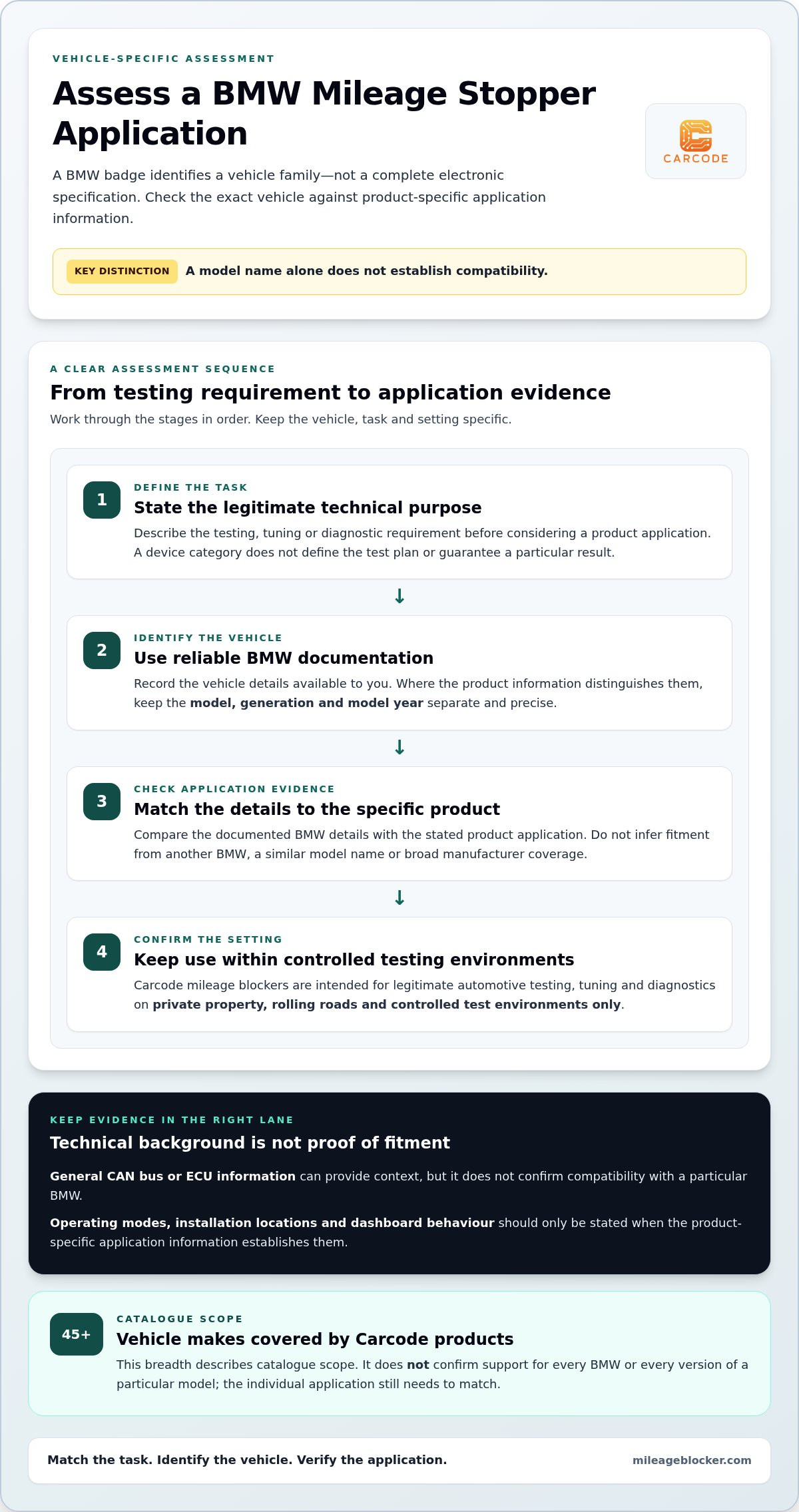
How to Assess a BMW Mileage Stopper Application Responsibly
Assess an application in a consistent order. Define the legitimate testing, tuning or diagnostic purpose first. Identify the BMW using reliable vehicle information, then compare it with the details for the relevant product application. This makes the assessment specific to the vehicle and task instead of relying on a generic description.
Start with the exact BMW application
Use details that you can establish from reliable documentation. If the product information distinguishes between model, generation or model year, preserve those distinctions. Do not infer compatibility from a different BMW or from a manufacturer-wide coverage figure. The relevant question is whether the product application matches the vehicle under consideration.
- Purpose: Describe the testing, tuning or diagnostic requirement.
- Vehicle identity: Record the BMW details available from reliable documentation.
- Application evidence: Compare those details with the stated product application.
- Setting: Keep the proposed use within the stated controlled testing environments.
Keep technical evaluation non-operational
Product assessment should establish whether the documented application matches the vehicle and the intended task. General explanations of CAN bus or ECU systems can help readers understand automotive electronics, but they cannot confirm compatibility. Keep technical background separate from the evidence needed for a vehicle-specific match.
Carcode mileage blockers use a non-destructive, plug-and-play design, with no cutting, soldering or permanent changes to vehicle wiring. However, installation details can vary by product application. Do not assume that a general description establishes the procedure for a particular BMW.
A responsible assessment does not need unverified activation sequences, wiring instructions or claims about diagnostic behaviour. It needs an accurately identified vehicle, a legitimate purpose and product information that supports the application. If a source does not establish an operating mode, installation detail or vehicle behaviour, do not present it as fact.
For a specific testing requirement, contact MileageBlocker.com with the vehicle details and test context.
What to Expect from MileageBlocker.com by Carcode
Product manufacture and support information explains who makes the hardware and what support is provided. It does not, on its own, confirm a match for a particular BMW. Keep provenance and compatibility as separate questions: one concerns the product, while the other depends on evidence for the exact vehicle application.
What Carcode’s supplied product information supports
Carcode mileage blockers are designed, assembled and tested in the UK. They are designed, manufactured and supported by Carcode Ltd: no middlemen, no white-labelling, no compromises. After-sales support includes a full warranty and lifetime technical support.
Carcode also offers a mileage blocker fitting service for the devices it sells. This can provide fitting assistance as part of a legitimate testing, tuning or diagnostic requirement. General service information is not a vehicle-specific installation procedure, so it should not be used to infer fitment or technical details for a BMW.
For a useful technical discussion, bring together the vehicle identity, intended test task and the application information you have. If a BMW-specific point has not been established, treat it as unresolved rather than presenting an assumption as a product fact.
For a legitimate BMW testing requirement, email MileageBlocker.com with the vehicle details and intended test context, or call 03300 436 312. A clear application brief is the most useful starting point for discussing the requirement responsibly.
Turn Your Testing Requirement into a Clear Brief
Prepare a concise brief before discussing a BMW mileage stopper application. Include the vehicle details you can verify, the work being carried out and the controlled setting. This gives the discussion a defined technical purpose instead of relying on a broad product description or an assumption based on the badge.
Keep the brief focused on legitimate automotive testing, tuning or diagnostics. If a vehicle detail or compatibility point is uncertain, identify it as an open question rather than treating it as settled. Separating confirmed details from unknowns makes the conversation more practical and helps avoid unsupported conclusions about fitment or operation.
Discuss your BMW testing requirements with MileageBlocker.com and share a clear application brief. Carcode mileage blockers are intended for use on private property, rolling roads and controlled test environments only.
Frequently Asked Questions
Will a BMW mileage stopper work with every BMW?
No. A listing for a BMW mileage stopper should not be assumed to fit every BMW. A description naming one model family does not verify another generation or configuration. Compare the exact vehicle details with the product application. Company-wide coverage figures describe the range of makes covered, not support for every individual vehicle.
Can a BMW mileage stopper be used on public roads?
No. Carcode mileage blockers are sold strictly for legitimate automotive testing, tuning and diagnostic purposes. It is illegal to use a mileage blocker to misrepresent a vehicle’s true mileage when selling or advertising a vehicle. Carcode Ltd accepts no liability for misuse. By purchasing, customers confirm they will use the product lawfully and responsibly.
Does a BMW model year affect mileage-stopper compatibility?
It can be relevant. Vehicles with the same model name may belong to different generations or configurations, so a match for one version should not automatically be applied to another. Compare the vehicle details with the stated product application, and leave out unverified claims about model-year compatibility, hardware, operating modes, installation or dashboard behaviour.
What information should I provide when discussing a BMW testing application?
Provide the BMW model and any other vehicle details you can establish from reliable documentation. Explain the planned testing, tuning or diagnostic work and the setting, such as private property or a rolling road. This gives the discussion a clear scope without treating a general product description as fitment confirmation. Use the device only for its stated legitimate purpose.
About the author
MileageBlocker TeamThe MileageBlocker Technical Team covers vehicle electronics, CAN and CAN-FD systems, mileage blocker compatibility, installation and product developments.
View author profile →