Mileage Correction vs. Blockers: A Beginner's Guide
A beginner's guide to mileage correction vs. mileage blockers — learn the key differences, legal uses, and how to protect your vehicle's ECU integrity.

Most people assume that any tool interacting with a car's odometer is designed to deceive, yet the reality is often about technical preservation rather than digital erasure. It's a distinction that matters. This is A Beginner's Guide to Mileage Correction vs. Mileage Blockers, a necessary roadmap for anyone who feels overwhelmed by conflicting technical jargon or the fear of damaging a modern digital dashboard. We’ve seen many owners hesitate because they don't want to compromise their vehicle's complex electronic architecture or trigger permanent error codes in the ECU.
If you are looking for an Audi A4 mileage blocker to use during authorised off-road testing, understanding how the underlying hardware communicates with internal memory modules is your first step toward professional confidence. We will help you distinguish between the invasive digital mechanics of altering an odometer and the sophisticated application of mileage blockers to protect your vehicle's electronic integrity. It's about choosing high-grade components over cheap, risky shortcuts.
Key Takeaways
- Understand why mileage correction acts as a digital eraser for the past, while a mileage blocker functions as a pause button for current testing.
- Follow A Beginner's Guide to Mileage Correction vs. Mileage Blockers to learn which technology maintains the electronic integrity of your vehicle's dashboard.
- Discover how premium hardware prevents the digital footprints and ECU errors typically associated with invasive odometer alteration software.
- Identify the authorised use cases for mileage stoppers under 2026 UK legislation to ensure your vehicle testing remains fully compliant.
Defining the Tools: Is it an Eraser or a Pause Button?
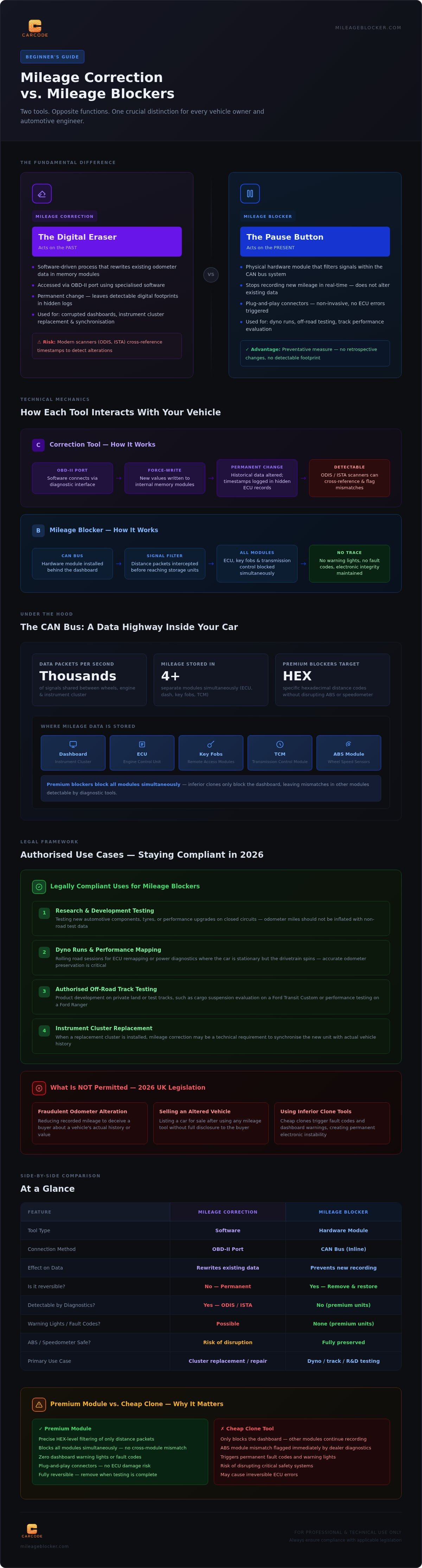
A common misconception suggests these tools are interchangeable. They are not. They perform opposite functions in vehicle maintenance. While correction tools act as a digital eraser for the past, a mileage blocker is a pause button for the present. Understanding this fundamental difference is vital for your car’s electronic health and long-term resale value. This section of A Beginner's Guide to Mileage Correction vs. Mileage Blockers clarifies how each technology operates within your car’s network.
When Correction is a Technical Necessity
Mileage correction is a software-driven process used to rewrite existing odometer data stored in the car's memory modules. This is often a technical requirement when a digital dashboard becomes corrupted or when you install a replacement instrument cluster that needs synchronising with the actual vehicle history. It's a permanent change to the software. If you're managing complex data, you might also need to understand Engine Hours to Miles: The Ultimate Conversion Guide for Vehicle Health to ensure all metrics align correctly.
The Role of the Modern Mileage Blocker
A mileage blocker is a physical hardware module that filters signals within the CAN bus system. Instead of rewriting history, it stops the vehicle from recording new mileage in real-time during specific testing scenarios. This is the preferred tool for dyno runs, off-road track testing, or product development where you don't want to inflate the odometer with non-road miles. For example, a Ford Ranger mileage can blocker allows engineers to test performance upgrades without altering the original factory data. It’s a preventative measure rather than a retrospective fix. High-quality modules use plug-and-play connectors, ensuring the car's electronic integrity remains untouched. In our business, we've seen that A Beginner's Guide to Mileage Correction vs. Mileage Blockers must emphasize that blockers are non-invasive.
Technical Mechanics: How Blockers and Correction Tools Interact with Your ECU
Correction tools typically access the vehicle via the OBD-II port. This interface allows specialised software to force-write new values directly into the internal memory modules. However, this invasive approach often leaves a permanent digital footprint. Modern diagnostic scanners, such as ODIS or ISTA used by main dealers, can detect these software-based alterations by cross-referencing timestamps and hidden logs. If the mileage in the ABS module doesn't match the dashboard, the system flags a critical discrepancy.
High-grade mileage blockers operate through a different mechanical principle. They are physical hardware modules installed behind the dashboard. By intercepting distance signals before they reach the storage units, they act as a silent gatekeeper. This distinction is central to A Beginner's Guide to Mileage Correction vs. Mileage Blockers, as inferior clones often trigger dashboard warning lights or permanent fault codes. Premium modules ensure the vehicle remains electronically stable during testing.
The CAN Bus Communication Highway
Modern cars communicate via a CAN bus system, which is a high-speed highway of data packets shared between the wheels, engine, and instrument cluster. The bus operates on a priority system where thousands of signals move every second. A precise tool, such as a McLaren 720s mileage blocker, knows exactly which hexadecimal codes represent distance. It filters these specific packets without disrupting critical safety functions like ABS or the speedometer. This level of precision is a core focus in A Beginner's Guide to Mileage Correction vs. Mileage Blockers.
Memory Storage Across Multiple Modules
Sophisticated vehicle networks don't just store mileage in the speedometer. Data is duplicated in the ECU, key fobs, and even the transmission control module to ensure redundancy. A mileage stopper is a more comprehensive solution for testing because it prevents the recording of mileage across all these synchronised modules simultaneously. If you have specific technical questions about your vehicle's architecture, you can speak with our technical support team for guidance.
Authorised Use Cases: Staying on the Right Side of the Law in 2026
The legal framework around odometer management is becoming more stringent. This is especially true with the 2026 UK legislation updates regarding odometer transparency. These changes reinforce consumer protection. They also clarify the distinction between fraudulent activity and technical testing. In our business, we always state that A Beginner's Guide to Mileage Correction vs. Mileage Blockers must start with a foundation of compliance.
Research and development testing for new automotive components or tyres is a primary authorised use case. If you are testing a high-performance vehicle like a Ford Transit Custom mileage blocker on a closed circuit to evaluate cargo suspension, you shouldn't be forced to compromise your vehicle's resale value with non-road miles. It's about data accuracy during the testing phase.
Testing on the Dyno and Off-Road
Performance tuning on a dynamometer involves high-speed wheel rotation without actual travel. This can skew your service history and maintenance schedule if the odometer continues to run. Professional racers use these tools during component development to ensure data accuracy. For a deeper dive into the setup, read Mileage Blocker: The Ultimate Guide to Odometer Stopper Technology. Using a pause button during these sessions maintains the integrity of your road logs.
Restoration and Cluster Replacement
Using correction tools to match a new speedometer to the car's actual engine hours ensures accuracy. If a digital dashboard fails, the new unit must be synchronised to reflect the vehicle's true history. We recommend documenting any mileage management in the car's permanent record to maintain transparency. This is a critical takeaway in A Beginner's Guide to Mileage Correction vs. Mileage Blockers. If you need advice on a specific application, contact our specialist team for technical assistance.
Choosing Your Solution: Why Hardware Quality is the Deciding Factor
Cheap clones found on marketplace sites pose a significant risk to your vehicle's safety. These devices often use inferior capacitors and non-shielded wiring. We have seen instances where poor circuitry bricks an ECU or, in extreme cases, causes electrical fires. Investing in high-grade hardware is the only way to ensure discreet and reliable operation. This is why A Beginner's Guide to Mileage Correction vs. Mileage Blockers stresses the importance of sourcing modules from established engineering specialists.
Premium components are essential for luxury brands where electronic sensitivity is high. For commercial operators, the Ford Transit Connect Custom mileage blocker provides a reliable choice for intensive fleet testing. This hardware follows a plug-and-play design. It requires no wire cutting or permanent modifications to the factory loom. Quality hardware protects your warranty and maintains the vehicle's electronic integrity.
DIY vs. Professional Installation
While many modules are simple to fit, complex digital dashboards sometimes require a mileage blocker fitting service. Professional installers ensure the device is hidden and securely integrated into the factory wiring harness. This prevents physical vibrations from loosening connections over time. It also guarantees that the module remains completely discreet within the dashboard housing, maintaining the original aesthetic of your interior.
Finding the Right Match for Your Vehicle
Compatibility is everything. You should use a find your car hub to ensure the module matches your specific model year and trim level. Software architecture changes frequently. Having access to ongoing technical support is vital when dealing with 2026 vehicle software updates. A professional supplier provides this long-term security. This concludes our A Beginner's Guide to Mileage Correction vs. Mileage Blockers, helping you make a safe, informed choice for your vehicle testing needs.
Secure Your Vehicle Testing Integrity
Distinguishing between invasive odometer alteration and preventative signal filtering is the primary step toward maintaining your car’s electronic health. We have explored how mileage blockers serve as a precise pause button during authorised testing scenarios while correction tools attempt to rewrite digital history. This has been A Beginner's Guide to Mileage Correction vs. Mileage Blockers, designed to help you make technical choices with absolute confidence. Our modules are precision-engineered for 2026 vehicle models and come with the security of expert technical support. If you require a solution that protects your ECU and ensures discreet operation, we offer next-day UK shipping for all standard orders.
Your next step is simple. Within the next week, verify your specific dashboard architecture to ensure perfect module compatibility for your testing needs. If you have any remaining questions about installation or legal safeguards for your specific car model, find the correct mileage blocker for your vehicle here by speaking with our specialist team. Protecting your car’s data integrity starts with choosing high-grade components over risky software shortcuts.
Frequently Asked Questions
Is it illegal to have a mileage blocker installed in my car?
Installing a mileage blocker is legal in the UK. We provide these tools for off-road testing. However, the 2026 UK legislation updates reinforce the requirement for transparency. Don't use these devices to defraud insurance companies or future buyers. It's essential to use them only within authorised testing environments to stay compliant. We always advise our clients to document any hardware use in their permanent vehicle records.
Will a mileage blocker leave a trace that a mechanic can see during a service?
High-quality mileage blockers are designed to operate discreetly without leaving a digital footprint in the car's memory modules. Premium hardware filters live data packets on the CAN bus. This prevents the ECU from flagging discrepancies. If you use a module with high-grade components, diagnostic tools won't detect anything unusual. This is a key point in A Beginner's Guide to Mileage Correction vs. Mileage Blockers.
Can I install a mileage blocker myself, or do I need a professional fitter?
Most modules feature a plug-and-play design for DIY installation without cutting factory wires. If your vehicle has a complex digital dashboard, we recommend a professional fitting service. This ensures the hardware is securely integrated and hidden. A professional installation provides peace of mind that the electronic integrity of your vehicle remains fully intact during testing. We’ve seen that technical support is vital here.
Does a mileage blocker stop the speedometer from working while it is active?
A precision-engineered mileage stopper allows the speedometer to function normally while the odometer is paused. This is achieved by filtering only the specific data packets related to distance accumulation. Cheap clones often cause the needle to drop to zero. Our high-performance modules ensure that your speed readings remain accurate during dyno runs or off-road testing. It’s about accuracy. You don't want to lose track of your speed.
What happens if I use a correction tool instead of a blocker for vehicle testing?
Using a correction tool for testing is invasive and often leaves permanent logs that diagnostic scanners can detect. These tools rewrite the vehicle's internal history rather than pausing live recording. This can lead to ECU errors. As noted in A Beginner's Guide to Mileage Correction vs. Mileage Blockers, a blocker is the superior choice for preventative testing. It doesn’t modify existing data or compromise your vehicle's software stability.
About the author
MileageBlocker TeamThe MileageBlocker Technical Team covers vehicle electronics, CAN and CAN-FD systems, mileage blocker compatibility, installation and product developments.
View author profile →