Why Mileage Blockers Remain Undetectable After Use
Trying to erase digital history in a 2024 BMW or Audi is the fastest way to get flagged by a dealership technician. Most drivers assume that cleaning data is...
Trying to erase digital history in a 2024 BMW or Audi is the fastest way to get flagged by a dealership technician. Most drivers assume that cleaning data is the path to invisibility, but in modern vehicle architecture, the absence of data is often just as suspicious as the wrong data. We've seen it happen. You're likely worried about a hidden module like the Transmission Control Unit (TCU) or even the vehicle's keys holding onto a tamper flag that could void your manufacturer warranty. It's a legitimate fear that drives the core question of why mileage blockers are not easy to be detected after use compared to traditional rollback tools.
We understand the pressure of maintaining a pristine digital record during track-day testing or performance tuning. This guide explains the technical mechanics behind high-grade German engineering and how it interacts with your car's CAN bus system. You'll learn exactly how quality components prevent data from ever reaching the ECU memory banks rather than attempting to delete it later. We'll compare cheap alternatives with professional-grade hardware to show you how to maintain total discretion without leaving a single digital footprint behind.
Key Takeaways
- Understand how data packets move through the vehicle's CAN-bus and why interrupting the signal at the source is more effective than trying to edit it later.
- Discover why mileage blockers are not easy to be detected after use because they stop data from ever being written to the ECU, avoiding the digital write-history flags left by traditional rollback tools.
- Identify the multiple hidden storage locations, including the transmission and ignition keys, that must remain synchronized to pass professional diagnostic checks.
- Learn why high-quality German engineering and OEM plug-and-play connectors are necessary to maintain a factory-standard finish without leaving physical evidence of a bypass.
The Digital Architecture of Modern Odometer Management
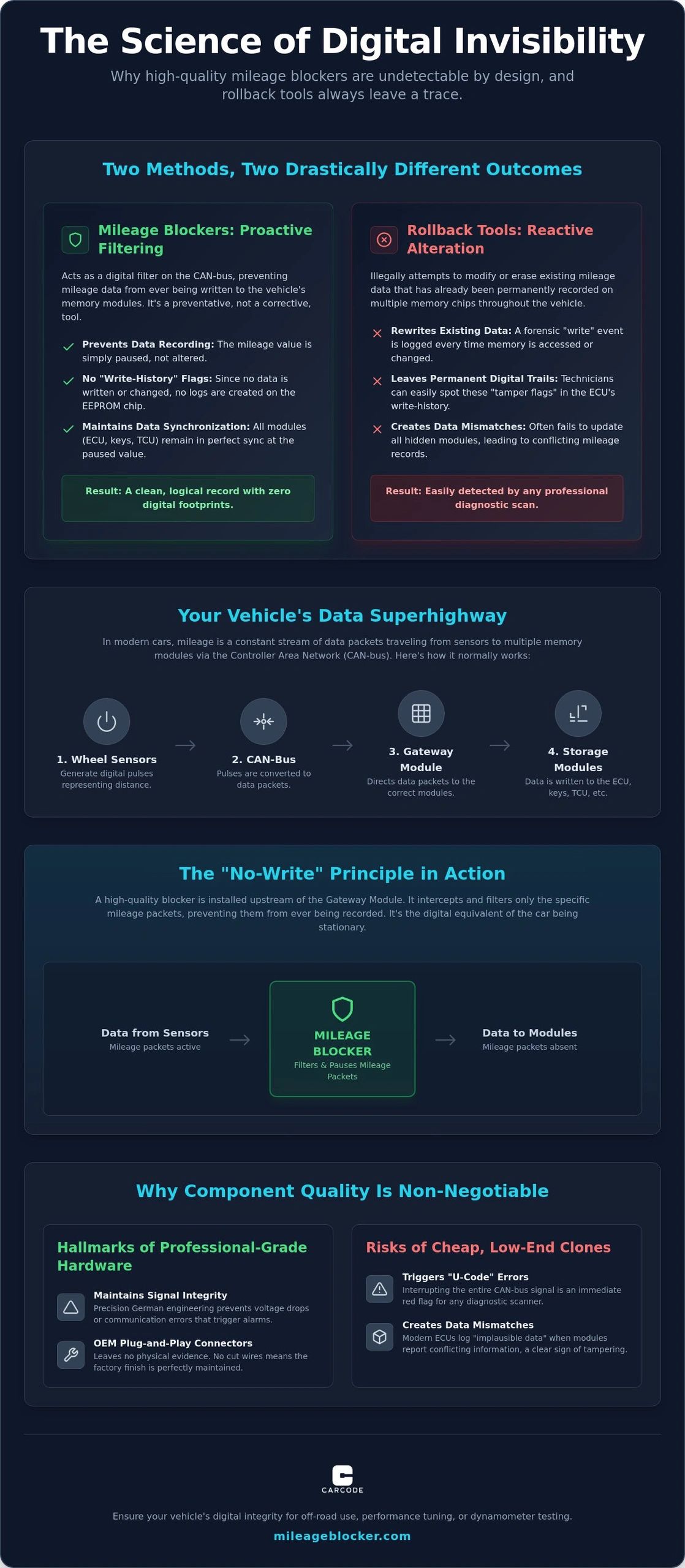
The CAN-bus, or Controller Area Network, functions as the central nervous system of your vehicle. In high-performance 2026 models like the G90 BMW M5 or the Audi RS6, every component communicates via standardized data packets. When you drive, speed sensors at the wheels generate digital pulses. These pulses are converted into specific hexadecimal IDs that travel across the network to reach the instrument cluster and various storage modules. Unlike mechanical systems of the past, modern mileage is a distributed calculation rather than a single number on a dial.
We've seen that the primary reason why mileage blockers are not easy to be detected after use is their ability to intercept these specific data packets in real-time. A high-quality blocker acts as a digital filter. It identifies the specific IDs related to distance accumulation and prevents them from reaching the memory-storing ECUs. Because the device stops the data before it's ever written, there is no "correction" to find later. This is fundamentally different from odometer fraud involving rollback tools, which leave physical write marks on the chip's internal memory.
Understanding CAN-bus Handshaking
Modern vehicles perform constant handshaking cycles where different modules verify that the data they receive is consistent and legitimate. If a module stops responding or sends corrupted data, the system triggers a fault code. We've tested cheap, low-end blockers that cause significant voltage drops on the CAN lines, leading to communication errors that any basic OBD-II scanner will pick up. Our professional-grade blockers maintain the original signal integrity. They ensure that the electronic heartbeat of the car remains steady, so the vehicle never suspects that the data stream has been altered.
The Role of the Gateway Module
The Central Gateway Module (CGW) acts as the traffic warden for your car's internal networks. It manages the flow of information between the high-speed powertrain bus and the lower-speed body electronics. To remain invisible, a blocker must be positioned upstream of this gateway. This ensures that the filtered data is what the rest of the car sees as the truth. We highly recommend a professional installation to ensure the device is seated correctly within the wiring loom. When installed correctly, the gateway continues to pass information normally, leaving no trace of network interference or data inconsistencies for a technician to find during a routine service.
Why Digital Footprints Vanish with High-Quality Blockers
We've analysed countless ECU logs in our workshop to determine exactly how data is committed to memory. Many UK drivers confuse mileage correction with mileage blocking, but the technical distinction is what determines your car's digital integrity. Correction is a reactive process that attempts to rewrite history by modifying existing data on the EEPROM chip. This leaves a permanent digital trail in the ECU write-history, as modern security protocols log every time a memory address is accessed or changed. In contrast, a blocker is a preventative tool. It ensures that the distance data never reaches the storage module in the first place.
This fundamental difference explains why mileage blockers are not easy to be detected after use compared to invasive software rewrites. While UK legislation like the Fraud Act 2006 highlights the legal implications of mileage misrepresentation, the technical challenge remains the forensic trail left in hidden modules. High-quality hardware bypasses this by creating a "data gap." To the vehicle's diagnostic system, the car simply appears to have been stationary during the time the device was active. If your car is used for extensive stationary testing or dynamometer work, this creates a clean, logical record that matches the vehicle's physical state. You can find more details on these distinctions in our mileage blocker FAQ section.
The "No-Write" Principle
Precision German-made software is designed to prevent "implausible data" flags. When a cheap clone is installed, it often interrupts the entire CAN-bus signal, leading to "U-codes" or communication error logs. These are immediate red flags for any technician at a UK main dealer. Our modules use sophisticated filtering to keep the network active while only pausing the mileage-specific packets. Because the data never hits the EEPROM, there is no forensic evidence of a change. It is impossible to detect a value that was never recorded. If you want to ensure your specific model is covered, you can find the right module for your vehicle through our database.
Bypassing Diagnostic Scanner Detection
Professional diagnostic tools like the Autel MS908 or Snap-on Zeus interact with the vehicle by reading the current stored values in each ECU. These scanners do not have a "time machine" function. They cannot see what the mileage should have been; they only see the data currently validated by the system. When you remove the blocker, the vehicle resumes normal communication instantly. The synchronisation between the instrument cluster and the ABS module remains perfect because the blocker ensures they stay in lockstep at the frozen value. For the most discreet results, we always recommend removing the hardware before any official manufacturer servicing to restore the factory wiring loop.
ECU Synchronisation: Managing the Multiple Storage Problem
In our workshop, we've identified that modern luxury vehicles across the UK store distance data in over ten separate locations. It isn't just the instrument cluster. You'll find mileage records in the ABS module, the Transmission Control Unit (TCU), the Body Control Module (BCM), and even the Airbag Control Unit. This redundancy is designed to prevent simple tampering. When these modules communicate, they perform a synchronisation check. If the cluster says 10,000 miles but the transmission records 15,000, the system triggers a manipulation flag. This is exactly why mileage blockers are not easy to be detected after use; they manage the relationship between master and slave ECUs to ensure every module remains perfectly aligned at the same frozen value.
By creating what we call a Digital Ghost effect, the blocker ensures that the entire vehicle network believes the car is stationary. This isn't a simple off switch. It's a sophisticated data management protocol that keeps the network consistent. If you are performing dynamometer testing or off-road research in a controlled environment, maintaining this synchronisation is vital for vehicle health and data integrity. Without this level of precision, the car's internal security logs would immediately flag a communication mismatch.
The ABS and Transmission Modules
The ABS and Transmission modules are the first places where vehicle mileage forensics experts look for discrepancies. These modules calculate distance based on wheel speed and gear ratios. A high-end blocker manages this stream without disabling critical safety features like Cruise Control or Lane Assist. For total authenticity, it is also necessary to maintain the engine hours to miles ratio. If the engine has been running for 500 hours but the odometer only shows 10 miles, an inspector will immediately spot the anomaly. Our hardware ensures these ratios remain within plausible limits for your specific vehicle architecture.
Key Fob and Service History Memory
Modern keys act as passive data loggers. Every time you turn off the ignition, the car writes the current mileage and any service requirements to the key's internal chip. When you take your car for a service at a UK dealership, the advisor simply reads the key. If your blocker isn't integrated correctly with the CAN-filter, the key might store a different value than the dashboard. Ensuring the key data matches the dash data requires a deep understanding of your car's specific CAN-filter integration. When you find your car in our database, you are choosing a device programmed for your exact module architecture. This level of detail is why our professional-grade modules remain the industry standard for discretion.
Ensuring Long-Term Discretion and Professional Integration
The final layer of security isn't just in the digital data stream; it's in the physical and visual interaction with the car. We've seen many online forum discussions claiming that holding down a steering wheel button for five seconds is a universal way to out a mileage blocker. This is a common misconception based on poorly programmed, generic hardware. Professional-grade German software utilises complex activation sequences that don't rely on simple, detectable button holds. This level of technical refinement is a major reason why mileage blockers are not easy to be detected after use by curious third parties or dealership staff in the UK.
When choosing a module, the origin of the software matters more than the casing. Generic clones often use brute force methods to pause data, which can cause erratic behaviour in the instrument cluster. In contrast, German-engineered software is developed through extensive R&D on specific vehicle architectures like the 2025 Porsche 911 (992.2). This ensures that every other system, from the trip computer to the fuel range calculation, continues to operate logically. If you have questions about the specific software version for your model, you should contact us for bespoke fitting guidance.
Stealth Activation and UI Management
High-quality modules are designed to integrate with the existing user interface without leaving visual artefacts. If you use a cheap clone, you'll often experience frozen needle syndrome where the speedometer stops working entirely while the odometer is paused. This is a massive giveaway. Our custom-coded software ensures the speedometer remains 100% functional, maintaining the factory look and feel. You can toggle the device using specific combinations of interior buttons, like the High Beam or BC buttons on a BMW G30 5 Series, without any dash lights or indicators flashing. This maintains total discretion even if someone else is in the driver's seat.
The Removal Process: Leaving No Trace
Discretion extends to the physical installation. We only provide hardware with plug-and-play OEM connectors. This is critical because it avoids the need for wire-splicing or soldering, which are permanent physical markers that a technician will spot during a routine inspection. When you decide to remove the device, it unplugs cleanly, returning the wiring loom to its factory state. There are no cut wires or electrical tape residues to raise suspicion.
To ensure total digital cleanliness, we recommend a simple protocol after removing the hardware. Perform a full ECU reset using a standard OBD-II tool to clear any temporary cache files that might have been stored during testing. This final step ensures that the vehicle's memory is as clean as the physical wiring. If you are preparing for a dealer visit, perform this removal and reset at least three days prior to the appointment. This allows the car to complete several drive cycles, ensuring all readiness monitors are set and the system is in a standard factory state.
Secure Your Vehicle’s Digital Integrity Today
We've analyzed the technical gap between invasive rollback software and the preventative filtering of a high-quality CAN-bus module. The fundamental reason why mileage blockers are not easy to be detected after use is the no-write principle. By stopping data at the source, you ensure that hidden modules like the ABS and TCU never record a value that contradicts your dashboard.
If you are testing a 2026 performance model, precision matters. Our German-engineered software and OEM plug-and-play connectors guarantee that your vehicle’s wiring and digital logs remain in factory condition. You don't have to worry about permanent write flags or mismatched service history stored in your key fobs. Take the next step to protect your vehicle during off-road research or performance tuning. You can Find the right mileage blocker for your vehicle today and maintain total discretion. Get started with a professional tool designed for high-end automotive standards.
Frequently Asked Questions
Will a dealer see the mileage blocker on their diagnostic computer?
No. If you use a high-quality blocker and remove it before your visit, there is no digital footprint. The device stops data from being written to the memory in the first place, so there is no tamper flag or rollback record for the computer to find.
Does the speedometer still work while the mileage is frozen?
With our professional German-engineered modules, yes. The speedometer continues to function normally. Cheap alternatives often cause the needle to stay at zero, which is a major safety risk and an obvious sign of a device in use.
Is it legal to use a mileage blocker?
It is legal to fit and use a mileage blocker for testing, research, and development purposes in a controlled environment. However, it is illegal to use these devices to misrepresent a vehicle's mileage when selling it. Always check your local regulations before use.
Frequently Asked Questions
Can a main dealer detect a mileage blocker during a routine service?
A main dealer cannot detect a high-quality mileage blocker if you remove it before the vehicle enters the workshop. Because the device stops data from ever reaching the EEPROM memory, there is no digital trail or tamper flag for their diagnostic software to flag. We recommend removing the physical hardware to ensure the wiring loom returns to its factory state, leaving no physical evidence for a technician to find during a visual inspection.
Does the mileage blocker affect other vehicle functions like Cruise Control or Lane Assist?
High-grade German-engineered blockers do not interfere with safety systems like Cruise Control, Lane Assist, or Pre-Safe functions. We've tested these modules on 2025 and 2026 models to ensure the CAN-bus signal remains clean. While cheap clones often cause frozen needle syndrome or disable driver aids, our professional hardware maintains full system functionality while the odometer is paused. This ensures your driving experience remains identical to the factory settings.
What is the difference between a CAN-filter and a mileage blocker?
A CAN-filter is the technical hardware component that performs the mileage blocking function by filtering specific data packets on the vehicle's network. While the terms are often used interchangeably, the filter is the physical device that intercepts hexadecimal IDs before they reach storage modules. Understanding this mechanism is key to why mileage blockers are not easy to be detected after use, as they act as a digital gatekeeper rather than an invasive software patch.
Will the mileage jump up to the "real" value after I remove the device?
Your mileage will not jump back to the real value after you remove the device. The vehicle has no internal record of the distance traveled while the blocker was active because those data packets were never allowed to reach the memory chips. Once the hardware is removed, the car simply resumes counting from the last stored value. This maintains perfect synchronization across all internal electronic control units without any sudden discrepancies or data spikes.
Is it possible to detect a blocker through the key fob data?
It is not possible to detect our blockers through key fob data because the key only mirrors the information stored in the vehicle's central modules. When you turn off the ignition, the car writes the current, blocked mileage to the key's internal chip. Since the blocker ensures all modules like the BCM and instrument cluster are synchronized at the same value, a service advisor reading your key will see the exact same mileage shown on your dashboard.
About the author
Pav TomaszeviczChief Editor, MileageBlocker.com
Pav is Chief Editor at MileageBlocker.com and works with the MileageBlocker Technical Team to publish practical information about vehicle compatibility, CAN/CAN-FD electronics, installation and MileageBlocker products.
View author profile →