Mileage Blocker Troubleshooting: A Technical Guide from Carcode
Why would a precision-engineered tool like a Carcode Mileage Blocker fail to halt the odometer on a Lamborghini Huracán or a BMW X7 after a seemingly pe...
Why would a precision-engineered tool like a Carcode Mileage Blocker fail to halt the odometer on a Lamborghini Huracán or a BMW X7 after a seemingly perfect installation? It is a common frustration for owners who expect seamless integration with their vehicle's sophisticated electronics. This expert guide provides the definitive mileage blocker troubleshooting framework to help you resolve communication gaps and secure physical connections within your car's internal memory modules.
We understand that seeing ABS or ESC warning lights on the dashboard of a Ferrari or a Bugatti is the last thing you want after fitting a high-end device. You need a solution that ensures your mileage stopper works exactly as intended without leaving a digital footprint. By following this technical resource, you'll learn how to stabilise the connection in premium models like the Range Rover and McLaren. We will walk you through synchronising the hardware with modern CAN-bus protocols, ensuring your device from MileageBlocker.com delivers a clean dashboard and the discreet operation you require.
Key Takeaways
- Verify physical connection integrity by ensuring OEM connectors are seated correctly and the vehicle battery was disconnected during the initial setup to prevent data corruption.
- Master mileage blocker troubleshooting by identifying how the high-grade filters in Carcode Mileage Blockers prevent CAN-bus congestion and common ABS or ESC dashboard errors.
- Resolve model-specific technicalities, such as Virtual Cockpit synchronisation on the Lamborghini Urus or active aerodynamics faults on Ferrari and McLaren models.
- Learn the precise sequence for a clean system reset to factory parameters, ensuring your mileage stopper remains discreet and leaves no trace within the internal memory modules.
- Access expert fitting services and long-term technical support through MileageBlocker.com to maintain the operational excellence of your hardware in premium vehicles like the Range Rover.
Troubleshooting Physical Connection and Power Issues
Effective mileage blocker troubleshooting begins with a rigorous assessment of the physical hardware. While many users suspect software glitches when a device fails to stop the odometer, the majority of operational faults stem from insecure connections or improper power-up sequences. Carcode Mileage Blockers are engineered as precision plug-and-play systems, but the tolerances in a Ferrari or McLaren wiring loom are tight. It's vital to distinguish these high-end diagnostic tools from the illegal practice of rolling back odometers; ensuring a stable physical link is the first step in maintaining that professional distinction. A loose connection won't just stop the device from working; it can lead to intermittent signal loss that confuses the vehicle's central gateway.
Identification of the correct installation point is equally critical. Most setups occur directly behind the speedometer cluster. However, specific premium models, including certain BMW and Range Rover variants, may require integration at the Body Control Module (BCM) or a different junction in the CAN-bus network. If the device is fitted at the wrong node, the mileage signal simply bypasses the blocker. Always check for loose wiring that might cause signal drops when driving on rough terrain, as even a millimetre of movement can break the data circuit in a high-vibration environment.
Verifying Connector Seating and Pin Alignment
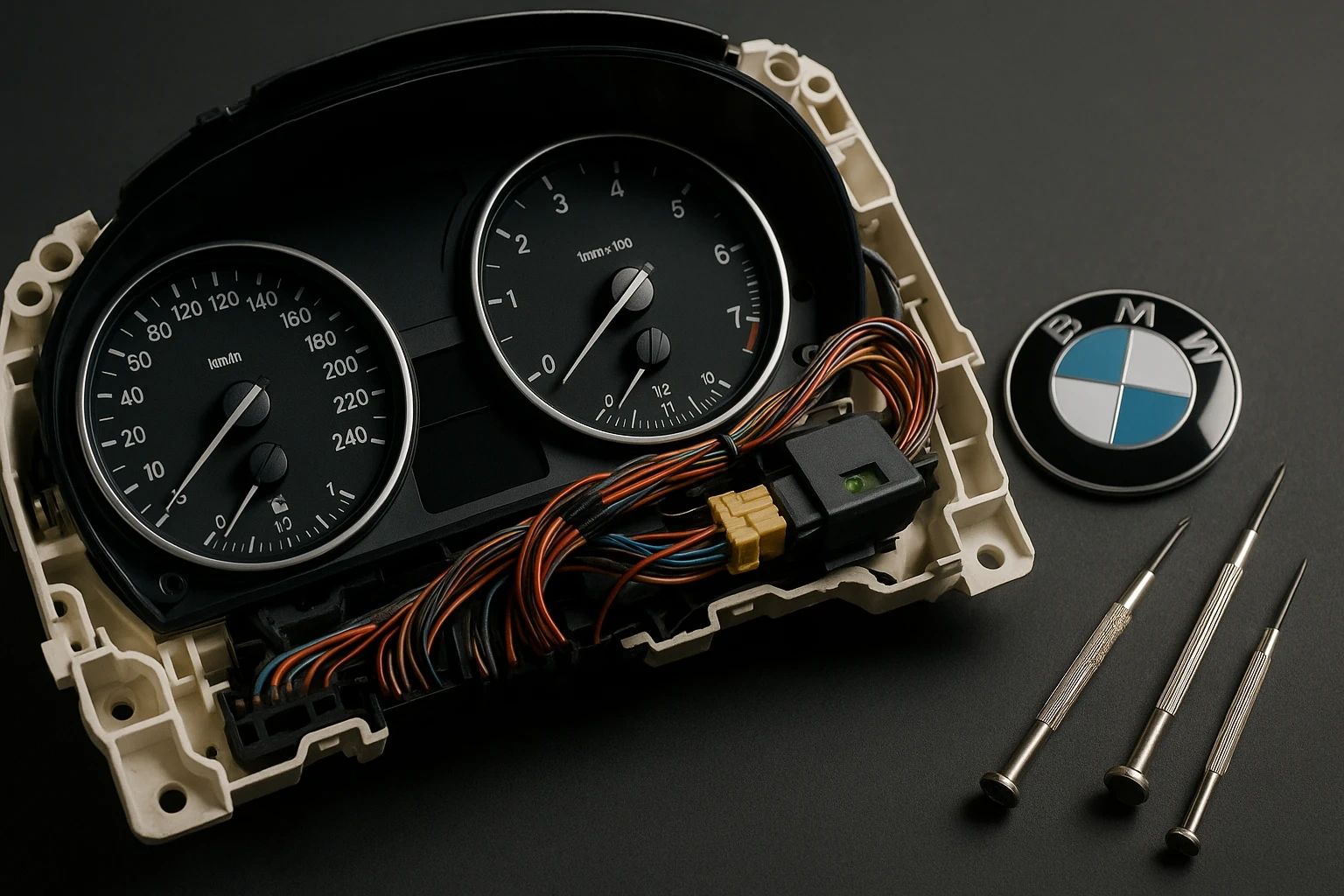
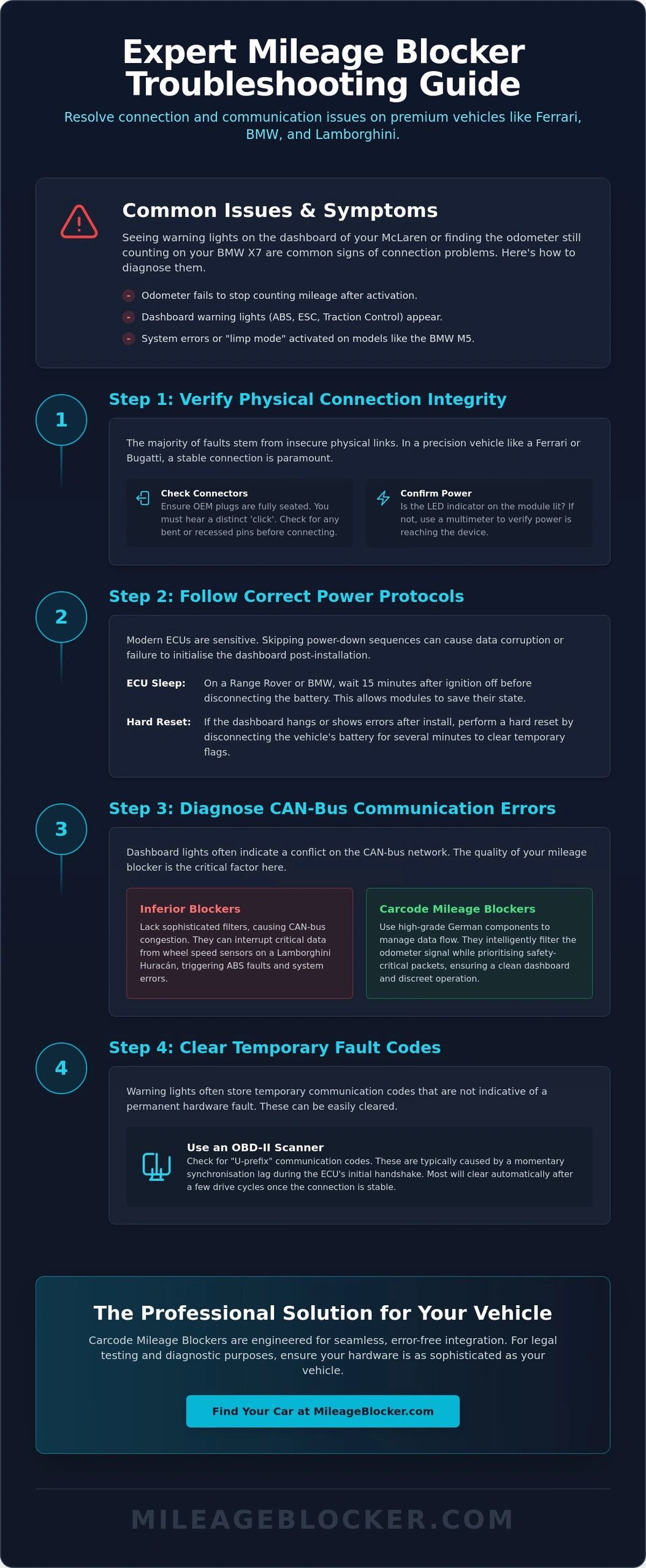
Examine the plug-and-play harness for bent or recessed pins before you finish the assembly. These components are delicate. You must hear a distinct clicking sound when mating the Carcode Mileage Blocker to the vehicle loom to ensure a locked connection. If the LED indicator on the module is absent, use a multimeter to verify power is reaching the device. A single recessed pin in a Lamborghini or Bugatti connector can trigger a cascade of communication errors across the entire network. Detailed diagrams for these connections are available on our installation page.
Battery Disconnection and ECU Wake-up Protocols
Modern vehicle electronics are sensitive to voltage fluctuations. On a Range Rover, you must allow a 15-minute "sleep" period after switching off the ignition before you disconnect the battery. This allows all control modules to power down and save their current states. Skipping this step often causes the dashboard to fail to initialise post-install. If the system hangs, perform a hard reset by disconnecting the battery for several minutes. This helps avoid voltage spikes that can trigger false "tamper" flags in the ECU memory.
Addressing CAN-bus Errors and Dashboard Warning Lights
Dashboard warning lights are the primary indicator that mileage blocker troubleshooting is required. When you install a low-quality device in a Ferrari or a McLaren, the system often triggers ABS, ESC, or Traction Control errors. This occurs because inferior blockers lack the sophisticated data filtering required to handle the high-speed communication of modern vehicles. Carcode Mileage Blockers are built with high-grade German components that ensure signal transparency in demanding systems like those found in a Range Rover. They don't just block data; they manage it to prevent the system from flagging a conflict.
It's essential to understand that while these devices are legal for testing and diagnostics, misusing them to misrepresent mileage is governed by strict federal odometer fraud laws. Our hardware is designed for professional detachment and technical superiority. CAN-bus congestion is the primary cause of dashboard flickering. High-quality filters prevent this by prioritising safety-critical data packets over the odometer signal. This ensures that your vehicle's stability systems remain fully functional while the mileage freezer is active.
Why Does My ABS Light Come On?
In vehicles like the Lamborghini Huracán or BMW M5, the odometer signal is often derived directly from wheel speed sensors. If a blocker interrupts the wrong data packet, the ABS module assumes a sensor failure. This can trigger a "limp mode" on BMW and Mercedes-Benz models, where the ECU restricts engine performance to protect the car. Identifying this requires checking if the blocker is correctly configured for your specific model's protocol. If you're looking for a device that maintains these complex balances, you can find your car in our compatibility database.
Clearing Communication Faults (U-Codes)
If you see warning lights, use an OBD-II scanner to identify "U" prefix communication codes. These aren't permanent hardware faults. They're usually stored communication errors caused by a simple synchronisation lag during the initial ECU handshake. Differentiating between a device failure and a temporary data mismatch is key to a successful setup. Most stored errors will clear automatically after a few drive cycles once the synchronisation is corrected. If you're unsure about your specific model's requirements, check our mileage blocker FAQ for protocol-specific guidance.
Model-Specific Troubleshooting: From Range Rover to McLaren
High-performance vehicles use unique data architectures that require specific mileage blocker troubleshooting protocols. For instance, the Audi RS6 and Lamborghini Urus share a Virtual Cockpit platform where the odometer signal is mirrored across multiple sub-networks. If the Carcode Mileage Blocker isn't correctly synchronised, the display might lag or freeze. Similarly, the latest Range Rover models from 2024 to 2026 often require specific Body Control Module (BCM) firmware updates to ensure the blocker communicates effectively with the vehicle's updated security gateway. These updates are essential for maintaining the integrity of the Controller Area Network (CAN bus).
In the electric vehicle sector, the Porsche Taycan presents a different challenge. Owners might notice the "Oil Service" or maintenance countdown continues even when the mileage stopper is active. This happens because high-performance EVs often calculate service intervals based on battery cycles or drive time rather than purely on distance. For Ferrari and McLaren owners, a common concern involves the "Active Aerodynamics" system. If the blocker isn't filtering data packets with precision, the car may fail to deploy its rear wing or active flaps, as these systems rely on accurate speed data to function safely.
Supercar Virtual Cockpit and HUD Glitches
Supercars like the Bugatti Chiron or Lamborghini Revuelto utilise secondary mileage storage within their infotainment units. A common glitch involves a frozen Head-Up Display (HUD) after activating the device. To fix this, you must ensure the trip computer remains functional. This allows for accurate track-day fuel management while the main odometer remains paused. If the HUD stops updating, it's usually a sign that the device is in the wrong operational mode for that specific software version. You can resolve these issues by following the mode-switching instructions specific to your chassis.
BMW and Range Rover Synchronisation
BMW G-series instrument clusters are notorious for the "Tamper Dot," a small red icon that appears if the mileage in the cluster doesn't match the storage in the Light Module or Key Fob. Resolving this requires a precise power-down sequence during installation. For Range Rover Sport models, it's vital to ensure the Key Fob mileage data remains consistent with the dash display. You can find your car and access specific model wiring diagrams to ensure your setup is flawless. If you want to ensure your premium vehicle's systems remain perfectly aligned, you can purchase a high-quality mileage blocker device from our shop today.
Final System Resets and Professional Support
The final phase of mileage blocker troubleshooting involves returning the vehicle to its factory state once testing is complete. Removing a Carcode Mileage Blocker is a straightforward process, but it must be done with precision to ensure no digital residue remains in the internal memory modules. While our hardware is designed for discreet operation, the vehicle's ECU must re-establish a direct, unfiltered handshake with the instrument cluster. If you've followed the steps in our guide on how to uninstall mileage blocker, you'll know that physical removal is only the first part of a clean exit strategy. For high-performance models like the BMW M4 or Range Rover, ensuring the central gateway synchronises correctly post-removal is vital for long-term system health.
Sometimes, despite following every technical step, a vehicle's specific software version might present unique challenges. If you've addressed physical connections and CAN-bus congestion but still face persistent errors, it's time to transition from DIY methods to professional assistance. We offer a dedicated Mileage Blocker Fitting Service for those who prefer an expert touch, especially when dealing with the complex looms of a Lamborghini or Bugatti. Accessing technical support through MileageBlocker.com ensures you're using the latest software patches and installation protocols for your specific chassis.
Resetting the ECU Post-Removal
Once the hardware is removed, you should use the "3-cycle" start method to clear any soft-stored communication codes. This involves starting the engine, allowing it to idle for sixty seconds, and then turning it off completely. Repeat this three times to allow the ECU to verify that all data packets are now flowing without interruption. While this works for most BMW and Range Rover models, we recommend using a professional diagnostic tool for Ferrari and McLaren resets. These supercars often store "shadow codes" that require a high-level scanner to clear, ensuring the vehicle remains in peak condition for future servicing.
Contacting Support and Professional Installation
If you're still experiencing issues, contact us for Carcode software updates or technical guidance. When reaching out, please provide your car model, year, and any specific error codes you've identified via OBD-II. This data allows our team to pinpoint whether the issue is a protocol mismatch or a physical seating problem. For owners in the UK, we can often recommend a mobile fitter for complex supercar installations. This ensures that your mileage stopper is integrated perfectly into the vehicle's electronics, providing the confidence that only a professional installation can offer.
Optimise Your Vehicle's Diagnostic Performance
Mastering mileage blocker troubleshooting requires a methodical approach that balances hardware integrity with software synchronisation. You've learned how to verify physical connections in premium looms and how to manage CAN-bus data packets to prevent dashboard errors in models like the BMW M5 or Range Rover Sport. By addressing these technical hurdles, you ensure your Carcode Mileage Blocker operates with the precision expected of high-end automotive engineering. It's vital to maintain this level of technical rigour when working with sophisticated vehicle networks.
Our devices utilise German-engineered high-grade components to maintain signal transparency across the most complex vehicle architectures. Whether you require specialist support for a Ferrari, McLaren, or Bugatti, our team provides the technical expertise to resolve any operational conflict. We offer discreet worldwide shipping to ensure your hardware arrives securely and ready for immediate integration. This commitment to quality ensures your vehicle's internal systems remain stable and unaffected by external modules.
If you encounter persistent communication faults or require a professional fitting service, you can troubleshoot your device with Carcode experts at MileageBlocker.com. Maintaining the technical superiority of your vehicle's electronics is our priority. You now have the knowledge to ensure a clean, error-free dashboard and a fully functioning mileage freezer.
Frequently Asked Questions
Why is my odometer still counting miles after I installed the blocker?
If your odometer continues to count distance, the device is likely in "Normal" mode or the wiring harness isn't fully seated. Carcode Mileage Blockers often require a specific button combination on the steering wheel to activate the freezing function. Check that the pins in the connector behind your BMW or Range Rover cluster are perfectly aligned. If the pins are bent, the data will bypass the module entirely and the system will record mileage as usual.
Will a mileage blocker cause permanent warning lights on my dashboard?
High-quality hardware from MileageBlocker.com doesn't cause permanent damage or lasting warning lights. While a temporary ABS or ESC light might appear during the initial handshake in a McLaren or Ferrari, these are soft-stored codes. They typically disappear after a few drive cycles or a simple system restart. This is a common part of mileage blocker troubleshooting when synchronising the device with the vehicle's central gateway for the first time.
How do I know if my Carcode Mileage Blocker is actually turned on?
Most Carcode Mileage Blockers provide visual confirmation through a built-in LED or by flashing the indicators on your instrument cluster. In a Lamborghini or Bugatti, you might see the high-beam indicator flash twice to confirm the device is active. If you don't see this feedback, verify the power supply using a multimeter at the harness junction. Detailed confirmation steps for every model are listed in our technical documentation to ensure you have full confidence in the device's operation.
Can a mileage blocker interfere with my car’s cruise control or park assist?
Some operation modes may temporarily disable cruise control or park assist because these systems rely on the same speed data the blocker is filtering. This is particularly prevalent in modern BMW G-series and Audi RS models. If you require these features for a specific journey, you should switch the device to a mode that allows speed display while still managing the odometer. This balance ensures your vehicle's driver assistance systems remain operational when needed during testing.
What should I do if my car won’t start after installing the device?
A car failing to start post-installation usually indicates a break in the CAN-bus circuit or a security lockout from the ECU. Ensure you followed the 15-minute sleep protocol before disconnecting the battery on your Range Rover or Ferrari. If the loop is broken, the immobiliser won't receive the "start" signal. Re-check the physical connectors to ensure the plug-and-play harness is fully mated and the circuit is complete to restore communication.
How do I clear the "Service Due" light if it becomes stuck?
The "Service Due" light often operates on a separate timer or battery-cycle counter, especially in performance EVs like the Porsche Taycan. If it becomes stuck, you can usually perform a manual reset through the vehicle's infotainment settings or by using an OBD-II diagnostic tool. This reset doesn't affect the mileage freezer's operation. If the light persists, it may be part of your mileage blocker troubleshooting process to check for a firmware update that better handles your vehicle's specific maintenance protocols.
About the author
Pav TomaszeviczChief Editor, MileageBlocker.com
Pav is Chief Editor at MileageBlocker.com and works with the MileageBlocker Technical Team to publish practical information about vehicle compatibility, CAN/CAN-FD electronics, installation and MileageBlocker products.
View author profile →