
Mileage Blocker for Track Days: A 2026 Technical Guide
Taking your Porsche 911 GT3 to Silverstone for a single afternoon of testing can wipe £5,000 off its resale value before you''ve even loaded it back onto...

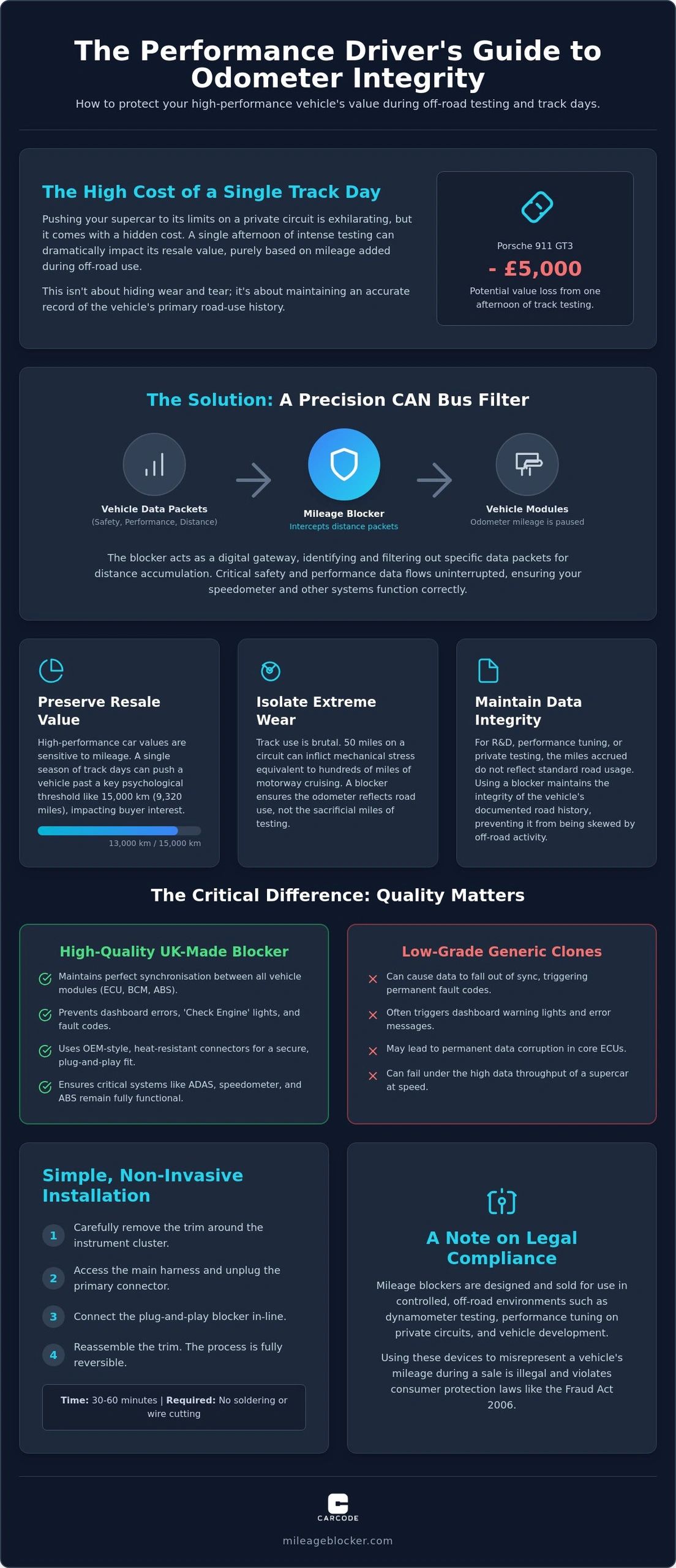
Taking your Porsche 911 GT3 to Silverstone for a single afternoon of testing can wipe £5,000 off its resale value before you've even loaded it back onto the trailer. It's a frustrating reality for owners of high-performance machinery. While engine oil and brake pads are sacrificial components during a session, your vehicle's recorded road history shouldn't be. We've seen in our workshop how a high-quality mileage blocker for track days serves as a precision tool to isolate these intense testing sessions from the car's primary odometer.
You likely agree that data integrity is paramount when pushing a Ferrari 488 or McLaren 720S to its limit on a private circuit. This guide explains how our hardware integrates with complex CAN-bus systems to pause distance recording without triggering the dashboard warning lights that plague cheaper, low-grade alternatives. We'll break down the technical operation of these devices and show you how to maintain a clean electronic record for your vehicle's off-road applications.
Key Takeaways
- Understand the technical role of CAN-bus filters in intercepting distance data packets before they reach the odometer module.
- Identify the hardware differences between UK-made precision components and generic clones that can damage your car's electronic control units.
- Learn why using a mileage blocker for track days is a standard practice for preserving the road-use history of high-performance vehicles.
- Master the steps for plug-and-play installation and the correct way to activate specific modes for off-road testing.
- Review the 2026 legal requirements to ensure you remain compliant with the Fraud Act 2006 and consumer protection regulations.
Why Use a Mileage Blocker for Track Days and Testing?
A mileage blocker for track days is a specialized digital filter designed for the Controller Area Network (CAN bus). Rather than altering existing data, it functions by intercepting specific distance-related packets before they reach the odometer module. We've seen in our workshop how this technology allows performance enthusiasts to run intense testing sessions on private circuits without those miles appearing on the road-use record. It's about data integrity. If you're testing a new suspension setup or aerodynamic kit, your focus is on performance metrics, not adding transit miles that don't reflect the car's primary use on public highways.
High-quality hardware is essential for these high-stress environments. Cheap clones often fail when subjected to the rapid data throughput of a supercar at 160 mph, leading to ECU errors or permanent data corruption. Our UK-made components are engineered to maintain communication across all vehicle modules, ensuring that while the distance is paused, your speedometer and assistance systems remain fully functional. You can check if your specific model is supported using our find your car tool.
Differentiating Track Use from Daily Driving
Track sessions are brutal. Fifty miles on a circuit like Donington Park is equivalent to hundreds of miles of gentle motorway cruising in terms of mechanical stress. Standard valuation models don't account for this discrepancy. We've found that performance enthusiasts prefer to keep their road life and track life separate. If you're running a car on a private circuit for research or performance tuning, those miles don't reflect the vehicle's standard road usage. Using a mileage blocker for track days ensures the odometer remains a record of road transit only, protecting the vehicle's documented history from being skewed by off-road testing.
Converting Track Distance: Why 15,000 km to Miles Matters
The number 15,000 km (approximately 9,320 miles) represents a major psychological threshold for high-performance car buyers. In our experience, a Lamborghini or Ferrari crossing this line often sees a steeper drop in interest and value. A single season of frequent track days can easily add 3,000 km to the clock. If you start the season at 13,000 km, those few weekends of testing will push you past that critical 15,000 km barrier. By using a blocker during these sessions, you ensure your car stays below these psychological thresholds during testing. This isn't about deception; it's about ensuring the odometer accurately reflects the road-miles the car was designed to record, rather than the sacrificial miles spent on a closed circuit.
The Technical Science of CAN-bus Data Management
Modern vehicles operate as sophisticated digital networks where every component, from the gearbox to the instrument cluster, communicates via the Controller Area Network. This system transmits thousands of data packets per second. A mileage blocker for track days functions as a precision digital gateway within this network. It identifies and filters out the specific data packets responsible for distance accumulation while allowing critical safety and performance data to flow uninterrupted. This ensures that your speedometer and trip computer function correctly while the permanent odometer storage remains paused.
Stopping the data at the source is vital. In modern performance cars, mileage isn't just a number on a screen; it's stored simultaneously in the engine control unit, the transmission module, and even the ignition keys. If these values fall out of sync, the vehicle's onboard diagnostics will trigger a fault. While using these tools for testing is legitimate, users must remain aware of the Federal law on odometer fraud which strictly prohibits the intent to deceive buyers during a sale. Quality hardware ensures that all internal modules stay synchronised, avoiding the red flags that cheap clones often trigger.
Plug-and-Play Integration with Modern ECUs
In our workshop, we prioritize hardware that utilizes OEM-style connectors. This ensures a secure, heat-resistant fit that can withstand the vibrations of high-speed track runs. For 2026 models like the BMW M5 or Audi RS6, software compatibility is non-negotiable. The device sits discreetly behind the instrument cluster, requiring no permanent wiring changes or soldering. This non-invasive approach preserves the physical integrity of your vehicle's harness. It's a clean solution that you can remove without leaving a trace of hardware modification.
Avoiding Dashboard Errors and Fault Codes
Quality hardware prevents the dreaded 'Check Engine' light by maintaining perfect synchronisation between the ABS, Body Control Module (BCM), and the main ECU. This is especially critical for modern ADAS systems that rely on accurate wheel speed and distance data to function safely. If you're curious about how other metrics impact vehicle life, you can read our guide on engine hours to miles for a deeper technical look. Ensuring your car remains error-free during testing is easy once you select the correct hardware for your specific model.
Step-by-Step Installation and Track-Side Activation
Installing a mileage blocker for track days is a methodical process that typically takes between 30 and 60 minutes. You'll usually begin by carefully removing the trim around the instrument cluster to access the main harness. Our hardware uses a bypass design. You unplug the factory connector and insert the blocker between the harness and the cluster. It’s a digital bridge. Once the physical connection is secure, you can find the right blocker for your car and follow the model-specific guide included with your shipment.
Before you head onto the circuit, verifying the device is active is crucial. Most units provide a visual cue, such as a flash of the hazard lights or a specific needle sweep on the speedometer. It’s essential to remember that while these tools are intended for track-side data management, legal frameworks like Oregon's Odometer Tampering Law highlight the strict regulations surrounding odometer manipulation for fraudulent purposes. We always advocate for the 'off-road only' application to ensure you stay on the right side of international regulations.
DIY vs. Professional Fitting Services
If you're comfortable with basic interior trim tools, the DIY path is straightforward. However, for high-value supercars where trim clips are fragile and expensive, many of our clients prefer a professional touch. We've seen how a misplaced pry tool can cause hundreds of pounds in damage to a carbon-fibre dashboard. We offer a mobile fitting service across the UK to handle the installation at your home or garage. This ensures the hardware is tucked away perfectly and the software is calibrated correctly for your 2026 ECU. Schedule your professional fitting today to ensure a zero-error installation.
Controlling the Device via Steering Wheel Commands
Modern blockers don't require external switches. You control them using existing factory buttons, often the 'Res' or 'Mode' buttons on your steering wheel. By holding a specific combination for five seconds, you can cycle through different recording ratios. Some drivers prefer a 10% or 20% mode to see some movement on the trip computer, while others opt for the 0% 'stop' mode for pure testing. You might see the indicator blink twice to confirm Mode 1 is active. Crucially, you must deactivate the device and verify that standard mileage recording has resumed before you leave the circuit and return to public roads. Failure to do so could result in inaccurate data being recorded during your drive home.
Navigating the Ethics of Odometer Management in 2026
Ownership of a mileage blocker for track days is legal in the UK, provided the device is used for its intended purpose: isolating off-road testing from the vehicle's road record. The legal risk only manifests under the Fraud Act 2006 if you intentionally deceive a buyer or insurer. We've found that the most professional way to manage this is through total transparency. If your car spends 40% of its life on the circuit, that's a performance metric you should be proud of, not something to hide. Transparency is your primary legal safeguard.
Using a mileage stopper on a private circuit is about data management, not deception. When you're pushing a Porsche GT3 or an Audi R8 to its limit, the distance covered is sacrificial. It doesn't represent the standard wear and tear associated with road miles. However, you must ensure the device is deactivated before you return to the public highway. Under the Consumer Protection from Unfair Trading Regulations 2014, failing to disclose the use of such a device during a sale could be classified as a misleading omission.
Understanding the 'Off-Road and Research' Designation
The DVSA implemented administrative changes on January 9, 2026, requiring MOT testers to take photographs of vehicles during the test to prevent 'ghost MOTs'. While this doesn't change the physical inspection for you, it highlights a broader trend toward data accuracy. Track days on private land like Silverstone or Oulton Park are technically exempt from standard road mileage reporting because the vehicle isn't using the public highway. Documenting these sessions in a private logbook provides a clear 'paper trail' that validates your car's history. You're effectively operating the vehicle as a piece of specialized testing equipment during these hours.
Best Practices for Maintaining a Transparent Service History
Servicing is the backbone of vehicle longevity. When the odometer is paused, your standard service intervals become irrelevant. You must transition to an engine-hour-based maintenance routine. High-performance fluids should be replaced after every three to four intense track days to ensure the engine remains protected. If you ever choose to sell the vehicle, providing a detailed folder of track logs and service invoices ensures you remain compliant with ethical and legal standards. If you have questions about the technical operation of your unit, contact us for technical guidance.
To implement this system within the next seven days, buy a dedicated logbook for your glovebox and record your current odometer reading. If you have a track day scheduled, practice the steering wheel activation sequence while stationary to ensure you're comfortable with the interface. Finally, review your recent service history and schedule an oil analysis if you've completed more than five track hours since your last change. This proactive approach ensures your vehicle remains in peak condition while maintaining a clear, honest record of its use.
Optimising Your 2026 Track Day Strategy
Technical precision and ethical transparency are the pillars of modern vehicle data management. We've shown how a high-quality mileage blocker for track days allows you to focus on shaving seconds off your lap times without compromising your car's documented road history. Our UK-made hardware provides the reliability needed for high-speed testing while ensuring all internal modules, from the ABS to the transmission, stay perfectly synchronized. If you're ready to implement a professional-grade solution, we offer nationwide fitting services and discreet technical support to keep your systems running flawlessly. It's about having the right tool for a specific, high-performance job.
It's time to take control of your vehicle's data. By combining a digital blocker with a dedicated track logbook, you protect your reputation and your car's resale value simultaneously. We're here to help you maintain that balance with hardware engineered for the most demanding performance environments. Secure your vehicle's data integrity; find your mileage blocker today. Your next session on the circuit deserves a clean record. We look forward to seeing you at the track.
Frequently Asked Questions
Is it legal to use a mileage blocker for track days in the UK?
Yes, it is legal to install and operate a mileage blocker for track days on private property or for specific testing purposes in the UK. The legal boundary is defined by intent. Under the Fraud Act 2006, using the device to misrepresent a vehicle's true mileage during a sale or for insurance claims is a criminal offence. As long as the hardware is used for data management during off-road sessions, you remain compliant with current regulations.
Will a mileage blocker affect my car's warranty?
A mileage blocker can technically affect your vehicle's warranty if a manufacturer discovers the modification during a service or repair. While our hardware is plug-and-play and leaves no physical trace in the wiring loom, we always recommend removing the device before taking your car to a main dealer. This prevents any potential disputes regarding the integrity of the vehicle's electronic systems, especially with sensitive 2026 diagnostic protocols.
Does the device stop the engine hours counter too?
No, the device is engineered to pause the odometer while leaving the engine hours counter fully operational within the ECU. We believe this is actually beneficial for performance owners. Engine hours provide a far more accurate metric for maintenance intervals on track-focused cars than simple mileage. You can use these hours to schedule oil changes and mechanical inspections accurately, even while the road-mileage record is paused for testing.
Can a mileage blocker be detected by diagnostic tools?
Our high-grade devices are designed to be invisible to standard OBDII scanners because they don't generate fault codes or trigger communication errors. Standard workshop tools won't flag the device's presence. However, we've seen that a deep forensic analysis of multiple ECUs might reveal data discrepancies if a low-quality clone was used. Using premium UK-made hardware ensures that all modules, including the ABS and BCM, stay synchronised to avoid detection.
What happens if I forget to turn it off on the road?
You must ensure the device is deactivated immediately before you leave the private circuit and return to the public highway. If you forget to turn it off, your odometer won't record the distance of your journey home, which results in an inaccurate legal record. We recommend making the deactivation sequence a standard part of your 'track-out' checklist to ensure your road history remains precise and legally compliant at all times.
About the author
Pav TomaszeviczChief Editor, MileageBlocker.com
Pav is Chief Editor at MileageBlocker.com and works with the MileageBlocker Technical Team to publish practical information about vehicle compatibility, CAN/CAN-FD electronics, installation and MileageBlocker products.
View author profile →