
How Does Mileage Affect Car Insurance? The 2026 UK Guide
You might assume that keeping your car on the driveway is a guaranteed way to slash your premiums, but the "low mileage trap" means those driving 4...

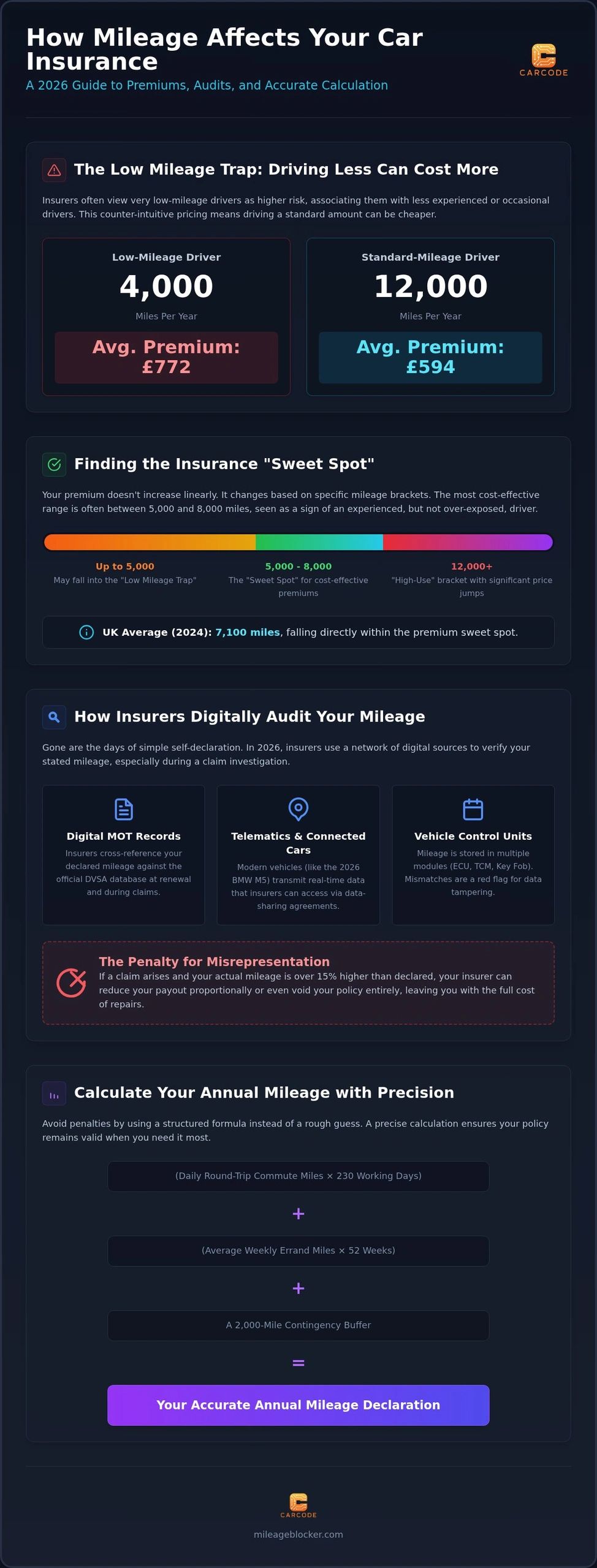
You might assume that keeping your car on the driveway is a guaranteed way to slash your premiums, but the "low mileage trap" means those driving 4,000 miles a year now pay an average of £772, significantly more than the £594 paid by 12,000-mile drivers. We've seen this data-driven shift first-hand at Carcode Mileage Blockers, where clients often worry that a slight miscalculation will lead to a voided policy or a rejected claim. Understanding exactly how does mileage affect car insurance is vital now that insurers utilise digital diagnostics to verify odometer readings against internal ECU memory. This guide provides the technical clarity you need to navigate the £711 average insurance market of 2026. We will explain how annual mileage dictates your costs, how to accurately calculate your distance, and what the latest digital auditing trends mean for your privacy and your wallet.
Key Takeaways
- Understand how insurers use specific mileage bands to price risk and why driving too little can sometimes cost more than a standard 12,000-mile policy.
- Learn how digital MOT records and connected vehicle telematics allow insurers to conduct real-time audits of your odometer data in 2026.
- Master a precise calculation framework to ensure your declared mileage is accurate and your policy remains valid during a claim.
- Identify why high-performance vehicles require German-engineered hardware to manage data integrity during off-road scenarios and how does mileage affect car insurance during these tests.
- Discover the financial impact of shifting your mileage bracket to help you choose the most cost-effective cover for your actual driving habits.
The Direct Link Between Annual Mileage and Insurance Premiums
Insurers operate on a cold, statistical foundation where every mile added to your odometer represents an incremental increase in risk. We've seen in our workshop how this actuarial logic translates directly to your wallet; the more time you spend on the road, the higher the mathematical probability of a collision. While the average UK driver covered 7,100 miles in 2024, 2026 insurance models now utilize AI-driven risk profiling to weight these miles more heavily in high-density urban areas like London or Birmingham. This shift often incorporates Usage-based insurance principles, where your specific habits and location are scrutinized alongside your distance. Declaring your car for "social, domestic, and pleasure" use rather than "commuting" can lower costs, but adding a commute often multiplies the risk factor as you are driving during peak congestion hours. Understanding exactly how does mileage affect car insurance requires looking past the total number and into these specific usage categories.
Why 12,000 Miles is the Critical Threshold
Premiums typically remain stable until you cross the 7,000-mile mark, but once you reach 12,000 miles, the pricing structure shifts into a "high-use" bracket. Our data suggests a 2026 "sweet spot" exists between 5,000 and 8,000 miles, where insurers view the driver as active enough to maintain skill but not overexposed to risk. For a high-performance vehicle like the [2026 Audi RS6], exceeding 12,000 miles can increase premiums by a significant margin compared to the 7,100-mile average. Exceeding this threshold often triggers different policy terms, as insurers assume the vehicle is being used for heavy professional purposes rather than occasional leisure.
The Financial Penalty of Underestimating Your Drive
Deliberately providing a low estimate to secure a cheaper rate is a form of misrepresentation that can lead to a voided policy. If a claim arises and a 15% discrepancy is found between your declared and actual mileage, the insurer may apply a pro-rata reduction to your payout. This means they will only pay the percentage of the claim that corresponds to the premium you actually paid versus what you should have paid for your real mileage. Insurers calculate this premium gap by subtracting the paid premium from the quote that would have been generated using the accurate odometer data found during the investigation. We often help clients understand that how does mileage affect car insurance is not just about the upfront cost, but about the security of your future claims.
How Insurers Audit Your Odometer Data in the Digital Age
The DVSA’s 2026 digital MOT system is now a primary tool for insurance underwriters. When you renew your policy, insurers cross-reference your self-declared figures against the centralised database. If you claim to drive 5,000 miles but the MOT record shows 9,000, the system flags the discrepancy immediately. Modern "connected cars" take this a step further. Vehicles like the 2026 BMW M5 transmit real-time telematics to manufacturer servers. Through industry data-sharing agreements, insurers can access this information during a claims investigation. Insurers no longer rely on guesswork, which changes the answer to how does mileage affect car insurance from a simple estimate to a verifiable data point.
Don't assume the dashboard is the only record of your travel. Mileage data is deeply embedded within the vehicle's architecture. It lives in the Engine Control Unit (ECU), the Transmission Control Module (TCM), and even the smart circuitry inside your key fob. During routine servicing or accident repairs, professional workshops use diagnostic tools to scan these modules. A mismatch between the TCM and the dash is a clear indicator of data tampering or system error. If you have technical questions about how these systems interact, you can check our mileage blocker FAQ for more detail.
Telematics and Black Box Verification
Policies based on telematics use GPS to monitor your position and distance with surgical precision. These "pay-per-mile" models are popular for low-mileage drivers, but they come with a significant privacy trade-off. Every trip is logged. If a telematics device detects a mileage jump that doesn't align with the physical odometer, insurers may suspend the policy pending a technical inspection. Understanding how does mileage affect car insurance in 2026 requires acknowledging that your car is constantly talking to your insurer.
CAN-bus Synchronisation: The Technical Challenge
The CAN-bus serves as the vehicle's central nervous system, facilitating communication between every electronic component. Maintaining vehicle health requires high-quality tools that synchronise data across all modules simultaneously. Low-quality hardware often fails to block data in secondary ECUs. This leads to "mileage jumping," where the dashboard suddenly updates to match a hidden, higher value stored in the TCM or ABS module. We've seen these failures in our workshop when owners use unverified equipment that cannot handle the complex communication protocols of modern 2026 vehicles.
Calculating Your Annual Mileage: Precision vs. Estimation
Precision is the only way to avoid the pro-rata claim reductions we've discussed. We suggest a structured calculation rather than a "best guess." Use the formula: (Daily round-trip commute x 230 working days) + (Average weekly errands x 52) + a 2,000-mile contingency buffer. This buffer is critical. It accounts for "one-off" events like a 500-mile tour of the North Coast 500 or a trip to the Scottish Highlands. If your life changes mid-term, such as starting a new job in a different city, you must update your insurer immediately. Failing to do so can invalidate your cover. It fundamentally changes how does mileage affect car insurance for your specific risk profile.
The MOT History Hack
The UK government’s "Check MOT History" service provides a verified record of your historical driving patterns. By entering your registration, you can identify trends over the last three to five years. Is your mileage creeping up? In 2026, digital service records from main dealers for brands like Audi or BMW are now as influential as MOT data. Insurers use these combined data streams to build a high-resolution map of your vehicle's usage. If you are curious about how high-performance hardware interacts with these digital logs, read our mileage blocker FAQ for technical insights.
Accounting for Business vs. Private Miles
There is a technical difference between "commuting" and "business use." Commuting covers travel to a single fixed place of work. Business use is required if you use your private vehicle for site visits or meeting clients. If you have a "Social, Domestic and Pleasure" policy but use the car for even one work-related errand, you risk a total claim rejection. Accurate logging is the only way to ensure your policy remains valid and secure. If you need assistance ensuring your vehicle's data remains accurate during testing, you can find your car in our compatibility database to see which solutions we offer.
Protecting Your Policy: Handling Discrepancies and Off-Road Miles
Legitimate scenarios exist where stopping odometer accumulation is a technical necessity. If you are conducting dyno testing, rolling road tuning, or off-road track days, these miles do not reflect your public highway risk profile. We've seen in our workshop how does mileage affect car insurance when high-performance vehicles, such as the 2026 BMW M5, require specialised German-engineered hardware to manage this data accurately. Standard consumer-grade devices often trigger CAN-bus errors that can lead to diagnostic failures during official inspections. Ensuring your vehicle's internal data remains consistent requires professional installation to avoid compromising the sophisticated electronics in modern 2026 models. Documenting these off-road sessions with date-stamped logs provides the transparency needed to justify discrepancies if an insurer ever audits your vehicle's telematics history.
Testing and Prototype Evaluation
Automotive R&D teams and collectors use a Mileage Blocker Device to prevent prototype depreciation during testing. Maintaining an "as-delivered" status is critical for vehicles intended for exhibition or closed-circuit evaluation where road registration is not the primary concern. High-quality plug-and-play kits with OEM connectors are the only viable choice for these applications. Unlike inferior wire-cutting alternatives, these kits preserve the integrity of the factory wiring loom. This technical superiority ensures that when the device is deactivated, the vehicle returns to normal data recording without leaving a digital footprint in the ECU or Transmission Control Module.
Actionable Steps for the Next 7 Days
Your goal this week is to align your physical odometer with your digital records to prevent policy invalidation. If you discover a significant gap, understanding how does mileage affect car insurance will help you decide whether a mid-term adjustment is necessary. Follow these steps immediately:
- Examine your current policy document to find your exact declared mileage limit; many drivers forget they set this lower to save money.
- Visit the DVSA website to verify your recorded mileage over the last three years; this is the data insurers will use first.
- If you use your vehicle for off-road testing or track days and need to manage data integrity, contact-us to discuss a bespoke hardware solution.
Securing Your Vehicle Data for 2026 and Beyond
Accuracy is no longer optional. It's a technical requirement. We've explained how insurers now use real-time telematics and digital MOT records to verify your driving habits. If you don't keep your insurer updated on lifestyle changes or commute shifts, you risk a pro-rata payout reduction that could cost you thousands. Understanding how does mileage affect car insurance empowers you to manage your risk and your premiums with precision.
For those conducting off-road testing or rolling road tuning, maintaining data integrity across all vehicle modules is essential. Our hardware features German-engineered components designed for 2026 architectures. It ensures discreet operation that leaves no trace on diagnostic tools. We also offer a professional UK-wide fitting service to guarantee a perfect CAN-bus integration. Taking control of your vehicle's digital footprint ensures that your policy remains valid and your high-performance assets are protected. You now have the framework to calculate your distance accurately and the specialist hardware to manage your testing scenarios professionally. Drive with confidence knowing your data is as precise as your performance.
Find the right Mileage Blocker for your vehicle testing needs and ensure your data remains accurate.
Frequently Asked Questions
Is it illegal to have a mileage blocker installed in the UK?
It's perfectly legal to purchase and install a mileage blocker in the UK for authorised testing, research, or off-road use on private land. The legal restriction applies only to the fraudulent use of such devices to misrepresent a vehicle's history to a buyer or an insurer. We provide high-performance hardware designed for legitimate scenarios where standard road distance tracking isn't appropriate for the vehicle's current application.
Will my insurance be voided if I exceed my annual mileage limit?
Exceeding your limit doesn't always result in an immediate cancellation, but it significantly jeopardises your cover during a claim. If an insurer discovers you've driven 10,000 miles on a 5,000-mile policy, they may reject the claim entirely or apply a pro-rata reduction to your payout. This highlights how does mileage affect car insurance when your actual risk profile no longer matches the data on your policy documents.
Does a mileage blocker stop the engine hours counter as well?
Most mileage blockers are designed specifically to intercept distance data on the CAN-bus rather than stopping the engine hours counter. While the odometer remains stationary, the ECU continues to log the time the engine is running to ensure maintenance schedules remain accurate. Our hardware focuses on maintaining data integrity within the odometer and transmission modules to prevent system errors during diagnostic scans.
How do insurers check my mileage if I don't have a black box?
Insurers utilise the DVSA’s digital MOT database and third-party data aggregators to audit your vehicle's history during renewals or claims. Even without a black box, your mileage is logged every time you visit a main dealer for servicing or pass an annual inspection. Modern connected vehicles also share data via manufacturer agreements, making it easy for insurers to spot discrepancies without physical access to the car.
Can I change my mileage limit halfway through my insurance policy?
You can contact your insurer at any time to increase your mileage limit, though you'll typically pay an additional premium and an administration fee. It's much safer to adjust your policy mid-term than to risk a rejected claim because you exceeded your initial estimate. Being proactive ensures you remain fully covered if your commuting habits change or you plan a long-distance road trip that wasn't originally calculated.
About the author
Pav TomaszeviczChief Editor, MileageBlocker.com
Pav is Chief Editor at MileageBlocker.com and works with the MileageBlocker Technical Team to publish practical information about vehicle compatibility, CAN/CAN-FD electronics, installation and MileageBlocker products.
View author profile →