
How to Stop Car Mileage From Increasing: A Technical Guide
Modern vehicles feature highly sophisticated electronic systems where mileage data is stored in multiple control units, not just the dashboard. This complexi...

Modern vehicles feature highly sophisticated electronic systems where mileage data is stored in multiple control units, not just the dashboard. This complexity means that researching how to stop car mileage from increasing for legitimate testing purposes is fraught with risk. Simple tricks that worked on older cars are now ineffective and dangerous, often triggering persistent error codes or even damaging sensitive ECU modules. If you are concerned about causing expensive electronic faults or using a detectable method, you are right to be cautious.
This technical guide cuts through the misinformation. We will explain the intricate process of how mileage is recorded and synchronized across multiple modules via the CAN-Bus system, revealing exactly why outdated approaches are destined to fail on today's cars. You will gain a clear understanding of the technology involved, empowering you to avoid the pitfalls of low-quality devices that can cause irreversible damage.
Most importantly, we will introduce the only professional-grade, untraceable method for halting mileage accumulation during vehicle testing or off-road use. Discover how to confidently and reliably manage your vehicle’s odometer for specific applications without leaving a digital footprint. Move beyond the uncertainty and find a premium quality solution engineered for the complex demands of modern automotive technology.
Key Takeaways
- Understand why traditional odometer tricks are obsolete on modern vehicles where mileage data is stored across multiple electronic control units (ECUs).
- Discover how a Mileage Blocker provides an untraceable solution for how to stop car mileage from increasing by filtering data, not erasing it.
- Recognise the critical legal distinction: these devices are intended for off-road vehicle testing, and selling a car with a misrepresented odometer reading constitutes fraud in the UK.
- Learn to identify a high-quality device by checking for genuine automotive-grade components and vehicle-specific software tailored to your car's CAN-Bus system.
Why Old Odometer Tricks No Longer Work on Modern Vehicles
In the era of classic cars, altering mileage was a crude, mechanical process. Rolling back the numbers on a physical Odometer was a common, albeit illegal, practice. However, modern vehicles are sophisticated networks of computers, rendering these outdated methods completely obsolete. Attempting old tricks, like disconnecting the speedometer, will not only fail but will likely trigger a cascade of error codes and system malfunctions.
The Rise of Digital Odometers and Data Redundancy
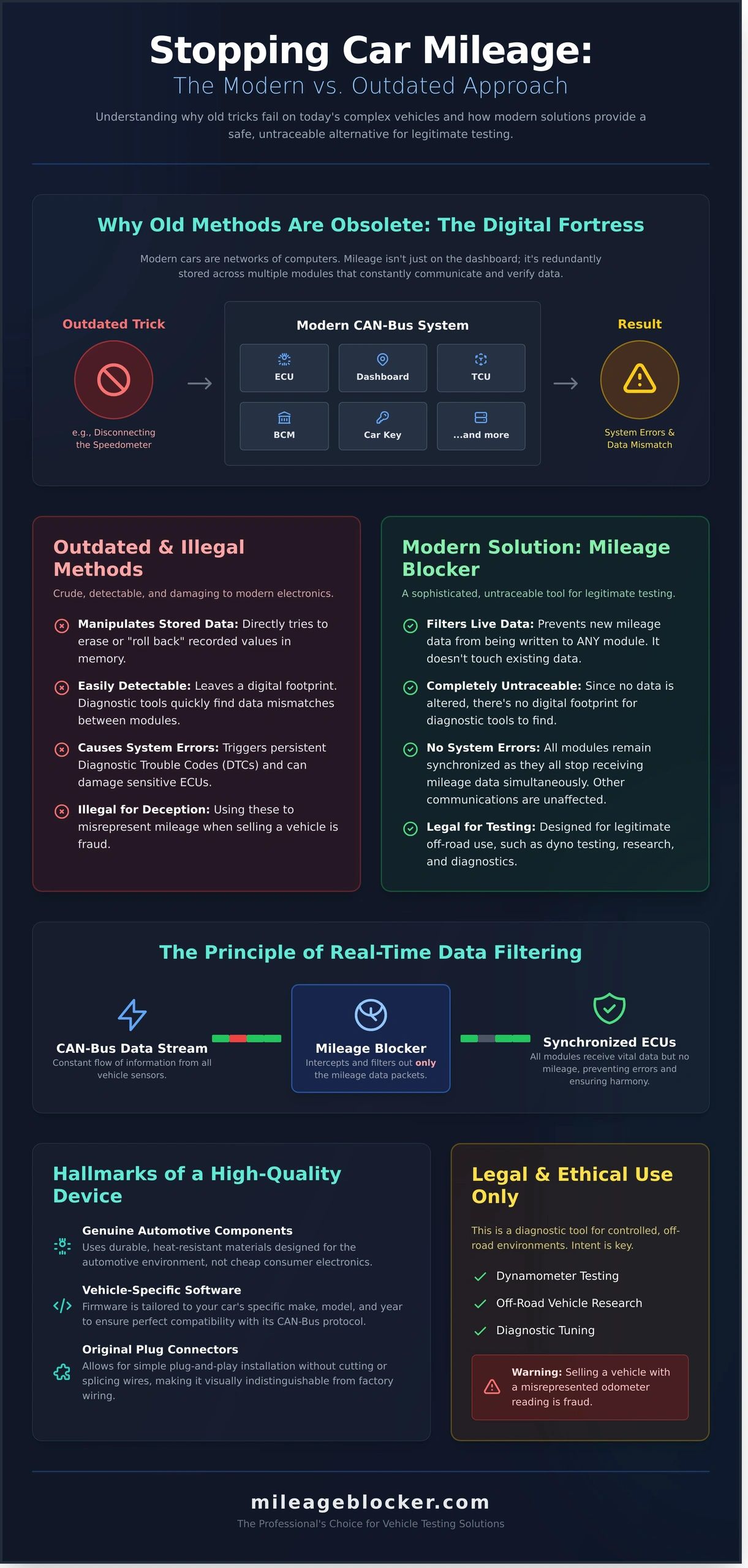
The digital display on your dashboard is merely a screen; the actual mileage data is a digital record stored in multiple locations to create redundancy and prevent tampering. This distributed data storage is a core security feature of modern automotive design. Mileage information is typically recorded in several independent memory modules, including:
- The instrument cluster's EEPROM memory
- The main Engine Control Unit (ECU)
- The Transmission Control Unit (TCU)
- The Body Control Module (BCM)
- In some models, even the car key's memory chip
This redundancy means that simply altering the value in one location is futile. The other modules will instantly recognise the data mismatch during the vehicle's next system check.
Understanding Your Car's CAN-Bus System
Modern vehicles use a Controller Area Network (CAN-Bus) which acts as a central nervous system, allowing dozens of Electronic Control Units (ECUs) to communicate with each other. Modules controlling everything from the engine and ABS to the infotainment system constantly exchange data. Mileage is a critical piece of this data, shared and cross-referenced continuously. If one module reports a different value-or stops reporting altogether-the other modules detect the inconsistency and log a fault code. This makes a traditional approach on how to stop car mileage from increasing impossible without creating traceable errors. The system is specifically engineered to identify and flag these discrepancies.
The Modern Solution: How Mileage Blocker Devices Work
When considering how to stop car mileage from increasing for legitimate off-road or testing purposes, the modern solution is a Mileage Blocker. This is not a crude rollback tool; it's a sophisticated electronic module designed for a highly specific function. It does not erase or alter existing mileage data. Instead, it acts as a specialised filter, intercepting distance information on the vehicle's CAN-Bus network before it is permanently recorded by the odometer and other electronic control units (ECUs). This process ensures all relevant modules remain synchronised, preventing system conflicts or error codes. The intended application for this technology is strictly for ethical uses, such as off-road vehicle testing and research, allowing for diagnostics without adding non-essential road mileage.
The Principle of Real-Time Data Filtering
A Mileage Blocker is installed within the vehicle's existing wiring, typically behind the instrument cluster, where it serves as an intelligent data gatekeeper. It is positioned to intercept signals and selectively filter out the specific data packets corresponding to distance travelled. Crucially, all other vital system information-such as oil pressure, engine temperature, and critical safety system data-is allowed to pass through completely unaffected. This selective filtering is fundamental to its design, ensuring the vehicle maintains full functionality without triggering diagnostic trouble codes (DTCs) that would indicate a system error.
Why a Mileage Stopper is Untraceable
The primary advantage of a premium quality mileage stopper is that its operation is completely untraceable. Unlike illegal mileage correction tools that manipulate data stored in the vehicle's EEPROM memory, a blocker simply prevents that data from being written. Since no mileage is recorded while the device is active, there are no digital inconsistencies for dealership diagnostic tools to flag. Altering recorded mileage is a serious offence, subject to stringent regulations and severe penalties. A Mileage Blocker circumvents this legal minefield entirely by leaving no digital footprint. Furthermore, high-quality modules use genuine automotive-grade components and original plug connectors, making them visually indistinguishable from factory wiring.
Legal and Ethical Guide: Using an Odometer Stopper Correctly
An odometer stopper is a specialised diagnostic tool, not a device for illegal activity. Its primary purpose is to temporarily halt the mileage recording process in controlled, off-road environments. The legality of the device depends entirely on the end-user's intent and application. When searching for how to stop car mileage from increasing, it is crucial to understand that this tool is designed exclusively for testing and tuning purposes, where adding mileage to the vehicle's record would be impractical or misleading.
Permissible Uses for a Mileage Blocker
In a professional context, a mileage blocker offers a smart solution for specific situations. The device should only be activated for the following legitimate uses:
- Dynamometer Testing: For performance tuning, diagnostics, or emissions testing on a dyno, where the wheels are spinning but the vehicle is stationary.
- Off-Road Applications: When operating a vehicle exclusively on private land, such as a farm or a dedicated track, where public road mileage is irrelevant.
- Vehicle Exhibitions: For moving a car short distances at a car show or exhibition without accumulating unnecessary mileage.
- Research & Development: For mechanics, engineers, or manufacturers to test vehicle systems and ECU modules without affecting the official odometer reading.
Prohibited Actions and Legal Consequences
The line between legal and illegal use is clear: deception. Using a mileage blocker on public roads to misrepresent the vehicle's true mileage is odometer fraud, a serious criminal offence in the United Kingdom. This includes activating the device to stay under a lease agreement's mileage cap or to artificially lower the odometer reading before selling the vehicle.
Such actions constitute fraud by false representation. While many associate this crime with older, mechanical odometers, digital systems are equally vulnerable, and authorities are well-aware of modern odometer fraud techniques. Ultimately, the odometer stopper is a tool; its legal status is defined by your actions. The responsibility to act ethically and within the bounds of the law rests solely with the user.
Choosing a High-Quality Mileage Blocker: What to Look For
When researching how to stop car mileage from increasing for legitimate off-road or testing purposes, you will find a vast market of devices. However, not all mileage stoppers are created equal. The difference between a premium, untraceable module and a cheap, unreliable filter can have significant consequences for your vehicle's complex electronic systems. A low-quality device can do more than just fail; it can actively disrupt your car's CAN-Bus network, leading to warning lights, system malfunctions, and potentially costly diagnostic work at a UK garage.
A basic filter simply blocks the mileage signal to the dashboard, but this crude method is easily detectable by diagnostic tools because other electronic control units (ECUs) continue to record the data. A true, high-quality mileage blocker is a smart module that communicates with all relevant ECUs, ensuring the mileage value is consistently halted across the entire vehicle network. This is the only way to achieve a genuinely untraceable effect.
Component and Build Quality
The physical construction of a mileage blocker is a critical indicator of its quality and safety. Inferior products often use cheap, generic components that are not designed for the automotive environment. Look for modules built with genuine automotive-grade components, housed in heat-resistant materials. The use of original plug-and-play connectors is essential. This ensures a perfect, secure fit without the need to cut or splice wires, protecting your vehicle's original wiring loom from damage and preserving its warranty.
Software Integrity and Ease of Use
The intelligence of a mileage blocker lies in its software. A premium device will feature professionally developed, vehicle-specific software designed to integrate seamlessly with your car's systems. This ensures flawless operation and avoids conflicts with other modules. Key features to demand include:
- Simple Activation: The best modules are easily turned on and off using existing steering wheel buttons, providing discreet control.
- Last Setting Memory: A quality device should remember its last used setting, so you don't have to reactivate it every time you start the vehicle.
- Clear Support: Reputable suppliers provide comprehensive instructions and ongoing support. For more detailed information on how these devices function, our mileage blocker FAQ offers clear answers.
Ultimately, investing in a well-engineered device from a trusted supplier like mileageblocker.com not only provides a reliable solution but also offers peace of mind that your vehicle's integrity is protected.
Finding and Installing the Right Device for Your Vehicle
Once you understand the legal applications, the next step in learning how to stop car mileage from increasing is selecting a device that is precisely engineered for your vehicle. Modern cars use complex communication networks, such as the CAN-Bus, where every electronic control unit (ECU) is interconnected. A generic mileage stopper will not work; the software must be tailored to the unique protocol of your specific make and model to function correctly and remain untraceable.
A premium quality mileage blocker integrates seamlessly with your vehicle’s existing systems without causing errors or data conflicts. This specificity is crucial for ensuring that all modules receive the correct filtered data, preserving the full functionality of your car’s safety and assistance features while the device is active for testing purposes.
How to Find a Compatible Device
The most reliable method for finding the correct module is to use a dedicated vehicle search tool on a reputable provider's website. It is essential to input your car's exact make, model, and manufacturing year to ensure perfect compatibility. For example, our catalogue includes dedicated blockers for specific Honda models, each with unique software. If you have any uncertainty about the correct product for your vehicle, always contact the seller’s support team to confirm before purchasing.
The Installation Process: DIY vs. Professional
Most mileage blockers are designed as plug-and-play modules, connecting behind the instrument cluster or digital cockpit. They use genuine automotive-grade connectors, meaning there is no need to cut or solder any wires. For those comfortable with basic vehicle maintenance, a DIY installation is straightforward and typically requires only a few trim removal tools.
However, for complex luxury vehicles or for complete peace of mind, a professional fitting is an excellent option. This ensures the installation is performed flawlessly and efficiently. We offer a dedicated mobile installation service across the UK for all products purchased from mileageblocker.com, providing a convenient and guaranteed solution for our customers.
The Modern Solution for Mileage Control
As we've explored, the days of simple odometer rollbacks are long gone. Modern vehicles feature sophisticated, interconnected electronic systems that make traditional methods obsolete and detectable. Understanding how to stop car mileage from increasing for legitimate off-road or testing purposes requires a technologically advanced solution. The key takeaway is that only a dedicated mileage blocker can effectively and safely pause mileage accumulation across all ECU modules, ensuring no data discrepancies are stored.
When performance and discretion are critical, choosing a superior device is essential. Our mileage stoppers are engineered for excellence, made with genuine automotive-grade components to ensure seamless integration with your vehicle's CAN-Bus system. They deliver a completely untraceable effect, generating no error codes and leaving no digital footprint. For a reliable tool backed by worldwide delivery and lifetime support, look no further.
Equip your vehicle with the market's leading technology. Browse Our Premium Quality Mileage Blocker Devices today and take confident control of your vehicle's diagnostic and testing needs.
Frequently Asked Questions
Is a mileage blocker detectable during servicing or diagnostics?
A premium quality mileage blocker is designed to be completely untraceable. Unlike inferior devices, our modules do not simply hide the mileage on the dashboard; they effectively filter the data from all electronic control units (ECUs). This means that even with sophisticated dealership diagnostic tools, the effect is undetectable. The data is not stored on the blocker itself, leaving no digital footprint once the device is deactivated or removed, ensuring total discretion during servicing.
What is the key difference between a mileage blocker and a mileage correction tool?
The primary difference lies in their function and legality. A mileage blocker is a preventative tool that stops the odometer from recording new miles, intended for off-road vehicle testing or tuning. In contrast, a mileage correction tool, also known as a rollback or clocking device, illegally alters the existing mileage figure stored in the vehicle's memory. Mileage blockers do not change past data, making them a distinct and superior technology for legitimate testing applications.
Do mileage blockers work on electric and hybrid vehicles?
Yes, our mileage blockers are fully compatible with the latest electric (EV) and hybrid vehicles. Modern vehicles, regardless of their powertrain, utilize complex communication systems like the CAN-Bus. We develop vehicle-specific software for each module to ensure flawless integration with these systems. Whether you have a petrol, diesel, hybrid, or fully electric car, our premium quality devices are engineered to function perfectly without causing any system errors or disruptions.
Can I install a mileage stopper device myself?
Absolutely. Our mileage stopper devices are designed for simple, do-it-yourself installation. Each module comes with genuine plug-and-play connectors that match your vehicle’s original wiring, eliminating any need for cutting or soldering wires. The process is straightforward and typically takes less than 30 minutes to complete with basic tools. We provide clear, model-specific installation instructions to guide you through every step, making it an easy task for any vehicle owner.
Is it illegal to stop the mileage on my car?
Using a mileage blocker module is legal in the UK for specific, legitimate purposes such as off-road vehicle testing, performance tuning on a dynamometer, or for research in a controlled environment. However, it is a criminal offence to deceive a buyer by misrepresenting a vehicle's true mileage during a sale. The responsibility for lawful use lies with the vehicle owner, who must ensure they comply with all relevant UK laws and disclose the true mileage when selling the vehicle.
Will using a mileage blocker void my car's warranty?
A high-quality, untraceable mileage blocker should not void your vehicle’s warranty. Because our devices use original connectors and require no permanent modifications like wire-cutting, they can be removed without a trace. This is the most secure method for anyone researching how to stop car mileage from increasing without leaving a digital footprint. For complete peace of mind, you can simply remove the module before any scheduled dealership service or warranty claim.
About the author
Pav TomaszeviczChief Editor, MileageBlocker.com
Pav is Chief Editor at MileageBlocker.com and works with the MileageBlocker Technical Team to publish practical information about vehicle compatibility, CAN/CAN-FD electronics, installation and MileageBlocker products.
View author profile →