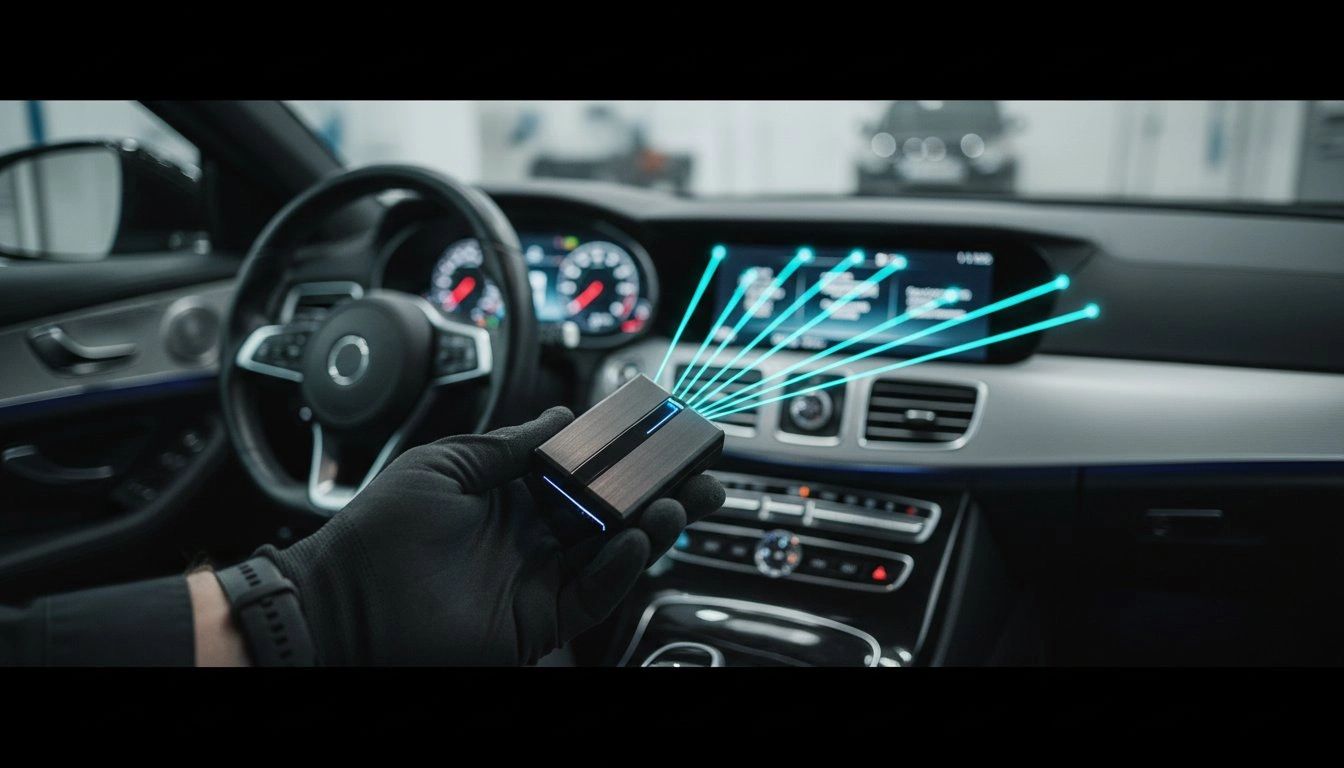
Check Car Mileage History UK: Free MOT & HPI Guide
The Foundation of Verification: Using Official UK MOT and Free History Checks

The Foundation of Verification: Using Official UK MOT and Free History Checks
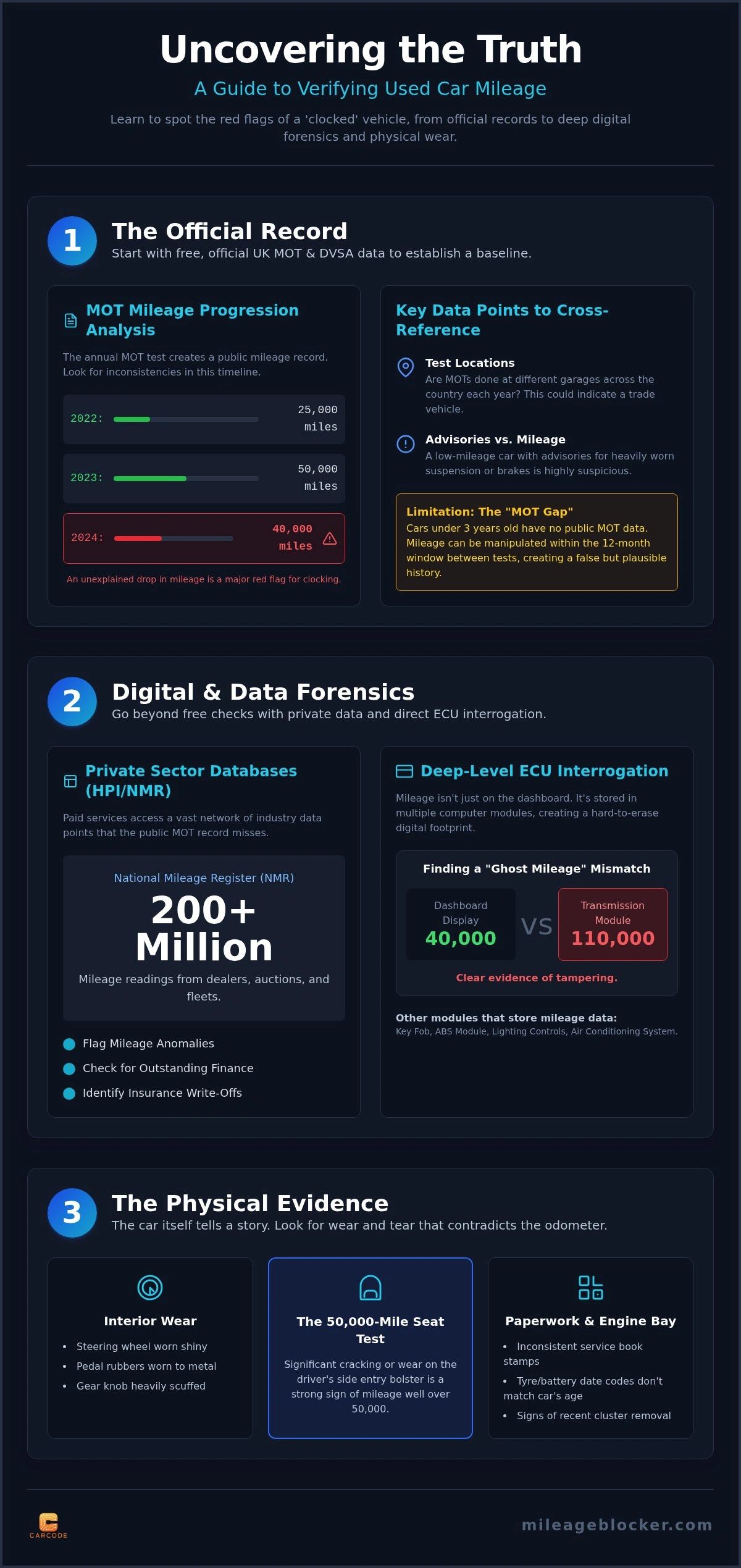
That pristine MOT certificate and clean online history check might not be telling the whole story. While they are the essential first step in verifying a car's past, they are far from foolproof. The official government MOT database is your starting point for any vehicle over three years old in the UK. It establishes a chronological baseline, recording the mileage at each annual test. This is where you’ll spot the most obvious red flags.
The primary thing to look for is a significant, unexplained drop or a bizarre jump in the recorded mileage between tests. A car showing 80,000 miles in 2024 and then 65,000 in 2025 is an immediate cause for concern. However, these free checks only provide a snapshot in time. They leave a 12-month window between each test where the odometer reading can be manipulated without leaving an obvious trace on the public record. For vehicles under three years old, there's a complete absence of public data, an issue we call the 'MOT gap'. This makes verifying the history of a nearly-new vehicle, like a recent Ford Ranger, particularly challenging without turning to other methods. If you're involved in the testing of such vehicles, a Ford Ranger mileage can blocker is a specialist tool used to prevent mileage accumulation during off-road evaluations.
Interpreting the DVSA Digital Record
The DVSA's online portal offers more than just the raw numbers. Using the 11-digit V5C logbook reference number, you can view the specific garage that conducted each MOT. A vehicle tested at different locations across the country every year could suggest it's been passed around the trade, or it might have a perfectly innocent explanation. The real insight comes from cross-referencing the recorded mileage with the test's 'minor defects' and 'advisories'. A car with 30,000 miles on the clock but advisories for worn suspension bushes or corroded brake pipes should make you suspicious. These wear patterns are more consistent with a vehicle that has covered significantly more ground.
The Limitations of Public Data
It's a common mistake to assume a clean MOT history guarantees a genuine odometer reading. In the digital era, sophisticated methods can be used to alter mileage without it being immediately obvious on a basic check. A 'clocked' car could have its mileage reduced just before an MOT, driven for 11 months, and then 'corrected' again before the next test, creating a plausible but false progression. Another complication is the use of private plates. A cherished registration number can move from car to car, sometimes making it tricky to trace the vehicle's original history. You must ensure you are checking the history against the car's VIN and original registration, not just the current private plate.
Beyond the Odometer: Investigating HPI, NMR, and Hidden ECU Modules
To get a true picture, you must look beyond the free government data. This is where paid services like HPI and Carfax come in, providing access to private industry databases. The most significant of these is the National Mileage Register (NMR), a vast repository containing over 200 million mileage readings sourced from auctions, dealerships, and fleet operators. It acts as the trade's private 'black book', often catching discrepancies that the public MOT record misses.
HPI and similar reports aggregate this data, along with information from insurance companies (has it been written off?) and finance houses (is there outstanding debt?). This is crucial. But modern cars have another layer of defence, and of complexity. They are built on a CAN-bus architecture, a complex network where multiple computers, or Electronic Control Units (ECU), communicate. Mileage isn't just stored on the dashboard display; it's mirrored and logged in various modules. Modern vehicles often store distance data in unexpected places, such as the key fob and lighting control modules, creating a digital footprint that is very difficult to erase completely.
The Role of Private Sector Databases
An HPI check is essential for uncovering 'mileage anomalies' that have been flagged by professionals. For instance, if a finance company recorded the mileage at 95,000 during a valuation but the car is now for sale showing 50,000, an HPI check will flag this inconsistency. For vehicles that have been imported, reports from providers like Carfax are invaluable. They can help track the history of a car from another country, filling in gaps that UK-only databases cannot see. This is especially important for high-value or specialist cars, like a supercar, where a complete history is paramount. The complex electronics in a vehicle like a McLaren mean that only specialised tools, such as a McLaren 720s mileage blocker, can interface with its systems for legitimate testing purposes.
Deep-Level ECU Interrogation
This is the forensic level of mileage investigation. Professionals can plug diagnostic tools directly into the car's OBDII port to communicate with its various ECUs. The goal is to find discrepancies between what the instrument cluster (the dashboard) is showing and what other modules have recorded. The Transmission Control Module (TCM), for example, often keeps its own mileage log. If the dashboard says 40,000 miles but the TCM says 110,000, you've found clear evidence of tampering.
Advanced dealer-level tools like BMW's ISTA or VW's ODIS can go even deeper. They can reveal 'ghost' mileage stored in the ABS module or even the air conditioning system. This data is often protected and not easily altered, providing a reliable backup record of the vehicle's true distance travelled.
Detecting Discrepancies: A Physical and Digital Inspection Framework
Sometimes, the most reliable tool is your own intuition, backed by a thorough physical inspection. The car itself tells a story that numbers on a screen cannot. Start with a tactile check of the interior. A car with a claimed 30,000 miles should not have a steering wheel that's shiny and worn smooth, pedal rubbers worn down to the metal, or a heavily scuffed driver's seat bolster. For premium vehicles with leather interiors, we use what we call the '50,000-mile seat bolster test'; significant cracking or wear on the driver's side entry bolster is a strong indicator of a mileage well north of that figure.
Next, scrutinise the service book. Look for inconsistent ink or stamps from garages that no longer exist. Are the pages in chronological order, or does it look like some have been removed? A genuine, fully stamped service history is a valuable asset. If you have access to a high-quality OBDII scanner, you can check for communication errors. These can sometimes suggest that the instrument cluster has been recently removed or tampered with, which is a necessary step in most 'clocking' procedures.
Physical Red Flags in the Engine Bay
The condition under the bonnet can also provide clues. Check the date codes stamped on the tyres and the battery. If a car is five years old with a claimed 20,000 miles but is wearing its third set of tyres, something doesn't add up. Look at the front of the car. A vehicle used primarily for motorway driving will have a radiator peppered with stone chips and damaged cooling fins. A low-mileage city car simply won't show this level of wear and tear.
Digital Diagnostic Verification
If you can get access to the car's onboard computer, a key piece of data to check is the 'engine hours'. This is a log of the total time the engine has been running. You can perform a simple calculation: divide the displayed mileage by the engine hours to get an average speed over the car's lifetime. If a car with 50,000 miles has an average speed of 15 mph, it's likely a city car with a plausible history. If its average speed is 65 mph, it suggests a life spent on the motorway, which could mean the true mileage is far higher. You can learn more by reading our guide on converting engine hours to miles. Finally, some modern digital clusters, particularly from brands like BMW, will display a small 'tamper dot' on the screen if the mileage stored in the cluster doesn't match the data stored elsewhere in the car, like the key.
Professional Mileage Management: Legitimate Tools for Testing and Protection
It's crucial to understand the difference between illegal odometer fraud and the legitimate use of professional tools in controlled environments. The act of deceptively rolling back an odometer to misrepresent a vehicle's value is illegal and is known as 'clocking'. However, there is a class of professional hardware, often called a Mileage Blocker or Mileage Stopper, designed for an entirely different and legitimate purpose.
These devices are engineered to halt the recording of mileage during specific testing scenarios. For example, a manufacturer or tuning company conducting dynamometer (dyno) runs needs to test an engine under load without adding thousands of "false" miles to the odometer. A Mileage Freezer is used here to ensure the vehicle's service intervals remain accurate. We insist on using high-grade German components to build our devices, as this prevents the CAN-bus errors and dashboard warning lights that plague inferior products. For commercial vehicles undergoing extensive modification or testing, such as a Ford Transit Connect Custom mileage blocker, this ensures the base vehicle's warranty and service data isn't corrupted before it even enters service.
Authorised Use Cases for Mileage Blockers
The primary authorised use for a mileage blocker is for off-road vehicle testing. When developing new components or evaluating performance on a private track, it is essential that the miles covered do not count towards the road-legal service history. Similarly, specialist vehicle transport companies use these tools when moving high-value supercars for logistical purposes. It prevents unnecessary mileage from being added during loading, unloading, and short-distance manoeuvres. These are preventative tools used to preserve the integrity of the vehicle's data during non-standard operation.
Ensuring System Integrity with Professional Fitting
While some of our clients are technically proficient, we always highlight the risks of DIY wiring. Modern vehicle electronics are incredibly complex. An incorrect installation can interfere with critical Advanced Driver Assistance Systems (ADAS). That's why we advocate for professional installation services that use OEM-grade connectors, ensuring a seamless and reversible integration. To ensure you have the correct hardware that integrates perfectly with your car's specific software, it's vital to find your specific car model on our compatibility list before purchase. This guarantees the device will function as intended without disrupting other vehicle systems.
The final step in your verification process is to take all this information—the public records, the private data, the physical inspection—and see if it tells a consistent story. If there are contradictions, walk away. This week, find a car you are interested in online and run its registration through the free GOV.UK MOT checker. Don't just look at the pass/fail result; scrutinise the mileage history between each test and see what story it really tells you.
Frequently Asked Questions
Is it illegal to use a mileage blocker in the UK for off-road testing?
No. Using a mileage blocker for its intended purpose, such as on a private track or during dynamometer testing, is legal. It only becomes illegal if the tool is used to deceive a potential buyer about the vehicle's true mileage on public roads.
Can an HPI check detect a mileage blocker that was used previously?
An HPI check cannot detect the physical device. Its purpose is to flag discrepancies in recorded mileage from its various data sources (auctions, finance companies, etc.). A high-quality blocker, when removed, leaves no digital trace, which is why a multi-layered verification process is so important.
What should I do if I find a mileage discrepancy on a car I just bought?
If you've purchased a car from a dealer and can prove it was 'clocked', you have rights under the Consumer Rights Act 2015. You should contact the dealer immediately and also report the issue to Citizens Advice and Trading Standards. Proving it can be difficult, which is why pre-purchase checks are vital.
Do modern digital odometers store mileage in the engine's ECU?
Yes, and in many other places too. Mileage data is often stored in the main Engine Control Unit (ECU), the transmission module, the ABS controller, the body control module, and sometimes even the key. This redundancy is what makes it so hard for fraudsters to alter the mileage without leaving a trace somewhere.
About the author
Pav TomaszeviczChief Editor, MileageBlocker.com
Pav is Chief Editor at MileageBlocker.com and works with the MileageBlocker Technical Team to publish practical information about vehicle compatibility, CAN/CAN-FD electronics, installation and MileageBlocker products.
View author profile →