How to Keep Mileage Down on a Car: Professional Guide
A new vehicle''s value drops by about 12.5% in the first year of ownership. Much of that financial hit is tied directly to the digits on your dashboard. We&#x...

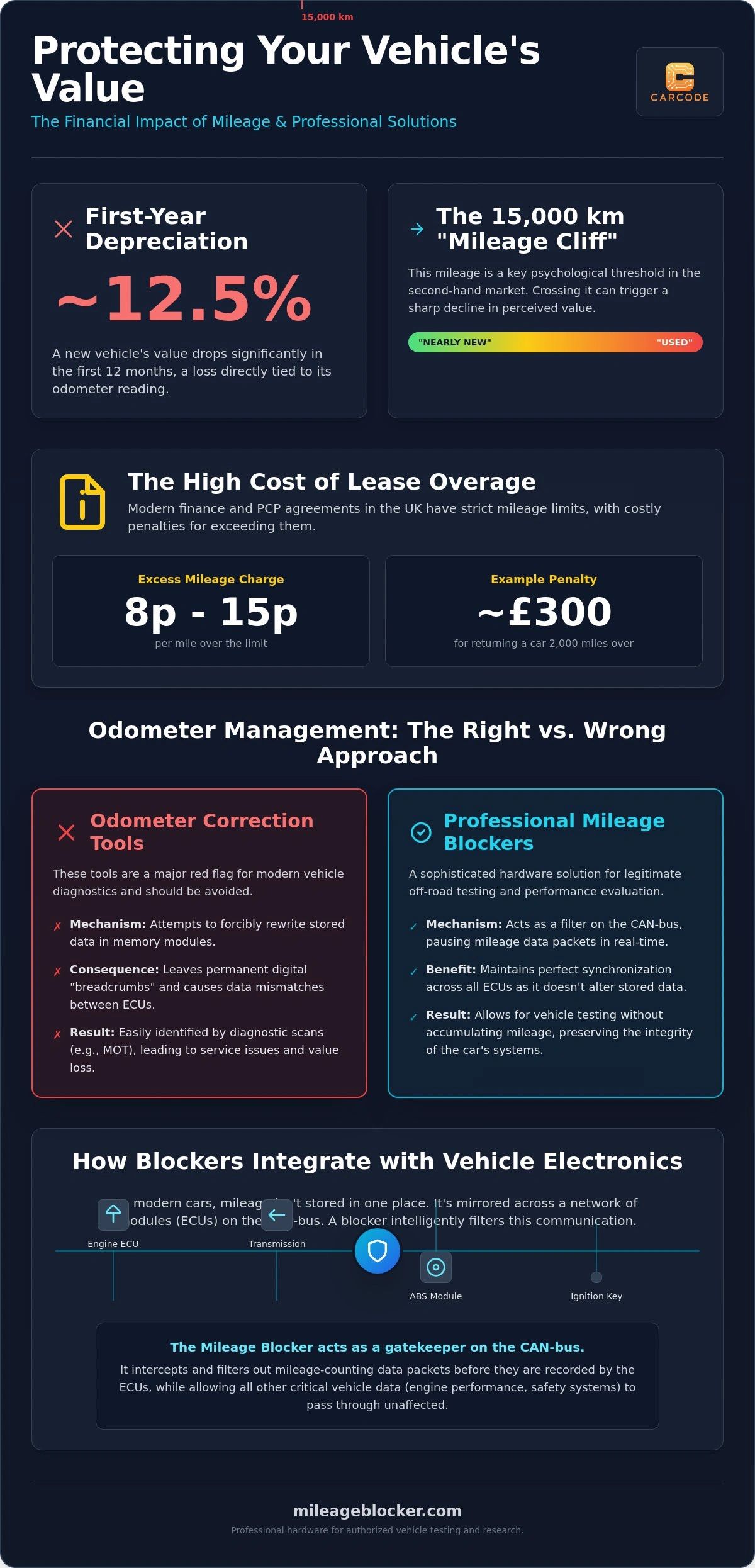
A new vehicle's value drops by about 12.5% in the first year of ownership. Much of that financial hit is tied directly to the digits on your dashboard. We’ve seen owners of 2024 Porsche 911s or Audi R8s lose thousands in resale value just by crossing a specific mileage threshold. If you are researching how to keep mileage down on a car, you likely feel the pressure of approaching a lease limit. It’s a quantifiable financial risk. Each mile driven impacts the bottom line.
We understand that finding a reliable way to manage these figures without triggering ECU errors or desynchronizing the electronics is your primary concern. In our workshop, we focus on hardware that maintains the integrity of the vehicle’s communication protocols. Such precision is vital during authorized testing and performance evaluations. You will learn how to use professional-grade hardware and strategic lifestyle adjustments to protect your car’s value. We will also examine the technical differences between simple alteration tools and sophisticated mileage blockers. These steps provide a clear path for effective vehicle management.
Key Takeaways
- Identify the 15,000-kilometre psychological threshold that buyers use to determine value and avoid the rapid depreciation cliff.
- Discover how to keep mileage down on a car by integrating professional hardware with lifestyle adjustments to protect your financial investment.
- Distinguish between problematic odometer correction software and sophisticated mileage blockers that filter data packets within the vehicle's CAN-bus system.
- Learn why high-performance models like the 2026 Audi RS6 require specialized hardware to ensure all electronic control units remain perfectly synchronized.
- Execute a professional installation strategy to prevent diagnostic errors and maintain the discreet operation of your mileage management tools.
Why the 15,000 Kilometre Threshold Matters for Car Value
Buyers in the second-hand market treat the 15,000-kilometre mark as a definitive line in the sand. Once a vehicle crosses this threshold, it shifts from "nearly new" to "used" in the eyes of automated valuation algorithms and discerning private buyers. We’ve seen high-performance vehicles in our workshop lose thousands in trade-in value simply because the owner didn't know how to keep mileage down on a car during a long-distance testing phase. This "mileage cliff" is particularly steep in the UK, where buyers are notoriously sensitive to odometer readings. Depreciation remains the single largest cost of car ownership in 2026. A car's odometer serves as a direct ticker for this financial loss.
The Financial Impact of Odometer Readings on Resale
A 2025 Porsche Taycan with 10,000 miles on the clock carries a significantly higher premium than an identical model with 20,000 miles. Collectors and high-end dealerships prioritize "delivery mileage" or "low-use" status to justify top-tier pricing. According to 2026 Carfax data, a vehicle loses roughly 12.5% of its value in the first year alone. If you exceed the average annual mileage, that percentage can spike. High-performance models suffer the most. Every additional mile suggests wear on specialized components like ceramic brakes or high-strung turbochargers, making low-mileage examples highly sought after.
Lease and PCP Constraints in the 2026 UK Market
Modern finance agreements are stricter than ever. Most standard 2026 UK contracts include excess mileage charges ranging from 8p to 15p per mile. If you return a car 2,000 miles over the limit, you could face an immediate penalty of up to £300. Buying extra miles mid-contract is rarely a smart financial move. Providers often charge a premium for the adjustment, which eats into your equity. Managing your mileage proactively ensures you avoid these end-of-term surprises. If your car is used for legitimate testing or off-road performance evaluation, it's essential to understand how to keep mileage down on a car to prevent these miles from accumulating on the permanent record.
Evaluating Solutions to Minimise Odometer Accumulation
If you want to know how to keep mileage down on a car, you might start with basic lifestyle changes. Carpooling or working from home can shave off a few hundred miles over a month. However, for professional testers or those verifying performance in a controlled environment, simply driving less isn't a viable strategy. We’ve seen owners use enclosed transport to move assets like a 2025 Ferrari 296 GTB between tracks. This prevents "dead miles" during transit but doesn't help when the engine must run for diagnostic purposes. Passive methods fail when you need to verify vehicle performance without inflating the permanent record.
Lifestyle Adjustments vs. Technical Interventions
Lifestyle adjustments are passive and limited. They don't address the specific need to test electronic systems without recording every rotation of the wheels. High-value vehicles require precise management of mileage and vehicle value, especially when every mile recorded during a dyno test translates to immediate depreciation. Technical interventions provide the control that professional drivers require during authorized testing sessions.
The Difference Between Blockers and Correction Tools
This is where many owners make a critical mistake. Mileage correction tools are a major red flag for modern digital diagnostics. These tools attempt to rewrite memory modules, often leaving digital breadcrumbs that 2026 MOT digital scans identify immediately. In contrast, a mileage blocker acts as a filter. It pauses the data flow between the speed sensor and the dashboard during testing. If you're evaluating how to keep mileage down on a car for testing purposes, professional hardware is the only way to maintain ECU synchronization.
Professional-grade hardware ensures that data remains consistent across all Electronic Control Units (ECUs). DIY methods or cheap OBDII plug-ins often fail to stop the mileage in the ABS or transmission modules. This creates a visible discrepancy during a routine service. High-quality devices use heat-resistant connectors and original-style plugs to prevent signal noise. If you are unsure which hardware fits your specific model, you can find your car in our compatibility database to ensure a perfect match.
How High-Performance Mileage Blockers Integrate with Vehicle ECUs
Modern vehicle electronics operate on a complex Controller Area Network, commonly known as the CAN-bus. In high-performance models like the 2026 BMW M5 or the Audi RS6, this system acts as the central nervous system, where dozens of modules communicate via rapid data packets. If you are researching how to keep mileage down on a car, you must understand that the odometer reading is no longer stored in a single location. It is mirrored across the engine control unit, the transmission module, and even the ignition key. Our hardware intercepts these specific data packets in real-time, filtering out the mileage increment signals while allowing all other critical data to pass through unaffected.
A common oversight in vehicle testing is failing to account for engine run-time. High-end diagnostic tools can identify discrepancies if the odometer remains static while the engine hours continue to climb. To maintain technical consistency, we recommend consulting our engine hours to miles guide. This ensures your testing data remains synchronised across all parameters. While the NHTSA provides clear warnings regarding Odometer Fraud in commercial settings, our tools are engineered specifically for discreet, authorised performance evaluation where data integrity is paramount.
Understanding CAN-bus Communication Protocols
You cannot simply install a physical switch to stop a modern digital cockpit. Doing so often triggers a "Christmas tree" effect on the dashboard, where every warning light from the ABS to the traction control illuminates simultaneously. High-quality blockers utilise proprietary software to mimic Original Equipment Manufacturer (OEM) signals. This level of integration ensures the vehicle's safety systems remain fully operational during your testing phase. We’ve seen many inferior chips fail because they cannot handle the data baud rate of 2026 luxury vehicles.
Why German-Engineered Components Outperform Cheap Alternatives
Heat resistance is a critical factor often ignored by manufacturers of low-cost clones. In the cramped space behind a dashboard, temperatures can reach levels that cause standard microchips to desolder or glitch. We utilise only heat-resistant German microchips designed for automotive environments. These units feature OEM-standard connectors that click directly into your factory wiring loom without the need for cutting or soldering. This prevents physical damage and ensures the operation remains entirely discreet. If you are ready to secure your vehicle’s electronics, you can browse our range of mileage blocker devices today.
Implementing a Professional Mileage Management Strategy
Selecting the right hardware is the first step toward effective vehicle management. If you own a 2024 Lamborghini Huracán or a McLaren 750S, you cannot rely on generic tools that might compromise the complex digital dash. You must ensure the software matches your vehicle’s specific firmware version. We always recommend a professional installation to ensure that the device is seated correctly behind the instrument cluster. This prevents any physical trace evidence, such as loose trim panels or damaged clips, which are common with DIY attempts. In our workshop, we’ve seen how a poorly fitted device can cause intermittent communication faults on the CAN-bus.
Before you begin any track testing or performance evaluation, you must verify that the device is functioning as intended. Use this short checklist to confirm the system is active:
- Start the engine and wait for the digital cockpit to initialise completely.
- Hold the designated activation button on the steering wheel for five seconds.
- Drive a short, controlled distance on private land to ensure the odometer remains static.
Installation and Discreet Operation in Supercars
Modern kits are designed as plug-and-play solutions. This means you don't have to cut or solder any part of the original wiring loom. By finding your car in a verified database, you ensure that the connectors are an exact match for the factory pins. Once installed, these devices operate with total discretion. You can typically activate or deactivate the blocking function using a specific sequence of steering wheel buttons, such as the 'Mode' or 'Res' switches. This allows you to toggle the device only when you are on private land or a closed circuit.
Documenting Off-Road and Private Track Use
Transparency is your best defense when managing vehicle data. If you are evaluating how to keep mileage down on a car during performance trials, keep a dedicated logbook for those sessions. Record the date, the specific track, and the estimated distance covered while the device was active. This documentation is vital if you ever decide to sell the vehicle. You can present the logbook to a buyer to explain the discrepancy between the odometer and the actual wear on the car. These tools are strictly for research and testing purposes. Using them to misrepresent a car's history to a buyer is illegal and unethical. Within the next week, you should verify your lease agreement's specific terms regarding off-road use and purchase the appropriate hardware for your upcoming testing sessions.
Secure Your Vehicle’s Future Market Value
Managing vehicle data is a technical necessity for any professional driver or high-end car owner. You now understand that the 15,000-kilometre threshold is a psychological cliff for buyers and that simple lifestyle changes often fall short during rigorous performance testing. By prioritising hardware that synchronises with the CAN-bus, you avoid the digital discrepancies that trigger error codes and devalue your asset. Knowing how to keep mileage down on a car for authorised testing ensures you stay within lease limits while maintaining the integrity of your engine hours and electronics. Precision is the only way to avoid the rapid depreciation cliff seen in the first year of ownership.
We provide worldwide shipping with tracked delivery to ensure your hardware arrives safely. Our high-quality German-engineered components offer the reliability required for 2026 luxury models, backed by full technical support and expert installation services. Protect your investment with a solution designed for engineering excellence. Find the correct mileage blocker for your vehicle here and take control of your car's depreciation today.
Frequently Asked Questions
Is it illegal to use a mileage blocker in the UK?
Operating a mileage blocker is legal in the UK when used for authorised testing, research, or off-road performance evaluation. It's a tool designed for professionals who need to verify vehicle systems without inflating the odometer during controlled sessions. However, using the device to misrepresent a vehicle's history to a buyer or insurance company is a criminal offence. You must ensure your use case remains within legal and ethical boundaries at all times.
Will a mileage blocker be detected during a standard MOT test?
A standard MOT focuses on safety components and emissions, so a visual inspection will not reveal the hidden hardware. Modern 2026 digital diagnostic scans are more sophisticated than previous years. If the device remains active during a test, the static odometer reading might conflict with other internal data modules. We always recommend deactivating the tool before any official inspection or service to maintain data consistency across the vehicle’s network.
Does the device affect the car's speedometer or cruise control?
High-performance blockers are engineered to filter mileage data packets without interfering with the speedometer or cruise control systems. In vehicles like the 2025 BMW M3, our software ensures that all safety-critical systems remain fully functional during testing. Cheap clones often cause the speedometer to drop to zero or trigger ABS errors. Professional-grade hardware avoids these issues by mimicking OEM signals within the CAN-bus.
Can I install a mileage blocker myself or do I need a specialist?
Most modern kits feature plug-and-play connectors that allow for a DIY installation if you're comfortable removing dashboard trim panels. If you want to ensure the most discreet finish without risking damage to fragile factory clips, we recommend using a specialist fitting service. This is particularly vital for supercars where interior components are expensive to replace. A professional fit ensures the device is seated correctly and remains invisible to casual observation.
What happens to the mileage data when I turn the blocker off?
When you deactivate the device, the odometer resumes recording miles from the exact figure currently displayed on the dashboard. The miles covered while the device was active are not added retrospectively. This is a key reason why owners research how to keep mileage down on a car for track days or dyno testing. The system simply continues its normal operation from the paused state without any sudden jumps in the recorded distance.
About the author
Pav TomaszeviczChief Editor, MileageBlocker.com
Pav is Chief Editor at MileageBlocker.com and works with the MileageBlocker Technical Team to publish practical information about vehicle compatibility, CAN/CAN-FD electronics, installation and MileageBlocker products.
View author profile →