How to Convert Engine Hours to Miles: A Simple Guide
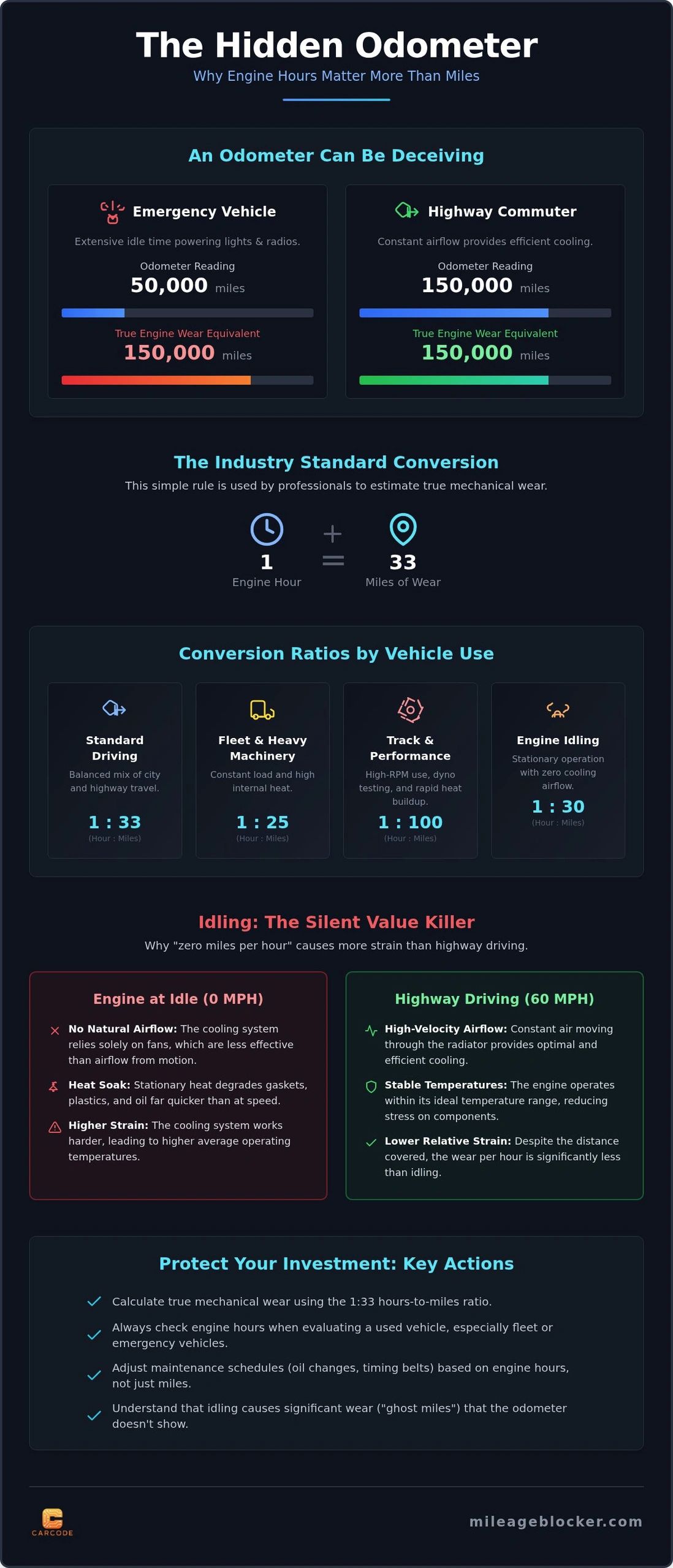
A police cruiser sitting at a scene might show 50,000 miles on the dash, but its engine has often endured the wear of 150,000 miles. It''s a hidden killer of ...
A police cruiser sitting at a scene might show 50,000 miles on the dash, but its engine has often endured the wear of 150,000 miles. It's a hidden killer of resale value. We've seen professional buyers get burned by clean odometers that hide thousands of hours of punishing idle time. You likely suspect that the odometer isn't giving you the full picture. You're right to be cautious. We'll show you exactly how to bridge that gap using a reliable Hours to Miles Calculator: How to Convert Engine Hours on Any Vehicle. You'll learn the specific formulas used by giants like Caterpillar and Ford. It's simple math. We'll also break down the 1:33 conversion ratio and explain how to protect your electronic data during specialized off-road or dyno testing. This ensures you aren't guessing about engine strain. Accurate data is the only way to safeguard your investment and keep maintenance schedules on track.
Key Takeaways
- Learn the industry-standard 1:33 ratio to calculate the true mechanical wear on your engine.
- Discover why idling at zero miles per hour often causes more strain than highway driving due to reduced airflow.
- Access our Hours to Miles Calculator: How to Convert Engine Hours on Any Vehicle to determine accurate resale value and service needs.
- Identify how high-quality hardware keeps ECU data synchronized during specialized off-road or dyno testing sessions.
- Adjust your maintenance schedule to account for hidden engine strain that an odometer alone cannot track.
The Hidden Odometer: Why Engine Hours Often Outweigh Mileage
Engine hours represent the total time a vehicle's crankshaft has been in motion. This clock starts the second the ignition fires and only stops when the engine is killed. While traditional mileage tracking measures how many times the tires have rotated, it ignores the thousands of internal combustion cycles occurring while a car sits in a driveway. In our business, we see this discrepancy constantly. Heavy machinery manufacturers like Caterpillar or marine engine builders like Volvo Penta abandoned mileage as a primary metric decades ago. They rely on hour meters because a generator or a boat engine faces significant stress without ever moving a single foot.
By 2026, savvy car buyers have caught on to this logic. They no longer trust the dashboard alone. Instead, they look for an Hours to Miles Calculator: How to Convert Engine Hours on Any Vehicle to find the mechanical truth hidden in the ECU. This hidden data reveals the actual strain on the pistons, oil, and cooling system. It's the difference between a highway-driven sedan and a city-bound vehicle that spent half its life in gridlock. Internal components don't care about distance. They care about friction and heat.
Modern vehicles log these stats deep within their internal memory modules. Accessing this information provides a transparent look at a vehicle's history. It's the only way to verify if a car was used for gentle commutes or grueling stationary work. If you are evaluating a pre-owned purchase, you can find your car to see which electronic modules track these critical run-time metrics.
When the Odometer Lies: The Case of the Idle Engine
Emergency vehicles and taxis are the clearest examples of why mileage is a flawed metric. A police cruiser might spend eight hours a day running its engine to power lights, radios, and climate control while sitting stationary. On paper, it looks like a low-mileage gem. In reality, the engine is exhausted. High run-time at idle means the oil has been heat-cycled hundreds of times without the benefit of highway airflow. We've seen engines with 40,000 miles that possess the internal wear of a car with 120,000 miles. Don't be fooled by a clean dash. Always check the hours.
The Math of Wear: How to Convert Engine Hours to Miles
Calculating mechanical fatigue requires more than a glance at the odometer. It demands a formula. The most reliable industry-standard heuristic states that one engine hour equals approximately 33 miles of driving wear. This 1:33 ratio is the foundation of any professional Hours to Miles Calculator: How to Convert Engine Hours on Any Vehicle. The "33-mile rule" represents a balanced average of combined city and highway driving cycles. You can adjust this. If your vehicle spends its life as a highway cruiser, use a 1:40 ratio instead. The basic calculation remains consistent: Total Engine Hours x 33 = Estimated Mileage Equivalent.
Calculating Fleet and Heavy Machinery Equivalents
Vans and heavy goods vehicles (HGVs) operate under constant load. Because of the added weight, a 1:25 conversion ratio provides a more realistic view of the engine's lifespan. The internal heat generated during heavy hauling at low speeds is far more damaging than cruising at 60 mph. These figures aren't just for show. Use them to justify critical maintenance intervals like oil changes and timing belt replacements. If you ignore the hour count on a fleet van, you risk catastrophic component failure before the odometer suggests a service is due.
Performance Car Metrics: Track vs. Street Hours
High-RPM track use or dyno testing changes the math entirely. One hour of aggressive driving at redline is roughly equivalent to 100 miles of standard street wear. It's punishing. Heat builds up rapidly without the consistent airflow of open-road driving. If you are conducting performance evaluations, you can check our mileage blocker FAQ to see how to pause odometer recording without losing ECU synchronization. This allows for accurate testing while maintaining the integrity of the vehicle's electronic logs.
Idle Hours vs. Driving Miles: The Silent Value Killer
Many owners assume that if the speedometer reads zero, the engine is resting. This is a dangerous misconception. Idling is one of the most stressful states for an internal combustion engine. Without the forward motion of the car, there is no natural high-velocity airflow through the radiator. The cooling system works harder. It relies entirely on electric fans to reject heat, which often leads to higher internal operating temperatures than highway cruising. We've seen this stationary heat soak degrade gaskets and plastic cooling components long before the odometer suggests a problem.
By 2026, most high-end ECU systems from manufacturers like BMW M5 and Porsche 911 992 log idle time as a distinct data point. They recognize that these "ghost miles" impact the vehicle's health. If you are assessing a luxury asset, you need a precise Hours to Miles Calculator: How to Convert Engine Hours on Any Vehicle to account for this stationary strain. A supercar with 5,000 miles but 400 idle hours is not the collector-grade machine the dash suggests. It's a vehicle with a significant thermal history that buyers will use to negotiate a lower price. Internal wear doesn't stop just because the wheels do.
The 1-to-30 Idle Rule
A widely accepted mechanical standard is that one hour of idling is equivalent to 30 miles of driving wear. You can spot these high-idle vehicles by checking for carbon buildup in the exhaust or listening for subtle valvetrain noise that shouldn't exist at low mileage. If you want to ensure your testing data remains accurate without inflating these metrics during stationary evaluations, you should find your car and see which hardware solutions we offer for your specific model. Using high-quality tools prevents the ECU from logging unnecessary strain during specialized testing or dyno sessions.
Managing Vehicle Data During Testing and Evaluation
Maintaining data integrity during specialized vehicle testing requires more than just stopping the clock. It's about precision. Whether you are conducting off-road evaluations or dyno-tuning a high-performance build, you need to ensure your electronic control units (ECUs) remain in perfect synchronization. High-quality mileage blockers allow professionals to pause odometer accumulation. They do this without disrupting the complex communication protocols between the engine, transmission, and dashboard modules. Professional installation services ensure that these devices are integrated correctly into the vehicle's wiring loom. This prevents the data corruption common with DIY attempts.
We recommend a dual-logging approach for any rigorous testing phase. Even when the odometer is paused, the engine continues to cycle. Always document your starting and ending engine hours alongside your recorded test mileage. By using an Hours to Miles Calculator: How to Convert Engine Hours on Any Vehicle during your post-test analysis, you can accurately account for the wear sustained during stationary or high-load testing sessions. This practice provides a complete mechanical audit trail for the vehicle. It's the only way to maintain a truly transparent service history.
Choosing High-Grade Components for Data Accuracy
The market is flooded with low-cost clones. These often cause mileage jumps or trigger permanent ECU error codes. These cheap devices fail to filter the CAN bus signals properly. For high-performance vehicles from brands like BMW, Audi Q7, or Mercedes-Benz, German-engineered hardware is a requirement. It's not an option. These vehicles utilize sophisticated internal memory modules that are sensitive to signal interference. By using a professional-grade Hours to Miles Calculator: How to Convert Engine Hours on Any Vehicle, you ensure your data remains clean. To see which tools are compatible with your specific model, you can find your car in our compatibility database. Reliable testing depends on hardware that respects the vehicle's original electronic architecture.
Securing Your Vehicle's Mechanical Truth
Understanding the mechanical reality of your engine is the only way to avoid costly surprises. You now have the formulas. You know that idling at zero mph is just as punishing as highway driving. This week, take ten minutes to check your vehicle's service menu or use an OBDII scanner to pull the total run-time. Use our Hours to Miles Calculator: How to Convert Engine Hours on Any Vehicle to compare that data against your odometer. If the numbers don't align, adjust your maintenance schedule immediately.
For those conducting specialized off-road or dyno evaluations, maintaining the integrity of this data is paramount. We provide German-engineered hardware designed for precise, discreet operation. Our specialist technical support and discreet worldwide shipping ensure you have the highest quality tools for your project. Find the right mileage blocker for your vehicle testing needs today. Protect your investment by prioritizing the engine's heart over the dashboard's display.
Common Questions About Engine Hours and Mileage
Does a mileage blocker stop the engine hours counter from running?
No, a professional mileage blocker does not stop the engine hour counter. These devices are engineered to pause the odometer during specialized testing by filtering specific CAN bus signals, but the ECU continues to track the total time the crankshaft is in motion. This distinction is critical for maintaining an honest mechanical record during off-road or dyno evaluations. It ensures that while the distance isn't logged, the engine's actual run-time remains accurate for service intervals.
How do I check the engine hours on my vehicle without a scanner?
You can often access engine hours through the vehicle's onboard trip computer or hidden service menus. Brands like Ford and Ram frequently include an "Engine Information" tab in the dashboard display that shows both total hours and idle hours. If your car doesn't have a visible menu, you may need a basic OBDII reader to pull the data. Our Hours to Miles Calculator: How to Convert Engine Hours on Any Vehicle relies on this data to give you a true wear estimate.
Is 5000 engine hours a lot for a standard petrol car?
Yes, 5,000 engine hours is significant for a standard petrol car. Using the industry-standard 1:33 ratio, 5,000 hours equates to roughly 165,000 miles of mechanical wear. Most petrol engines begin to require major component overhauls, such as timing chains or water pumps, long before reaching this threshold. If you see high hours on a low-mileage car, it likely spent years idling in heavy traffic or served as a stationary power source.
Why does the dealership care about engine hours during a part-exchange?
Dealerships use engine hours to identify "hidden" wear that the odometer doesn't show. A car with low mileage but high engine hours suggests the vehicle was used as a taxi or an emergency unit. This type of usage leads to carbon buildup and transmission wear that wouldn't be apparent during a standard test drive. They want to ensure the trade-in value reflects the actual remaining life of the internal components, not just the distance traveled.
Can engine hours be reset or altered like an odometer?
It is extremely difficult to reset or alter engine hours. Unlike the odometer, which is often mirrored in just a few locations, the engine hour log is deeply embedded in the primary ECU and often secondary modules. Altering this data usually requires specialized factory-level software and leaves a digital footprint. We've seen that high-quality testing tools respect these logs, ensuring that your Hours to Miles Calculator: How to Convert Engine Hours on Any Vehicle remains a reliable diagnostic resource
About the author
Pav TomaszeviczChief Editor, MileageBlocker.com
Pav is Chief Editor at MileageBlocker.com and works with the MileageBlocker Technical Team to publish practical information about vehicle compatibility, CAN/CAN-FD electronics, installation and MileageBlocker products.
View author profile →