Engine Hours to Miles: Professional Conversion Guide
One hour of idling equals 30 miles of road wear, a metric that stays hidden from your dashboard but remains permanently etched into the ECU. We''ve seen owner...

One hour of idling equals 30 miles of road wear, a metric that stays hidden from your dashboard but remains permanently etched into the ECU. We've seen owners stunned when a low-mileage 2024 Ford F-150 suffers premature valvetrain failure. It's frustrating. The odometer tells one story, but the internal components tell another. This guide explains Engine Hours to Miles: The Real Conversion Mechanics Built Into Every Modern car so you can calculate equivalent wear with precision. We understand that valuation and maintenance depend on accuracy.
You'll discover the technical conversion formulas modern ECUs use to translate engine idle time into equivalent road miles, allowing you to see the true mechanical age of your engine. We'll also identify exactly where this data lives. Our team will demonstrate how to manage these figures during off-road testing scenarios to ensure your logs remain accurate. Understanding these hidden metrics is the only way to prevent unexpected mechanical failure and maintain the integrity of your vehicle's data.
Key Takeaways
- Learn why the dashboard odometer is often a misleading indicator of engine health and how the internal ECU tracks every second of crankshaft rotation.
- Master the specific calculation for Engine Hours to Miles: The Real Conversion Mechanics Built Into Every Modern car by applying the industry-standard 1:33 ratio used by major manufacturers.
- Identify the mechanical risks of excessive idling, specifically how one hour of stationary run-time can cause as much wear as 33 miles of highway driving.
- Find out how to maintain data synchronisation across vehicle modules during off-road testing using high-grade German components to ensure your logs remain professional and accurate.
- Get a clear, three-step process to calculate equivalent mileage, which is essential for valuing vehicles used in stationary testing or high-idle environments.
The Shadow Odometer: Why Engine Hours Are the True Measure of Vehicle Life
Engine hours measure the total duration your crankshaft has been in motion. While your odometer tracks the distance the wheels have travelled, it doesn't account for the thousands of revolutions occurring while the vehicle is stationary. In our workshop, we've seen 2026 model-year vehicles with pristine odometers that hide massive internal wear. This is the shadow odometer. Understanding Engine Hours to Miles: The Real Conversion Mechanics Built Into Every Modern car is vital for anyone managing high-performance or fleet assets. If your car spends hours idling in traffic or during stationary testing, the odometer only tells half the story.
Discrepancies between recorded miles and engine hours often trigger red flags during professional inspections. Under current 2026 DVSA diagnostic standards, technicians look for a logical correlation between these two data points. If a vehicle shows 10,000 miles but 4,000 engine hours, it suggests heavy idle time or a potential data mismatch. Modern telematics systems, currently used by 67% of commercial fleets, now report these discrepancies directly to central servers in real-time. This makes it impossible to ignore Engine Hours to Miles: The Real Conversion Mechanics Built Into Every Modern car when calculating true vehicle depreciation and service requirements.
Odometer vs. Hour Meter: The Digital Disconnect
Your odometer relies on wheel speed sensors to calculate distance. In contrast, the engine hour log is a digital version of a Hobbs meter, recording every second the ignition is active and the engine is running. We've encountered scenarios where hours accrue rapidly without adding a single mile. This happens during PTO (Power Take-Off) use, dyno testing, or prolonged idling in extreme weather. Luxury brands like Porsche and BMW now prioritise these hour logs for specific service intervals. They recognize that oil degradation and bearing wear are products of run-time, not just distance.
Where the Data Lives: ECU and BCM Modules
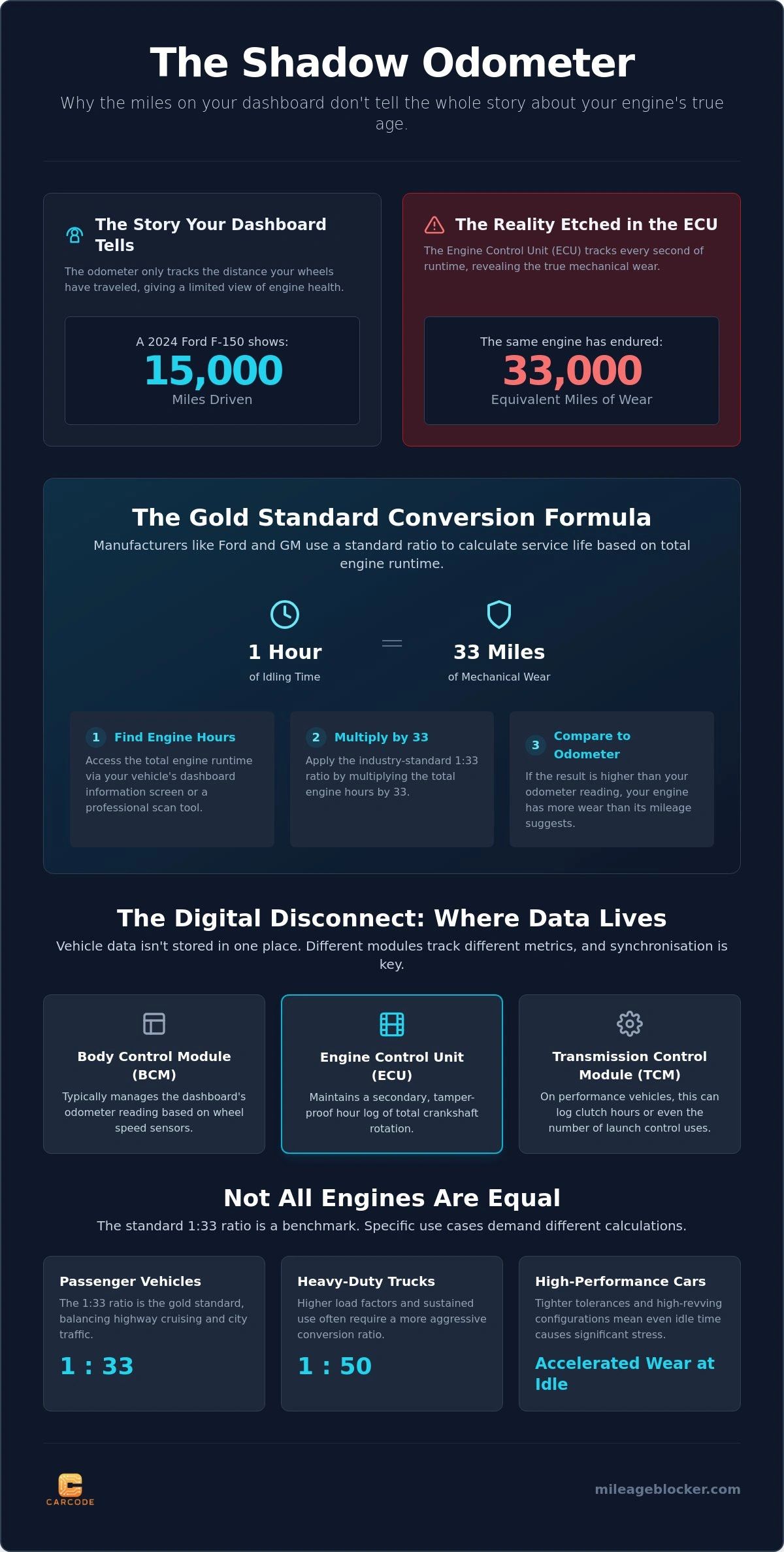
Modern vehicle architecture doesn't store data in a single location. The Body Control Module (BCM) typically handles the dashboard odometer, but the Engine Control Unit (ECU) maintains a secondary, tamper-proof hour log. If you are performing off-road testing, maintaining synchronisation between these modules is essential. High-performance vehicles also use the Transmission Control Module (TCM) to log clutch hours or launch counts. In 2026, predictive AI systems in telematics suites flag any module that falls out of sync with the others. If you need to verify which modules your specific vehicle uses, you can find your car in our compatibility database to ensure your data management remains professional.
Cracking the Code: The Standard Conversion Mechanics Used by Manufacturers
We've spent years analyzing ECU logs in our workshop. We've found that the 1:33 ratio remains the gold standard for petrol and diesel passenger vehicles. While many generic guides suggest a flat 30-mile estimate, manufacturers like Ford and GM use 33 miles per hour as the benchmark for service life calculations. This figure accounts for the average fuel burn and thermal stress an engine undergoes during a typical mixed-use cycle. To calculate your equivalent mileage, find your total engine hours via the dashboard or a scan tool. Multiply that number by 33. Compare the result to your current odometer reading. If the calculated figure is significantly higher, your engine has experienced more wear than the mileage suggests.
By 2026, telematics systems have evolved to use these conversion mechanics for predictive maintenance. These systems don't just provide alerts; they draft service schedules based on real-time data integration. Approximately 85% of fleet managers using these tools report improved productivity. If you are curious about your vehicle's specific logging capabilities, you can find your car in our compatibility list to see which modules we support. This is the only way to ensure you are managing Engine Hours to Miles: The Real Conversion Mechanics Built Into Every Modern car with professional accuracy.
The 1:33 Ratio Explained
The 33-mile-per-hour average was derived from decades of manufacturer road testing. It represents a balance between high-speed highway cruising and stop-and-go urban traffic. Applying the 1:33 formula to a real-world 1,000-hour engine log yields 33,000 equivalent miles. If that vehicle only shows 15,000 miles on the odometer, the engine has effectively endured an extra 18,000 miles of mechanical wear while stationary. This discrepancy is what leads to "unexpected" failures in vehicles that appear low-mileage on paper.
Variable Factors: Fleet vs. Luxury Assets
Heavy-duty trucks often require a more aggressive 1:50 conversion ratio. This is due to higher load factors and sustained highway use. Conversely, high-performance supercar engines experience stress miles even at idle. High-revving configurations and tighter tolerances mean that oil degradation happens faster when the car isn't moving. If you're testing a high-value asset, you need to account for these variances to maintain an accurate service history. Using a Mileage Blocker Device during sanctioned off-road testing ensures that your data remains synchronized across all modules without creating the diagnostic "red flags" that generic tools often leave behind.
The Impact of Idle Time on Component Longevity and Resale Value
Idling for 60 minutes creates more mechanical fatigue than 33 miles of consistent highway cruising. We've disassembled engines where the cylinder walls showed significant glazing despite the odometer reading under 20,000 miles. This occurs because of the "Cold Engine" trap. During low-temperature idling, internal friction accelerates as the oil fails to reach the viscosity required for maximum protection. This is a critical factor in Engine Hours to Miles: The Real Conversion Mechanics Built Into Every Modern car. If your car spends its life in stationary testing or heavy traffic, you are effectively doubling its mechanical age without the odometer reflecting the reality.
Diesel Particulate Filters (DPF) are particularly vulnerable to high-hour, low-mileage duty cycles. Stationary hours prevent the exhaust from reaching the temperatures needed for passive regeneration. This leads to rapid soot saturation and eventual system failure. In our workshop, we've seen 2025 and 2026 diesel models requiring expensive forced regenerations after only 150 stationary hours. For those managing these assets during development, checking our mileage blocker faq can provide clarity on how to maintain data integrity during these intensive testing phases.
Hidden Wear in Modern Diesels and Hybrids
Modern hybrids present a unique challenge for data logging. The ECU must distinguish between total "Key On" time and actual Internal Combustion Engine (ICE) run-time. If you are idling in a hybrid, the hour meter may only tick when the petrol engine is engaged to charge the battery or provide heat. This complicates the Engine Hours to Miles: The Real Conversion Mechanics Built Into Every Modern car calculation. For diesel owners, soot buildup during prolonged idling sessions is the primary cause of EGR valve failure and intake manifold carbonization. These issues often appear well before the first scheduled service interval.
Resale Implications for High-Value Assets
The 2026 UK resale market has shifted toward transparency. Collectors and professional buyers now demand full ECU diagnostic printouts to verify "Total Engine Health" before finalizing a purchase. A high hour-to-mile ratio can slash 15% to 20% off the valuation of a high-performance asset like a Ferrari SF90 or a Porsche 911 GT3 RS. Buyers recognize that 500 hours of idle time is not "gentle" use. It is a precursor to expensive valvetrain or turbocharger service. Protecting your investment during specialized testing sessions requires professional hardware that ensures your module data remains synchronized and accurate.
Managing Data Integrity During Off-Road Testing and R&D
During intensive R&D or off-road testing, maintaining a logical relationship between distance and run-time is a strict technical requirement. We've seen numerous cases where engineers overlook the secondary logs stored deep within the ECU. If you use a Mileage Blocker Device, it must be capable of sophisticated CAN-bus filtering. Generic, low-cost alternatives often fail because they only intercept signals intended for the instrument cluster. This leaves a trail of mismatched data in the BCM and transmission modules. To maintain professional standards, we insist on using high-quality German components. These tools are designed to manage Engine Hours to Miles: The Real Conversion Mechanics Built Into Every Modern car without triggering diagnostic errors in 2026 vehicle architectures.
A professional-grade Mileage Stopper integrates directly into the vehicle's communication network. It monitors the data packets sent between the ABS sensors and the central gateway. During stationary dyno testing or enclosed trailer transport, these devices ensure that the odometer doesn't rack up unnecessary miles while the engine is running for diagnostics. However, the hour counter continues to track mechanical run-time. This is essential for maintaining a "clean" ECU profile. If the odometer and hour meter fall out of sync beyond manufacturer-defined tolerances, the system may flag the vehicle for unauthorized tampering. We've found that maintaining this synchronisation is the only way to protect the long-term viability of the asset.
How Mileage Blockers Handle Hour Counters
Cheap alternatives fail to stop secondary data logs because they lack the processing power to filter complex CAN-bus traffic. Our hardware uses high-speed microprocessors to ensure that every module receives the correct data packets. This prevents the "milestone" errors that occur when the ECU detects that the engine has been running for 50 hours but the wheels haven't moved an inch. For track-day use or off-road evaluation, this level of precision is mandatory. It ensures that Engine Hours to Miles: The Real Conversion Mechanics Built Into Every Modern car remains a useful metric for your maintenance team rather than a source of diagnostic confusion.
Professional Integration for Testing Protocols
Complex 2026 electrical systems require more than just a basic connection. For advanced models, we recommend professional fitting to ensure that the ABS and BCM modules remain perfectly aligned. Our German-engineered kits utilize factory-spec connectors, preserving the integrity of the original wiring loom. This is not just about discretion; it is about data synchronisation. Before finishing a testing session, we suggest performing a full module scan. Verify that the hour-to-mile ratio remains within the expected range for your specific duty cycle. If you don't, you risk a permanent data mismatch flag that can never be erased from the vehicle's history.
Mastering Your Vehicle's Hidden Data Lifecycle
Your odometer is only a partial witness to your vehicle's history. True mechanical age lives in the ECU's hour log, where every second of stationary run-time is recorded. By applying the 1:33 ratio, you can finally reconcile your dashboard reading with the actual wear on your valvetrain and cooling system. This week, we recommend pulling your vehicle's total engine hours using an OBD-II scanner or the internal service menu. Multiply this figure by 33. If the result exceeds your odometer reading by more than 20%, schedule an oil analysis to check for premature degradation from excessive idling. Understanding Engine Hours to Miles: The Real Conversion Mechanics Built Into Every Modern car is the only way to maintain your asset's long-term performance.
For those conducting professional testing or R&D, data synchronisation across all modules is non-negotiable. Our German-engineered hardware provides a discreet, plug-and-play solution that integrates with 2026 vehicle architectures. We offer worldwide delivery and full technical support to ensure your testing logs remain accurate and professional. Find the perfect mileage blocker for your vehicle testing needs and secure the integrity of your engine's data today. You've invested in quality hardware; your diagnostic tools should match that standard. Taking control of your data now prevents expensive mechanical surprises later.
Frequently Asked Questions
Can I reset the engine hours on my modern car's ECU?
You cannot reset engine hours on a modern ECU through standard diagnostic tools or service menus. This data is stored in non-volatile memory and serves as a permanent mechanical record of the crankshaft's life. We've tested multiple manufacturer-level scanners and they only allow for reading, not modifying, this specific log. Attempting to wipe this data usually requires a full ECU replacement or specialized forensic hardware that is not available to the public.
Is it possible for a car to have low miles but very high engine hours?
It's very common for vehicles used in professional testing, law enforcement, or urban delivery to have low mileage but high engine hours. A car idling for six hours a day may only travel ten miles, but its internal wear matches a vehicle that has driven 200 miles. This is why Engine Hours to Miles: The Real Conversion Mechanics Built Into Every Modern car is the only reliable way to assess an engine's true condition during a professional pre-purchase inspection.
Does a mileage blocker also stop the engine hour counter from accruing time?
A professional mileage blocker does not stop the engine hour counter. Our devices are engineered to manage odometer data during testing while allowing the ECU to track run-time for critical safety and fuel management systems. Stopping the hour log would cause immediate data synchronisation errors and likely trigger a permanent limp mode. We prioritise maintaining the vehicle's electronic integrity while you manage your testing logs during sanctioned off-road sessions.
What is the most accurate formula for converting engine hours to miles in 2026?
The industry-standard formula for 2026 is the 1:33 ratio, which assumes one hour of engine operation is equivalent to 33 miles of road wear. For performance assets or heavy-duty trucks, we suggest adjusting this to 1:50 to account for higher thermal stress and load. Applying Engine Hours to Miles: The Real Conversion Mechanics Built Into Every Modern car provides a realistic baseline for scheduling maintenance and predicting component longevity beyond what the dashboard odometer suggests.
How do I find the hidden engine hour log on a BMW or Mercedes-Benz?
On BMW G-Series models, you can often access the hour log through the hidden service menu by holding the odometer reset button for ten seconds. For Mercedes-Benz vehicles equipped with MBUX, navigate to the "Service" menu and look under "Engine Data" or "Trip Info." If these menus are restricted, a professional diagnostic tool will pull the raw data directly from the ECU's internal memory modules in seconds. We've found that these hidden logs are essential for verifying the history of high-value assets.
About the author
Pav TomaszeviczChief Editor, MileageBlocker.com
Pav is Chief Editor at MileageBlocker.com and works with the MileageBlocker Technical Team to publish practical information about vehicle compatibility, CAN/CAN-FD electronics, installation and MileageBlocker products.
View author profile →