
How to Calculate Cost per Mile: A Complete Guide for 2026
According to a 2024 study by the RAC, the average UK motorist underestimates their annual vehicle running costs by a staggering £750. That''s a significa...

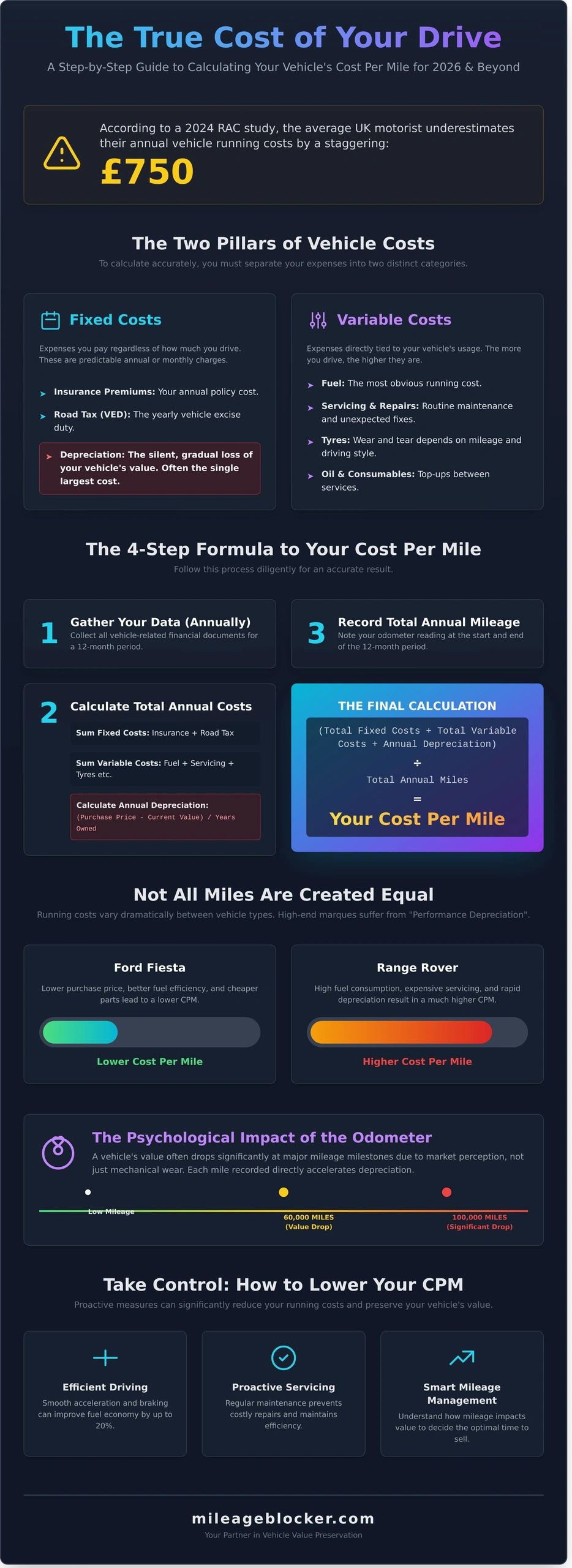
According to a 2024 study by the RAC, the average UK motorist underestimates their annual vehicle running costs by a staggering £750. That's a significant budget shortfall, driven by costs you can't see, like the silent depreciation on a new BMW 3 Series or a sudden insurance premium hike. It’s easy to focus on the price at the pump, but the true cost of keeping your car on the road is far more complex. You're right to be concerned about these hidden expenses, especially with maintenance costs climbing every quarter.
This guide removes the guesswork. We'll provide the exact formula and steps for how to calculate cost per mile, giving you a precise pence-per-mile figure for your specific vehicle. You'll learn to distinguish fixed from variable costs, accurately factor in depreciation, and ultimately take control of your vehicle's financial footprint for 2026 and beyond.
Key Takeaways
- Understand why rising 2026 fuel prices and insurance premiums in the UK make calculating your vehicle's cost per mile (CPM) an essential financial skill.
- Master the exact formula for how to calculate cost per mile by factoring in every expense, from fuel receipts and servicing to the crucial cost of annual depreciation.
- Discover the significant running cost differences between vehicles like a Range Rover and a Ford Fiesta, and learn how "Performance Depreciation" impacts high-end marques.
- Implement practical driving techniques and proactive servicing schedules to significantly lower your pence-per-mile and improve your car's long-term efficiency.
- Ensure your calculations remain accurate by learning how to correctly account for mileage during testing phases without unfairly inflating your running costs.
What is Cost per Mile and Why is it Critical for Vehicle Owners?
Your vehicle's Cost per Mile (CPM) is the ultimate measure of its total financial impact. It moves beyond the sticker price or monthly payment to reveal the true cost of every single mile you drive. Calculating this figure isn't just an academic exercise; it’s a critical diagnostic tool for managing your finances. From the fuel you pump to the insurance you pay, every expense contributes to this single, powerful metric.
For a practical breakdown of how these costs apply, especially for business use, this video provides a clear guide:
The relevance of CPM is set to intensify. With UK car insurance premiums averaging over £900 in early 2024 and fuel prices remaining volatile, drivers in 2026 and beyond will face even greater financial pressures. Understanding your precise CPM allows you to budget effectively and make informed decisions, rather than guessing at your real expenditure. This knowledge is fundamental whether you're managing personal finances or operating a business fleet.
A clear distinction exists between personal cost tracking and business claims. For a sole trader running a Ford Transit Custom, knowing your real CPM might reveal that HMRC's approved mileage allowance of 45p per mile doesn't fully cover your operational costs. For a private owner of a BMW 3 Series, understanding your CPM is about personal budgeting and wealth preservation. Knowing how to calculate cost per mile accurately provides the data needed to decide when to trade in a vehicle. When the CPM begins to climb sharply due to repairs and inefficiency, it’s often the signal that it's time to sell before its value drops further.
Fixed vs. Variable Costs: The Two Pillars of CPM
To calculate your CPM, you must first separate your expenses into two categories. Fixed costs are consistent expenses you pay regardless of how much you drive. These include:
- Insurance Premiums: Your annual policy cost.
- Road Tax (VED): The yearly tax required for your vehicle.
- Depreciation: The gradual loss of your vehicle’s value over time, which is its single largest cost.
In contrast, variable costs are directly tied to your vehicle's usage. The more you drive, the higher they are. These include fuel, tyres, oil changes, and routine servicing. These operating costs fluctuate based on external factors; aggressive driving on country lanes will wear out the tyres on a Range Rover Evoque far quicker than steady motorway cruising, directly increasing your CPM.
The Psychological Impact of the Odometer
The odometer reading has a disproportionate effect on a vehicle’s perceived value. Major mileage milestones, such as crossing the 60,000 or 100,000-mile mark, often trigger significant drops in resale value. This isn't always tied to mechanical reality; it's linked to the market's perception of increased wear and tear. A 2020 Volkswagen Golf with 58,000 miles will command a higher price than an identical model with 61,000 miles, purely due to this psychological barrier.
This direct link between recorded mileage and perceived engine health makes precise mileage tracking essential for financial management. Inaccurate or uncontrolled mileage accumulation directly accelerates depreciation, eroding your asset's value. Therefore, a core component of learning how to calculate cost per mile is understanding how each mile recorded impacts your vehicle's long-term financial standing.
The Step-by-Step Formula to Figure Out Your Cost per Mile
Calculating your true cost per mile is less about complex mathematics and more about diligent data collection. The accuracy of your result depends entirely on the quality of the information you use. Before you begin, you'll need to gather a year's worth of financial documents related to your vehicle. This method of separating fixed and variable costs is standard practice, similar to how official bodies, such as HMRC, establish mileage allowances for business travel and fleet management purposes. Start by assembling these key items:
- Running Costs: All fuel receipts, servicing and repair invoices, and receipts for consumables like tyres or oil top-ups.
- Standing Costs: Your annual insurance premium document, VED (road tax) confirmation, and your most recent MOT certificate.
- Depreciation Data: Your vehicle's original purchase price and its current, realistic market value from a source like Auto Trader or Parkers.
Depreciation is often the single largest, yet most overlooked, expense. To calculate it, subtract the car's current market value from the price you paid for it. Divide that figure by the number of years you've owned it to find the annual depreciation cost. For example, a Ford Focus bought for £22,000 three years ago that is now worth £15,000 has an annual depreciation of (£7,000 / 3) = £2,333.
The final calculation is straightforward: divide your total annual costs by the total number of miles you drove in that year. Looking ahead, remember to factor in external economic pressures. The UK government's fuel duty freeze, held at 52.95p per litre since 2011, is reviewed annually, and any change will directly impact your fuel costs. Similarly, OBR inflation forecasts for 2025-2026 suggest parts and labour costs will continue to rise.
A Practical Calculation Example
Let's run the numbers for a 2020 Volkswagen Golf covering 10,000 miles a year. To find your cost per mile, add your total annual standing and running costs, then divide by your yearly mileage.
- Total Standing Costs: £2,000 (depreciation) + £750 (insurance) + £180 (VED) + £55 (MOT) = £2,985
- Total Running Costs: £1,550 (fuel at 45 mpg) + £250 (annual service) + £200 (tyre wear) = £2,000
- Total Annual Cost: £2,985 + £2,000 = £4,985
This brings the cost to 49.8p per mile. This figure provides the data you need for accurate expense claims or budgeting. You can use a yearly mileage calculator to project how these costs will change if your driving habits are altered, giving you a powerful tool for financial forecasting.
Accounting for Unexpected Repairs
A key part of learning how to calculate cost per mile accurately is planning for the unexpected. We recommend adding a "contingency fund" of 2p-5p per mile to your calculation. For older vehicles, this is critical. A car over eight years old, such as an older Audi A4, can see its CPM spike dramatically from a single component failure like a worn clutch or a faulty turbocharger, which can easily cost over £1,200 to fix. Modern vehicles rely on sophisticated ECU modules to track performance and flag required service intervals, but these systems can't predict every mechanical failure. Understanding your vehicle's electronic systems is key to managing its long-term health, and for off-road testing or diagnostic purposes, you can explore Carcode Mileage Blockers' premium quality tools to gain deeper insight.
Comparing Driving Costs Across Different Vehicle Makes and Models
A mile is not just a mile. The cost of covering 1.6 kilometres in a city car is vastly different from doing so in a luxury SUV or a high-performance supercar. The vehicle's purpose, engineering, and market position create entirely different cost per mile (CPM) profiles. Understanding how to calculate cost per mile accurately becomes critical when comparing such different classes of vehicle, as the dominant cost shifts from fuel in one category to depreciation in another.
For example, a £15,000 city car might lose £6,000 in value over three years and 30,000 miles, equating to 20p per mile in depreciation. A £90,000 luxury SUV could lose £45,000 over the same period, a staggering £1.50 per mile. This doesn't even account for the SUV's higher fuel, insurance, and maintenance bills. Electric vehicles (EVs) further complicate the formula, drastically reducing fuel costs to as low as 4-5p per mile with off-peak home charging, but often carrying a higher initial purchase price and a different depreciation curve tied to battery technology.
Commercial vans operate under a separate logic entirely. A Ford Transit's CPM is heavily influenced by its payload. Fuel consumption and component wear increase significantly when fully laden, meaning its running costs must be calculated based on its typical operational state, not just its unladen mileage.
High-Performance Costs: The Ferrari Purosangue Example
At the extreme end of the spectrum, vehicles like the Ferrari Purosangue redefine the concept of running costs. With a starting price over £313,000, the largest single cost is "performance depreciation." For these exclusive models, the first few thousand miles can erase tens of thousands of pounds in value. A loss of £40,000 over the first 2,000 miles translates to an eye-watering £20 per mile in depreciation alone. For collectors and specialists conducting vehicle testing, maintaining mileage integrity is therefore of absolute financial importance.
Mainstream Efficiency: Mercedes-Benz and BMW
For popular premium models like the Mercedes-Benz C-Class or BMW 3 Series, the calculation is more nuanced. These cars balance brand prestige with manageable running costs. A key factor is the choice between petrol and diesel. A diesel C220d may offer a fuel CPM of 12-15p on a long run, while its petrol C200 equivalent might be closer to 18-22p. However, the diesel may incur higher long-term maintenance costs for its emissions control systems. Detailed analyses, such as the annual AAA's Your Driving Costs study, consistently show how variables like fuel type and maintenance schedules influence the final cost. This detailed breakdown is a core part of how to calculate cost per mile for premium vehicles, which is why many owners who perform their own testing or maintenance often need to find their car model to source specific, compatible diagnostic tools.
How to Reduce Your Cost per Mile and Improve Efficiency
Understanding the variables is the first step in learning how to calculate cost per mile. The next is to control them. A lower Cost Per Mile (CPM) isn't just about saving money; it's about operating your vehicle with maximum efficiency. By implementing a few strategic adjustments to your driving habits, maintenance schedule, and planning, you can significantly reduce your running costs.
Your driving style has a direct and immediate impact. Aggressive acceleration and hard braking can increase fuel consumption by up to 30% in urban environments. For a typical family car like a Nissan Qashqai, that's the difference between achieving 40 MPG and a costly 28 MPG. Smooth, anticipatory driving also extends the life of your tyres. According to a 2023 study by Kwik Fit, drivers who maintain correct tyre pressures and avoid harsh manoeuvres can extend tyre life by as much as 25%, saving hundreds of pounds over the vehicle's lifetime.
Beyond the driver's seat, your vehicle choices have long-term financial consequences. When purchasing a new vehicle in the UK, Vehicle Excise Duty (VED) is a major fixed cost. A high-emission vehicle like a BMW X5 M Competition (258g/km CO2) incurs a first-year VED of £2,605, whereas a more efficient hybrid like the Lexus NX 350h (129g/km) costs just £220. Similarly, shopping around for insurance annually is non-negotiable. Data from MoneySuperMarket in Q4 2023 showed that drivers could save an average of £340 by switching providers instead of auto-renewing.
Finally, consider the physics of your vehicle. Excess weight and poor aerodynamics are silent drains on your fuel budget. Every 50kg of unnecessary weight in your boot reduces fuel efficiency by 1-2%. A roof box, essential for holidays, can increase fuel consumption by 15% at 70mph. Removing it after your trip is a simple action that will directly lower your fuel spend as we head towards 2026 and face continued fuel price volatility.
Technical Optimisation and Maintenance
Proactive maintenance is fundamentally cheaper than reactive repair. Using genuine OEM or equivalent quality parts, such as original plug connectors and sensors, ensures your vehicle's electronic control units (ECUs) receive accurate data, optimising fuel injection and engine timing. A misaligned vehicle can reduce fuel efficiency by up to 10% and cause premature tyre wear, forcing you to replace a £150 tyre thousands of miles early. Keeping engine idle hours low is also critical; it consumes fuel without adding to your "rolling miles," artificially inflating your true CPM.
Smart Route Planning
Modern navigation tools like Waze are essential for avoiding stop-start traffic, which spikes fuel consumption. Combining multiple short trips into one longer journey allows your engine to reach its optimal operating temperature (around 90-105°C), where it runs most efficiently. For professionals who need to conduct performance tuning or diagnostic tests without these miles affecting road-use data, it's crucial to isolate this activity. You can use a mileage blocker for off-road testing to ensure your on-road CPM calculations remain accurate and untainted by non-standard usage.
Maintaining Accuracy and Vehicle Value During Testing Phases
Calculating your true cost per mile (CPM) depends entirely on accurate data. But what happens when your vehicle accumulates mileage from non-road activities? If you own a performance car like a BMW M4 for track days or a Land Rover Defender for dedicated off-road use, the mileage clocked during these events can significantly distort your real-world running costs and unfairly reduce the vehicle's resale value.
This is because every mile, whether on the M25 or a dyno rig, is treated the same by your car's complex electronics. A single day of performance testing or tuning could add over 100 "phantom miles" to your odometer, inflating your service schedule and skewing any analysis of how to calculate cost per mile for your daily commute. This is where a preventative tool becomes essential for data integrity.
It’s vital to understand the technical distinction between a Mileage Blocker and illegal mileage correction tools. Correction tools, often called "rollback" devices, fraudulently alter existing data stored in your vehicle's memory modules. This process is detectable during advanced diagnostics and is illegal in the UK for the purpose of selling a vehicle. In contrast, a Mileage Blocker is a preventative module. It's designed specifically for off-road or testing environments to temporarily halt the recording of new mileage data across all electronic control units (ECUs). Because the data is never written, the effect is genuinely untraceable.
The Role of Mileage Blockers in Professional Testing
Modern vehicles operate on sophisticated networks like CAN-Bus and FlexRay, which transmit data between dozens of modules. During dyno testing or software development, these systems continue to record mileage, even if the vehicle is stationary. A premium Mileage Blocker intercepts these signals before they are stored in the instrument cluster, engine ECU, and other EEPROM memories. For this to work flawlessly, professional installation is key, ensuring the device integrates perfectly without disrupting critical vehicle functions.
Next Steps for Performance Owners
When selecting a device, prioritise premium quality. A module built with genuine automotive-grade components ensures it won’t interfere with vital safety systems like ABS or stability control. Cheaper alternatives can cause unpredictable electronic faults. Furthermore, look for a supplier that offers lifetime support for their hardware, giving you confidence in its long-term reliability. If you have technical questions about mileage tracking during testing, contact our team today for specialist advice.
By isolating non-public road use, you ensure your odometer accurately reflects your vehicle's true service life. This not only preserves its market value but also provides you with the clean, reliable data needed to calculate your genuine cost per mile. It’s a smart solution for the complexities of modern performance vehicle ownership.
Take Control of Your Driving Costs in 2026 and Beyond
Mastering your vehicle's running costs is no longer a mystery. Whether you drive a dependable Vauxhall Corsa or a high-performance Audi A4, you now have the tools to get a precise financial picture. Remember, the formula is straightforward, but consistent tracking of everything from fuel at £1.45 per litre to annual insurance premiums delivers true accuracy. Understanding how to calculate cost per mile gives you the power to actively manage and reduce your expenses, potentially saving you hundreds of pounds each year.
For professionals and enthusiasts focused on vehicle testing while maintaining component integrity, precision is paramount. Carcode Mileage Blockers are designed for this exact purpose. Engineered using original plug connectors, our premium tools ensure an untraceable effect on all ECU modules, safeguarding your car's complex systems during off-road use or diagnostic tests. With the assurance of lifetime email & WhatsApp support, you can test with complete confidence.
Equip your vehicle with a smart, secure solution today. Browse our range of premium Mileage Blockers for testing and off-road use.
Frequently Asked Questions
Is cost per mile the same as fuel cost?
No, cost per mile (CPM) is far more comprehensive than just fuel cost. While fuel is a major component, a true CPM calculation also includes all other vehicle ownership expenses. These cover fixed costs like insurance, road tax, and depreciation, as well as variable costs such as maintenance, servicing, and tyre replacement. Your fuel might only be 15p per mile, but your total CPM for a Volkswagen Golf could be closer to 48p once all factors are included.
How much does the average car cost per mile in the UK in 2026?
While exact figures for 2026 aren't available, we can project based on current data. In 2024, analysis from sources like the RAC and NimbleFins placed the average cost for a new petrol car at around 50p to 55p per mile. Factoring in inflation and rising maintenance costs, it’s reasonable to estimate the average cost per mile in 2026 will be between 58p and 63p. This figure will vary significantly between a small city car and a large SUV.
Does a mileage blocker affect the cost per mile calculation?
Yes, a mileage blocker directly impacts the 'mileage' variable in your calculation. The device is designed to stop the mileage recording process in a vehicle’s memory modules during testing or off-road use. If you use one for its intended purpose, the odometer reading won't reflect the vehicle's total distance travelled. Therefore, you must use your own records of actual distance covered, not the odometer reading, to calculate an accurate CPM for your personal reports.
Can I calculate cost per mile for an electric vehicle?
Yes, you can calculate the cost per mile for an electric vehicle (EV), and the formula is largely the same. You simply replace the cost of petrol or diesel with the cost of electricity used. This requires tracking your spending on both home charging and public charging networks. Other costs, such as insurance, tyre wear, and battery degradation (a form of depreciation), must also be included to get a true running cost for your Kia EV6 or Tesla Model Y.
How does high mileage affect my car’s resale value?
High mileage significantly reduces a car’s resale value because it indicates greater wear and tear on all components. According to automotive valuation experts at CAP HPI, a car with 80,000 miles can be worth 20-25% less than an identical model with 50,000 miles. Since depreciation is the single largest factor in your cost per mile, managing your mileage is crucial to controlling the overall cost of ownership for vehicles like a Ford Focus or Mercedes C-Class.
What is the HMRC mileage rate for 2026?
The HMRC Approved Mileage Allowance Payment (AMAP) rate has remained unchanged since 2011. For the 2024/2025 tax year, the rate is 45p per mile for the first 10,000 business miles and 25p per mile thereafter. While the government could change it, it's widely expected that this 45p rate will continue into the 2025/2026 tax year. Always consult the official GOV.UK website for the most current confirmed rates before making a claim.
How do I track my miles accurately for a CPM report?
The most reliable methods for tracking miles are using a GPS-based smartphone app or keeping a detailed manual logbook. Apps such as MileIQ or Everlance automatically record your journeys, providing precise data with minimal effort. If you prefer a manual method, note your vehicle's odometer reading at the start and end of each trip. This accurate distance figure is essential when you need to know how to calculate cost per mile for business expenses or personal budgeting.
Is it worth calculating CPM for a leased car?
Yes, calculating your CPM is especially important for a leased vehicle. Most lease agreements, such as those from PCP or PCH contracts, include a strict annual mileage cap, often between 8,000 and 12,000 miles. If you exceed this limit, you'll face an excess mileage charge, which can range from 8p to over 25p for every extra mile. Regularly monitoring your CPM and mileage accumulation helps you stay within your allowance and avoid a large, unexpected bill.
About the author
Pav TomaszeviczChief Editor, MileageBlocker.com
Pav is Chief Editor at MileageBlocker.com and works with the MileageBlocker Technical Team to publish practical information about vehicle compatibility, CAN/CAN-FD electronics, installation and MileageBlocker products.
View author profile →