Understanding KM Mileage: A Complete Guide for Car Owners
When evaluating a vehicle, the odometer reading is a critical data point. But what happens when that data is presented in kilometers instead of miles? For ma...
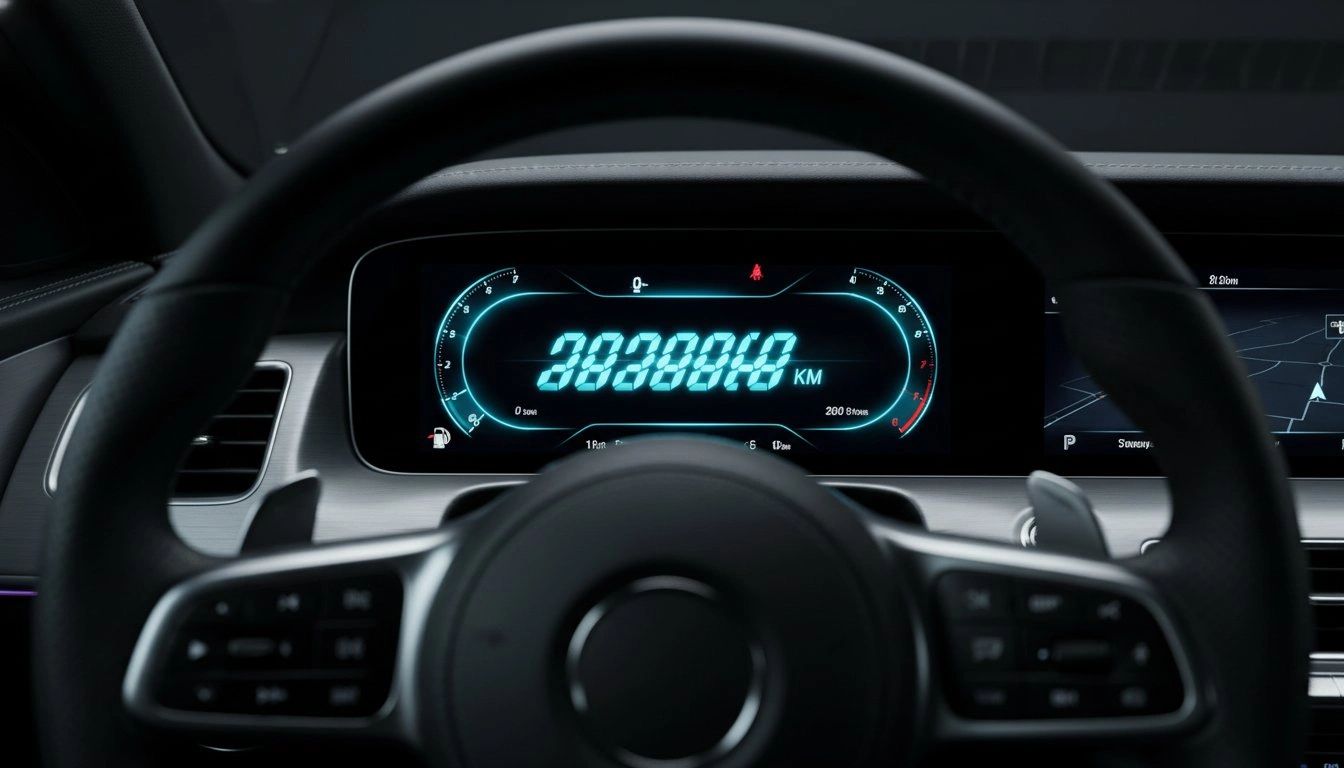
When evaluating a vehicle, the odometer reading is a critical data point. But what happens when that data is presented in kilometers instead of miles? For many buyers, particularly those considering imported vehicles, an odometer displaying km mileage can create uncertainty and complicate the assessment process. Questions immediately arise: Is 150,000 km a high reading? How does it compare to a car with 90,000 miles? More importantly, how can you be certain the reading is accurate and hasn't been manipulated?
This comprehensive guide is designed to eliminate that uncertainty. We will provide the essential knowledge required to confidently interpret a vehicle's history, regardless of the unit of measurement. You will learn the precise method for converting kilometers to miles, understand the key benchmarks for assessing a vehicle's usage, and discover the critical warning signs of odometer fraud. By the end, you will be equipped to make an informed, data-driven decision, ensuring your next vehicle purchase is a secure one.
What is KM Mileage? The Basics Explained
KM mileage is a direct measurement of the total distance a vehicle has traveled, expressed in kilometers. While drivers in the United States, UK, and a few other countries are accustomed to seeing distance measured in miles, the vast majority of the world utilizes the metric system. Consequently, vehicles manufactured for markets in Europe, Asia, and South America display their travel history in kilometers.
This measurement is recorded and displayed by the vehicle's Odometer, a standard instrument in every modern car. It's crucial to understand that the unit of measurement—kilometers versus miles—is simply a different way of representing the same physical reality. A car's engine, transmission, and suspension wear are determined by the actual distance covered, not by the number shown on the dashboard. The distinction is purely numerical, but it has significant implications when evaluating a vehicle's history and value.
Kilometers vs. Miles: The Fundamental Difference
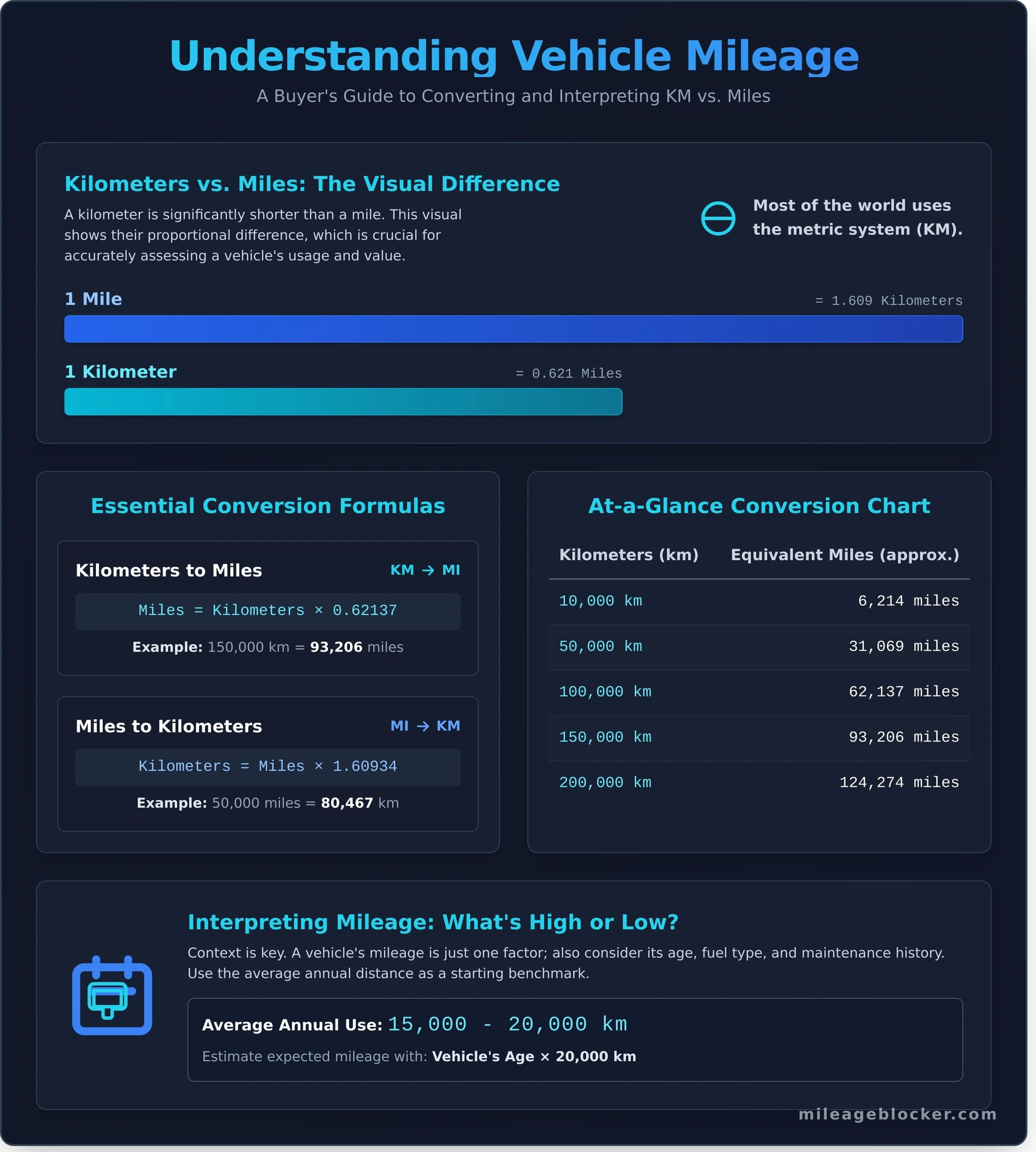
The core difference lies in the unit's length. A kilometer is substantially shorter than a mile, a fact that can cause significant confusion when assessing a vehicle's usage. The conversion is straightforward:
- 1 kilometer is approximately 0.621 miles.
- 1 mile is approximately 1.609 kilometers.
This means a vehicle with high km mileage has traveled less than a vehicle with the same number in miles. For example, a car showing 150,000 km on its odometer has actually traveled only 93,205 miles. Misinterpreting this can lead to a severe underestimation of a car's remaining lifespan and an overestimation of its wear.
Why Some Cars Show Mileage in KM
You may encounter a vehicle displaying kilometers for several common reasons. The most frequent cause is the vehicle's origin; cars manufactured for and sold in markets like Germany, Japan, or Korea are factory-set to the metric system. When these vehicles are imported, their odometers reflect their native standard.
This includes personal imports, such as vehicles brought to the US or UK by military service members or automotive enthusiasts. Additionally, many modern vehicles with digital dashboards offer the flexibility to switch between units. In these cars, the display can be changed from miles to kilometers (and vice-versa) through the infotainment system or instrument cluster settings, a feature useful for international travel or personal preference.
How to Convert KM Mileage to Miles: Formulas and Tools
When assessing a vehicle with a metric odometer, the primary goal is to convert its recorded kilometers into a familiar and comparable figure: miles. This conversion is not just for convenience; it is essential for accurate valuation, maintenance scheduling, and understanding the vehicle's true usage history. For imported vehicles, correctly calculating the km mileage is a critical step in ensuring all documentation aligns with Federal odometer disclosure requirements. While automated online calculators are available, understanding the direct formulas provides complete control and transparency.
The Simple Formula: Kilometers to Miles
The most direct method for converting kilometers to miles is a simple multiplication. For technical precision, use the exact conversion factor. The official formula is:
Miles = Kilometers × 0.62137
For example, a vehicle with 100,000 km on its odometer has traveled an equivalent of 62,137 miles (100,000 km × 0.62137). For a quick mental estimate, you can use a simplified rule of thumb: multiply the kilometers by 0.6. In this case, 100,000 km is approximately 60,000 miles.
The Reverse Formula: Miles to Kilometers
Occasionally, you may need to convert miles back into kilometers. This is useful when comparing a US-market vehicle's mileage to a service schedule or parts lifespan specified in kilometers by an international manufacturer. The formula for this calculation is:
Kilometers = Miles × 1.60934
For instance, a vehicle with 50,000 miles has an equivalent km mileage of 80,467 (50,000 miles × 1.60934).
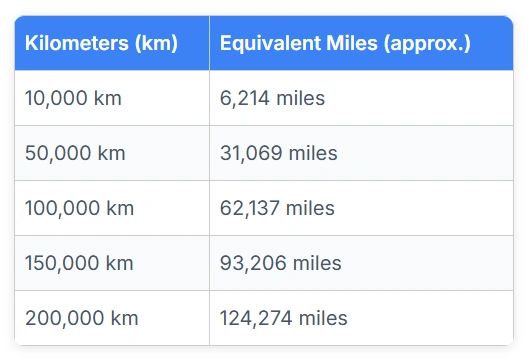
Quick Conversion Chart (KM to Miles)
For rapid assessment of common mileage milestones, this reference chart provides at-a-glance conversions. This is ideal for quickly evaluating a vehicle's history during an initial inspection.
Interpreting KM Mileage: What’s Considered High or Low?
One of the most persistent questions in the automotive market is whether a specific number on the odometer is "too high." The answer is not absolute. A vehicle's km mileage is a critical data point, but its significance is relative and must be assessed in context with the vehicle’s age, fuel type, and intended use. A high number on a well-maintained, one-year-old vehicle may be less concerning than a suspiciously low number on a ten-year-old car.
As a baseline, the average passenger vehicle is driven between 15,000 and 20,000 kilometers per year. This figure provides a simple formula: multiply the vehicle's age in years by 20,000 km to get a rough estimate of what would be considered average mileage. Any figure significantly above this suggests heavy use, which directly impacts resale value and future maintenance requirements. Ultimately, the question of how many miles are too many depends less on the raw number and more on the vehicle's documented service history and overall condition.
General Mileage Benchmarks in Kilometers
While context is crucial, these general benchmarks can provide a starting point for evaluating a vehicle's usage based on its age. A five-year-old car, for example, would be considered average with approximately 75,000 to 125,000 km on its odometer.
- Low Mileage: Under 15,000 km per year. This often indicates minimal use and potentially less wear on components.
- Average Mileage: Between 15,000 and 25,000 km per year. This is the expected range for a typical daily driver.
- High Mileage: Over 25,000 km per year. These vehicles have seen extensive use, which may necessitate more frequent inspections and component replacements.
How Vehicle Type Affects Mileage Perception
The definition of high km mileage shifts depending on the vehicle's powertrain and class. Different engineering philosophies mean that odometers must be interpreted differently across vehicle types.
- Diesel Engines: Built for endurance and high-torque applications, diesel engines are expected to cover vast distances. A reading of 200,000 km on a well-maintained diesel truck is often considered normal, not excessive.
- Electric Vehicles (EVs): For EVs, the primary concern is not engine wear but battery health and degradation. Mileage is still a factor, but the battery's state of health (SOH) and charging history are more critical indicators of long-term viability.
- Luxury & Performance Cars: These vehicles are often used as secondary cars for leisure, not daily commuting. Consequently, the expected annual mileage is much lower, and a higher-than-average odometer reading can significantly decrease their value.
KM Mileage on Imported Cars: A Buyer’s Checklist
Purchasing an imported vehicle, particularly from Japan or Europe, often means acquiring a car with an odometer that reads in kilometers. While a simple metric conversion is easy, the real challenge lies in verifying the vehicle's history. The international nature of the sale can create opportunities for mileage discrepancies, making thorough due diligence an absolute necessity for any serious buyer. Protecting your investment starts with a systematic approach to validating the car's true usage.
Verifying the Vehicle's History
Authenticating the recorded km mileage is the most critical step in assessing an imported car. Your goal is to cross-reference multiple sources to build a consistent and believable history. A professional inspection should always include these checks:
- Export/De-registration Certificates: For Japanese imports, the official Export Certificate is invaluable. It records the last two odometer readings from the vehicle's bi-annual "Shaken" inspections, providing a government-verified baseline.
- International History Reports: Standard vehicle history reports may not cover a car's life overseas. Use specialized services that pull data directly from the country of origin to uncover accident history, theft records, and mileage logs.
- Service Records and Stickers: Look for maintenance logs in the glove box or service stickers on the door jambs, under the hood, or on the windshield. These often include the date and mileage of the last service.
Common Red Flags to Watch For
Beyond paperwork, the vehicle itself tells a story. Odometer fraud, often called 'clocking', is a persistent issue. Be vigilant and look for physical signs that contradict the number displayed on the dashboard. Key warning signs include:
- Excessive Wear and Tear: A car with 30,000 km should not have a worn-through driver's seat, a shiny steering wheel, or heavily worn pedal rubbers. The condition of high-touch surfaces should match the low mileage claim.
- Inconsistent History: Large, unexplained gaps in the service history are a major red flag. It may indicate a period where the car was driven extensively without documentation.
- Signs of Tampering: Inspect the instrument cluster closely. Look for scratches on the clear plastic cover, misaligned dashboard panels, or flickering digits on the odometer display, which can indicate it has been removed or manipulated.
Understanding Legal vs. Technical Realities
It is crucial to distinguish between illegal odometer rollback and the legitimate function of halting mileage recording for testing. Odometer fraud is a criminal act designed to artificially inflate a vehicle's value. However, the technology to control mileage recording in a vehicle’s complex electronic systems also serves legitimate purposes.
Specialized diagnostic tools are developed for vehicle manufacturers, tuners, and testing facilities. These devices are used to pause mileage accumulation during dynamometer runs, off-road evaluations, or extensive electronic systems testing to avoid adding non-representative mileage. For legitimate testing needs, you can explore advanced vehicle solutions engineered for modern vehicle electronics.
Beyond Conversion: How KM Affects Maintenance and Usage
Understanding the difference between kilometers and miles goes far beyond a simple mathematical conversion. The unit of measurement native to your vehicle's design dictates critical aspects of its operation, maintenance, and long-term health. Ignoring these metric-based specifications can lead to premature wear, performance issues, and even costly repairs. The total km mileage is a key data point that informs a vehicle's entire lifecycle.
Decoding Service Schedules in Kilometers
Most global vehicle manufacturers design their maintenance schedules around kilometers. A common mistake for owners in regions that use miles is to apply an incorrect "rule of thumb" conversion, which can have serious consequences. It is essential to adhere to the manufacturer's specified intervals precisely.
- Example Interval: An oil change might be specified for every 15,000 km. This is approximately 9,300 miles, not 10,000 miles. Consistently overshooting this interval leads to accelerated engine wear.
- Warranty Protection: Failing to follow the exact kilometer-based service schedule can provide grounds for a manufacturer to deny a warranty claim.
- Component Lifecycles: Everything from timing belts to transmission fluid is scheduled for service based on precise kilometer milestones.
Understanding Fuel Economy: L/100km vs. MPG
In metric systems, fuel efficiency is measured in Liters per 100 kilometers (L/100km). Unlike Miles Per Gallon (MPG), where a higher number is better, a lower L/100km value indicates superior fuel economy. For context, an efficient vehicle might achieve 6 L/100km, while a less efficient one could be 12 L/100km or higher. For example, 8 L/100km is roughly equivalent to 29 MPG. For accurate tracking, always use your vehicle's trip computer in its native L/100km setting rather than relying on mental conversions.
Even components like tires often have their lifespan rated in kilometers by the manufacturer. Properly interpreting your vehicle's km mileage and its associated metric data is fundamental to correct maintenance and usage. For professionals who must manage vehicle data during testing or off-road use, understanding these systems is critical. Modern vehicles require smart solutions to handle complex electronic modules and ensure data integrity.
Final Thoughts on Mastering KM Mileage
Navigating the world of automotive metrics is simpler when you have the right information. From converting kilometers to miles to accurately assessing an imported vehicle's history, understanding your car's odometer reading is fundamental to responsible ownership. A clear grasp of what constitutes high or low km mileage empowers you to make smarter decisions regarding maintenance and vehicle valuation, ensuring your car performs optimally for years to come.
For professionals and enthusiasts who require precise control over odometer readings during vehicle testing or off-road use, having the right equipment is paramount. Shop our range of premium quality mileage blockers for vehicle testing. Engineered with genuine automotive-grade components, our devices offer an untraceable effect. We provide worldwide delivery and lifetime support, ensuring you have the highest quality tools for your specific needs. Take control of your vehicle's data with confidence and precision.
Frequently Asked Questions
Is high KM mileage always a bad thing for a car?
No, high mileage is not an automatic indicator of poor condition. A vehicle with 200,000 kilometers that has a complete and consistent service history can be mechanically superior to a low-mileage car that has been neglected. The type of driving is also a critical factor; consistent highway kilometers cause less wear on engine and transmission components than the stop-and-go stress of city driving. Always prioritize maintenance records over the odometer reading alone.
How can I permanently change my car's odometer from KM to miles?
A permanent change from kilometers to miles requires reprogramming the vehicle’s instrument cluster software. This is not a standard user-selectable setting and must be performed by a dealership or a specialized automotive electronics technician using diagnostic tools that can access the vehicle’s core coding. Attempting this without the correct equipment can lead to irreversible damage to the instrument cluster or other electronic control units (ECUs), so professional service is essential for this conversion.
Can you trust the KM mileage shown on an imported vehicle?
Exercising caution is essential. It is difficult to verify the history of an imported vehicle, and odometer tampering can be an issue. Always request any available service records or vehicle history reports from its country of origin. A comprehensive pre-purchase inspection by a qualified mechanic is the most reliable method. They can assess the physical wear on components like the seats, pedals, and steering wheel to see if it aligns with the displayed km mileage.
Does replacing the instrument cluster reset the KM mileage?
In modern vehicles, replacing the instrument cluster typically does not reset the true mileage. The total distance traveled is often stored in multiple locations, such as the Body Control Module (BCM) or the engine's ECU. When a new cluster is installed, it will often synchronize with the data stored in these other modules. If it doesn't, a mileage discrepancy will exist between the car's electronic systems, which can be easily detected with diagnostic tools.
How many kilometers is considered a lot for a used car?
Generally, a gasoline car with over 200,000 kilometers (about 125,000 miles) is considered to have high mileage. For diesel vehicles, which are built for greater longevity, this figure is often higher, around 300,000 kilometers. However, these are just guidelines. A well-maintained vehicle with high km mileage can be a very reliable purchase, making the quality of its service history more important than the number on the odometer.
What is the difference between an odometer and a trip meter?
An odometer is a non-resettable counter that displays the total cumulative distance a vehicle has traveled throughout its entire operational life. This is the official figure used for maintenance schedules and vehicle valuation. In contrast, a trip meter measures distance over a short, specific journey. It is a convenience feature that can be reset to zero by the driver at any time, commonly used to track fuel economy or the length of a specific trip.
About the author
Pav TomaszeviczChief Editor, MileageBlocker.com
Pav is Chief Editor at MileageBlocker.com and works with the MileageBlocker Technical Team to publish practical information about vehicle compatibility, CAN/CAN-FD electronics, installation and MileageBlocker products.
View author profile →