Engine Idle Hours to Miles: The Complete Conversion Guide
Does your vehicle''s odometer truly reflect its operational life? For fleet vehicles, former police cars, or any engine that spends significant time stationar...
Does your vehicle's odometer truly reflect its operational life? For fleet vehicles, former police cars, or any engine that spends significant time stationary, the number on the dash tells only part of the story. While the mileage remains static, the engine is still running, accumulating significant wear and tear that goes unrecorded. This 'hidden' usage makes it difficult to accurately assess a vehicle's condition or schedule critical maintenance. Understanding how to convert engine idle hours to miles is the key to unlocking the true picture of your vehicle's health and value.
This complete conversion guide provides the definitive methodology for calculating the real impact of idling. Here, you will discover a clear, industry-accepted formula to translate idle time into equivalent driven miles. We will break down the specific effects of prolonged idling on critical engine components and provide the technical insight needed to make more informed decisions. Stop relying on incomplete data and learn to calculate the true wear on your vehicle for accurate maintenance and valuation.
Key Takeaways
- An odometer reading provides an incomplete picture of vehicle use; engine hours reveal the true extent of mechanical wear.
- Learn the industry-standard formula to convert engine idle hours to miles and accurately calculate your vehicle's 'hidden' wear and tear.
- Understand why excessive idling can cause more severe engine damage than high-speed driving due to incomplete combustion and carbon buildup.
- Identify if your vehicle is in a high-risk category, such as commercial transport or emergency services, where engine hours are a more critical metric than mileage.
Engine Hours vs. Odometer Miles: Understanding the Key Difference
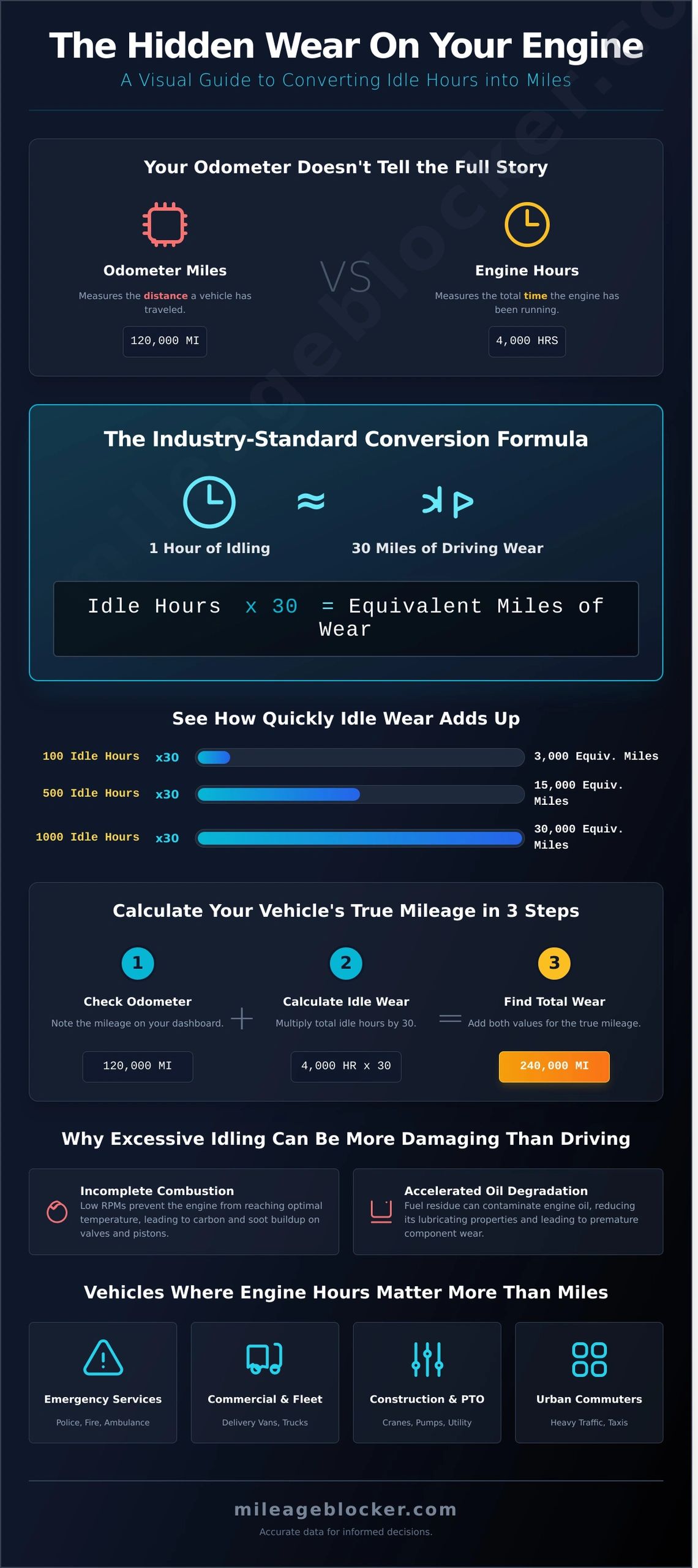
When assessing a vehicle's condition, most people look straight at the odometer. However, this number only tells part of the story. The odometer measures the distance a vehicle has travelled, while engine hours measure the total time the engine has been running. This distinction is critical because significant engine wear occurs even when the vehicle is stationary. Think of it this way: odometer miles are the 'steps taken,' while engine hours are the total 'time on your feet.' Both contribute to fatigue and wear, but only one is tracked by your dashboard's mileage display.
What Constitutes 'Idle Hours'?
Idling is any time your vehicle's engine is running while the vehicle itself is not moving. During this time, the engine operates at its minimum rotational speed, often referred to as its engine idle speed, to power essential systems without propelling the vehicle forward. This "unseen mileage" accumulates in many common situations, including:
- Waiting in heavy city traffic or at long traffic lights.
- Warming up the vehicle on a cold morning.
- Using the vehicle's climate control while parked.
- For commercial vehicles, running power take-off (PTO) equipment like cranes or pumps.
Why Your Odometer Doesn't Tell the Full Story
For vehicles with high idle time-such as police cars, delivery vans, or construction trucks-the odometer is a poor indicator of true engine wear. An engine can accumulate hundreds of hours of wear without adding a single mile to the odometer. This discrepancy directly impacts critical aspects of vehicle ownership. Understanding the conversion of engine idle hours to miles is essential because it affects maintenance schedules, engine longevity, and ultimately, the vehicle's resale value in the UK market. A low-mileage vehicle with excessively high engine hours may require major service far sooner than the odometer suggests.
How to Convert Engine Idle Hours to Miles: The Formulas and Logic
While your odometer tracks distance, it completely ignores the significant wear and tear caused by idling. To bridge this gap, the automotive and fleet management industries rely on a standard conversion factor to translate stationary engine runtime into an equivalent mileage figure. This provides a far more accurate assessment of a vehicle's true condition and maintenance needs.
The most widely accepted rule of thumb, backed by studies from organisations like the Society of Automotive Engineers (SAE), is based on average fuel consumption and component stress during idling versus driving. This leads to a straightforward and effective formula for calculating the wear from engine idle hours to miles.
The Standard Conversion Formula
The core principle is to assign a mileage value to every hour the engine runs without moving. The industry-standard formula is simple yet powerful:
1 Hour of Idling ≈ 30 Miles of Driving Wear
Using this, the calculation is direct: Idle Hours x 30 = Equivalent Wear in Miles. It’s crucial to understand this figure represents mechanical wear, not a literal distance the vehicle could have travelled. For instance, if a vehicle has 100 idle hours, it has accumulated wear equivalent to driving an extra 3,000 miles. This industry-accepted method provides a clear guide on how to calculate engine hours to miles, giving a more accurate picture of component stress. While 30 is the standard, some manufacturers or fleet managers may use a slightly different value, such as 25 or 33, depending on the specific vehicle type and operating conditions.
For quick reference:
- 1 Idle Hour = 30 Equivalent Miles
- 5 Idle Hours = 150 Equivalent Miles
- 10 Idle Hours = 300 Equivalent Miles
- 100 Idle Hours = 3,000 Equivalent Miles
Calculating Your Vehicle's Total 'Equivalent Mileage'
To get a comprehensive view of your vehicle's total wear, you must combine the odometer reading with the calculated idle wear. This three-step process gives you the data needed for proactive maintenance.
- Step 1: Note the exact mileage displayed on your odometer.
- Step 2: Find your total engine idle hours and multiply by 30 to get the equivalent wear in miles.
- Step 3: Add the odometer reading and the equivalent wear miles together.
This final number, or 'Equivalent Mileage,' is the most accurate representation of your engine's operational life and should be used when planning oil changes, filter replacements, and other critical servicing.
Finding Your Vehicle's Engine Hours
Accessing your vehicle's engine hour data is usually straightforward. Most modern vehicles integrate this information directly into their onboard systems. Check within the settings of your infotainment display or cycle through the options on your instrument cluster's trip computer. If you cannot locate it, the data is almost certainly stored within the vehicle's ECU. In this case, a simple OBD-II scanner can be used to access and read the total engine hours and idle hours directly from the vehicle's control modules.
The Real-World Impact: Why Idle Hours Are a Critical Metric
While an odometer reading provides a simple measure of distance travelled, it fails to capture the full story of a vehicle's operational life. Engine idle hours represent the "hidden" work an engine performs, and this time is often more detrimental than driving at speed. Unlike highway driving where airflow and consistent RPMs maintain optimal conditions, idling subjects an engine to a uniquely stressful environment.
Accelerated Engine Wear and Tear
An engine idling is not an engine at rest. It operates under sub-optimal conditions that accelerate wear far more than the odometer suggests. The primary issues include:
- Poor Lubrication: At idle, oil pressure is at its minimum. This reduced flow can lead to inadequate lubrication of critical components like camshafts and bearings.
- Incomplete Combustion: Lower operating temperatures prevent fuel from burning completely. This results in carbon deposits forming on piston rings, valves, and spark plugs, reducing efficiency and performance.
- Component Stress: The exhaust system, particularly Diesel Particulate Filters (DPFs) and catalytic converters, can become clogged and fail prematurely as they don't reach the high temperatures required for self-cleaning (regeneration).
Inaccurate Maintenance Schedules
Relying solely on mileage for service intervals is a significant risk for any high-idle vehicle. A delivery van showing 20,000 miles on the odometer could have the engine wear equivalent of a vehicle with 60,000 miles due to extensive idling. Its engine oil will be highly degraded, contaminated with fuel and moisture, losing its protective properties. Following the manufacturer's mileage-based schedule in this scenario can lead to premature engine damage and costly repairs costing thousands of pounds.
Impact on Resale Value
In the UK's used vehicle market, particularly for commercial vans and fleet vehicles, educated buyers look beyond the odometer. A low-mileage truck with exceptionally high engine hours is an immediate red flag, indicating a life of hard, stationary work. This discrepancy tells a potential buyer that while the chassis has not travelled far, the engine has been running constantly. Understanding the true wear by analysing the ratio of engine idle hours to miles provides powerful leverage for price negotiation and helps avoid purchasing a vehicle with a deceptively short lifespan.
Vehicle Types Most Affected by High Idle Time
While every internal combustion engine idles, the impact is not uniform across all vehicles. For certain industries and use cases, the odometer reading is a fundamentally flawed indicator of mechanical wear. In these scenarios, engine hours provide a far more accurate picture of the vehicle's true condition and operational lifecycle.
Commercial and Fleet Vehicles
For fleet managers, mileage is only part of the operational cost equation. Commercial vehicles often accumulate extreme idle hours that contribute significantly to wear and tear, fuel consumption, and maintenance requirements. This is particularly true for:
- Delivery Vans: Vehicles like the Ford Transit or Mercedes Sprinter spend hours idling in urban traffic, during drop-offs, and at depots throughout the UK.
- Utility Trucks: Many work vehicles use Power Take-Off (PTO) systems to operate equipment like lifts, pumps, or compressors, all while the vehicle is stationary but the engine is under load.
- Heavy Goods Vehicles (HGVs): Long-haul lorries idle for extended periods at loading docks, in queues at ports, or overnight to power cabin climate control and electronics.
Fleet operators use engine hour data to calculate true running costs and schedule preventative maintenance, as mileage alone fails to capture this intense operational demand.
Emergency Services and Law Enforcement
No category of vehicle demonstrates the disparity between miles and wear better than emergency service fleets. Police cars, ambulances, and fire engines operate under constant, severe-duty conditions. Their engines are often left running for entire shifts to power a vast array of critical onboard systems, including radios, computers, emergency lighting, and life-support equipment. A retired police vehicle with 100,000 miles on the odometer may have engine wear equivalent to a privately owned car with three times that mileage. This is a critical instance where the conversion of engine idle hours to miles reveals a hidden history of extreme use, justifying their rigorous and costly maintenance schedules.
Personal Vehicles in Urban Environments
High idle time is not exclusive to commercial applications. An increasing number of private vehicles are subjected to conditions that accelerate engine wear without adding significant mileage. Consider the daily commuter navigating stop-and-go traffic on the M25, parents waiting in long school pickup queues, or ride-sharing drivers positioned in city centres awaiting their next fare. Each minute spent idling contributes to oil degradation, carbon build-up, and component stress. This "hidden wear" means that even a low-mileage urban car can have a harder life than a vehicle used primarily for long-distance motorway driving.
Managing Vehicle Data: Beyond the Standard Odometer
As we've established, a vehicle's odometer provides an incomplete picture of its operational life. The crucial data related to engine wear, particularly from idling, is not captured by a simple distance measurement. Modern vehicles are complex networks of electronic control units (ECUs), with mileage and usage data often stored in multiple modules beyond the instrument cluster. This distributed data creates significant challenges for accurate tracking, diagnostics, and specialised testing.
The Role of Advanced Diagnostic Tools
While a standard OBD-II scanner can reveal basic information like engine run time, it only scratches the surface. Dealerships and specialist technicians use proprietary software to communicate with all of a vehicle’s ECUs, creating a complete diagnostic profile. Accessing this data is essential for accurately assessing wear and tear. It allows a technician to properly contextualise metrics and understand the true relationship between engine idle hours to miles when diagnosing potential issues or planning preventative maintenance.
Controlling Data Recording for Testing Purposes
In controlled environments such as research and development, dynamometer testing, or dedicated off-road use, the accumulation of mileage can be undesirable. It can skew test parameters or impact a vehicle's subsequent valuation. For these legitimate testing purposes, specialised hardware, such as devices from Carcode Mileage Blockers, can be installed to prevent mileage data from being recorded in the vehicle's various memory modules. This ensures that performance and endurance tests can be conducted without adding unnecessary distance to the odometer. Unsure how vehicle data is managed during such processes? See our detailed Carcode Mileage Blockers FAQ for more information.
Ensuring Proper Tool Integration
The advanced electronics in today's vehicles, including complex CAN-Bus and FlexRay systems, demand the use of high-quality tools for any modification or data management task. Inferior devices can cause communication errors between ECUs, leading to dashboard warning lights or malfunctions in other systems. Proper integration with premium-quality hardware, like that offered by Carcode Mileage Blockers, is critical to prevent these issues. For Carcode Mileage Blockers devices that interface directly with your vehicle's core systems, professional installation services are highly recommended to ensure flawless operation. You can find the right Carcode Mileage Blockers device for your vehicle on our website to guarantee perfect compatibility.
Idle Hours: The Key to Accurate Vehicle Assessment
Understanding that an odometer reading is only part of the story is the first step toward effective vehicle management. As we've detailed, excessive idle time contributes significantly to engine wear, a factor that standard mileage tracking completely overlooks. By learning how to convert engine idle hours to miles, you gain a precise and comprehensive view of a vehicle's true usage and condition, enabling smarter maintenance decisions and more accurate valuations.
For professionals who require absolute control and discretion during vehicle development and testing, managing electronic data is paramount. Our diagnostic tools are engineered with this principle in mind, offering an untraceable effect for discreet testing environments. Built with premium quality components for reliable performance and compatible with a wide range of modern vehicles, they provide the control you need for accurate assessments.
Explore our range of tools for vehicle testing and development.
Take control of your vehicle data and ensure your testing is precise and secure.
Frequently Asked Questions
What is the standard formula to convert engine hours to miles?
There is no single, universally mandated formula. However, a widely accepted industry standard equates one hour of engine idle time to approximately 33 miles of driving wear. This conversion of engine idle hours to miles is not about fuel consumption but reflects the equivalent mechanical stress and wear on critical components like pistons, cylinders, and bearings. This metric provides a more accurate assessment of an engine's true operational life than the odometer reading alone, which only tracks distance traveled.
Does idling a car for an hour use a lot of gas?
Yes, idling consumes a significant amount of fuel without covering any distance. A typical modern car engine will consume between 1 to 2 litres of fuel for every hour it idles. In the UK, with petrol prices averaging around £1.45 per litre, this translates to a direct cost of £1.45 to £2.90 per hour. Over time, this unnecessary fuel expenditure can accumulate into a substantial and avoidable expense, impacting your vehicle's overall running costs and efficiency.
Can idling damage your engine or other car parts?
Prolonged idling absolutely contributes to engine wear and can damage key components. It leads to lower combustion temperatures, resulting in carbon deposit buildup on spark plugs, piston heads, and within the exhaust system, particularly affecting Diesel Particulate Filters (DPFs). Engine oil can also degrade faster as it circulates at lower pressures and temperatures. This "hidden" wear is precisely why engine hours provide a more accurate picture of a vehicle's condition than its odometer reading.
How can I check the total engine hours on my car?
The method to check engine hours varies by manufacturer. Many modern vehicles, especially commercial trucks and certain cars, display this information directly within the instrument cluster or infotainment system menu. For vehicles that do not, a professional-grade OBD-II scanner is required to access the data stored in the Engine Control Unit (ECU). Alternatively, an authorised dealership's service department can retrieve this information for you using their proprietary diagnostic tools and provide a full report.
Why do used police cars have low mileage but high engine hours?
Ex-police vehicles often present a classic case of low mileage versus high engine wear. This discrepancy arises because officers spend considerable time stationary with the engine running to power radios, computers, lights, and climate control systems. While the odometer isn't moving, the engine is accumulating significant operational hours. When you evaluate the high engine idle hours to miles, their true mechanical wear becomes much higher than the low mileage on the dashboard suggests.
Is it better to turn off my car or let it idle?
For any stop longer than 30 seconds, it is more fuel-efficient and better for your engine to turn it off. While restarting uses a brief surge of fuel, it is less than the amount consumed by idling for that same period. Modern starter motors and ignition systems are engineered for durability and are not significantly worn by this practice. This simple habit reduces unnecessary fuel consumption, lowers emissions, and minimises the accumulation of idle hours on your engine over its lifespan.
About the author
Pav TomaszeviczChief Editor, MileageBlocker.com
Pav is Chief Editor at MileageBlocker.com and works with the MileageBlocker Technical Team to publish practical information about vehicle compatibility, CAN/CAN-FD electronics, installation and MileageBlocker products.
View author profile →