
Do HMRC Ask for Proof of Mileage? The Definitive 2026 Guide
That sinking feeling when a letter from HMRC lands on your doormat is a familiar fear for many business drivers. You’ve diligently claimed your mileag...
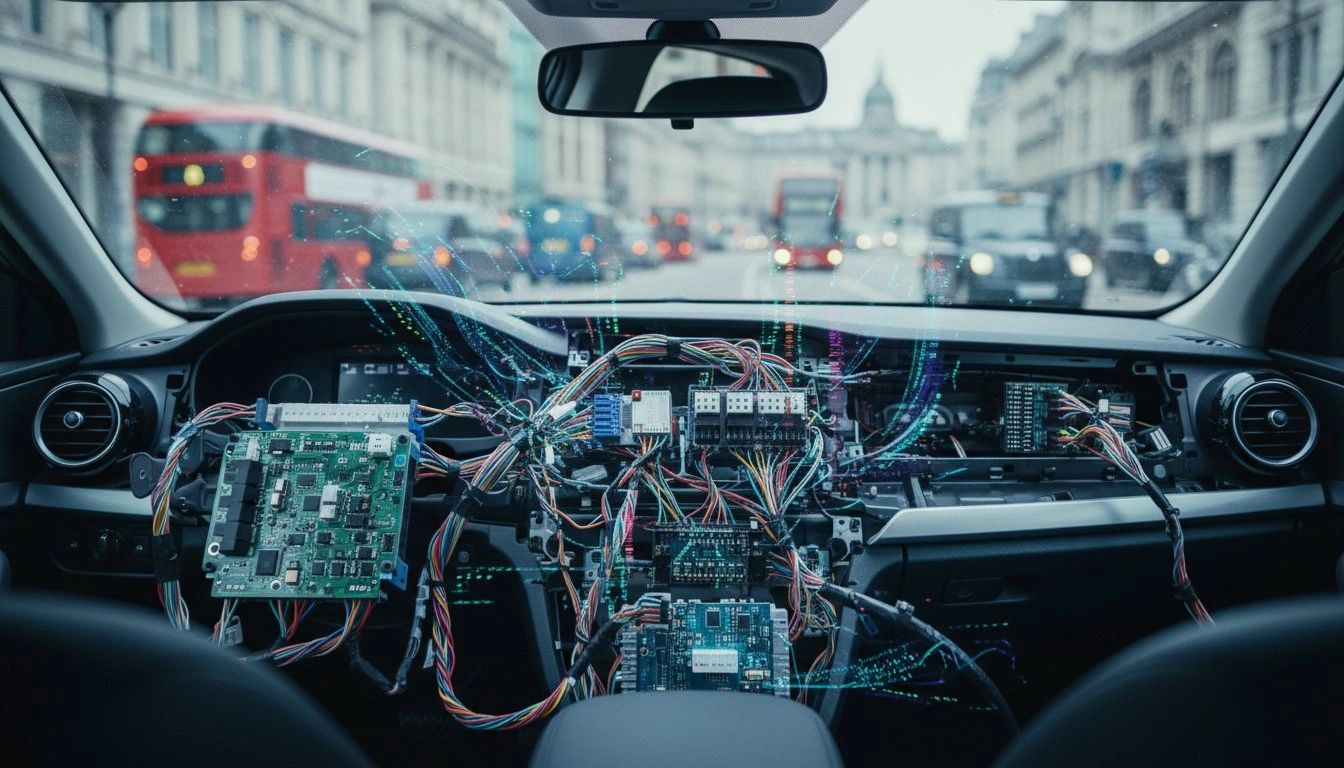
That sinking feeling when a letter from HMRC lands on your doormat is a familiar fear for many business drivers. You’ve diligently claimed your mileage expenses, but is that simple spreadsheet or handwritten logbook truly enough to withstand scrutiny? The core question isn't just about record-keeping; it's about what happens when they demand to see it. So, do HMRC ask for proof of mileage? The answer is a definitive yes, and their requirements for what constitutes valid 'proof' are often more stringent than people realise.
This guide cuts through the uncertainty. We provide a direct, technical breakdown of the exact information HMRC demands for a fully compliant, audit-proof mileage log. You will get a clear checklist to validate your current system, understand the costly mistakes to avoid (especially concerning fuel receipts), and gain the confidence to handle any official enquiry. Prepare to eliminate the guesswork and secure your peace of mind for 2026 and beyond.
Key Takeaways
- The direct answer to "do HMRC ask for proof of mileage" is yes; however, they require a specific type of log, and fuel receipts alone are insufficient.
- Constructing an 'audit-proof' mileage log is critical; learn the specific data points HMRC demands for every business journey to ensure compliance.
- Understand the common mileage claim errors and unusual patterns that automatically trigger HMRC software enquiries and place your business under scrutiny.
- Accurate vehicle data extends beyond tax claims; implementing a robust record-keeping system is essential for vehicle valuation and expense management.
The Short Answer: Yes, HMRC Demands Proof (But Not What You Think)
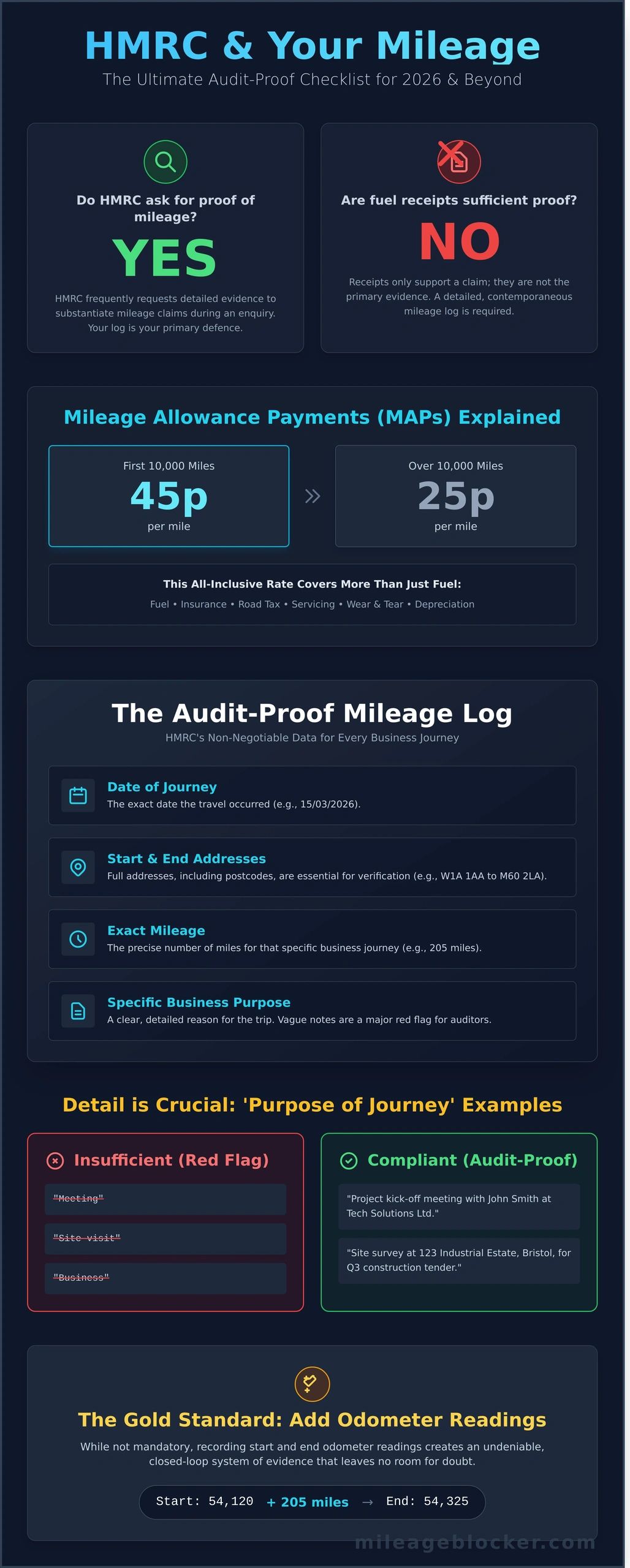
Let's address the core question directly: do HMRC ask for proof of mileage? The answer is an unequivocal yes. If you are a sole trader, a limited company director, or an employee claiming business mileage expenses, HMRC can and frequently does request evidence to substantiate your claims during an enquiry. An investigation can be triggered for various reasons, and inadequate mileage records are a common red flag.
However, there's a significant misconception about the type of proof required. Many people diligently hoard a glovebox full of fuel receipts, believing this is sufficient. It is not. While receipts can support your claim, they are not the primary evidence HMRC demands. To better understand the core requirements, the following video provides a clear overview.
What HMRC truly requires is a contemporaneous and detailed mileage log. This is a record of your business journeys made at the time they happened, not estimated weeks or months later. This log is the cornerstone of your claim, whether you use the simplified fixed mileage allowance method or calculate the actual running costs of your vehicle. Without it, your entire claim is at risk of being disallowed.
Why is HMRC So Focused on Mileage Claims?
Mileage is one of the most common business expense claims and, consequently, one of the most susceptible to error or deliberate inflation. Every business mile you claim directly reduces your taxable profit, which in turn lowers your Corporation Tax or Income Tax bill. HMRC’s primary role is to ensure that all claimed expenses are legitimate and were incurred 'wholly and exclusively' for business purposes. A robust mileage log is the only way to prove this distinction between business and private travel.
Mileage Allowance Payments (MAPs): The Basics
For most businesses and sole traders, the simplest way to claim is using HMRC’s approved Mileage Allowance Payments (MAPs). This system uses a flat rate per mile to cover all vehicle running costs. The current rates are:
- Cars and vans: 45p per mile for the first 10,000 business miles in a tax year.
- Cars and vans: 25p per mile for each business mile over 10,000.
Crucially, this rate is designed to be an all-inclusive figure, covering not just fuel but also insurance, road tax, servicing, and depreciation. This is precisely why a folder of fuel receipts is insufficient proof. The use of a standard mileage rate is an internationally recognised method for simplifying tax affairs, but it places the burden of proof squarely on logging the miles themselves, not the individual running costs.
Crafting the 'Audit-Proof' Mileage Log: Your Gold Standard Checklist
When business owners ask, "do HMRC ask for proof of mileage?", the answer is a definitive yes, especially during a compliance check or formal investigation. Your best defence is a meticulously maintained, 'contemporaneous' mileage log. This means recording journeys as they happen, not attempting to reconstruct them months later. The goal is to create a clear, indisputable narrative of your business travel that leaves no room for an auditor's questions. Following the best practices for tracking mileage ensures your records are robust and removes all ambiguity between personal and business use.
Essential Data Points for Every Journey
To be considered credible by HMRC, every single entry in your mileage log must contain specific, non-negotiable details. Think of this as the minimum required data for each trip:
- Date of the journey: The exact date the travel occurred (e.g., 15/03/2026).
- Start and end addresses: Full addresses, including postcodes, are essential for verification (e.g., from your office at W1A 1AA to a client's site at M60 2LA).
- Exact mileage: The precise number of miles for that specific business journey (e.g., 205 miles).
- Specific business purpose: A clear, detailed reason for the trip.
What 'Purpose of Journey' Really Means
This is where many mileage claims fail under scrutiny. A vague note like 'Client visit' or 'Business' is insufficient. You must provide enough detail to prove the journey was 'wholly and exclusively' for business purposes. The level of detail you provide is critical if HMRC ask for proof of mileage. Consider the difference:
- Bad Example: "Meeting"
- Good Example: "Project kick-off meeting with John Smith at Tech Solutions Ltd."
- Bad Example: "Site visit"
- Good Example: "Site survey at 123 Industrial Estate, Bristol, for Q3 construction tender."
Odometer Readings: The Extra Layer of Proof
While not a mandatory HMRC requirement, recording the start and end odometer readings for each journey is the gold standard of proof. This simple action cross-references your logged miles with the vehicle's own internal data, creating a closed-loop system of evidence. An annual log that aligns perfectly with the vehicle's total mileage increase (minus personal travel) is exceptionally difficult for an inspector to dispute, making your entire claim more secure.
Choosing Your Record-Keeping System: Paper vs. Digital
The core question isn't just "do HMRC ask for proof of mileage?", but rather how you can make providing that proof effortless and accurate. A robust record-keeping system is your best tool for compliance, ensuring you can justify every penny of your claim. There is no single "best" method; the ideal choice depends entirely on your workflow, technical comfort, and the volume of your business travel. The critical factor is consistency. Whichever system you choose, you must stick with it for every business journey to create a complete and defensible log. Let’s examine the three primary options available.
Method 1: The Traditional Paper Logbook
This is the classic, no-frills approach. A simple notebook kept in your glove compartment can be perfectly adequate for HMRC purposes, provided it's filled out diligently and accurately for every single trip.
- Pros: It's simple, requires no technology or batteries, and is always accessible in your vehicle for immediate updates.
- Cons: Paper logs are highly prone to loss or damage, require manual calculation for totals (which can lead to errors), and can become messy and difficult to decipher over time.
Pro Tip: To maintain accuracy, make it a non-negotiable habit to fill in your journey details immediately after you park, not at the end of the week when details become fuzzy.
Method 2: The Digital Spreadsheet (Excel/Google Sheets)
A digital spreadsheet offers a significant step up from paper, blending manual entry with automated calculations. Using software like Microsoft Excel or Google Sheets allows for a clean, organised, and easily searchable record of your business travel.
- Pros: Formulas can calculate your claim totals automatically. Digital files are easily backed up to the cloud, and you can customise the sheet with extra columns for project codes or client details.
- Cons: This method still requires the discipline to update it regularly. It's easy to forget to log a short trip, leading to an incomplete record.
You can create your own or download a free mileage spreadsheet template to get started.
Method 3: GPS Mileage Tracking Apps
For maximum efficiency and accuracy, dedicated GPS mileage tracking apps are the superior solution. These apps run on your smartphone and automate the entire logging process, virtually eliminating manual data entry and human error.
- Pros: They automatically track journeys, capturing all necessary data points. Most importantly, they generate HMRC-ready reports at the touch of a button. These reports contain all the details required by HMRC's official guidance.
- Cons: The most powerful apps often come with a subscription cost (typically £5-£10 per month) and rely on your phone's battery and GPS signal.
This is the most robust method for high-mileage drivers who need an airtight answer if HMRC ask for proof of mileage.
Red Flags: Common Mileage Claim Mistakes That Trigger HMRC Enquiries
HMRC utilises sophisticated software to analyse tax returns, automatically flagging claims that fall outside of expected norms. These systems are designed to spot irregularities and high-risk submissions. Understanding and avoiding common errors is your most effective defence against a compliance check or a full-blown tax investigation. One of the most frequent mistakes involves misunderstanding what constitutes a business journey versus 'ordinary commuting'.
Inconsistent or Vague Records
Your mileage log is the primary evidence for your claim. If it appears fabricated, it will attract scrutiny. Common triggers include consistently using round numbers for every trip (e.g., 50 miles, 100 miles), which suggests estimation rather than accurate recording. Large gaps in your log or records created retrospectively are also significant red flags. Furthermore, journey descriptions must be specific; 'Client Visit' is insufficient. A compliant record would state 'Visit to ABC Ltd, 123 Business Park, Manchester'.
Claiming for Personal Journeys
A fundamental rule of mileage claims is that you cannot claim for personal travel. This includes 'ordinary commuting', which HMRC defines as the journey between your home and your permanent place of work. Even if you use your vehicle for work during the day, your daily trip to and from the office is not a business expense. Similarly, any detours for personal reasons, like stopping at the supermarket or a gym, must be excluded from your business mileage total.
The Consequences of Getting It Wrong
When people ask, 'do HMRC ask for proof of mileage?', the answer is a definitive yes, and the penalties for incorrect claims can be severe. If your records are found to be inaccurate or insufficient, HMRC can take several actions:
- Full Disallowance: Your entire mileage claim for the year could be rejected, resulting in a significant tax bill for the repayment.
- Interest Charges: HMRC will charge interest on the underpaid tax, calculated from the original payment deadline.
- Financial Penalties: Depending on the nature of the error, penalties can range from 0% for an innocent mistake that you correct, to as high as 100% of the tax owed for deliberate inaccuracies.
Ensuring your records are precise is not just about compliance; it is a critical step in protecting yourself from substantial financial penalties.
Beyond Tax: Why Accurate Vehicle Data Is Critical
While the question "do HMRC ask for proof of mileage" is a critical one for financial compliance, the importance of accurate vehicle data extends far beyond your tax return. In today's technologically advanced vehicles, mileage is a fundamental data point that influences everything from market value and insurance premiums to maintenance schedules and diagnostic accuracy. Ensuring the integrity of this data is essential for any owner, technician, or developer.
Modern cars are complex networks of electronic control units (ECUs), and mileage data is often recorded in multiple modules, not just the instrument cluster you see on the dashboard. Discrepancies between these modules can create significant issues during servicing or diagnostics, potentially flagging errors or even devaluing the vehicle. Therefore, managing this data correctly is a matter of technical precision.
The Role of Mileage in Vehicle Testing
For automotive professionals, controlling odometer recording is a legitimate and necessary part of research and development. When conducting performance analysis on a dynamometer (dyno) or performing extensive off-road testing, developers need to halt mileage accumulation. This prevents the artificial inflation of a vehicle's mileage during procedures that do not represent standard road use, ensuring that all test data remains pure and unskewed.
Ensuring Data Integrity Across All Systems
Because mileage is stored in various ECUs, CAN-Bus systems, and EEPROM memories, any advanced work requires a tool that communicates correctly with the entire vehicle network. Ensuring data consistency is key to avoiding system conflicts. If you have questions about how this data is managed, our comprehensive Mileage Blocker FAQ provides detailed answers. For specialised tools designed for testing and tuning, you can find the right device for your car on our website.
Ultimately, while you must be prepared if HMRC ask for proof of mileage, it is equally important to understand the technical landscape of your vehicle. For professionals engaged in legitimate testing or development, having precise control over vehicle data is not just an advantage-it's a necessity for maintaining the integrity and performance of sophisticated automotive systems.
Mastering Your Mileage Claims: The Final Word on HMRC Compliance
Navigating the complexities of tax compliance doesn't have to be a challenge. The key takeaway is clear: while the answer to do HMRC ask for proof of mileage is a resounding yes, their focus is on the quality and consistency of your records. Maintaining a detailed, contemporaneous log is your best defence against enquiries, and avoiding common red-flag errors is crucial for staying off their radar. Accurate data is not just about tax; it's about professional diligence.
For professionals engaged in automotive research, the need for precise data control is even more critical. Our solutions are engineered for legitimate testing and development purposes, offering an untraceable effect without storing information in any memory modules. Built from genuine automotive-grade components, our products guarantee reliability and performance. With worldwide delivery and lifetime support, you receive a tool built for the highest professional standards.
Equip yourself with the best. Discover premium tools for vehicle testing and development and take full control of your vehicle's data with confidence.
Frequently Asked Questions About HMRC Mileage Claims
Do I need to keep fuel receipts for my mileage claim at all?
If you use the HMRC-approved simplified flat-rate mileage allowance (AMAPs), you are not required to keep fuel receipts. The 45p per mile rate is designed to cover all running costs, including fuel, insurance, and wear and tear. While not mandatory, fuel receipts can serve as secondary evidence to support the dates and locations listed in your mileage log if your records are ever questioned by HMRC. Your primary proof remains a detailed mileage log.
Can I claim mileage if I use my personal car for business?
Yes, you can and should claim mileage expenses for business journeys made in your personal vehicle. This is precisely what the Approved Mileage Allowance Payments (AMAPs) system is for. It allows you to claim a tax-free allowance from your employer or tax relief from HMRC for travel to temporary workplaces. The current rate is 45p for the first 10,000 business miles in a tax year and 25p for each mile thereafter.
How far back can I claim mileage allowance from HMRC?
You are permitted to make a backdated claim for mileage expenses for the previous four tax years. If you have neglected to claim in the past, you can still submit the necessary forms to receive tax relief. For example, during the 2024/2025 tax year, you can submit claims for as far back as the 2020/2021 tax year. It is critical that you have accurate and detailed mileage logs for any period you wish to claim for.
What is the difference between a 'permanent' and 'temporary' workplace?
A 'permanent' workplace is your normal, regular place of work. The daily commute between your home and this single location is considered ordinary commuting and is not eligible for a mileage claim. A 'temporary' workplace is a location you attend for a specific, limited task or a period of short duration. Travel from your home or permanent workplace to a temporary site, such as a client’s office or a different branch, qualifies as a business journey.
Can HMRC track my car or check my MOT records for mileage?
HMRC does not have the authority or technical means to track your vehicle in real-time. However, during a tax compliance check, they can request access to your vehicle's MOT history. These records contain a dated log of your car's odometer reading. Any significant discrepancies between your MOT mileage and your business mileage log could trigger a deeper investigation into the accuracy of your claim. This is a key reason why accurate logs are non-negotiable.
What happens if I lose my mileage logbook?
Losing your primary mileage log is a serious issue that can jeopardise your claim. If this occurs, you must attempt to reconstruct the records as accurately as possible using secondary sources. This can include digital calendars, work schedules, expense receipts, and client invoices that prove you were travelling for business on specific dates. A carefully reconstructed log is far better than providing no evidence at all, but it is not a substitute for proper, contemporaneous record-keeping.
Is it better to claim the 45p per mile flat rate or actual vehicle costs?
For the vast majority of individuals, the 45p per mile flat rate is the superior option. It is administratively simple, requiring only a detailed mileage log. Claiming actual vehicle costs is a complex process that involves tracking and calculating a proportion of every single expense, including fuel, insurance, servicing, and vehicle depreciation. This method is significantly more work and is typically only more financially beneficial for those with exceptionally high-cost vehicles or very low business mileage.
Does using a mileage blocker affect my tax claim?
Mileage blockers are intended for legitimate purposes such as vehicle testing in a controlled, off-road environment. Using such a device to intentionally misrepresent the mileage driven for a business claim submitted to HMRC is illegal and constitutes tax fraud. People often ask, do HMRC ask for proof of mileage, and the answer is an emphatic yes. A detailed, accurate log is required, and any attempt to falsify this data with mileage manipulation tools can result in severe financial penalties and criminal prosecution.
About the author
Pav TomaszeviczChief Editor, MileageBlocker.com
Pav is Chief Editor at MileageBlocker.com and works with the MileageBlocker Technical Team to publish practical information about vehicle compatibility, CAN/CAN-FD electronics, installation and MileageBlocker products.
View author profile →