
How Mileage Affects Your PCP Car Finance Agreement: Your Guide
A significant, unexpected bill at the end of a Personal Contract Purchase (PCP) is a primary concern for many drivers across the UK. This anxiety often origi...

A significant, unexpected bill at the end of a Personal Contract Purchase (PCP) is a primary concern for many drivers across the UK. This anxiety often originates from one critical question: how does mileage affect my PCP car finance agreement? The mileage clause is a cornerstone of your contract, directly influencing not only your monthly payments but also the vehicle’s Guaranteed Minimum Future Value (GMFV). Exceeding this pre-agreed limit means the car is worth less than the finance company predicted, and they will hold you liable for that depreciation in the form of an excess mileage charge.
These penalties, often charged at several pence per mile, can rapidly accumulate into a final bill of hundreds or even thousands of pounds. This complete guide provides the technical details you need to avoid that outcome. We will break down exactly how charges are calculated, what your options are at the end of the contract, and how to manage your mileage effectively throughout the term, giving you the confidence to control your costs and make an informed decision on your next vehicle.
Key Takeaways
- The primary way how mileage affects your PCP car finance agreement is by setting the car's future value; this calculation directly determines the cost of your monthly payments.
- If you're asking "how does mileage affect my PCP car finance agreement if I go over the limit?", the answer is a 'pence per mile' (PPM) charge that can lead to a final bill of hundreds or even thousands of pounds.
- Discover proactive strategies to monitor your mileage. This is the best way to manage how mileage affects your PCP car finance agreement in real-time and avoid unexpected excess charges at the end of your term.
- Your final mileage total is critical. It impacts your end-of-contract options and any potential equity, which is the ultimate answer to how does mileage affect my PCP car finance agreement?. In fact, understanding how mileage affects your PCP car finance agreement is key to making a smart financial decision.
The Core of Your PCP Deal: Understanding Mileage and Vehicle Value
A Personal Contract Purchase (PCP) is a highly popular car finance method in the UK, primarily because it offers lower monthly payments compared to a traditional Hire Purchase (HP) agreement. The key distinction is that with PCP, your monthly payments are not designed to cover the car's total value. Instead, they cover its predicted depreciation – the difference between the car's initial price and its calculated value at the end of your contract. The entire agreement hinges on this predicted future value.
This video provides a clear overview of how PCP agreements work in practice:
What is the GMFV and Why Does it Matter?
The Guaranteed Minimum Future Value (GMFV) is the most critical figure in your PCP contract. It is the amount the finance company predicts your car will be worth when your agreement concludes. This value is guaranteed, which protects you from unexpected drops in the used car market. At the end of the term, this GMFV becomes the optional 'balloon payment' you can pay if you decide you want to own the vehicle outright.
The Direct Link Between Mileage and Depreciation
So, how does mileage affect my PCP car finance agreement? The answer is simple: mileage is the single biggest factor determining a vehicle's depreciation. Higher mileage directly correlates to increased wear and tear on mechanical components, the engine, and the interior, which significantly lowers its resale value. The finance company sets a strict mileage limit in your contract specifically to protect the GMFV they have guaranteed. Exceeding this limit devalues their asset, and they pass that cost on to you.
How Your Annual Mileage Limit is Calculated
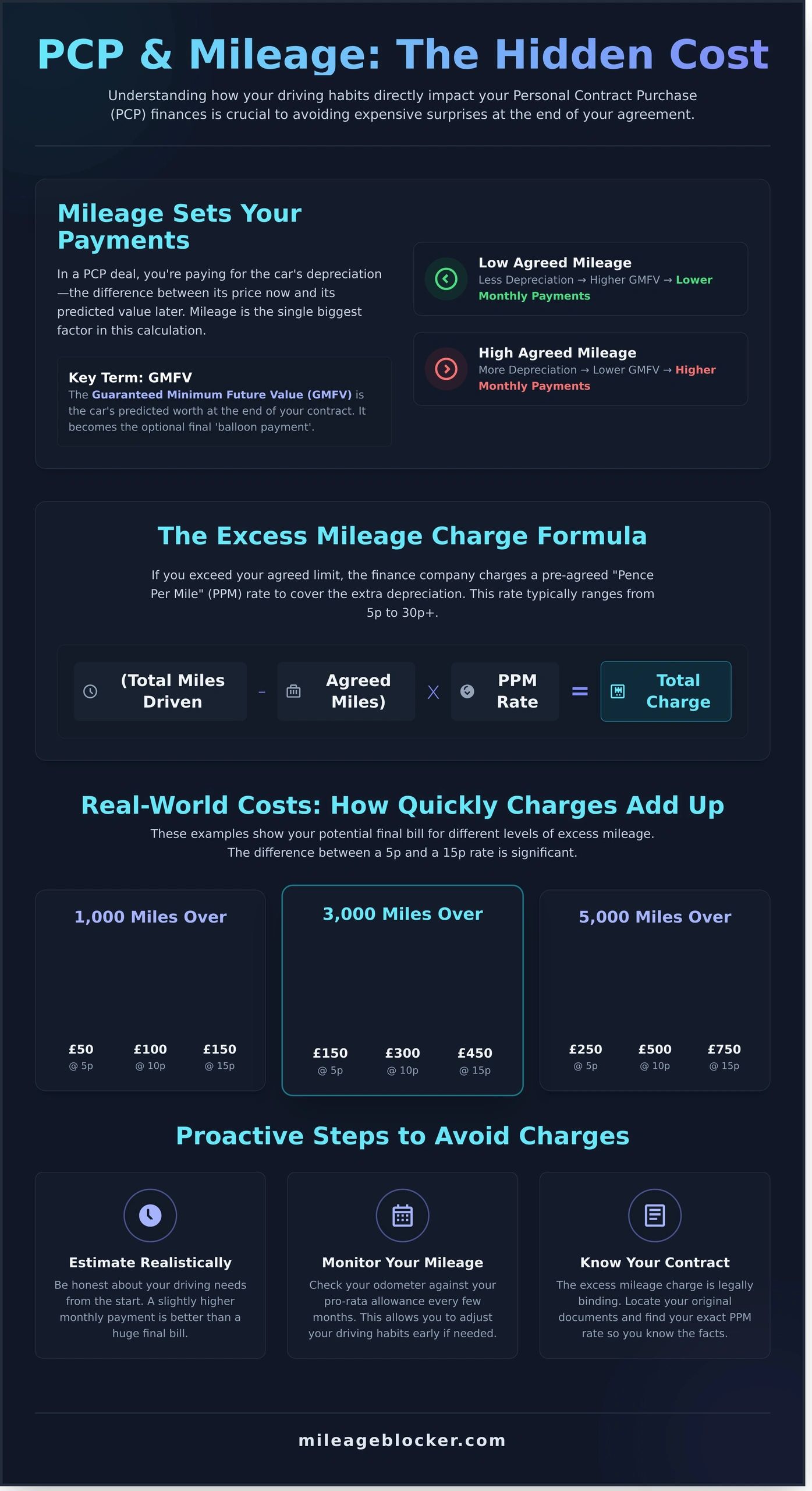
During the application process, you and the finance provider will agree on an annual mileage allowance. This figure is fundamental to the structure of your deal. A lower mileage limit (e.g., 8,000 miles per year) suggests less depreciation, resulting in a higher GMFV and, therefore, lower monthly payments. Conversely, a higher mileage allowance (e.g., 20,000 miles) means more depreciation, a lower GMFV, and higher monthly payments. It is vital to be realistic with your estimate from the outset to avoid costly excess mileage charges later.
The Financial Impact: Calculating Excess Mileage Charges
The primary concern for any driver approaching the end of their PCP term is the final bill. Exceeding your agreed mileage limit results in a straightforward financial charge designed to compensate the finance company for the vehicle's additional depreciation. This is not a penalty, but a pre-agreed contractual cost. The key metric you must understand is the 'pence per mile' (PPM) rate, which is clearly defined in your signed finance agreement. This rate varies significantly based on the manufacturer and the vehicle's value, typically ranging from 5p to over 30p for premium models.
The Simple Formula for Excess Mileage Costs
Calculating your potential liability is a simple matter of arithmetic. The formula is non-negotiable and applied directly as stipulated in your contract. It is essential to locate your original documents to find your exact PPM rate. The calculation is as follows:
(Total Miles Driven - Contracted Miles) x PPM Rate = Total Excess Mileage Charge
For example, if your agreement was for 30,000 miles over three years and you returned the car with 34,000 miles on the odometer, you have an excess of 4,000 miles. With a PPM rate of 8p (£0.08), the calculation would be: 4,000 miles x £0.08 = £320.
Real-World Cost Examples
To illustrate how quickly these costs can accumulate, the following examples demonstrate the total charge for various levels of excess mileage at different PPM rates. Understanding this is central to answering the question, how does mileage affect my PCP car finance agreement?
If you are 1,000 miles over your limit:
- At 5p per mile, your charge is: £50
- At 10p per mile, your charge is: £100
- At 15p per mile, your charge is: £150
If you are 3,000 miles over your limit:
- At 5p per mile, your charge is: £150
- At 10p per mile, your charge is: £300
- At 15p per mile, your charge is: £450
If you are 5,000 miles over your limit:
- At 5p per mile, your charge is: £250
- At 10p per mile, your charge is: £500
- At 15p per mile, your charge is: £750
Are These Charges Legally Enforceable?
Yes, absolutely. The excess mileage charge is a legally binding component of the PCP contract you signed. It is not a discretionary 'fine' but a contractual fee you agreed to when you took possession of the vehicle. Refusing to pay this charge constitutes a breach of your finance agreement. This will result in the account going into default, which will be reported to credit reference agencies and will negatively impact your credit score for several years, affecting your ability to secure future finance.
Proactive Strategies for Managing Your PCP Mileage
Understanding the consequences of exceeding your mileage limit is crucial, but the most effective strategy is proactive management. By staying aware of your usage throughout the contract, you can avoid the stress and significant financial penalties at the end of your term. Answering the question "how does mileage affect my PCP car finance agreement?" is not just about the final bill; it's about taking control from day one. These practical steps will help you stay on track and prevent any unwelcome surprises.
Track Your Mileage: The 'Little and Often' Approach
Consistent monitoring is the foundation of good mileage management. Instead of waiting for the annual service reminder, get into the habit of checking your odometer regularly. This allows you to spot trends and make adjustments to your driving habits early.
- Set a Monthly Reminder: Use your phone or calendar to log your mileage on the 1st of each month. This takes less than a minute.
- Calculate Your Pro-Rata Allowance: Divide your annual limit by 12 to find your average monthly allowance. For example, a 10,000-mile annual limit equals approximately 833 miles per month.
- Keep a Simple Log: Use a basic spreadsheet, a dedicated notebook, or a vehicle management app to track your monthly figures against your allowance.
What to Do if You Predict an Overage Mid-Contract
If your tracking reveals you are consistently exceeding your monthly allowance, do not wait until the end of the contract. Contact your finance provider as soon as you predict a potential overage. Many lenders are willing to help and offer solutions. Some may allow you to formally adjust your agreement by increasing your mileage limit, which in turn slightly raises your monthly payments. This is almost always cheaper than paying the excess mileage penalty, which can be as high as 10p-30p per mile.
Understanding How Mileage is Recorded in Modern Vehicles
It's important to recognise that the mileage displayed on your dashboard is just one representation of the data stored within your vehicle. In modern cars, mileage information is not held in a single location. Instead, it is recorded across multiple Electronic Control Units (ECUs) and control modules. This decentralised system creates a robust and verifiable record. This complexity is why any diagnostic or testing work requires specialist tools to interface correctly with the vehicle's network without causing data conflicts.
Your Options at the End of the PCP Agreement
As your Personal Contract Purchase (PCP) plan concludes, you arrive at a critical decision point. You have three distinct options, and your vehicle's mileage is a primary factor in determining the most financially advantageous path. Understanding these choices is the final step in answering how does mileage affect my PCP car finance agreement?
Option 1: Return the Car (and Pay the Charge)
This is the most straightforward option and the one where excess mileage charges are most commonly applied. You simply hand the vehicle back to the finance company. An inspector will then assess the car's condition, record the final mileage from the odometer, and compare it to your contractual limit. If you have exceeded the agreed mileage, an invoice for the excess mileage penalty will be issued. For example, being 5,000 miles over your limit with a 10p-per-mile charge results in a £500 bill.
It is important to note that this is separate from charges for damage beyond 'fair wear and tear'. The finance company will assess the vehicle's condition against a standard guide, and any significant dents, scratches, or interior damage may incur additional costs.
Option 2: Buy the Car (The Mileage Becomes Irrelevant)
If you decide you want to keep the car, you can purchase it outright by paying the pre-agreed balloon payment, officially known as the Guaranteed Minimum Future Value (GMFV). When you choose this option, the mileage clause in your contract becomes void. The finance company has no further interest in the vehicle's mileage or future value because you are taking full ownership. There are no excess mileage charges to pay, making this an excellent choice if you are significantly over your limit and wish to keep the vehicle.
Option 3: Part-Exchange for a New Vehicle
Many drivers choose to use any equity in their car as a deposit for a new one. In this scenario, the dealer assesses your car's current market value. If this trade-in value is higher than the GMFV, you have positive equity. For instance, if your GMFV is £12,000 and the dealer offers you £13,500, you have £1,500 in equity to put towards your next car.
However, high mileage directly and significantly reduces a car's market value. Exceeding your mileage allowance can easily erase any potential equity, leaving you with nothing for a deposit or, in some cases, requiring you to pay the difference if the car's value has fallen below the GMFV.
Common Questions and Misconceptions About PCP Mileage
Understanding the fine print of your Personal Contract Purchase (PCP) agreement is crucial for avoiding unexpected costs at the end of your term. To provide maximum clarity, this section addresses the most common questions and myths surrounding PCP mileage allowances. Knowing the answers is the final step in understanding precisely how does mileage affect my PCP car finance agreement?
Do I Get a Refund or Credit for Unused Miles?
The answer is unequivocally no. Finance companies do not offer a cash refund or credit for finishing the term under your agreed mileage limit. The Guaranteed Minimum Future Value (GMFV) is calculated based on you meeting the contract terms, including the mileage cap. Being under your allowance may mean the car is worth more than the GMFV, but this extra value is only realised as potential equity if you choose to part-exchange the vehicle for a new one.
What About Mileage Used for Off-Road or Track Days?
A vehicle's odometer records the total distance its wheels have travelled, regardless of whether that is on a public road, a private race track, or an off-road course. All mileage clocked by the vehicle contributes to your total and will be counted towards your contractual limit when the car is inspected. For accurate testing, it's vital to understand how odometer data is recorded across the vehicle's various electronic control units (ECUs).
Can I Hide or Alter the Mileage Before Returning the Car?
Absolutely not. Attempting to alter, hide, or "clock" a vehicle's odometer is illegal odometer fraud and a criminal offence under the UK's Fraud Act 2006. Finance companies and dealerships use sophisticated diagnostic tools and check against MOT and service histories to detect tampering. The consequences are severe, including potential prosecution, heavy fines, a prison sentence, and a damaged credit file, making it a risk that should never be taken.
Does Voluntary Termination Affect Mileage Charges?
Voluntary Termination (VT) allows you to end your agreement early once you have paid 50% of the total amount payable. However, this does not give you a free pass on mileage. Your agreement will include a pro-rata mileage allowance. If you have exceeded this proportional limit at the point of termination, the finance company is legally entitled to invoice you for the excess mileage. Always check the specific VT clause in your finance agreement to confirm the terms.
Mastering Your Mileage: The Final Word on Your PCP Agreement
Ultimately, the answer to how does mileage affect my PCP car finance agreement? is simple: it is one of the most critical factors in determining your final costs. By understanding its direct impact on your vehicle's Guaranteed Minimum Future Value (GMFV) and staying within your agreed limits, you can avoid expensive excess mileage charges. Proactive management and knowing your options at the end of the term empower you to make the most of your finance deal and drive away without any financial regrets.
Modern vehicles require smart solutions, especially for professionals who need precise control during diagnostics or off-road activities. Carcode Mileage Blockers are engineered with premium quality components for absolute reliability, offer a simple plug-and-play installation, and are available with worldwide shipping. For professional vehicle testing and off-road use, find the right tool for your car.
Frequently Asked Questions About PCP Mileage
What is a typical excess mileage charge on a PCP deal?
In the UK, excess mileage charges on a PCP agreement typically range from 3p to 30p per mile. The exact figure depends on the finance provider and the vehicle's value; premium and performance cars usually command a higher rate. For example, a charge of 8p per mile would result in a bill of £800 for every 10,000 miles you go over your agreed limit. Always check this specific figure in your contract before signing.
Can you change the agreed mileage on a PCP contract midway through?
Yes, many finance providers allow you to adjust your agreed mileage during the contract term. It is crucial to contact them as soon as you anticipate exceeding your limit. They will recalculate your monthly payments based on the new, higher mileage allowance. Acting early is more effective and can prevent a large one-off payment at the end of the agreement. Some lenders may have specific cut-off points for making changes, so prompt communication is key.
What happens if you lie about your mileage when returning a PCP car?
Attempting to misrepresent your vehicle's mileage is considered fraud and is a serious offence. Finance companies have thorough inspection processes and access to vehicle history, including MOT and service records, which record mileage. If discovered, you will face severe consequences, including legal action, substantial financial penalties, and a damaged credit file. This will make it extremely difficult to obtain any form of vehicle finance or credit in the future.
Is it better to choose a higher mileage limit from the start to be safe?
This depends on your financial planning. Opting for a higher mileage limit increases your monthly payments but provides a buffer against end-of-contract charges. It is often more cost-effective to pay a slightly higher monthly fee than to face a large excess mileage bill. The key is to be realistic about your expected usage. Understanding how does mileage affect my PCP car finance agreement from the outset allows you to make an informed, financially sound decision.
How much does a 1p per mile excess charge actually cost?
While a 1p per mile charge sounds minimal, it can accumulate quickly. The calculation is straightforward: for every 1,000 miles you are over your limit, you will be charged £10. If you exceed your allowance by 5,000 miles, the cost would be £50. If your charge is higher, for instance 10p per mile, that same 5,000-mile excess would cost you £500. Always use the specific rate in your contract to calculate potential costs.
Does poor servicing history affect the end-of-contract inspection as much as mileage?
Both are critically important and can lead to significant charges. Exceeding your mileage results in a clear, pre-agreed financial penalty. However, a poor or incomplete service history can be viewed as a breach of the agreement's terms. This can lead to substantial devaluation charges, as the vehicle's future value is compromised. In some cases, these charges for poor maintenance can be even higher than those for excess mileage, highlighting the need to adhere to all contract terms.
About the author
Pav TomaszeviczChief Editor, MileageBlocker.com
Pav is Chief Editor at MileageBlocker.com and works with the MileageBlocker Technical Team to publish practical information about vehicle compatibility, CAN/CAN-FD electronics, installation and MileageBlocker products.
View author profile →