Can a Car Odometer Show an Inaccurate Reading? Causes, Detection, and Management
Can a car odometer show inaccurate reading? Absolutely. Uncover the electronic and mechanical causes, from ECU glitches to sensor fails, and protect your inv...
With over 450,000 vehicles sold annually with fraudulent readings according to NHTSA data, you're right to ask: can car odometer show inaccurate reading without intentional tampering? While many assume the dashboard is the ultimate source of truth, modern systems in a Range Rover or a McLaren are far more complex. Electronic glitches, sensor failures, or even tyre size changes can lead to discrepancies that cause genuine anxiety during MOT checks or resale negotiations.
We understand the frustration of trying to reconcile service history with a digital display that doesn't seem to add up. This article provides a technical deep dive into the mechanical and electronic causes of mileage inaccuracy, from ECU desynchronisation to internal memory errors. You'll learn how to verify data across multiple control modules and understand how professional tools, such as Carcode Mileage Blockers available at MileageBlocker.com, provide essential mileage management for authorised testing and research purposes. We'll also cover the latest 2026 industry trends in digital fraud detection to help you protect your investment in any vehicle, from a BMW to a Lamborghini.
Key Takeaways
- Understand why a can car odometer show inaccurate reading due to mechanical gear wear in classic BMWs or electronic desync between the ABS module and dashboard in modern vehicles.
- Discover how mileage is stored across multiple Electronic Control Units (ECUs) in supercars like Ferrari and McLaren, making total accuracy more complex than a single dashboard figure.
- Learn to verify a vehicle's digital footprint by cross-referencing MOT history with physical wear indicators on high-contact areas like steering wheels and seat bolsters.
- Explore how Carcode Mileage Blockers from MileageBlocker.com allow for precise mileage management during authorised testing scenarios, such as dyno trials or off-road performance evaluations.
Understanding Why a Car Odometer Might Show an Inaccurate Reading
Many drivers assume the digital or analogue numbers on their dashboard represent an absolute, unchangeable truth. However, a discrepancy between recorded and actual distance travelled is a documented technical reality in the automotive industry. When asking can car odometer show inaccurate reading, you must first understand what is an odometer and how it calculates distance. Whether you are behind the wheel of a classic BMW or a high-performance McLaren, the system relies on specific input signals that can be compromised by physical wear, electronic interference, or configuration changes. Precision is not always guaranteed.
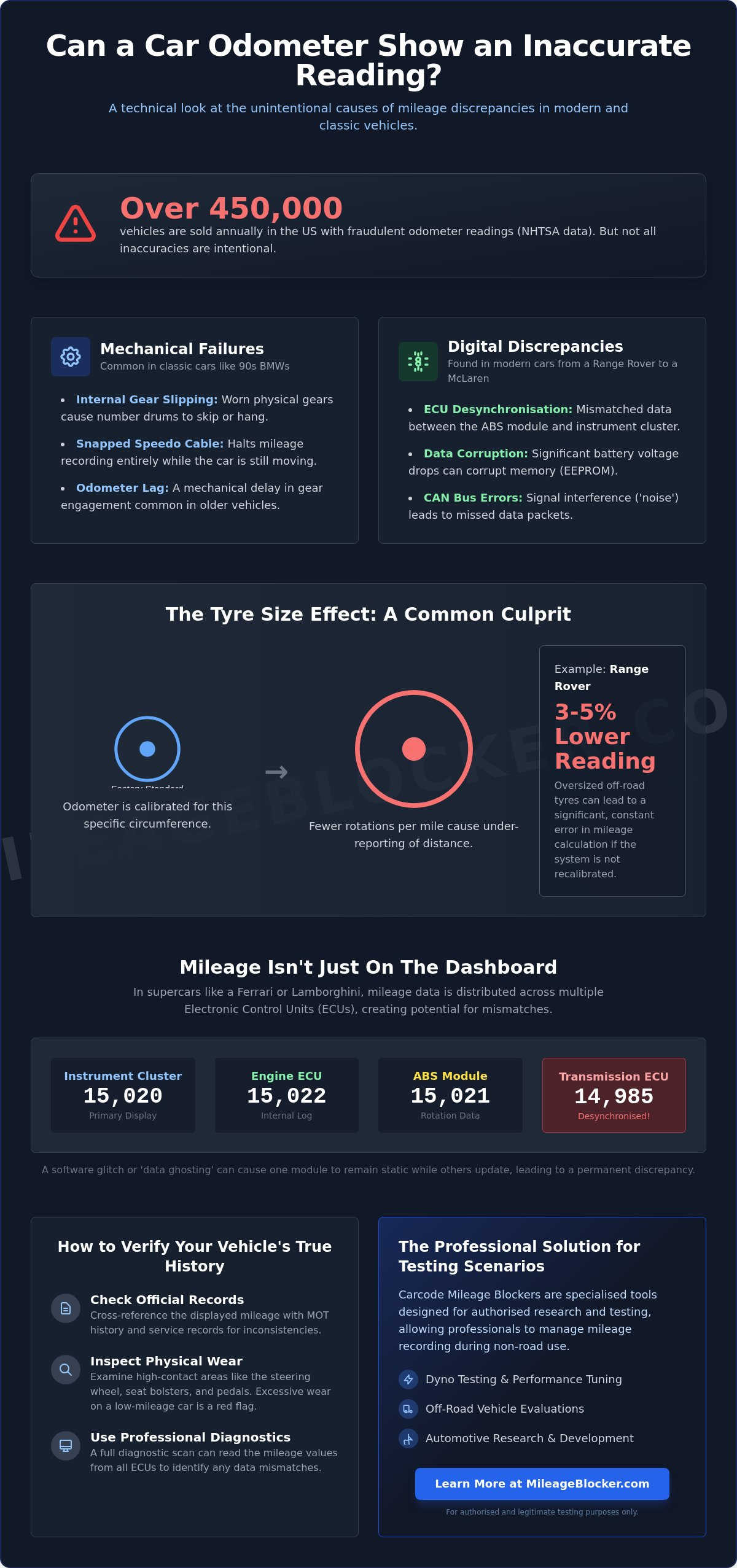
Mechanical systems in older vehicles rely on physical gear ratios to translate wheel rotations into mileage. If these gears lose their grip or the sensor pulse signal degrades over time, the reading begins to drift. Sensor degradation often manifests as an intermittent or weak speed pulse. This results in the system failing to capture every rotation, leading to a significant under-reporting of the actual miles covered on the road.
Mechanical Wear and Component Failure
Vintage dashboards, particularly those found in 90s BMW and Range Rover models, frequently suffer from internal gear slipping. This physical failure causes the numerical drums to hang or skip entirely during rotation. A snapped speedometer cable is another common failure point that halts the recording process immediately while the vehicle remains in motion. Odometer lag is a mechanical delay in gear engagement common in 90s vehicles. These issues create a permanent gap between the display and the vehicle's true history.
Tyre Size and Calibration Errors
Tyre circumference plays a critical role in mileage calculation because the vehicle's computer counts rotations to determine distance. Larger tyres result in fewer rotations per mile. This causes the odometer to show a lower mileage than what has actually been covered. For example, a Range Rover equipped with oversized off-road tyres may show a 3-5% lower reading than actual. Switching from factory-standard tyres to larger aftermarket variants introduces a constant percentage of error. It is vital to prioritise recalibrating the speedometer after any significant wheel modifications to maintain data integrity.
Professionals conducting controlled vehicle trials often require tools to manage data during non-road use. Carcode Mileage Blockers from MileageBlocker.com are designed for these specific, authorised scenarios. These devices allow testers to stop the recording process during dyno testing or off-road evaluations, ensuring the primary odometer remains accurate to the vehicle's legitimate road-use history.
Digital Discrepancies and ECU Data Mismatches in Modern Vehicles
Modern vehicles are essentially rolling computers. While mechanical failure was once the primary culprit for mileage issues, the question of can car odometer show inaccurate reading in 2026 typically revolves around electronic synchronisation. Data is rarely stored in a single location. Instead, it is distributed across several Electronic Control Units (ECUs), creating multiple points of potential failure.
A common desync occurs between the ABS module and the instrument cluster. If these modules fail to communicate perfectly, the dashboard might display a figure that contradicts the internal logs. If you've ever dealt with a flat battery in a Ferrari, you'll know the headache of resetting sensitive electronics; this is often where the trouble begins. Significant battery voltage drops can lead to data corruption in the EEPROM (Electrically Erasable Programmable Read-Only Memory), causing the mileage display to jump erratically or freeze.
The Role of CAN Bus Communication
The Controller Area Network (CAN) acts as the vehicle's nervous system, facilitating the exchange of data packets between various modules. Signal interference, often referred to as electronic 'noise', can cause the system to miss specific distance packets. In a McLaren 720S, where electronic synchronisation is vital for performance metrics, even minor packet loss can lead to mileage discrepancies. This technical complexity is why Carcode Mileage Blockers are engineered to interact directly with these digital protocols during authorised testing and research.
Multiple Memory Modules in Supercars
In a Lamborghini or Bugatti, mileage is recorded in the transmission and engine modules alongside the dashboard. While digital odometer fraud is a significant concern for law enforcement, technical glitches are equally problematic for owners. You might wonder, can car odometer show inaccurate reading results after a major software update? The answer is yes, particularly if 'data ghosting' occurs. This happens when a software glitch allows one module to update while another remains static. Diagnostic tools available at MileageBlocker.com help technicians identify these internal mismatches, ensuring the vehicle's data integrity is preserved. If you're unsure about your vehicle's current configuration, you can contact our technical team for guidance on mileage management.
How to Verify Odometer Accuracy and Identify Discrepancies
Identifying a discrepancy requires a multi-layered investigation. While you might ask can car odometer show inaccurate reading without any intent to deceive, you must verify the data to be certain of the vehicle's history. Start with the digital footprint. In the UK, official government MOT history checks are public and provide a chronological record of mileage at every annual test. Any drop or stagnation between these tests is a primary indicator of 'clocking' or a significant electronic fault that has gone unaddressed.
The MOT History and Service Record Audit
A thorough audit involves more than just checking the most recent certificate. You must look for consistency in the dates and intervals recorded in the manufacturer's database. Cross-referencing physical service stamps with digital logs often reveals gaps that a single dashboard reading cannot show. Discrepancies in the logbook timing suggest the system may have been tampered with or suffered a synchronisation failure. You can use the Find Your Car tool to identify which specific modules in your BMW or Range Rover store mileage data, as these vary significantly by model year and trim level.
Physical and Digital Forensic Checks
Beyond the paperwork, physical evidence often tells the real story. High-contact areas provide the best clues; a worn-out driver's seat in a low-mileage BMW is a major red flag. Inspect the pedal rubbers, steering wheel texture, and seat bolsters for wear that doesn't align with the displayed distance. In high-performance vehicles like a Ferrari or Lamborghini, these interior components are designed for longevity, so visible degradation usually indicates high usage.
Digital forensics offer even deeper insight. Use a high-quality OBD-II scanner to pull data from the Transmission Control Module (TCM) or the Engine Control Module (ECM). These modules often record mileage independently of the instrument cluster. Comparing these figures can expose internal mismatches. Additionally, checking 'engine hours' is a reliable way to detect if a car has been idling excessively or used in heavy traffic, which adds wear not always reflected in the mileage. As noted by the NHTSA on Odometer Fraud, verifying these data points is the most effective way to protect against financial loss.
For those conducting performance trials or research, managing this data correctly is vital. If you require a solution for mileage management during authorised off-road testing, explore the range of Carcode Mileage Blockers to ensure your vehicle's history remains accurate to its road-use profile.
Managing Odometer Data During Controlled Vehicle Testing
While previous sections explored how technical faults or environmental factors lead to the question can car odometer show inaccurate reading, there is a professional side to mileage management where intentional data control is necessary. Vehicle manufacturers and independent testers often require technology to halt distance recording during controlled trials. This ensures that testing data doesn't artificially inflate the vehicle's road mileage history. Maintaining accurate asset records is vital for both valuation and maintenance scheduling during intensive research phases.
The use of a Mileage Blocker is a standard practice for stopping the odometer during specific, authorised use cases. These devices are high-performance tools designed for a knowledgeable, professional clientele who require precision and discretion. At MileageBlocker.com, we prioritise the quality of components in our Carcode Mileage Blockers to ensure no data corruption occurs within the vehicle's sensitive EEPROM or multiple ECU modules. Whether you're testing a daily driver or a Ferrari SF90, the hardware is engineered to maintain system stability without triggering error codes.
Why Testers Use Odometer Stopper Technology
Testing a new engine programme on a dynamometer involves high-speed wheel rotation without the vehicle ever leaving the workshop. Without intervention, the dashboard would record hundreds of 'phantom miles' that don't reflect actual road wear. Similarly, off-road performance testing in a Range Rover often takes place on private tracks where recording road mileage isn't required. In these scenarios, mileage management is a technical necessity. For those needing professional fitting for specialised testing rigs, our Installation Guide provides the necessary technical support to ensure a seamless setup.
The Technical Superiority of Carcode Mileage Blockers
These devices filter CAN bus data packets with surgical precision. This approach allows the odometer to stop while other critical systems, such as the speedometer and active safety features, continue to function as intended. The 'plug and play' nature of the hardware is a significant advantage, as it requires no permanent modifications to the vehicle's wiring loom. This is essential for high-value assets where original factory specifications must be preserved. For a deeper dive into the hardware and its specific applications, refer to Mileage Blocker: The Ultimate Guide to Odometer Stopper Technology. Our tools are developed with proprietary software to handle the complex electronic architecture of modern supercars, ensuring that the question of can car odometer show inaccurate reading is managed through professional, controlled intervention rather than accidental glitching.
Take Control of Your Vehicle Data Integrity
Understanding the technical nuances of modern automotive electronics is essential for maintaining a vehicle's history. From mechanical gear slippage in a vintage BMW to complex ECU desynchronisation in a Lamborghini or McLaren, the answer to can car odometer show inaccurate reading is often found in the hardware's communication protocols. By utilising MOT history audits, physical inspections, and diagnostic scans, you can verify data across multiple control modules to ensure total transparency during resale or testing.
For those engaged in authorised vehicle research or performance trials, professional mileage management is a necessity. Precision is paramount. You can secure your vehicle's data with a premium Carcode Mileage Blocker from MileageBlocker.com. Our devices utilise high-grade German-engineered components to provide discreet operation for professional testing rigs. We offer worldwide delivery and a professional UK fitting service to support your requirements. Equip your vehicle with the industry's leading hardware and ensure your data remains reliable throughout your testing programme.
Frequently Asked Questions
Can a digital odometer be wrong without being tampered with?
Yes, a digital display can be wrong due to non-fraudulent technical issues. Factors like ECU desynchronisation or significant tyre diameter changes on a Range Rover often lead to discrepancies. If the wheel circumference is larger than the factory setting, the computer records fewer rotations per mile. This demonstrates how a can car odometer show inaccurate reading result occurs through purely mechanical or electronic calibration errors rather than manual interference.
Is it possible for a car's mileage to jump forward suddenly?
Mileage jumps are usually the result of data synchronisation between multiple modules. Modern vehicles like a Ferrari or McLaren store mileage in several locations. If the instrument cluster fails and is replaced with a used unit, or if a battery voltage drop corrupts the EEPROM, the system might suddenly sync to the highest value stored in the BCM or engine module. This creates a sudden, unexplained leap in the displayed figure.
How do I know if the odometer has been clocked on a used car?
You can detect clocking by cross-referencing digital records with physical evidence. Start by checking the UK MOT history for chronological consistency. Inspect high-wear areas such as the steering wheel and seat bolsters in a BMW; excessive wear on a low-mileage car is a red flag. Professional diagnostic tools available through MileageBlocker.com can also pull hidden data from the Transmission Control Module to identify internal mismatches.
Does changing the battery affect the odometer reading?
A standard battery change shouldn't alter the mileage, but extreme power loss can cause issues. In sensitive supercars like a Bugatti or Lamborghini, a sudden drop in voltage during a cold start or battery failure can lead to data corruption in the dashboard memory. While the mileage isn't lost, it can cause the display to freeze or show erratic numbers until the modules are properly resynchronised by a specialist.
Can a faulty speed sensor cause an inaccurate odometer reading?
A faulty speed sensor is a primary cause of distance under-reporting. The odometer relies on a consistent pulse signal from the sensor to calculate distance travelled. If the sensor is failing or the wiring is degraded, the system misses data packets. This results in the vehicle travelling a greater distance than what is recorded on the dashboard, making the service history and actual wear difficult to reconcile.
Is using a mileage blocker legal for vehicle testing?
Using a mileage blocker is legal when used for specific, authorised purposes such as dyno testing or performance trials on private land. These devices are designed to prevent the accumulation of phantom miles during non-road evaluations. Carcode Mileage Blockers from MileageBlocker.com are high-quality tools engineered for these professional scenarios. It's the user's responsibility to ensure they comply with local regulations regarding mileage disclosure during the eventual sale of the vehicle.
About the author
MileageBlocker TeamThe MileageBlocker Technical Team covers vehicle electronics, CAN and CAN-FD systems, mileage blocker compatibility, installation and product developments.
View author profile →