
Why Buy Mileage Blockers Direct: Warranty Guide
Mileage blocker resellers, warranty rights and buying direct explained. Learn how blockers affect odometer records, disclosure and vehicle warranty claims.
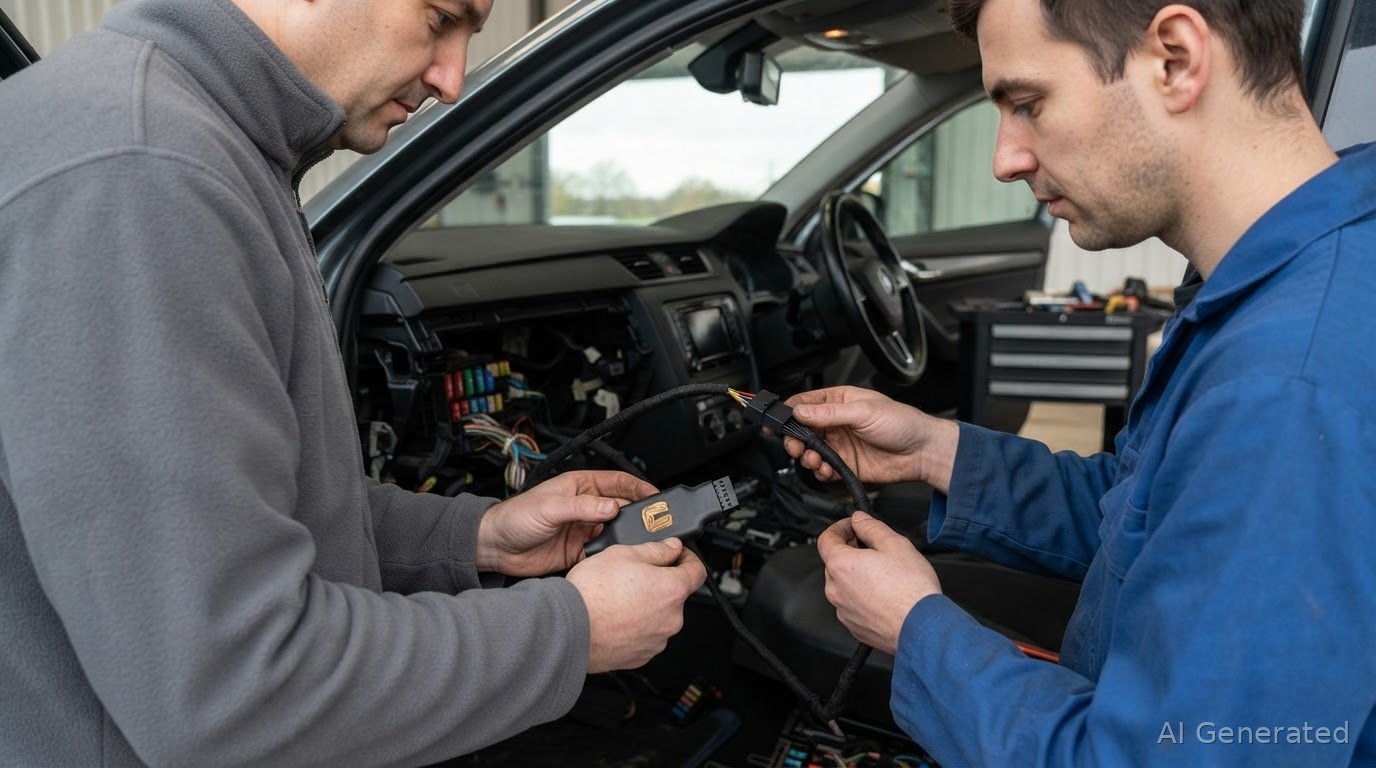
A Mileage Blocker can pause odometer recording, but it does not erase the vehicle’s true mileage or the distance travelled. Buying directly from the manufacturer clarifies who designed and supports the device and what warranty applies. It is also important to understand what the device records and how that differs from the vehicle’s actual use.
Fitting an aftermarket device does not automatically cancel a vehicle’s entire manufacturer warranty in the UK. A manufacturer may refuse a specific claim if the part caused or contributed to the fault. This guide explains how mileage blockers work, how they affect mileage records and why accurate disclosure matters.
A mileage blocker is different from mileage correction, which changes recorded data rather than pausing mileage recording. Blockers can reduce recorded road mileage or conceal mileage use. Misrepresenting a vehicle’s mileage can mislead others, so accurate disclosure matters.
Key Takeaways
- Understand how a mileage blocker affects the odometer and why other vehicle records may still matter.
- Learn how dealers may identify mileage discrepancies and why accurate mileage information matters when selling a vehicle.
- See how mileage blocking differs from mileage correction, and why controlled testing is the appropriate context for use.
- Understand what to consider about warranty and insurance disclosure, and where MileageBlocker.com’s device and fitting service may fit.
How is Vehicle Mileage Normally Recorded?
A vehicle’s mileage is calculated from signals gathered by components such as wheel sensors and the engine control unit. Manufacturers use different sensors and electronic systems, so the dashboard reading is only one part of a wider record. Mileage may also appear in other modules, service records, MOT history, telematics and finance records. As a result, a reading stored in one module may differ from information recorded elsewhere.
A Mileage Blocker interrupts mileage recording in a compatible vehicle, but compatibility depends on the vehicle’s electronic architecture and the device’s design. It intercepts CAN-bus signals while active and does not alter a stored odometer value. Separate records may still show distance travelled. A blocker intended for one model or generation should not be assumed to work with another, and fitting and repair considerations depend on how it connects to that vehicle.
Mileage affects a vehicle’s value, warranty limits and finance terms. A vehicle with 120,000 genuine miles is not equivalent to a comparable vehicle with 60,000 genuine miles. Service history and warranty coverage may also depend on accurate mileage reporting. Under the Consumer Rights Act, consumers in the UK have 30 days to claim a full refund for goods that are unsatisfactory, unfit for purpose or not as described, according to UK legislation. The Competition and Markets Authority’s current guidance gives examples of false mileage information and clocking as potentially misleading commercial practices under the Digital Markets, Competition and Consumers Act 2024. When selling, disclose in writing before the sale if the displayed mileage is not the vehicle’s true mileage.
What are mileage blockers?
A Mileage Blocker can pause dashboard mileage recording while active, so the display may not reflect distance travelled during that time. For a UK buyer, comparing the odometer with independent records is essential.
Dealer Detection and Mileage Discrepancies
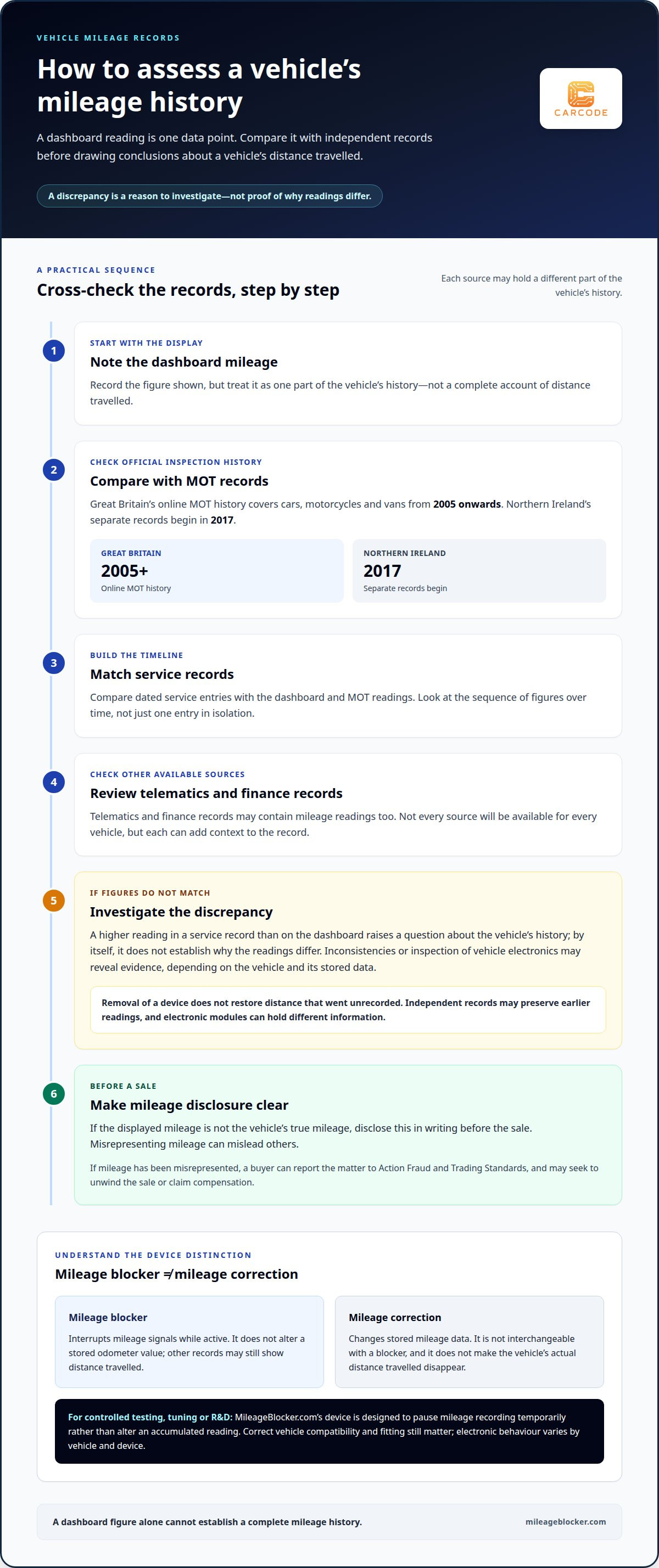
Dealers can spot possible discrepancies by comparing the odometer with independent records rather than relying on one display. MOT history, service entries, telematics and finance records may each contain mileage readings. For example, a service record showing a higher figure than the dashboard raises a question about the vehicle’s history, but does not by itself establish why the readings differ.
To check a car’s true mileage and service history, compare its dashboard reading with MOT history and service records, then review available finance or telematics records. Great Britain’s online MOT history covers cars, motorcycles and vans from 2005 onwards; Northern Ireland’s separate records begin in 2017. If a seller misrepresented mileage, a buyer can report the matter to Action Fraud and Trading Standards, and may seek to unwind the sale or claim compensation.
Blocker Detectability and Removal
A blocker may be identified through inconsistent records or inspection of vehicle electronics, but the evidence depends on the vehicle and its stored data. A dealer cannot establish a complete mileage history from the dashboard alone. When buying, remember that the visible reading may not represent the distance the vehicle has travelled, even if it appears consistent.
Some devices connect without cutting or soldering and can be unplugged, but removal does not restore distance that went unrecorded. Independent records may preserve earlier readings, while electronic modules can hold different information. Treat a mismatch as a reason to investigate the vehicle’s documented history, not as something removal will make disappear.
Mileage Blockers vs Mileage Correction
A Mileage Blocker intercepts mileage signals so the odometer does not record distance, or records a reduced proportion, while the device is active. It does not alter any stored odometer value. Mileage correction, by contrast, changes stored mileage data. Neither makes the vehicle’s actual distance travelled disappear.
This distinction matters when choosing a device for controlled testing. A Mileage Blocker pauses recording during a test and does not rewrite the odometer’s existing mileage figure. Mileage correction changes data already held by the vehicle, which can affect the consistency of its mileage history. Electronic behaviour varies by vehicle and device, so do not assume a method is compatible across models.
For testing, tuning or R&D, MileageBlocker.com’s Mileage Blocker is designed to pause mileage recording temporarily rather than alter an accumulated reading. Correct vehicle compatibility and fitting still matter. Mileage correction may have a legitimate role when correcting an inaccurate display, but it is not interchangeable with a blocker. A blocker can also reduce recorded mileage while a vehicle is driven on-road, potentially enabling users to avoid lease mileage limits or conceal mileage use. This can misrepresent a vehicle’s mileage history; use the device responsibly and lawfully.
How mileage blockers affect displayed and recorded mileage
A blocker interrupts mileage signals, so the dashboard may stop increasing while the vehicle is driven. Some operating modes record 10% or 20% of distance instead of all of it. The result depends on the device and vehicle electronics. That difference matters during controlled testing, when mileage accumulation may need to be limited.
Other records can continue accumulating mileage independently. MOT entries, service records, telematics and finance data may therefore show different figures from the odometer. A dashboard reading is only one part of the vehicle’s history, not a filter that removes other records. If a vehicle shows 50,000 miles while it has travelled further, that displayed figure does not represent its complete distance.
A mileage blocker can reduce recorded road mileage, but a discrepancy can conceal how much a vehicle has been used. Never use a discrepancy to mislead someone buying or selling a vehicle. Keep accurate records and disclose any known difference.
Keep a written log of when the device was active and why. Record relevant testing or track use, and retain service and mileage documents. The selected mode is retained between ignition cycles, so the vehicle may remain in that mode until it is changed. Treat displayed mileage and actual distance travelled as separate facts, and disclose any difference when required during a sale.
Does fitting a mileage blocker affect car insurance or require disclosure to an insurer?
Tell your motor insurer about a fitted Mileage Blocker. It changes how the vehicle records distance, which may be relevant to the information used for a policy or claim. The effect on cover depends on the policy terms and circumstances. Removing the device later does not remove the need to disclose its use.
Give your insurer accurate details about the modification and its purpose, such as controlled testing or off-road use. If you make a claim, disclose the device and explain when it was active. A difference between dashboard mileage and service or MOT records may prompt questions about the vehicle’s use. Keep a dated log and relevant records so you can explain the discrepancy clearly.
Insurance and warranty are separate matters. Fitting an aftermarket part does not automatically cancel a vehicle’s entire manufacturer warranty, but a manufacturer may refuse a specific claim if the part caused or contributed to the fault. For example, a claim involving vehicle electronics may be assessed against the device’s connection and the reported fault. Accurate disclosure helps keep the modification and its use transparent. Mileage blockers can also reduce recorded road mileage or conceal use, and reduced recorded mileage can be used to avoid lease limits. This must not be used to mislead an insurer, buyer or finance provider. Keep operation to controlled testing or off-road settings, and report mileage truthfully in policy, service and finance records.
MileageBlocker.com
MileageBlocker.com supplies mileage blocker devices that can pause recorded mileage during testing and can also reduce recorded mileage when the vehicle is driven on the road. Its devices are made with high-quality components and provide an option for situations where mileage recording needs to pause. They are distinct from mileage correction tools, which change recorded data.
Vehicle electronics differ by model, year and generation, so the device must match the vehicle. MileageBlocker.com provides vehicle-specific product information to help identify a suitable option. A Mileage Blocker does not make the vehicle’s actual distance travelled disappear, so keep mileage records accurate and disclose known discrepancies.
For readers who prefer professional installation, MileageBlocker.com also offers a Mileage Blocker Fitting Service. The device can be used for controlled testing or off-road use, and can reduce recorded mileage during road use. Keep a log of when the device is active and retain relevant testing records.
Buying directly from MileageBlocker.com connects your purchase with the business that designs, manufactures and supports the device. It is a practical next step if you need a Mileage Blocker for a legitimate testing application. Buying direct does not replace accurate vehicle records or the need to use the device lawfully and responsibly.
Contact MileageBlocker.com to discuss your requirements.
Frequently Asked Questions
After removing the module, will the mileage increase?
No. Removing the module does not add distance that went unrecorded while it was active. Once removed, the vehicle returns to its factory state, and normal mileage recording resumes. For example, distance travelled while the device was active will not automatically appear later on the odometer. Keep a separate log to document its use.
Are mileage blockers detectable?
A mileage blocker may be identified through physical inspection, vehicle records or inconsistencies between readings. The available evidence depends on the vehicle’s electronics and history. A service entry or MOT record that differs from the dashboard reading can prompt further questions, but a mismatch alone does not establish its cause. Keep supporting records and disclose relevant discrepancies when required.
Can mileage information exist in multiple vehicle modules?
Yes. Depending on the vehicle’s design, mileage-related data may be stored in more than one electronic control module. The instrument-cluster reading may not match data held elsewhere or information recorded by connected systems. A diagnostic inspection, for example, may reveal readings beyond the dashboard display. The number and role of modules vary by vehicle, so there is no universal layout.
Is mileage stored in more than one place?
Yes. Mileage may appear in vehicle modules, MOT history, service records, telematics data and finance records. These sources are created at different times and may document separate readings. An earlier service invoice, for example, can provide a reference point against a later dashboard figure. Keep records together, since the odometer alone may not show the vehicle’s complete mileage history.
What product quality should you expect?
Look for clear vehicle-specific information and documented construction standards. MileageBlocker.com states that its units are designed, hand-built and bench-tested in-house in the UK. Its plug-and-play CAN-bus modules require no cutting, soldering or coding, and installation typically takes 15-30 minutes. The stated product terms include a 12-month manufacturer warranty. Use the device responsibly and do not misrepresent a vehicle’s mileage.
What is a mileage blocker, and how does it affect an odometer reading?
A Mileage Blocker is a plug-and-play CAN-bus module that intercepts mileage signals while active. Depending on the selected device mode, the odometer may stop recording distance or record a reduced proportion. The device does not alter any stored odometer value. It is designed for off-road, testing, tuning and R&D use, but can also reduce recorded mileage on roads. Do not use it to misrepresent a vehicle’s mileage, including when offering it for sale. Ensure use complies with the laws of the country where it is installed.
Article by
Pav Tomaszevicz
Pav Tomaszevicz is Chief Editor at MileageBlocker.com and works closely with the Carcode technical team on content covering vehicle electronics, CAN and CAN-FD systems, mileage blocker compatibility, installation and product development. His articles draw on practical product development, technical support, installation experience and ongoing research into modern vehicle electronics. Content may use AI-assisted drafting and research, but technical information is reviewed against Carcode's product knowledge and real-world experience before publication
About the author
MileageBlocker TeamThe MileageBlocker Technical Team covers vehicle electronics, CAN and CAN-FD systems, mileage blocker compatibility, installation and product developments.
View author profile →