
Stop Range Rover Sport Mileage Without Error Codes
How to stop mileage on a Range Rover Sport without triggering TPMS or ABS faults: learn why no device guarantees this, and why compatibility and fitting matter.
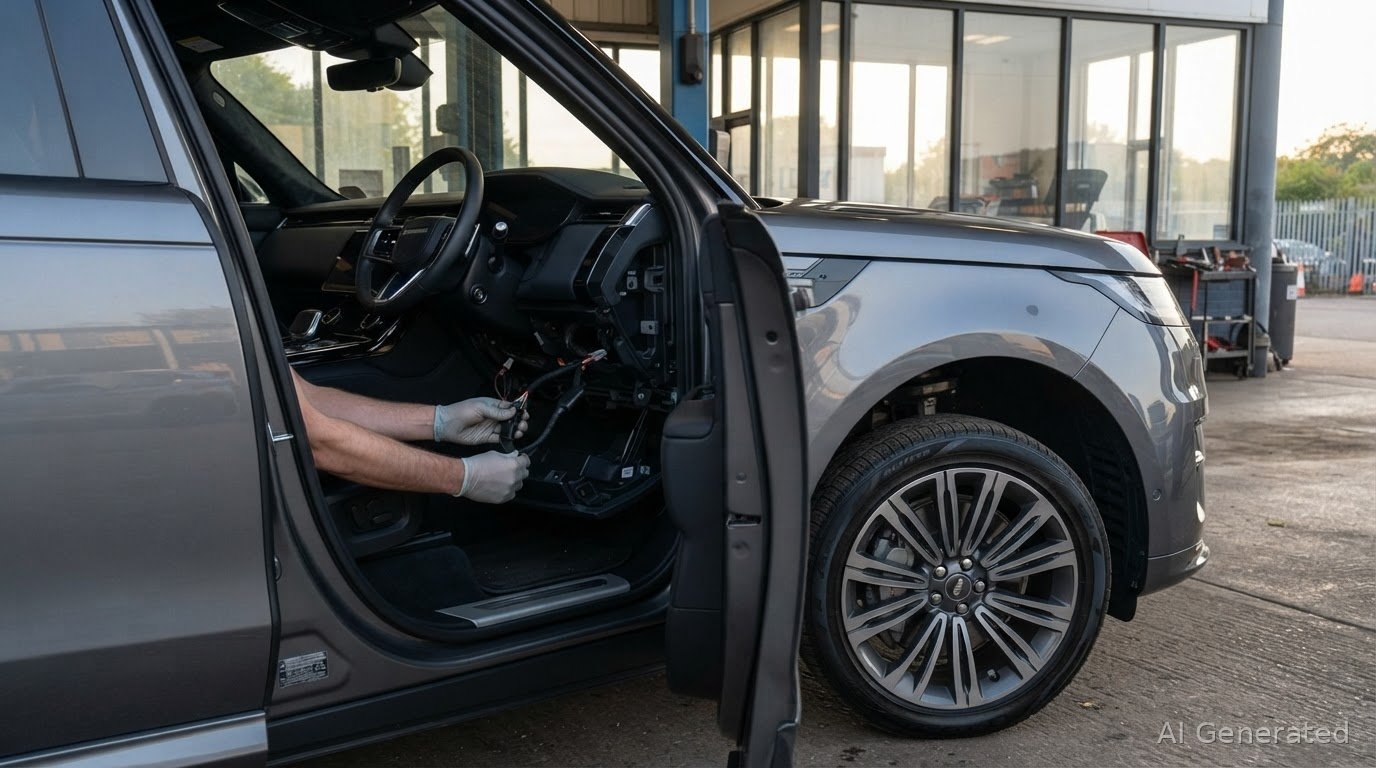
A mileage blocker cannot guarantee that TPMS or ABS warnings will never appear. Understanding how to stop mileage on a Range Rover Sport without triggering TPMS or ABS faults starts with the vehicle’s specific generation and the device’s compatibility, not a promise of fault-free operation. These systems serve separate functions, so any warning needs proper technical diagnosis, not concealment.
It’s reasonable to want mileage-blocking equipment fitted without disrupting other vehicle electronics. This article explains the potential TPMS and ABS fault risks, why Range Rover Sport variants should not be assumed to behave alike, and what professional fitting can help address. Mileage blockers are intended for authorised uses such as vehicle testing or off-road tracks, not for misrepresenting a vehicle’s history. The practical distinction matters: correct application and vehicle-specific compatibility come before any decision about fitting.
Key Takeaways
- Learn why a mileage blocker cannot be treated as a guarantee against TPMS or ABS warnings.
- Understand why Range Rover Sport generation and vehicle-specific compatibility matter before fitting.
- See how to distinguish mileage-blocking operation from a separate tyre-pressure or braking-system fault.
- Find out when MileageBlocker.com’s vehicle-specific device and fitting service may suit authorised testing or off-road use.
How to Have Mileage Stopped on a Range Rover Sport Without Triggering TPMS or ABS Faults
No fitting method can responsibly promise that a Range Rover Sport will never display a TPMS or ABS warning. A mileage blocker intercepts CAN-bus signals to prevent mileage recording while active; it does not repair an existing tyre-pressure or braking-system fault. The practical approach is correct vehicle-specific fitting, followed by proper diagnosis if a warning appears. Use the device only for legitimate testing, tuning and diagnostic purposes in controlled environments.
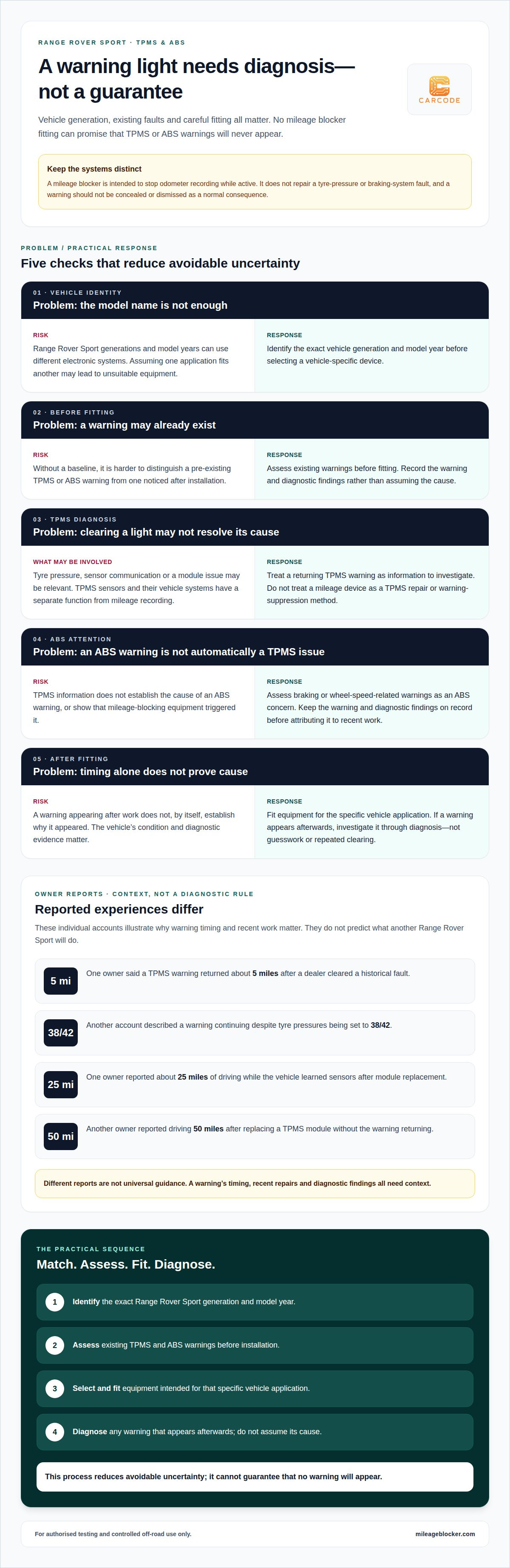
Begin with the exact vehicle identity. Range Rover Sport generations and model years can use different electronic systems and require different equipment. Identify the vehicle’s generation and year before selecting a device. The model name alone is not enough, since assuming one Range Rover Sport application fits another can lead to an unsuitable device.
Next, establish the vehicle’s condition before installation. A diagnostic assessment can help distinguish a warning that already exists from one that appears afterwards. This matters especially for TPMS, where tyre pressure, sensor communication or a module issue may be involved. Investigate an existing warning on its own merits, rather than assuming mileage-blocking equipment caused it.
TPMS and mileage recording are separate functions, but they coexist within the vehicle’s electronic environment. Owner reports describe TPMS sensor signals being received by the TPMS ECU, while wheel initiators prompt sensors to transmit data. This is a useful distinction: a mileage device should not be treated as a TPMS repair or as a way to suppress a warning. A fault still needs diagnosis.
Reported Range Rover Sport cases also show why a dashboard light needs context. One owner said the TPMS warning returned about 5 miles after a dealer cleared a historical fault. Another account described a light continuing despite tyre pressures being set to 38/42. These are individual reports, not a universal diagnostic rule. They illustrate that clearing a warning or adjusting pressure does not necessarily resolve the underlying cause.
Sensor learning can also affect what happens after TPMS component work. Owner reports describe a Range Rover Sport taking about 25 miles of driving to learn sensors after module replacement. Another owner reported driving 50 miles after replacing a TPMS module without the warning returning. These differing experiences cannot predict what another vehicle will do. They do show why a warning’s timing, recent repairs, and diagnostic findings matter.
ABS requires separate attention. TPMS information does not establish that an ABS fault has the same cause, or that mileage-blocking equipment will trigger one. Assess a warning related to braking or wheel-speed information as an ABS concern, rather than dismissing it as a normal consequence of mileage blocking. Record the warning and diagnostic findings before attributing it to recent work.
A professional fitting process should therefore follow a clear sequence:
- Identify the Range Rover Sport’s exact generation and model year.
- Assess existing TPMS and ABS warnings before fitting.
- Select equipment intended for that specific vehicle application.
- Fit it according to the applicable vehicle-specific procedure.
- Assess any warning that appears afterwards through diagnosis, not guesswork.
This sequence reduces avoidable uncertainty, but it cannot guarantee that no warning will appear. If a TPMS light returns after a historical fault is cleared, as reported in one 5-mile case, the recurrence is a reason to investigate the TPMS system. It is not a reason to clear the warning repeatedly or conceal it. The same principle applies to an ABS warning: maintain the distinction between mileage recording and a safety-related system fault.
The reliable answer to how to stop mileage on a Range Rover Sport without triggering TPMS or ABS faults is careful application matching and professional assessment, not bypassing alerts. The vehicle’s generation, existing faults and post-fitting behaviour all matter. Use the mileage blocker only for authorised testing in a controlled environment, and treat TPMS or ABS warnings as separate technical information that needs attention.
MileageBlocker.com: Mileage Stopper / Freezer
MileageBlocker.com offers a Mileage Stopper / Freezer for authorised vehicle testing and off-road use. It is designed to stop the odometer recording mileage; it is not a TPMS or ABS fault repair, and fitting cannot be presented as a guarantee against warnings.
Range Rover Sport applications can differ by generation, so the correct vehicle-specific option matters. The Range Rover Sport mileage blocker page provides the relevant product information. For a professional installation, the Mileage Blocker Fitting Service is the natural next step, particularly when you want fitting handled alongside careful attention to the vehicle’s existing electronic condition.
Use a mileage blocker only for its lawful, authorised purpose. Contact MileageBlocker.com to discuss the fitting service for your Range Rover Sport. Professional fitting is available on request.
Choose the Right Next Step for Your Range Rover Sport
If you’re deciding how to stop mileage on a Range Rover Sport without triggering TPMS or ABS faults, start by outlining the vehicle’s planned testing use and the fitting support you need. This gives the discussion a practical focus without assuming every Range Rover Sport application is the same.
Consider what the vehicle needs to do during testing and what role you want a specialist to play. A clear brief helps focus the discussion on the relevant fitting option for your requirements.
Ask MileageBlocker.com about your options. A clear starting point can make the next decision more straightforward.
Article by
Pav Tomaszevicz
Pav Tomaszevicz is Chief Editor at MileageBlocker.com and works closely with the Carcode technical team on content covering vehicle electronics, CAN and CAN-FD systems, mileage blocker compatibility, installation and product development. His articles draw on practical product development, technical support, installation experience and ongoing research into modern vehicle electronics. Content may use AI-assisted drafting and research, but technical information is reviewed against Carcode's product knowledge and real-world experience before publication
About the author
MileageBlocker TeamThe MileageBlocker Technical Team covers vehicle electronics, CAN and CAN-FD systems, mileage blocker compatibility, installation and product developments.
View author profile →