
Short vs Long Mileage Blocker Cables: Which Is Best?
Learn the difference between mileage blocker with short cable and long cable with quick removal option, and choose based on access, routing and vehicle fit.

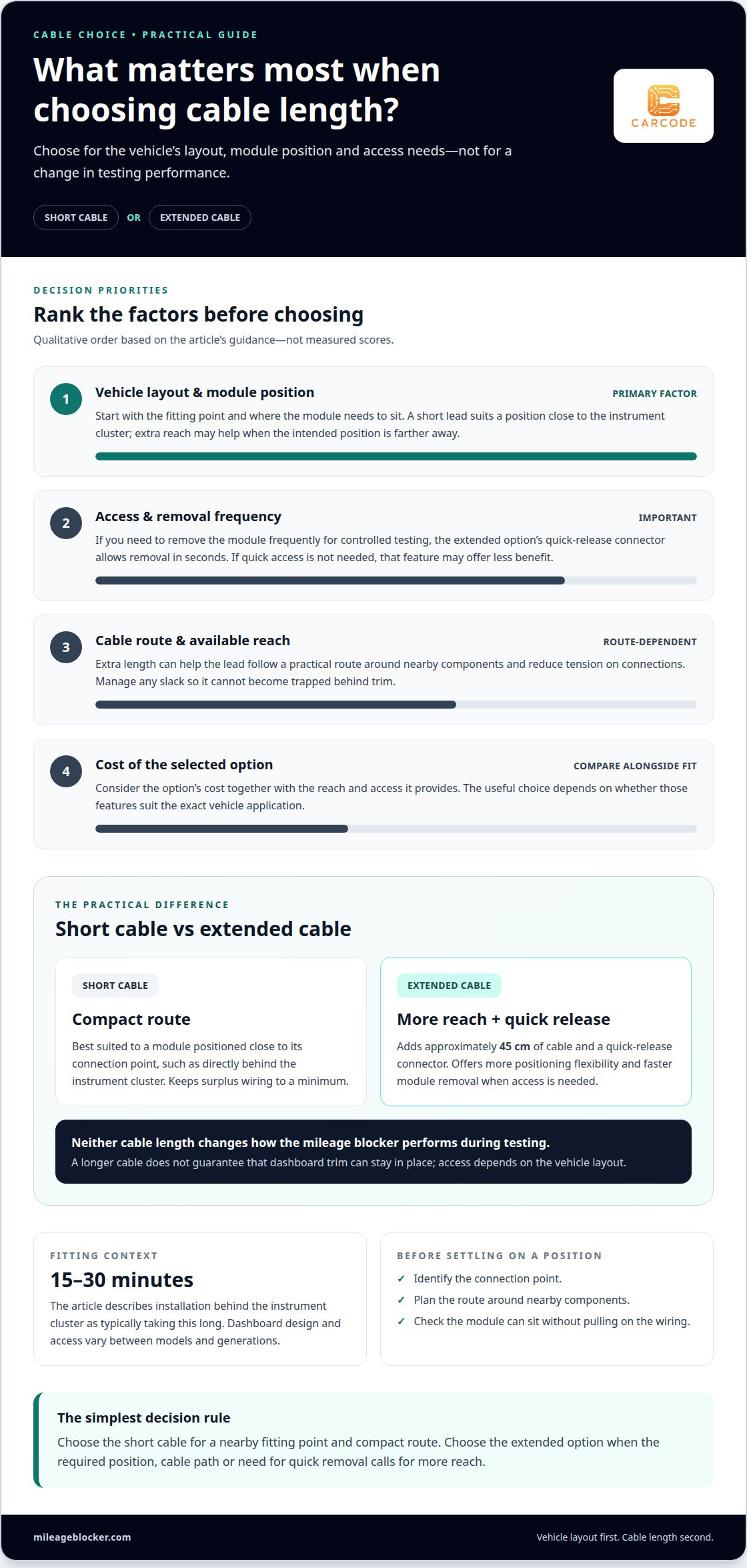
The cable changes installation convenience, not how a mileage blocker performs during testing. The difference between a mileage blocker with a short cable and a long cable with a quick removal option is the module’s positioning and access: the extended version adds approximately 45 cm of cable and has a quick-release connector for removal in seconds.
The choice is less about performance and more about the space behind the dashboard, the cable route and how often you need to access the module. A short cable suits a fitting point close to the instrument cluster, while extra length gives you more flexibility in positioning the module.
This guide explains how cable length can affect removal access, dashboard disassembly, installation flexibility and the cost of the selected option. You’ll also see why the vehicle’s layout matters more than choosing the longest cable by default, and how to approach the decision for controlled testing or off-road use.
Key Takeaways
- Choose cable length for the module’s position and the access you need, not for a different testing performance.
- A short cable can keep wiring compact when the installation point is close to the instrument cluster.
- The extended option adds about 18 inches of cable and a quick-release connector for easier module removal.
- Consider dashboard layout, cable routing and the cost of the selected option together before deciding.
Additional cost of the extended cable
The extended-cable option adds approximately 45 cm of cable and includes a quick-removal feature. The practical value depends on whether that reach and faster access suit the vehicle’s layout and intended use. For testing work that requires frequent removal, the connector may justify choosing the extended option. If the module sits close to its connection point, the added reach may offer less benefit.
The difference between a mileage blocker with a short cable and a long cable with a quick removal option is mainly reach and removal convenience, not testing performance. Compare the cable configuration for the exact vehicle application. Layouts vary by model and generation, so a longer cable is not a universal fit. Consider the module’s intended position when choosing.
In the UK, mileage blockers are intended for controlled applications such as vehicle testing and off-road use. Using one to misrepresent a vehicle’s true mileage when selling or advertising it is illegal. Keep the vehicle’s mileage information accurate and disclose discrepancies appropriately.
A mileage blocker prevents new mileage from being recorded while active; it does not change mileage already stored in the vehicle. Once removed, normal recording resumes. During use, displayed mileage may not represent the distance travelled, so never present it as a complete or accurate record of the vehicle’s use.
For example, after a controlled test session, you may need to remove the module. The quick-removal feature makes that easier, while the longer cable can provide more flexibility in positioning. A short cable may suit an installation close to the connection point when quick access is not needed.
That is the practical difference between a mileage blocker with a short cable and a long cable with a quick removal option: the short cable suits a compact route, while the extended cable offers more reach and quicker removal. Choose for the exact vehicle and its controlled use, rather than assuming the longer option is always preferable.
Avoiding dashboard disassembly
A short cable suits a fitting point close to the instrument cluster. It keeps surplus wiring to a minimum when the module sits directly behind the cluster. In a compact dashboard, this can simplify routing without sending a longer lead through the cabin. The key question is where the device needs to sit.
Consider access before choosing a configuration. If the intended position is already reachable from the instrument-cluster area, a short lead may avoid routing the cable towards another part of the dashboard. Less excess wire also means fewer decisions about where to secure and store slack. That can make the finished installation more orderly, particularly where space behind the cluster is restricted.
A longer cable does not automatically eliminate the need to remove dashboard trim. It provides more reach for positioning, but the vehicle layout determines the access route. If the suitable connection point is away from the cluster, extra cable may help with placement, but it cannot guarantee that trim removal will be unnecessary.
Plan around the actual installation point: identify where the device connects, where it will sit and whether that position remains accessible. The short-cable option suits a module positioned directly behind the instrument cluster. If the cable needs to pass through a tight space or reach another position, the extended option may be more practical.
Installation typically takes 15-30 minutes behind the instrument cluster, although dashboard design and access can vary between models and generations. The cable choice helps manage routing; it does not replace vehicle-specific fitting requirements. A tidy installation depends on keeping the lead clear of trim edges and avoiding unnecessary tension at the connections.
For a compact layout with a nearby fitting point, consider the short cable. Choose the extended option when the required position or access route calls for more reach or quick removal. This keeps the decision grounded in the vehicle’s layout, not the assumption that a longer lead prevents dashboard disassembly.
Extended cable length
The difference between a mileage blocker with a short cable and one with a long cable is the available reach between the connection point and the module. Extra length can help the wiring follow a practical route instead of pulling the module towards the connection. This matters when nearby space is limited or the intended position is around an obstruction.
Where the route behind the dashboard is tight, cable length affects how easily the wiring can follow the available space. A short lead may need a direct path; extra reach can allow a route around nearby components, if the vehicle-specific installation allows it. Do not stretch the cable to reach the module’s position.
Routing also affects strain on the connectors. If the cable is taut, fitting or positioning the module can put unnecessary load on the connections. Extra slack gives more freedom to position the module while keeping the wiring relaxed. A route around a dashboard support, for example, may need more cable than a direct route behind the instrument cluster.
Extra length still needs to be managed. Arrange any slack so it cannot become trapped behind trim or interfere with the module’s position. The correct route depends on the vehicle’s interior and the fitting points for that application. More cable gives you options, but tidy routing still matters.
Before settling on a position, consider the connection point, the route around nearby components and whether the module can sit without pulling on the wiring. This is why an extended cable can help on some models, while a shorter route suits others. Match the reach to the actual path rather than assuming extra length is always necessary.
Long-cable installation flexibility
A longer lead gives you more choice about where the module sits and how the wiring is routed. Its practical value depends on the vehicle layout and intended use.
Flexible Placement with a Long Cable
A long cable lets the module sit farther from its connection point without stretching the wiring. That extra reach can help when space near the instrument cluster is limited or another position is more accessible. It also gives more routing options. Keep the cable on a clear route without tension on the connections. Extra length is useful when it solves a real placement constraint, not simply because it is longer.
Choosing an Option for Vehicle and Use
The right option matches the vehicle layout, the module’s position and the planned use. A short lead suits a nearby fitting point; the long cable is useful when flexible placement or quick removal matters. Both options serve the same testing purpose, so the choice is about installation convenience. For controlled testing that requires frequent access, the extended option may be more practical. For a compact installation close to the connection, the short cable avoids unnecessary slack.
Vehicle Compatibility by Cable Type
Compatibility depends on the exact vehicle application, including its model and generation, rather than cable length alone. A cable option available for one model cannot automatically be assumed to fit another from the same manufacturer. The vehicle-specific design determines the appropriate device and installation arrangement. Match the option to the exact application, then consider whether short or extended reach best suits its layout. This avoids treating a cable choice as universal across different vehicles or generations.
For details about selecting a vehicle-specific setup, read the mileage blocker FAQs.
MileageBlocker.com
MileageBlocker.com sells vehicle-specific mileage blockers for legitimate testing, tuning and diagnostic use, with a fitting service available for installation support. Its plug-and-play mileage blocker range is intended for controlled applications, not use on public roads or to misrepresent a vehicle’s mileage.
When comparing short and long cables, focus on the exact vehicle application, the module’s intended position and whether quick removal matters for your work. Cable choice affects installation convenience, so the right option depends on the vehicle layout rather than a universal preference. Use mileage-blocking technology responsibly, and keep vehicle mileage records accurate.
Contact MileageBlocker.com to discuss your vehicle and installation requirements.
Make the next choice vehicle-specific
Before choosing a cable configuration, define how the module needs to fit into your work. Note the vehicle’s exact model and generation, the preferred module position and whether quick access after testing is part of the routine. That gives you a sound basis for choosing a vehicle-specific setup rather than relying on assumptions from another model.
Judge the difference between a mileage blocker with a short cable and one with a long cable and quick removal option against the actual installation. Consider cable length alongside compatibility and access. This keeps the choice focused on the vehicle, rather than a general preference for more cable.
For further guidance before settling on your requirements, explore the mileage blocker FAQs. A considered choice starts with the right vehicle details and a clear purpose.
Frequently Asked Questions
Why are there different types of mileage blockers?
Vehicle models and generations can have different electronic layouts, so mileage blockers are designed for specific applications. Cable options address a separate practical need: the space available to position and route the module. A compact dashboard may suit a short lead, while another layout may benefit from extra reach. Cable choice does not make one device suitable for every vehicle.
How does cable length affect mileage blocker installation and compatibility?
Cable length affects where the module can sit and how the wiring can be routed; it does not determine vehicle compatibility. That depends on the specific vehicle application and generation. Treat cable length as a configuration choice for a compatible device, not a way to adapt a device intended for another vehicle.
How is a mileage blocker installed and removed?
Installation is vehicle-specific and uses the connection and placement intended for that application. The product is “Plug & Play - no cutting, no soldering, no coding.” MileageBlocker.com offers a fitting service for installation support. For removal, access and disconnect the module according to its fitting instructions. The extended cable’s quick-removal feature makes the module quicker to remove.
About the author
MileageBlocker TeamThe MileageBlocker Technical Team covers vehicle electronics, CAN and CAN-FD systems, mileage blocker compatibility, installation and product developments.
View author profile →