
Porsche Mileage Blocker Fitment and Installation for UK Owners
Check Porsche mileage blocker fitment by generation, plug-in installation considerations and UK mileage disclosure duties in this practical guide for owners.

A Porsche’s model name alone doesn’t establish fitment. A Porsche mileage blocker is designed to stop the odometer recording distance during controlled testing, dyno work or off-road use, but the correct application and installation depend on the vehicle’s specific generation. Some solutions use plug-in installation; that doesn’t make every Porsche application identical.
It’s understandable to expect a straightforward fit, especially when a device is described as plug-and-play. In practice, checking the exact model and generation matters before choosing an application or planning installation. The UK disclosure point matters too: mileage must not be misrepresented when a vehicle is sold, and use of a blocker should be disclosed.
This guide explains what a Porsche mileage blocker does, how to check fitment and what to consider before installation. It also covers the device’s intended technical uses and the mileage disclosure requirement when selling a vehicle.
Key Takeaways
- Plug-in fitting avoids cutting or soldering on the covered applications, but installation details vary by Porsche generation.
- Use mileage-blocking technology only for appropriate testing, motorsport, dyno or off-road purposes, and disclose its use when selling the vehicle.
- Match the vehicle’s model, generation and model year to the specific application before ordering; similar Porsche names do not guarantee the same fitment.
- Macan, Taycan and Panamera applications have distinct fitment considerations, so identify the exact model generation before choosing a device or fitting service.
Plug-in installation requirements
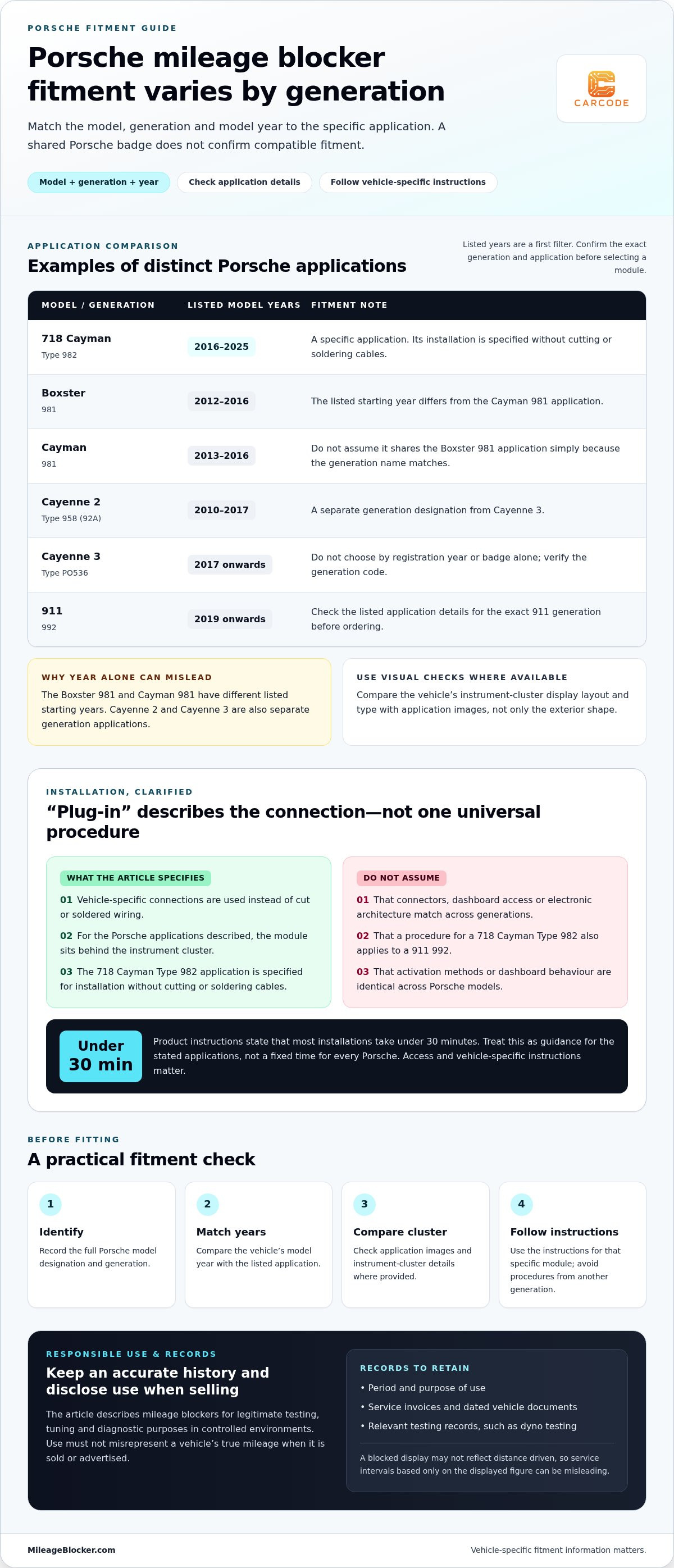
Plug-in fitting uses vehicle-specific connections rather than cut or soldered wiring. For the Porsche applications described, the module sits behind the instrument cluster. The Porsche 718 Cayman Type 982 application is specified for installation without cutting or soldering cables. This preserves the original wiring and makes correct vehicle matching essential.
“Plug-in” describes the connection method, not a universal procedure. Porsche generations can differ in dashboard layout, connectors and electronic architecture. A 718 Cayman Type 982 and a 911 992 must not be treated as interchangeable. The correct instructions depend on the exact model and generation, not simply the Porsche badge.
Before installation, identify the vehicle and compare it with the application details. Check the model designation, generation and model year against the relevant product information. If fitment images are provided, compare them with the vehicle’s instrument cluster. This helps avoid selecting a module intended for a different configuration.
- Confirm the Porsche model and generation.
- Match the vehicle’s model year to the application.
- Review the installation instructions for that specific module.
- Use the stated connection points without cutting or soldering where specified.
The module is described as fitting behind the instrument cluster, so access to that area forms part of the installation. The required trim removal and connector details depend on the vehicle-specific instructions. Avoid applying a procedure from another Porsche generation. A similar dashboard or model name does not prove that the wiring arrangement is the same.
Product instructions state that most installations take under 30 minutes. Treat this as guidance for the stated applications, not a fixed time for every Porsche. Access, careful trim handling and following the correct instructions all affect the work. If the procedure exceeds your experience, a fitting service provides a practical alternative to attempting unfamiliar dashboard work.
After installation, follow the instructions for the selected device’s operation. Do not assume that activation methods or dashboard behaviour are the same across Porsche models. Match the application to the vehicle before fitting; plug-and-play installation does not replace that check.
UK legality and mileage disclosure
Carcode mileage blockers are sold strictly for legitimate automotive testing, tuning and diagnostic purposes. They are intended for use on private property, rolling roads and controlled test environments only. It is illegal to use a mileage blocker to misrepresent a vehicle’s true mileage when selling or advertising a vehicle. Carcode Ltd accepts no liability for misuse. By purchasing, customers confirm they will use the product lawfully and responsibly.
When selling a Porsche, disclose that a blocker has been used. Keep a written record of the period and purpose of use, alongside service invoices and other dated vehicle documents. For example, a dyno-testing record can help explain why the odometer reading differs from distance driven.
A mileage blocker prevents mileage from being recorded while active; it does not correct mileage already recorded. Use it only for legitimate controlled testing, tuning or diagnostic purposes, never to misrepresent a Porsche’s true mileage when selling or advertising it.
When assessing a vehicle’s history, compare the odometer with dated service records, inspection documents and the vehicle’s condition. Modern cars may store mileage information across electronic components, including gearbox and airbag or seatbelt systems. Consider available records and vehicle evidence together rather than relying on one display alone.
If you suspect mileage misrepresentation, preserve the advert, messages, service documents and any inspection findings. Report your concern to the relevant UK authorities, providing the vehicle details and the specific evidence behind it.
Blocked mileage can also complicate servicing records. Service intervals based only on the displayed figure may not reflect distance actually driven. A gap in records can create questions during warranty discussions and affect buyer confidence at resale. Keep an accurate history and disclose the device’s use; this gives a future owner clearer context.
For further general information about mileage-blocking technology, the mileage blocker FAQs provide relevant background.
Checking fitment before ordering
Start with the Porsche’s full model designation, generation and model year. A 911, Cayman or Cayenne name alone is not enough. Different generations can use different electronics and require different modules. Match the vehicle against the application details before selecting a device.
Use the listed years as a first filter, then confirm the generation code. Examples include:
- Porsche 718 Cayman Type 982: 2016-2025.
- Porsche Boxster 981: 2012-2016.
- Porsche Cayman 981: 2013-2016.
- Porsche Cayenne 2, Type 958 (92A): 2010-2017.
- Porsche Cayenne 3, Type PO536: 2017 onwards.
- Porsche 911 992: 2019 onwards.
- Check the listed application details for the exact 911 generation before ordering.
These examples show why model-year overlap can mislead. The Boxster 981 and Cayman 981 have different listed starting years. The Cayenne 2 and Cayenne 3 also use separate generation designations. Do not select a module based only on registration year or a shared badge.
Next, compare the vehicle’s instrument cluster with the application images, where provided. Check the display layout and type, not just the exterior shape. This helps distinguish applications where the model name or year alone may not identify the correct fitment.
Record the vehicle’s model, generation and model year before ordering. If the car is a 718 Cayman Type 982, compare all three details with that exact application. If it is a 911, establish whether it is a 991.1, 991.2 or 992. A close match is not a fitment match.
Modern cars can store mileage information across electronic components, including the gearbox and airbag or seatbelt systems. Fitment details identify the intended module application, but do not establish a vehicle’s complete mileage history. Keep those questions separate when assessing a Porsche.
Where a model has multiple generations, use the application specified for the exact generation rather than making assumptions based on another Porsche. Identify the car precisely, match the listed years and compare the instrument display before proceeding.
Macan, Taycan and Panamera applications
These three Porsche lines need separate fitment checks. The model name alone does not identify the required application. Match the exact generation and model year before choosing a module. This is especially important across Panamera generations, where one designation cannot establish another’s compatibility.
The listed Macan 95B application covers model year 2014 onwards. The generation code is a useful identifier, but still compare it with the vehicle’s model year and application details. Do not assume that a different Macan generation uses identical hardware or installation instructions.
Taycan fitment is a distinct application. The available application details do not provide a model-year range here, so avoid transferring Macan or Panamera dates to a Taycan. Check the exact vehicle designation against its own fitment information. The operating note is specific: the Taycan speedometer continues working while its blocker is active.
For the Panamera, the listed second-generation Type 971 application covers model years 2017-2023. That range applies to the 971 application, not automatically to the earlier Panamera 970. Identify the generation first, then match the year range. A shared Panamera name does not make those applications interchangeable.
- Macan: identify Type 95B and compare the year with its application.
- Taycan: use Taycan-specific fitment information, not another model’s details.
- Panamera: distinguish Type 971 from Type 970 before selecting.
Operating behaviour also differs between these applications. The Macan speedometer does not work while its blocker is active. On the Taycan and Panamera 971, the speedometer continues working. These details are not universal Porsche features; they belong to the stated applications. They matter when planning testing or track use, because speed indication may behave differently between models.
Before ordering, record the model, generation and model year. Compare all three against the relevant application, then read its specific operating notes. For common questions about mileage-blocking technology, review the mileage blocker FAQs.
MileageBlocker.com: Mileage Blocker Device
MileageBlocker.com offers a vehicle-specific Mileage Blocker Device for controlled testing and off-road use. It is designed to prevent the odometer recording distance while the device is active, rather than correct mileage already recorded. Use should remain within appropriate testing, motorsport, dyno or off-road contexts, with transparent mileage disclosure when selling the Porsche.
Choose an application by the Porsche’s model, generation and model year. Fitment and operating behaviour can differ between Macan, Taycan and Panamera vehicles, so review the vehicle-specific product information before selecting a device. MileageBlocker.com also offers a fitting service for the device it sells.
For product details or fitting information, visit MileageBlocker.com.
Plan the next step around your Porsche
Before a controlled session, decide what information the test needs to produce. An odometer reading is only one part of a vehicle record. A written test plan can identify the measurements and observations that matter and how to document the session.
For a Porsche mileage blocker, the practical question is whether the selected vehicle application and its operating characteristics suit that planned task. Resolve that point before arranging the work, rather than treating the device as a substitute for a test procedure or vehicle records.
For more information about the technology and its intended use, visit the MileageBlocker.com FAQs. A clear plan helps you approach the next step with purpose.
Frequently Asked Questions
What Are Porsche Mileage Blockers?
A mileage blocker is an electronic module that prevents mileage from being recorded while active. It does not rewrite distance already stored. Its intended role is technical testing, tuning and diagnostics in a controlled environment. Keep accurate records of the vehicle’s use during testing.
Does the Porsche Dashboard Affect Compatibility?
Yes. Dashboard display type can be a fitment identifier, not merely a styling detail. Some applications specify a matching display image, so compare the actual instrument cluster with the relevant application visuals. A similar-looking dashboard is not enough by itself; use the image comparison together with the vehicle’s model designation and generation to distinguish closely related configurations.
Does the speedometer still work?
Speedometer behaviour is application-specific. The Taycan and Panamera Type 971 applications are described as retaining speed indication while active, whereas the Macan 95B application is described differently. Do not infer behaviour from another Porsche, even within the same model family. For a planned test, use the operating notes for the exact vehicle-specific module.
Are mileage blockers legal in the UK?
Carcode mileage blockers are intended for legitimate automotive testing, tuning and diagnostic purposes, on private property, rolling roads and controlled test environments only. It is illegal to use a mileage blocker to misrepresent a vehicle’s true mileage when selling or advertising a vehicle. Carcode Ltd accepts no liability for misuse. By purchasing, customers confirm they will use the product lawfully and responsibly.
Which Porsche models and years are compatible with mileage blockers?
Applications include Porsche 911, 718, Boxster, Cayman, Cayenne, Macan, Taycan and Panamera variants. Fitment is not determined by the badge alone: the relevant generation and model-year range define the application. Some listings also use the instrument-cluster display as a compatibility clue. Treat each listed application separately, rather than assuming a module suits every version of that model.
About the author
MileageBlocker TeamThe MileageBlocker Technical Team covers vehicle electronics, CAN and CAN-FD systems, mileage blocker compatibility, installation and product developments.
View author profile →