
Porsche Cayenne Mileage Blocker: Buyer's Guide
Best Mileage Blocker for Porsche Cayenne: Full Buyer's Guide explains PO536 compatibility, blocker versus correction, service records and responsible use.
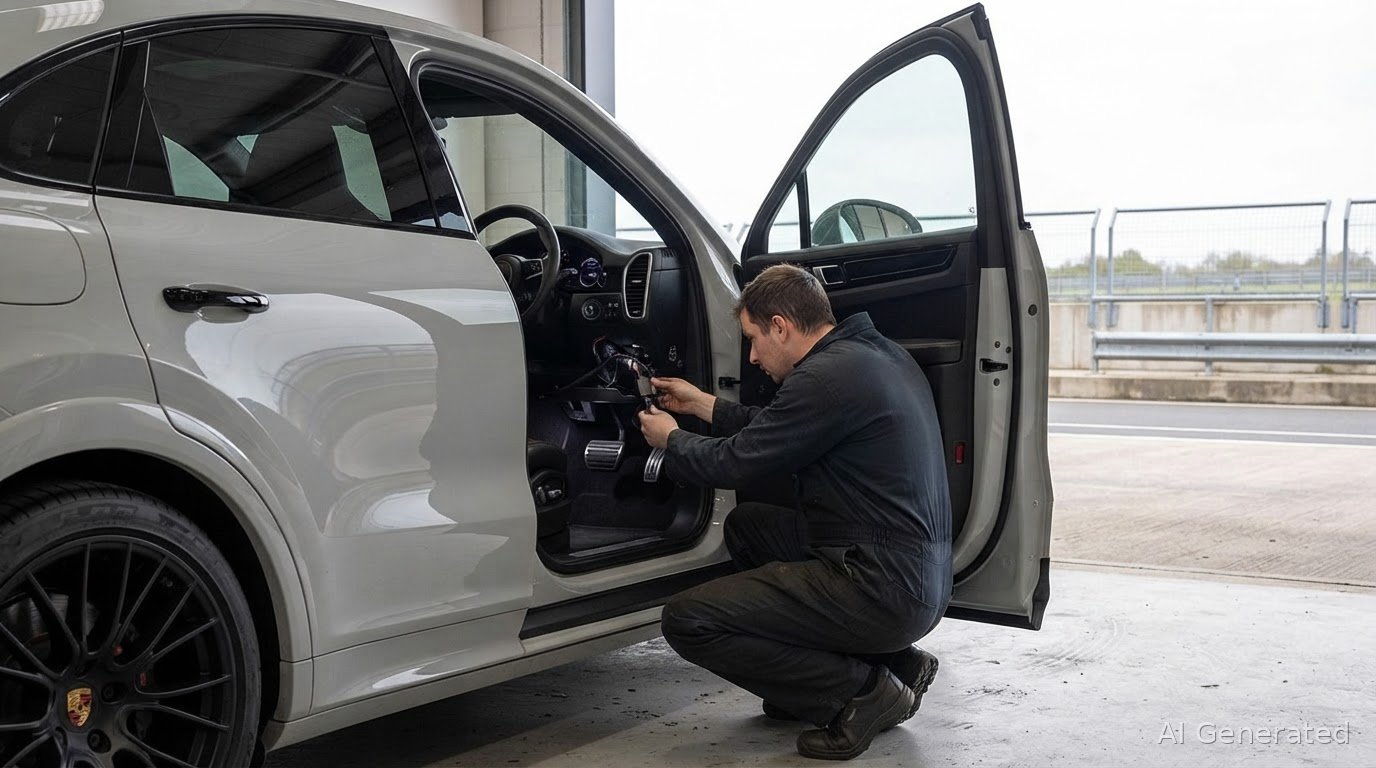
Choosing a mileage blocker for a Porsche Cayenne is not simply a matter of selecting a device: exact generation compatibility and intended use come first. For controlled testing, the listed PO536 device is compatible with Cayenne III models from 2017 to 2026. A mileage blocker stops distance being added to the odometer while it is active; mileage correction changes an odometer reading. This distinction is central to choosing the best mileage blocker for a Porsche Cayenne.
Service history and maintenance records still matter because a lower displayed mileage doesn’t undo wear or replace evidence of the vehicle’s actual use. A blocker is designed for controlled testing and off-road use, but it can also reduce recorded road mileage, including to avoid lease limits or conceal vehicle use, which can make a mileage history misleading. This guide explains how to weigh compatibility alongside maintenance, insurance implications and servicing costs, so you can understand the practical trade-offs before deciding whether a mileage blocker suits your requirements.
Key Takeaways
- Match compatibility to your Cayenne’s exact generation and model year before considering a device.
- Understand how a mileage blocker differs from mileage correction, and why controlled testing is the appropriate use.
- Use service records and maintenance condition alongside the odometer reading when assessing a Cayenne.
- Compare verified device features and fitting information to decide whether a blocker and professional installation suit your requirements.
How does a mileage blocker differ from mileage correction?
A mileage blocker is a plug-and-play CAN-bus module that intercepts signals to prevent mileage from being recorded while active. It does not alter any stored odometer value. Mileage correction, by contrast, changes a reading that has already been recorded. These are different functions, and a mileage blocker is technical testing hardware, not a mileage-correction tool.
For controlled testing, a blocker can be used to keep test distance from accumulating on the odometer. It does not require changing the vehicle’s existing displayed mileage, which helps preserve that record. Mileage correction may have a legitimate role in rectifying a known odometer discrepancy, but it changes the displayed value and should not be confused with a preventative testing device.
That distinction matters when considering safety. A blocker is the more appropriate option for controlled testing because its function is to stop additional mileage recording, rather than rewrite an existing reading. It is not a safeguard for public-road use, and it should not be used to create a misleading impression of a vehicle’s history. In practice, a mileage blocker can reduce recorded road mileage, help avoid lease limits or conceal vehicle use. Those outcomes can mislead insurers, lessors or future buyers if the vehicle’s use is not represented accurately.
Use a blocker only for controlled testing or off-road applications, and keep mileage records clear. Choose mileage correction only when the aim is to address an existing discrepancy, not to disguise use. The appropriate choice depends on whether the task is preventing odometer accumulation during testing or correcting a reading that is already inaccurate.
Which mileage blockers are compatible with each Porsche Cayenne generation and model year?
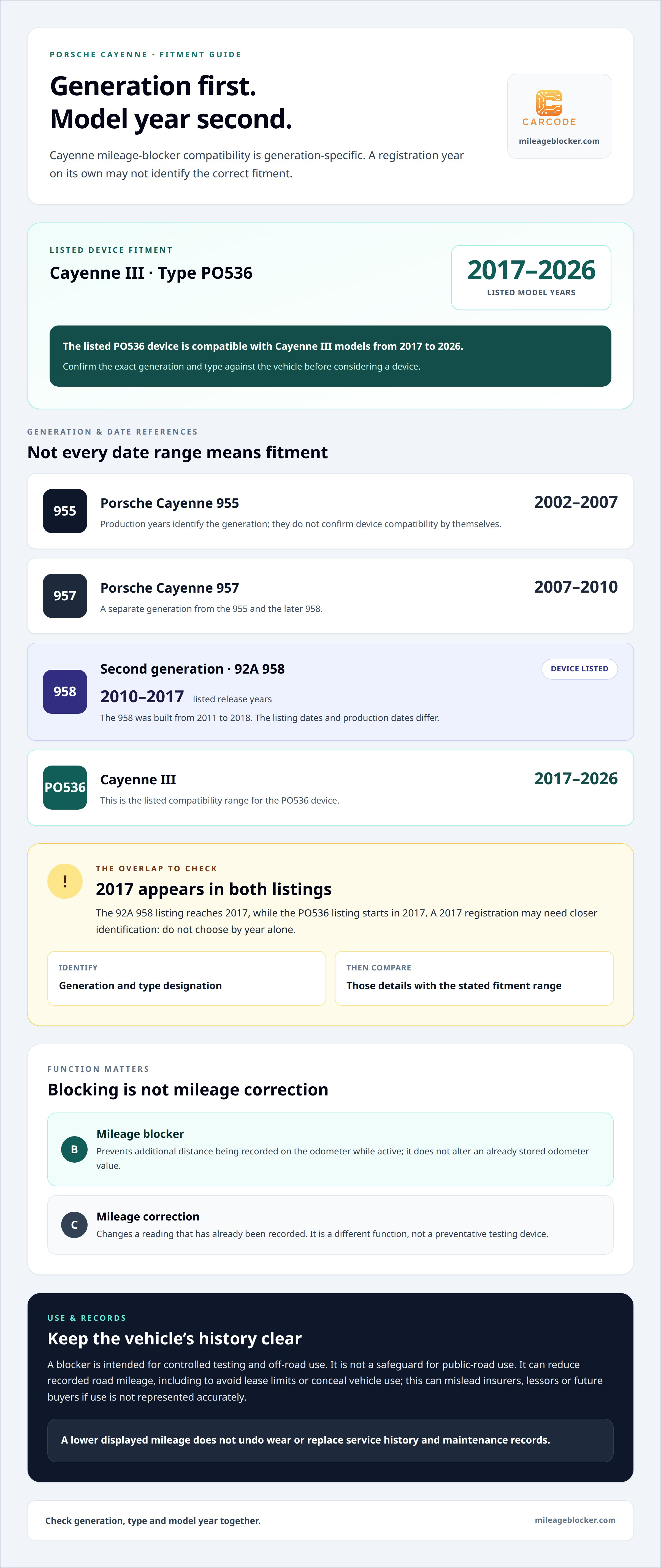
Compatibility is generation-specific. The listed Cayenne III, 3rd Gen Type PO536 device covers models from 2017-2026. The Porsche Cayenne 955 was produced from 2002 to 2007, while the 957 followed from 2007 to 2010. Those production dates identify the generation, but don’t establish device compatibility by themselves.
For the second-generation Cayenne, the 958 was built from 2011 to 2018. A device is listed for Porsche Cayenne 2 Type 92A 958 models released between 2010 and 2017. The date ranges differ, so use the vehicle’s generation and type designation as well as its year. A registration year alone may not identify the correct fitment.
The overlapping dates make precise identification especially important. The 92A 958 listing reaches 2017, and the PO536 listing starts in 2017. A 2017 registration could therefore require closer identification of the vehicle’s generation and type. Don’t choose solely by the year shared between those ranges.
For a Cayenne up to 2013, activation differs from activation on models from 2013 onward. That distinction is another reason to match the device information to the exact vehicle, rather than assume that all 958 models operate identically. Establish the Cayenne’s generation, type and model year first; then compare those details against the stated compatibility range. This helps avoid treating the 955, 957, 92A 958 and PO536 as interchangeable.
How do leading Porsche Cayenne mileage blockers compare on features, compatibility and price?
The best mileage blocker for a Porsche Cayenne is one explicitly listed as compatible with the vehicle’s exact generation and variant. Check the product’s fitment information before comparing features. A general Cayenne label alone does not establish compatibility, and the selected module must be used only for legitimate testing, tuning or diagnostics in a controlled environment.
Compare prices only for devices listed for the same Cayenne generation and variant. A lower price for a different fitment does not show better value for your vehicle. Review the applicable product’s warranty and returns terms, and account separately for any fitting service when considering the total cost.
For a useful comparison, apply the same criteria to each candidate: confirmed vehicle fitment, documented operating modes, activation method, warranty and returns terms. Match those details to the controlled test plan. If a test requires a specific mileage-recording behaviour, confirm that the listed mode supports it. Judge the device by its documented fit and function, not a general “best” label or price alone.
Mode 1 stops the speedometer from working; Mode 2 makes it indicate 50% of actual speed. In Mode 3, it indicates 25% of actual speed and records 25% of actual mileage.
How much does a Porsche Cayenne mileage blocker cost in the UK, including fitting?
This figure applies to the device, not a fitted total. It can help with budgeting, but it should not be assumed to cover every Cayenne generation. The vehicle’s exact type and model year determine which compatible device is relevant.
Fitting adds a separate cost. Its amount depends on the installation requirements for the specific Cayenne and the fitting service involved. The 92A 958 and PO536 are separate fitment listings, so their prices should not be assumed identical.
To assess the total, first identify whether the vehicle is a 92A 958 or PO536. Then separate the device price from the fitting charge and account for VAT on the listed PO536 price. Don’t use a generic Cayenne figure for another generation.
Keep costs in context with the intended controlled-testing use. A blocker is not mileage correction, and the two devices perform different functions. For a PO536, compare the listed device cost with the fitting component and the requirements of the test. That approach makes the budget clearer without treating an unrelated generation’s price as equivalent.
How is a mileage blocker professionally installed and removed from a Porsche Cayenne?
For the Cayenne III Type PO536, the listed fitment covers 2017-2026 models. Installation is rated 9/10 for difficulty and described as expert-level. The module can be installed without cutting cables or soldering. Those details make professional fitting important, particularly on a vehicle with complex electronic systems.
The stated installation time is under 30 minutes for most installations. That is a general fitting estimate, not a guaranteed duration for every PO536. The vehicle’s configuration and the work required can affect the appointment. The expert difficulty rating also means that the time figure should not be treated as a guide for DIY work.
Removal is a separate task. The under-30-minute estimate and 9/10 difficulty rating describe installation, not removal. They should not be used to promise a removal time or infer a specific removal procedure. A professional can handle the device and vehicle connections as a workshop task, rather than treating removal as an owner-led tutorial.
For a Cayenne used in controlled testing, clear communication about the device helps the workshop understand the vehicle’s setup. Installation does not involve cable cutting or soldering, according to the PO536 fitment information. That distinction is useful when discussing the work, but it does not establish a removal sequence. Keep the vehicle’s generation and model year clear: PO536 fitment applies to Cayenne III models from 2017-2026, not every Cayenne.
MileageBlocker.com
MileageBlocker.com sells mileage blocker devices and offers a fitting service for the devices it sells. These are practical options when preparing a compatible vehicle for legitimate, controlled testing. Professional fitting is available upon request for customers who prefer assistance with installation.
For Cayenne III Type PO536 models from 2017-2026, the listed device records 0% of covered mileage in Mode 1 and 50% in Mode 2. It is activated or deactivated with three quick presses of the Return button. The device has a 12-month warranty and a 28-day returns period. Those details help clarify its operating options and purchase terms for this specific fitment.
Use the generation and type designation to distinguish a PO536 from an earlier 92A 958 Cayenne. This matters because model-year ranges overlap, and a device intended for one generation should not be assumed compatible with another. MileageBlocker.com’s product range includes a Porsche Cayenne 9YA/9YB mileage blocker; the matching fitment depends on the vehicle’s exact type and year.
A mileage blocker is intended for controlled testing and off-road use. Recorded road mileage can also be reduced, including to avoid lease limits or conceal vehicle use, which may mislead others about the vehicle’s history. Keep its use and the Cayenne’s actual use accurately represented. For a fitting enquiry, contact MileageBlocker.com.
Frequently Asked Questions
What is a mileage blocker and how does it work on a Porsche Cayenne?
A mileage blocker is a plug-and-play CAN-bus module that prevents mileage recording while active. It intercepts CAN-bus signals and does not alter any stored odometer value. For a Cayenne, first confirm that the device is listed for the vehicle’s exact type and generation, then use it only for legitimate testing, tuning or diagnostics in a controlled environment.
What is the best-rated mileage blocker for a Porsche Cayenne in the UK?
There isn’t a substantiated UK rating comparison here, so a “best-rated” winner can’t be named reliably. Choose by exact vehicle fitment and documented features instead. For example, the listed PO536 device covers Cayenne III models from 2017-2026, while earlier generations use different fitment listings. Compare the applicable mode information and warranty terms, and treat customer ratings as useful context rather than proof of compatibility.
Can a Porsche Cayenne mileage blocker be detected by diagnostic tools or vehicle inspections?
Whether a diagnostic tool or inspection will identify the module or inconsistencies in vehicle records cannot be guaranteed. Use it only for legitimate testing, tuning or diagnostics, never to misrepresent a vehicle’s true mileage when selling or advertising it.
Is using a mileage blocker legal in the UK, and what are the rules on odometer tampering?
Do not use a mileage blocker to misrepresent a vehicle’s mileage. The guide recommends using one only for controlled testing or off-road use and keeping mileage records clear.
Article by
Pav Tomaszevicz
Pav Tomaszevicz is Chief Editor at MileageBlocker.com and works closely with the Carcode technical team on content covering vehicle electronics, CAN and CAN-FD systems, mileage blocker compatibility, installation and product development. His articles draw on practical product development, technical support, installation experience and ongoing research into modern vehicle electronics. Content may use AI-assisted drafting and research, but technical information is reviewed against Carcode's product knowledge and real-world experience before publication
About the author
MileageBlocker TeamThe MileageBlocker Technical Team covers vehicle electronics, CAN and CAN-FD systems, mileage blocker compatibility, installation and product developments.
View author profile →