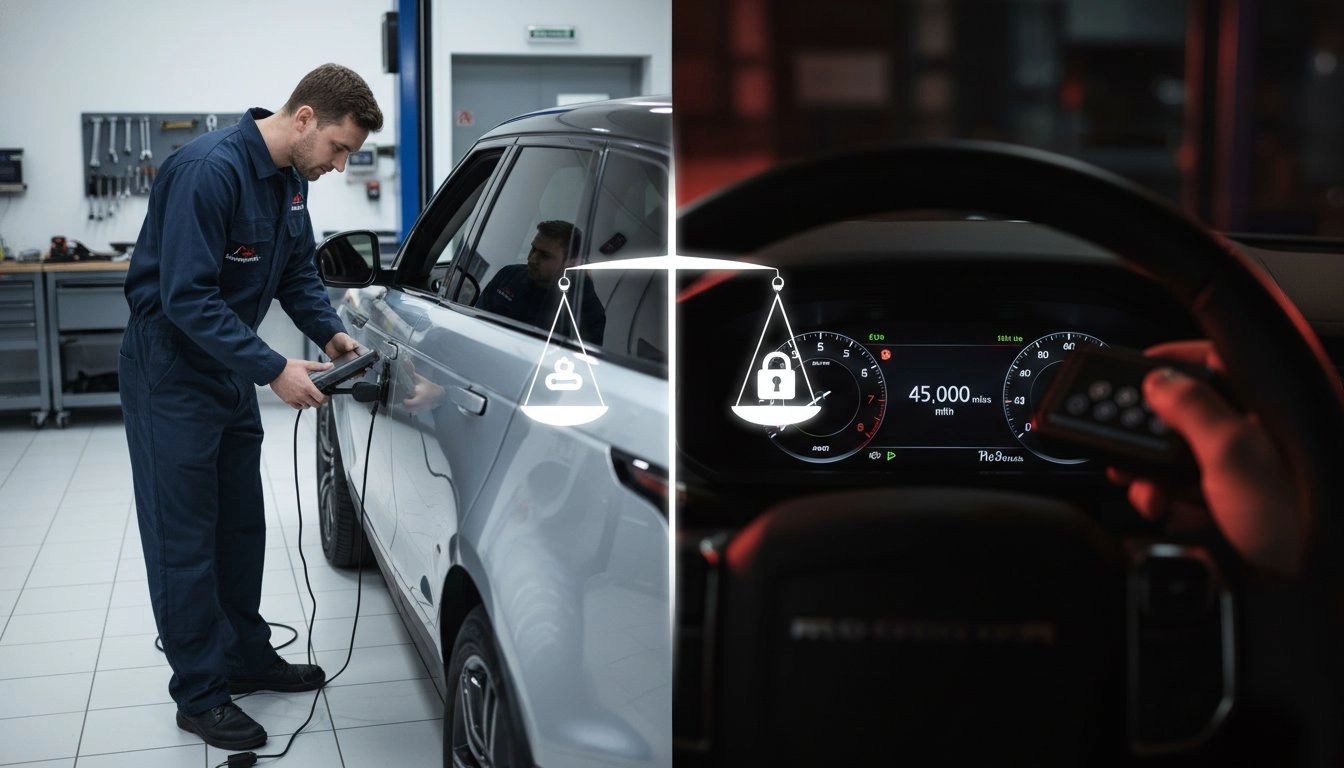
Odometer Fraud: A Comprehensive Guide to The Law and How to Avoid
The digital dashboard on a modern used car inspires confidence, but the threat of odometer fraud is more sophisticated than ever. With thousands of UK driver...
The digital dashboard on a modern used car inspires confidence, but the threat of odometer fraud is more sophisticated than ever. With thousands of UK drivers potentially overpaying for 'clocked' vehicles each year, the financial risk is substantial. It's a common fear: is that low mileage a genuine bargain or a costly deception? This uncertainty can turn the excitement of buying a car into a stressful gamble, especially when even advanced electronic systems can be manipulated.
This comprehensive guide provides the technical knowledge you need to buy with assurance. We will detail the precise methods for detecting mileage discrepancies, from analysing MOT history to spotting subtle physical clues. You will learn the critical legal framework in the UK that governs mileage alteration, understanding the clear line between illegal tampering and the legitimate use of advanced diagnostic tools for testing purposes. Equip yourself with the expertise to identify fraud and make an informed, secure purchase.
Key Takeaways
- Learn the essential physical and digital checks to protect your next used car purchase from costly odometer fraud.
- Discover why modern digital odometers are not tamper-proof and where hidden mileage data is stored across a vehicle's electronic systems.
- Understand the critical legal distinction between illegal odometer tampering and the legitimate reasons for stopping mileage accumulation for off-road or testing purposes.
- Find out how to select and ethically use a high-quality mileage blocker for vehicle testing, ensuring you operate within legal boundaries.
What Is Odometer Fraud and Why Is It a Serious Crime?
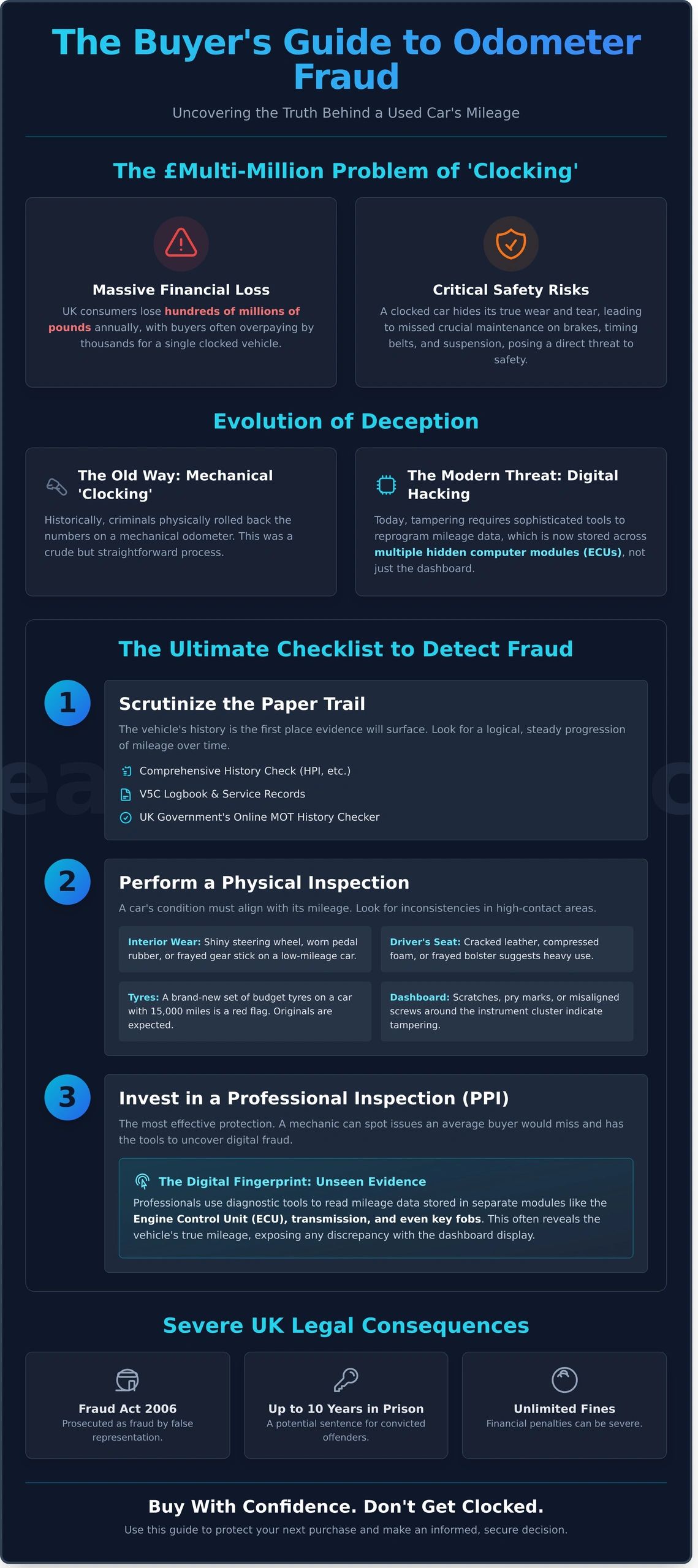
Odometer fraud, often referred to as 'clocking' in the UK, is the illegal act of deliberately altering a vehicle's mileage reading to make it appear as though it has travelled fewer miles than it actually has. The primary motivation is to dishonestly inflate the vehicle's resale value. This deceptive practice not only leads to massive financial losses for unsuspecting buyers but also creates critical safety risks by obscuring the vehicle's true wear and tear.
The scale of the problem is significant. According to data from vehicle history experts, this type of fraud affects a substantial number of used cars in the UK. The financial impact is estimated to cost UK consumers hundreds of millions of pounds annually, with individuals often overpaying by thousands for a single clocked vehicle. Beyond the financial sting, a buyer unknowingly purchases a vehicle with a misrepresented service history, potentially missing crucial maintenance for components like timing belts, brakes, and suspension systems, which poses a direct threat to road safety.
The Evolution: From Mechanical 'Clocking' to Digital Tampering
Historically, odometer fraud involved physically rolling back the numbers on a mechanical odometer. However, modern vehicles feature digital dashboards, which has shifted the challenge. Today, tampering requires sophisticated electronic tools to reprogram the mileage data. Crucially, mileage information is no longer stored just in the dashboard's memory; it is often recorded across multiple Electronic Control Units (ECUs) throughout the vehicle, such as in the engine management system and key fobs, making comprehensive alteration more complex.
The Legal Landscape: UK Laws and Penalties
In the United Kingdom, odometer fraud is prosecuted primarily under the Fraud Act 2006. The act of altering an odometer with the intent to deceive a potential buyer is considered fraud by false representation. Trading Standards authorities are responsible for investigating these cases, and the penalties are severe. If convicted, offenders can face unlimited fines and a prison sentence of up to 10 years. The key element of the crime is the 'intent to defraud,' meaning the act becomes illegal when the vehicle is offered for sale with the altered mileage undisclosed.
How to Detect Odometer Fraud: A Checklist for Used Car Buyers
Identifying a "clocked" vehicle requires more than a quick glance at the dashboard. Sophisticated criminals can make it difficult to spot discrepancies, but a systematic approach greatly increases your chances of uncovering the truth. No single check is foolproof; the key is to look for a pattern of inconsistencies. If multiple red flags appear during your evaluation, your best course of action is to walk away from the sale.
Scrutinize Vehicle History and Service Records
The vehicle's paper trail is often the first place evidence of odometer fraud will surface. Begin with a comprehensive history check from a service like HPI or CarValuations. These reports can reveal mileage inconsistencies recorded during previous sales or services. Carefully examine the V5C logbook and all available service and MOT records. Look for a steady, logical progression of mileage over time. The UK government's online MOT history checker is an invaluable free tool for this. As outlined by authorities like the Odometer Fraud - NHTSA, comparing official records to the vehicle's current state is a critical step in consumer protection.
Perform a Thorough Physical Inspection
A car's physical condition should align with the mileage displayed on the odometer. A vehicle showing low mileage should not exhibit signs of high usage. Pay close attention to high-contact areas and components that wear out predictably over time.
- Interior Wear: Check for excessive wear on the steering wheel, gear stick, clutch, brake, and accelerator pedals. A shiny, worn steering wheel or worn-down pedal rubber is inconsistent with a car that has supposedly only covered 20,000 miles.
- Driver's Seat: Inspect the driver's seat bolster (the side you slide over to get in). Frayed fabric, cracked leather, or compressed foam suggests many more hours of use than a low mileage figure would indicate.
- Tyres: Check if the tyres are all the same brand and have consistent wear. A car with 15,000 miles should likely still have its original tyres. If it has a brand-new set of budget tyres, question why they were replaced so soon.
- Dashboard Tampering: Look for scratches, pry marks, or misaligned screws on or around the instrument cluster. This can be a direct sign that the dashboard has been removed to alter the odometer reading.
Consult a Professional for a Pre-Purchase Inspection (PPI)
The most effective way to protect yourself is to invest in a pre-purchase inspection from a trusted, independent mechanic. A professional can spot mechanical issues and signs of tampering that an average buyer would miss. Crucially, modern vehicles often store mileage data in multiple electronic control units (ECUs), not just the dashboard display. A mechanic with advanced diagnostic tools can read the data from these separate modules (like the engine or transmission control unit), which may reveal the vehicle's true mileage and expose a discrepancy with the odometer.
Digital Odometers: The Myth of an 'Untraceable' Rollback
In the era of mechanical odometers, altering a vehicle's mileage was a crude but straightforward process. Today, the landscape is entirely different. Modern vehicles are complex networks of computers, and the belief that a digital odometer can be rolled back without a trace is a dangerous myth. Mileage data isn't just a single number displayed on your dashboard; it's a critical piece of data recorded and synchronised across multiple electronic systems.
This data is stored in various locations, creating a web of digital handshakes that verify the vehicle's true mileage. These locations can include:
- The Engine Control Unit (ECU)
- The transmission control module
- The ABS control unit
- The vehicle's key fob
- Infotainment systems
Attempting to alter the mileage in one location without updating all others creates a digital conflict-a permanent record of tampering that is easily discovered during a professional diagnostic scan.
Odometer Correction Tools vs. Mileage Blockers: A Critical Distinction
It is crucial to understand the difference between two distinct types of devices. Odometer 'correction' tools are designed to reprogram or erase existing mileage from a vehicle's memory modules. These tools are often crude and ineffective, as they typically only alter the visible display, leaving conflicting data in other ECUs. This creates a digital footprint that is a clear sign of illegal alteration.
In contrast, a Mileage Blocker is a preventative tool. It does not alter past mileage. Instead, it is engineered to filter new mileage data from being recorded across all relevant control units simultaneously. This makes it a suitable solution for legitimate purposes such as vehicle testing or off-road use, where mileage accumulation needs to be paused without creating data conflicts.
Why Low-Quality Correction Tools Are Easily Detected
Committing odometer fraud with a cheap correction tool is an almost guaranteed way to get caught. When a vehicle is connected to a main dealer's diagnostic system, the software cross-references the mileage data from every relevant module. A mismatch between the dashboard display and the data stored in the ECU, for example, is an immediate red flag.
Regulatory bodies and law enforcement are well aware of these methods. In the United States, for instance, agencies actively enforce federal odometer fraud laws, and similar stringent regulations exist here in the UK. Beyond the legal risks, using low-quality, unreliable tools can cause irreversible damage to your vehicle’s sensitive electronic systems, leading to costly repairs that far outweigh any perceived benefit.
Legitimate and Legal Reasons to Stop Mileage Accumulation
While the consequences of illegal mileage tampering are severe, it is crucial to understand that the technology to halt mileage recording has legitimate, professional applications. The critical distinction between a legal tool and an instrument of odometer fraud lies entirely in the user's intent. When used ethically and for its intended purpose, a mileage stopper is an indispensable device for many automotive professionals.
Modern vehicles require smart solutions. For specific, controlled environments, preventing the accumulation of non-road mileage is not only logical but necessary to preserve a vehicle's accurate service history and value. The legality is tied directly to the purpose and the absence of any intent to deceive a future buyer.
Vehicle Development and Dyno Testing
Performance tuners, mechanics, and automotive engineers frequently run vehicles for extended periods on a dynamometer (dyno) or rolling road. This stationary testing is essential for engine tuning, diagnostics, and performance validation. Accruing hundreds of miles while the vehicle is stationary would misrepresent its actual road use, skewing service intervals and devaluing the car with "phantom" mileage that reflects no wear on the chassis, suspension, or brakes.
Off-Road and Private Track Use
Many high-performance and specialised vehicles are used exclusively on private land or race tracks. The mileage accumulated in these demanding, off-road conditions is not comparable to standard public road usage. For owners of vehicles like a Ferrari Purosangue used for track days, stopping the odometer during these events ensures the recorded mileage accurately reflects its on-road history, which is the standard measure for valuation and wear.
Showroom and Exhibition Purposes
For car dealerships, collectors, and automotive exhibitors, preserving a vehicle's 'as-new' status is paramount. Even moving a car around a showroom, transporting it to an exhibition, or using it for a photoshoot can add unwanted miles. A mileage stopper allows these movements without impacting the odometer, ensuring a collector's car or a brand-new vehicle maintains its zero-mileage value for a potential buyer.
In these scenarios, the objective is not to commit odometer fraud but to maintain an honest and accurate record of a vehicle's public road usage. For professionals requiring premium quality tools for legitimate testing and preservation, you can find reliable solutions at mileageblocker.com.
Choosing and Using a High-Quality Mileage Blocker Ethically
For legitimate purposes such as vehicle diagnostics, performance testing, or off-road use, a mileage blocker is an effective tool. However, its use must be approached with a clear understanding of legal and ethical boundaries. Selecting a premium device and using it responsibly are paramount to ensure you stay on the right side of the law and avoid any association with odometer fraud.
What to Look For in a Reputable Mileage Stopper
A reliable device is built with genuine, automotive-grade components to ensure it functions perfectly within your vehicle's electronic ecosystem. Prioritise solutions that feature plug-and-play connectors, which allow for simple installation without cutting or soldering wires, thereby preserving your vehicle’s warranty and integrity. A reputable provider will also stand behind their product with a solid warranty and accessible customer support, demonstrating confidence in their engineering and commitment to their customers.
The Importance of Proper Installation and Use
A premium mileage stopper is designed to integrate flawlessly with your car's complex systems, such as the CAN-Bus network. Correct installation ensures the device works as intended without triggering warning lights or storing fault codes in any ECU modules. While many users can perform the installation themselves, a professional fitting service is an excellent option for total peace of mind. You can learn more about the professional installation process to ensure a perfect setup.
Your Legal Responsibility: Disclosure is Key
This is the most critical aspect of ethical use. A mileage blocker should only be active during off-road driving or for testing purposes in a controlled environment; it must always be deactivated on public roads. If you sell a vehicle where a blocker has been used and the true mileage is not accurately reflected, you are legally obligated in the UK to disclose this discrepancy to the buyer. Transparency is the definitive line between legitimate tool use and committing odometer fraud. Always consult local laws to ensure full compliance.
For a tool engineered with premium components for ethical testing purposes, explore the advanced solutions available at mileageblocker.com.
Your Final Checkpoint: Defeating Odometer Fraud with Confidence
Navigating the complexities of modern vehicles requires both knowledge and precision. As this guide has shown, understanding the serious nature of odometer fraud is the first step towards protecting yourself from a crime that costs UK consumers millions of pounds annually. It is equally important to distinguish illegal tampering from the legitimate need to halt mileage accumulation for legal purposes, such as controlled vehicle testing or off-road use.
For these professional and ethical applications, a superior tool is essential. Carcode Mileage Blockers are engineered with genuine automotive-grade components for an untraceable effect and feature a simple plug-and-play installation. When your work demands the highest standard of quality and discretion, trust a Carcode Mileage Blockers device backed by lifetime support and worldwide shipping.
Protect your assets and ensure accurate testing. Shop for Carcode Mileage Blockers for your vehicle testing needs and drive forward with confidence and integrity.
Frequently Asked Questions About Odometer Fraud
Is using a mileage blocker illegal?
In the United Kingdom, it is illegal to use a mileage blocker on public roads or to misrepresent a vehicle's true mileage during a sale. The act of altering an odometer reading to deceive a buyer is a criminal offence. However, the devices themselves are intended for legitimate off-road and vehicle testing purposes, such as dynamometer testing, where mileage accumulation needs to be temporarily halted. The legality is determined by the user's intent and application.
What is the difference between an odometer rollback tool and a mileage blocker?
An odometer rollback tool, often called a mileage correction tool, is used to illegally alter or rewind the existing value stored in a vehicle’s memory modules (EEPROM). In contrast, a mileage blocker is a preventative device. It works by filtering the mileage data being sent through the vehicle's CAN-Bus system, effectively stopping new mileage from being recorded across all ECUs while it is active. It does not change any previously recorded data.
Can a mechanic or dealership detect that a mileage blocker was used?
The detectability of a mileage blocker is entirely dependent on its quality. Low-quality devices can create electronic conflicts and leave diagnostic fault codes that are easily discovered. However, premium-quality mileage blockers are engineered to be untraceable. They integrate flawlessly with the vehicle's software and do not store error codes in any control unit. Once the device is removed, it leaves no digital footprint, making it undetectable even with advanced dealership diagnostic tools.
How do I know if the used car I'm buying has had its mileage altered?
To spot potential odometer fraud in the UK, always use the free GOV.UK online MOT history checker to verify past mileage readings. Any inconsistencies are a major warning sign. You should also meticulously review the car’s service history and look for physical signs of wear on the steering wheel, pedals, and driver's seat that seem excessive for the advertised mileage. A significant mismatch between wear and the odometer reading suggests tampering.
Do I have to disclose the use of a mileage blocker when I sell my vehicle?
Yes. Under UK law, specifically the Fraud Act 2006, you are legally obligated to disclose a vehicle's true mileage to a potential buyer. If a mileage blocker has been used for any reason, causing the odometer to display a figure lower than the actual distance the vehicle has travelled, you must declare the discrepancy. Failure to do so is considered misrepresentation and can lead to severe legal consequences, including prosecution for fraud.
How do mileage blockers work with modern electric and hybrid vehicles?
Electric and hybrid vehicles record mileage data across numerous electronic control units (ECUs), including the battery management system and motor controllers. A high-quality mileage blocker for these advanced vehicles is programmed to interface with the entire network, such as the CAN-Bus or FlexRay system. It simultaneously filters the speed signal to all relevant modules, ensuring the mileage count is halted consistently and untraceably across every part of the vehicle's complex electronic architecture.
About the author
Pav TomaszeviczChief Editor, MileageBlocker.com
Pav is Chief Editor at MileageBlocker.com and works with the MileageBlocker Technical Team to publish practical information about vehicle compatibility, CAN/CAN-FD electronics, installation and MileageBlocker products.
View author profile →