Are Mileage Blockers Legal? A Comprehensive Guide
The legality of mileage blockers is a source of significant concern for many vehicle owners and technicians. You''ve likely heard the warnings about hefty fin...
The legality of mileage blockers is a source of significant concern for many vehicle owners and technicians. You've likely heard the warnings about hefty fines, voided warranties, and even jail time associated with odometer tampering, creating a cloud of uncertainty. The internet is filled with conflicting information, making it difficult to distinguish a high-quality diagnostic tool from a fraudulent device. This confusion often boils down to one critical question: is using a mileage blocker legal for my specific, intended purpose?
This comprehensive guide is engineered to eliminate that uncertainty. We provide clear, direct answers, defining the crucial difference between the legitimate use of a mileage stopper for vehicle testing or off-road applications and the illegal act of odometer fraud. We will break down the specific regulations in the US, UK, and EU, outlining exactly when and how these advanced tools can be used without violating the law. By the end, you will have the confidence to make an informed decision, understanding how to utilize a premium mileage blocker for its intended diagnostic functions responsibly and legally.
The Core Question: Is the Mileage Blocker Device Itself Legal?
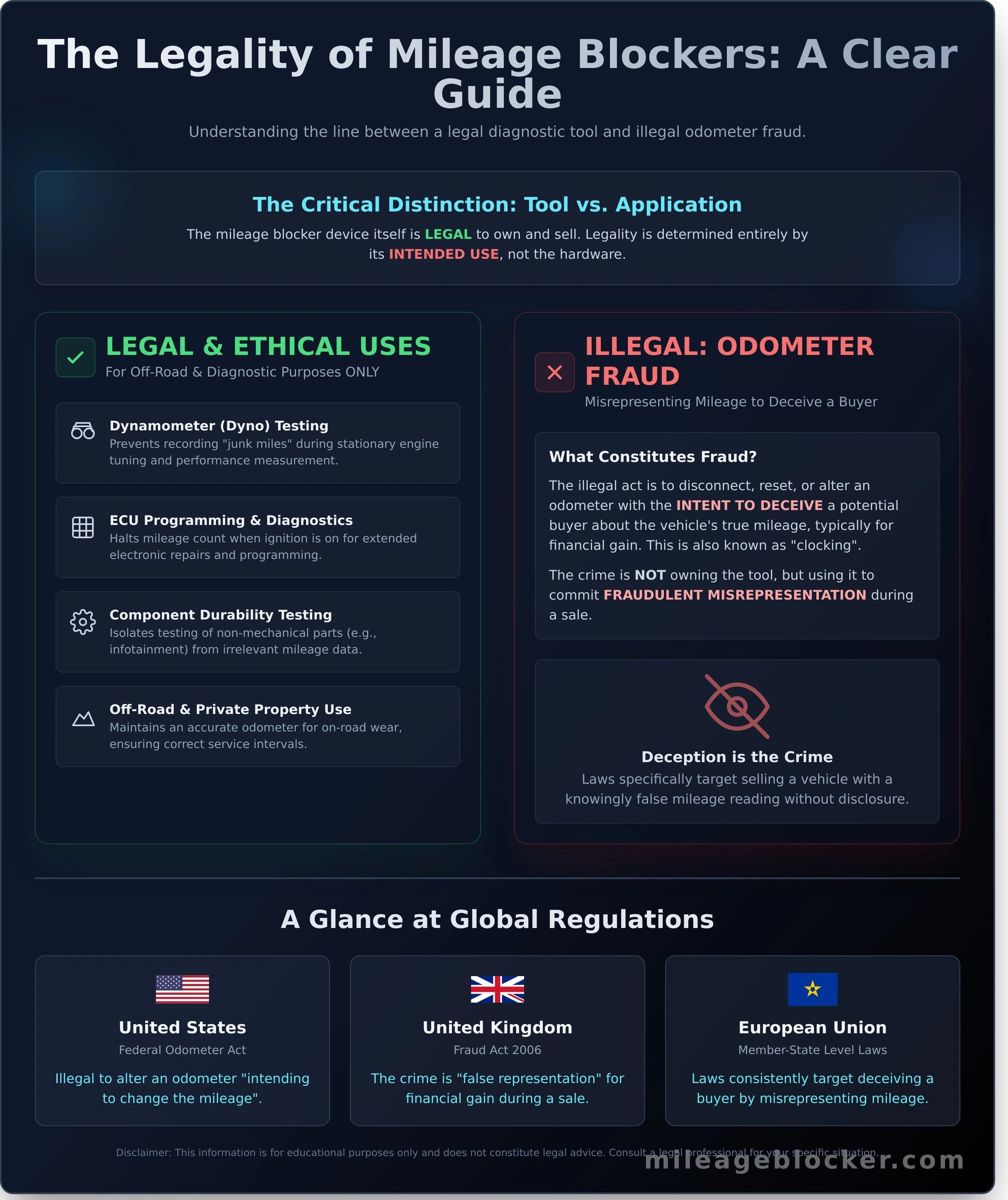
The direct answer is straightforward: The mileage blocker device itself is legal to own and sell in most regions. The legality hinges entirely on its intended application, not the hardware. This distinction is critical. The core issue of whether a mileage blocker legal status is positive or negative depends on user intent. Think of it like a professional kitchen knife; it's a tool for a chef, but it can be used illegally. The law prosecutes the misuse, not the tool's existence.
This principle separates legitimate diagnostic tools from illegal activities. The crime is not in possessing a device capable of stopping the odometer, but in using that capability to deceive a potential buyer during the sale of a vehicle. This act of deception is known as odometer fraud.
Understanding the 'Tool vs. Application' Principle
A mileage blocker is an advanced diagnostic tool designed for specific, legitimate scenarios. Its primary function is to temporarily halt the mileage recording process across all of a vehicle's electronic control units (ECUs) and memory modules. This is not a mileage correction or rollback tool. Its sole purpose is to prevent the addition of miles during off-road testing, dynamometer tuning, or vehicle research and development where public road mileage is irrelevant and can complicate testing data.
What is Odometer Fraud?
Odometer fraud is the illegal act of disconnecting, resetting, or otherwise altering a vehicle's odometer with the intent to change the number of miles indicated. To fully grasp this, it helps to understand what is an odometer and its role as a legal record of a vehicle's use. Federal and state laws specifically target the fraudulent misrepresentation of a vehicle's mileage to a buyer. It is this deceptive act, often called 'clocking', that is illegal—not the ownership of a tool that could be misused.
A Global Look at Odometer Laws: US, UK, and EU Regulations
Navigating the legal landscape for mileage blockers requires a clear understanding of intent versus action. While laws across major markets are incredibly strict about odometer fraud, the question of whether a mileage blocker legal status exists for the device itself is more nuanced. The critical factor is almost always how the tool is used. Laws target the act of deceiving a buyer, not necessarily the possession of a diagnostic tool. However, regulations differ significantly by region.
Disclaimer: This information is for educational purposes only and does not constitute legal advice. You must consult with a legal professional regarding your local laws and regulations.
United States Law: The Federal Odometer Act
In the United States, the primary legislation is the Federal Odometer Act, codified under 49 U.S. Code § 32703. This law makes it illegal to "disconnect, reset, or alter, or have disconnected, reset, or altered, an odometer of a motor vehicle intending to change the mileage registered by the odometer." The National Highway Traffic Safety Administration (NHTSA) actively enforces the US federal law on odometer fraud and has clarified that selling a device with the knowledge that it will be used for fraudulent purposes is also illegal. This is why our mileage stoppers are engineered and marketed strictly for legitimate, non-fraudulent purposes, such as off-road vehicle testing and diagnostics in a controlled environment.
United Kingdom Law: The Fraud Act 2006
The UK’s approach centers on the concept of deception. Under the Fraud Act 2006, the act of fitting a mileage blocker is not explicitly outlawed. The crime is committed when a seller makes a "false representation" to make a financial gain. This means selling a vehicle with an altered mileage reading without disclosing it to the buyer constitutes fraud. The law focuses on the dishonest act of misrepresenting a vehicle's value during a sale, rather than the installation of the hardware itself.
European Union Regulations
The European Union has taken a strong stance against odometer tampering, recognizing it as a significant issue affecting the cross-border used car market. While there are EU-wide initiatives to share mileage data and combat fraud, specific laws are enforced at the member-state level. For example, countries like Germany and Poland have explicit laws making odometer manipulation a criminal offense. The overarching principle remains consistent across the EU: the illegal act is deceiving a buyer by misrepresenting a vehicle's mileage for financial gain.
Legitimate and Ethical Uses of a Mileage Blocker
While the function of a mileage blocker is straightforward, its application is often misunderstood. The core purpose of this diagnostic tool is not to deceive, but to prevent the recording of non-essential mileage in controlled environments. In these specific scenarios, added kilometers or miles do not represent actual road wear and can skew maintenance schedules, component data, and overall vehicle valuation.
Vehicle Testing and Development Scenarios
In the automotive industry, precision is paramount. Mechanics, tuners, and manufacturers require the ability to run extensive tests without accumulating "junk miles" that misrepresent the vehicle's condition. A mileage stopper is an essential tool for these diagnostic purposes.
- Dynamometer (Dyno) Testing: When tuning an engine or measuring performance, a vehicle can run for hours on a dyno, accumulating significant mileage while stationary. A blocker ensures the odometer reflects only genuine on-road use.
- ECU Programming and Diagnostics: Technicians often need the ignition on for extended periods to diagnose electronic issues or program ECU modules, a process that can cause the odometer to count up unnecessarily in some vehicles.
- Component Durability Testing: Manufacturers test specific components like infotainment systems or climate control over hundreds of hours, a process where mileage accumulation is entirely irrelevant to the test's outcome.
Off-Road and Private Property Use
For vehicles used exclusively or primarily off-public roads, the odometer reading can be a misleading indicator of its condition. A mileage blocker helps maintain an accurate record of on-road wear and tear, which is critical for proper service intervals.
- Dedicated Off-Road Vehicles: Trucks, UTVs, and 4x4s used on private land, farms, or competitive tracks can have their service intervals aligned with actual road use, not off-road hours.
- Show Cars: Prized vehicles that are transported to events via trailer but driven for short periods on display grounds can avoid adding non-essential mileage that devalues the automobile.
The User's Ethical and Legal Responsibility
The entire discussion of whether a mileage blocker legal status is defensible hinges on user integrity. This tool is designed exclusively for temporary use in controlled, off-road, or diagnostic settings. It is the user's absolute responsibility to deactivate the device before operating the vehicle on public roads. Failure to do so transitions from legitimate testing into illegal odometer tampering, an act strictly prohibited by federal law, as detailed in the NHTSA Odometer Fraud Regulations. Furthermore, ethical practice dictates that if the device's use could in any way affect the vehicle's history, it must be disclosed upon sale. The key is transparency and adherence to its intended purpose.
Mileage Blockers vs. Odometer Correction/Rollback Tools
A frequent source of confusion in discussions about whether a mileage blocker legal status is clear is the incorrect grouping of these devices with odometer correction or "rollback" tools. Technologically and legally, they are fundamentally different. Understanding this distinction is crucial for anyone considering a device for legitimate vehicle testing, as one is a preventative tool while the other is an alteration device designed for deception.
How They Work: Prevention vs. Alteration
A mileage blocker is an intelligent electronic module that filters mileage data on the vehicle’s communication network (like the CAN-Bus) before it is recorded. It does not erase or change existing data; it simply pauses the counting process across all relevant ECUs simultaneously. When removed, the device leaves no trace because no stored data was ever manipulated.
In stark contrast, an odometer correction tool is an invasive device. It directly accesses the EEPROM memory chips within a vehicle’s modules to rewrite the stored mileage value. This process of altering historical data can often be detected through advanced diagnostic scans, which may reveal inconsistencies or digital "footprints" left by the manipulation.
Legal Status and Intended Purpose
The intended purpose is the core of the legal distinction. Mileage blockers are engineered for specific, legitimate applications where mileage accumulation is undesirable, such as:
- Off-road vehicle testing and modification showcases
- Dynamometer (dyno) performance tuning
- Advanced diagnostic procedures
Odometer rollback tools, however, have one primary function: to fraudulently lower a vehicle’s displayed mileage to deceive a potential buyer. This act is explicitly illegal under laws like the Federal Odometer Act in the U.S. and is viewed by authorities as a tool for committing fraud, plain and simple.
Why Quality Matters for Legitimate Use
For any legitimate testing scenario, the integrity of the vehicle's complex electronic systems is paramount. Premium-quality blockers are built with genuine automotive-grade components and use OEM plug-and-play connectors to ensure a perfect, non-damaging fit. Their software is meticulously developed to integrate flawlessly, preventing dashboard errors or long-term electrical issues.
Poorly manufactured devices can disrupt communication between ECUs, trigger warning lights, and fail to stop the mileage count in all necessary memory modules. For safe and effective use, choosing a professionally engineered solution is essential. Our premium blockers are designed for safe, reliable testing.
The Final Word on Mileage Blocker Legality and Ethical Use
As we have explored, the legality of mileage blockers is a nuanced subject. The critical distinction lies not in the device itself, but in its application. While misrepresenting a vehicle's mileage for fraudulent sale is unequivocally illegal across the US, UK, and EU, there are clear, legitimate purposes for these tools in controlled environments like off-road use and professional vehicle testing.
Ultimately, the question of whether a mileage blocker legal use is achievable depends entirely on your intent and transparency. These devices are designed as preventative tools for specific scenarios, setting them apart from fraudulent odometer correction tools. For professionals who require a reliable solution for vehicle diagnostics and development, choosing a superior device is paramount.
Our modules are engineered with premium quality components to ensure a completely untraceable effect. We provide a comprehensive solution with worldwide delivery & a fitting service, ensuring you receive a superior tool for your specific, ethical applications. Shop for Premium Mileage Blockers for Vehicle Testing and make an informed decision for your professional needs.
Frequently Asked Questions
Do I have to disclose the use of a mileage blocker when I sell my car?
Yes, you are legally obligated to disclose the vehicle's true and accurate mileage during a sale. Using a mileage blocker to misrepresent the odometer reading to a potential buyer is considered fraud and is illegal in most jurisdictions, including the UK and USA. The device should be used only for its intended purpose, such as off-road testing. Before selling, the device must be removed and the odometer must reflect the vehicle's actual mileage.
Can a mechanic or dealership detect if a mileage blocker has been used?
Premium quality mileage blockers are engineered to be completely untraceable. Unlike simple rollback tools that leave a data footprint, our modules filter mileage information from all relevant ECUs and control units simultaneously. This prevents data discrepancies that could be flagged by diagnostic tools. When the device is properly removed before a service appointment, it leaves no electronic trace, making its prior use undetectable by standard dealership or workshop equipment.
Will using a mileage blocker void my vehicle's warranty?
Any aftermarket modification can potentially affect a vehicle's warranty if it is detected and proven to be the cause of a fault. However, our mileage blockers are designed for seamless integration and are untraceable once removed. To protect your warranty, you should always deactivate and remove the module before any dealership service or warranty claim. As the device leaves no data in any of the vehicle’s memory modules, its previous installation cannot be proven.
What is the difference between a 'mileage blocker' and a 'mileage stopper' or 'freezer'?
There is no functional difference between these terms. 'Mileage blocker,' 'mileage stopper,' and 'mileage freezer' are all names used to describe the same type of device. They all refer to a module that intercepts and halts the recording of mileage data across the vehicle’s entire electronic system, including the instrument cluster and various ECUs. The different names are simply marketing terms used by various manufacturers for the same core technology.
Is it legal to buy and possess a mileage blocker in the UK/USA?
Yes, in most regions, including the UK and the USA, it is legal to purchase and own a mileage blocker. The crucial factor is the device's intended use. These modules are sold for legitimate applications like off-road vehicle testing, tuning, and diagnostic purposes. The question of whether a mileage blocker is legal to use depends on intent; using it to deceive or defraud by falsifying mileage on public roads is strictly illegal and carries severe penalties.
How is a mileage blocker different from an illegal odometer rollback device?
The technical distinction is critical. An odometer rollback tool, often called a 'mileage correction tool,' crudely rewrites the existing mileage value stored on the dashboard's memory chip. This process is easily detectable because it creates conflicts with mileage data stored in other ECUs. A mileage blocker, however, is a sophisticated CAN-Bus filter. It doesn’t alter existing data; it prevents new mileage from being recorded system-wide, ensuring no data inconsistencies are created.
About the author
Pav TomaszeviczChief Editor, MileageBlocker.com
Pav is Chief Editor at MileageBlocker.com and works with the MileageBlocker Technical Team to publish practical information about vehicle compatibility, CAN/CAN-FD electronics, installation and MileageBlocker products.
View author profile →