
How to Calculate Cost Per Mile: A Comprehensive Guide for 2026
What is the true operational cost of your vehicle for every mile you drive? Many owners and fleet managers significantly underestimate this critical figure, ...
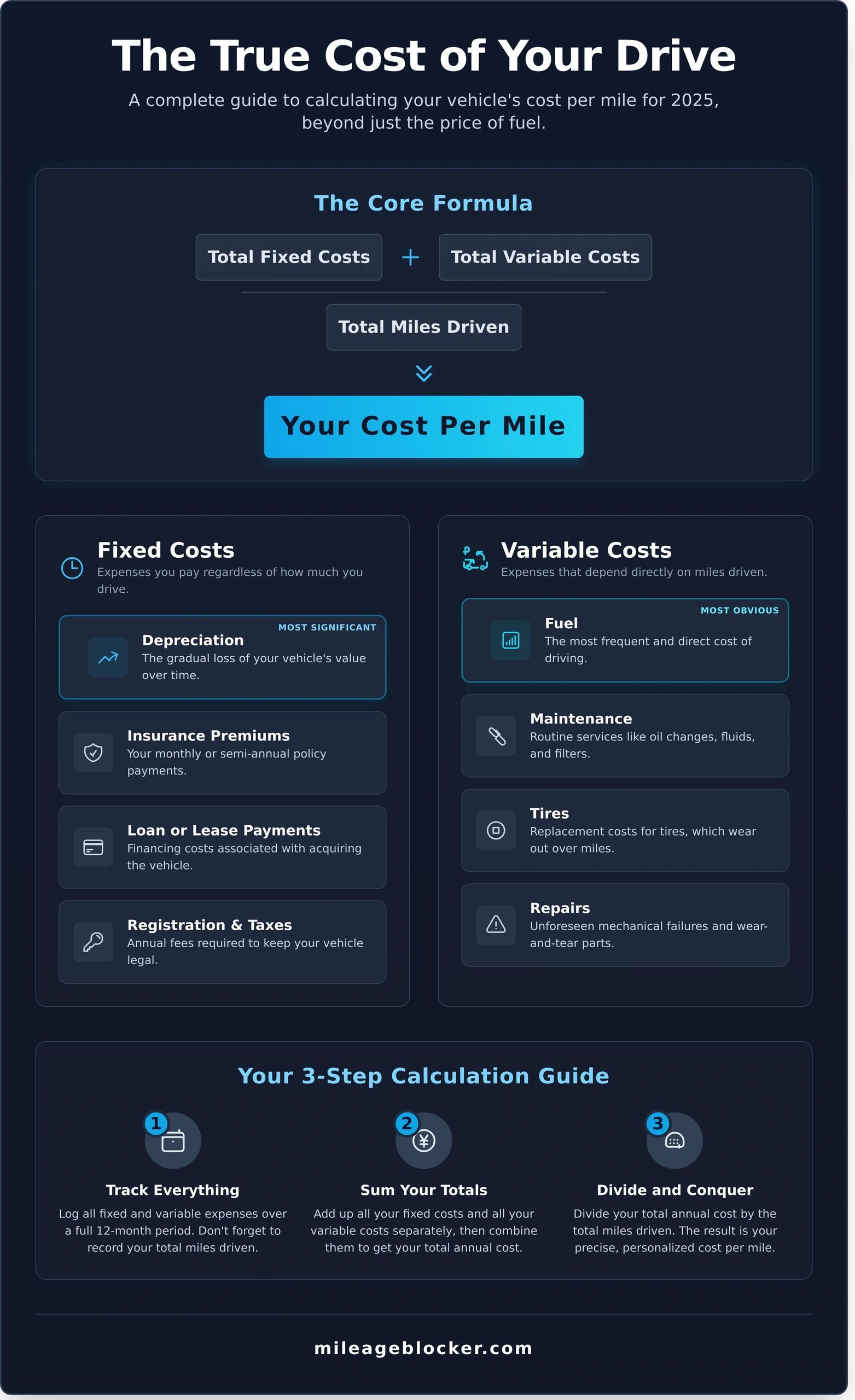
What is the true operational cost of your vehicle for every mile you drive? Many owners and fleet managers significantly underestimate this critical figure, focusing only on fuel while overlooking substantial expenses like depreciation, insurance, and routine maintenance. This common oversight leads to inaccurate personal budgets, flawed expense claims, and reduced business profitability. Understanding the complete financial picture is essential for effective vehicle management. This guide eliminates the complexity and provides the definitive methodology for how to calculate cost per mile with precision for 2025.
Here, we demystify the entire process. You will master a straightforward formula that clearly separates fixed and variable costs, removing any intimidation from the math. We provide a comprehensive checklist to ensure no expense is forgotten, from loan interest to tire replacement. By the end of this guide, you will have the confidence to calculate an accurate cost-per-mile figure, empowering you to make informed financial decisions for your personal vehicle or commercial fleet.
Why Calculating Your Vehicle's Cost Per Mile is Crucial
Most vehicle owners equate driving costs with the price of fuel. This is a significant miscalculation. The true financial impact of your vehicle extends far beyond the gas pump, encompassing insurance, maintenance, depreciation, and more. Understanding how to calculate cost per mile condenses all these expenses into a single, powerful metric. This number is the key to unlocking smarter financial decisions regarding your vehicle's operation and ownership.
To better understand this concept, this video provides a practical step-by-step guide:
To accurately determine your cost per mile, you must first categorize your expenses into two primary groups: fixed and variable costs. A clear grasp of these categories is fundamental to the entire calculation.
- Fixed Costs: These are consistent expenses you incur whether your vehicle is driven one mile or one thousand. They include insurance premiums, loan payments, registration fees, taxes, and depreciation.
- Variable Costs: These expenses are directly proportional to the distance you drive. They cover fuel, oil changes, tire wear, routine maintenance, and unscheduled repairs. For a comprehensive breakdown of vehicle costs, these two categories form the foundation of your total operational expense.
For Personal Financial Planning
For an individual, knowing your cost per mile enables precise financial management. You can create accurate monthly and annual vehicle budgets, eliminating guesswork. It allows for a direct comparison between the true cost of your daily commute and alternatives like public transport. This data is also invaluable when purchasing a new or used car, helping you see beyond the sticker price to the real long-term cost of ownership.
For Business Owners and Freelancers
If you use a vehicle for work, calculating the cost per mile is not just useful-it's essential for profitability. This figure allows delivery or service-based businesses to set pricing that accurately covers vehicle expenses. Furthermore, it is the basis for claiming vehicle expenses on your tax return, ensuring you receive the maximum legal deduction. For companies with multiple vehicles, this metric is critical for evaluating the cost-effectiveness of the entire fleet.
For Accurate Vehicle Evaluations
The cost per mile calculation provides a clear, objective assessment of a vehicle's long-term value. It reveals how factors like fuel efficiency, reliability, and depreciation truly impact your wallet over time. Understanding how mileage affects running costs helps you anticipate future expenses and can justify upgrading to a more efficient or lower-maintenance model, proving that a higher initial investment can lead to significant long-term savings.
The Core Formula: Understanding Fixed vs. Variable Costs
To determine your vehicle's true operational expense, you must start with a simple, universal formula: Total Cost / Total Miles Driven = Cost Per Mile. While many drivers reference the official IRS mileage rates for business use, this figure is a national average. For a precise metric tailored to your specific vehicle and driving habits, a personalized calculation is essential.
The critical first step in how to calculate cost per mile is understanding that 'Total Cost' is not a single number but the sum of two distinct categories: fixed costs and variable costs. A failure to account for both components will produce a significantly inaccurate and misleading result, undermining any financial planning or reimbursement claims.
What are Fixed Costs?
Fixed costs are the consistent, predictable expenses you incur for owning a vehicle, regardless of whether it moves an inch. These costs accrue over time, not by distance. The primary fixed costs include:
- Insurance Premiums: Your monthly or semi-annual payment to your insurance provider.
- Loan Interest or Lease Payments: The financing costs associated with purchasing or leasing the vehicle.
- Registration and Taxes: Annual fees required by your state or municipality to keep the vehicle legally on the road.
- Depreciation: This is the most significant and often overlooked fixed cost. It represents the gradual loss of your vehicle's value over time due to age, wear, and market factors.
What are Variable Costs?
Variable costs, also known as running costs, are expenses directly correlated with the distance you drive. The more miles you log, the higher these costs will be. They are the most tangible expenses of vehicle operation and are essential for an accurate cost-per-mile calculation.
- Fuel: The most obvious variable cost, determined by your vehicle's fuel efficiency (MPG) and local gas prices.
- Maintenance: This includes routine services like oil changes, tire rotations, and fluid checks.
- Tires: Tires have a finite lifespan measured in miles, making their eventual replacement a direct variable cost.
- Repairs: Both expected wear-and-tear replacements (e.g., brake pads) and unforeseen mechanical failures fall into this category.
- Other Expenses: Costs such as tolls, parking fees, and car washes can also be included for a more comprehensive figure.
A Step-by-Step Guide to Gathering Your Cost Data
To accurately determine your vehicle’s operational expenses, you must be meticulous. The key to learning how to calculate cost per mile is precise data collection. We recommend using a full 12-month period to account for seasonal variations in driving and maintenance. Use a dedicated spreadsheet or notebook to log every expense. Rely on actual bank statements, credit card bills, and receipts-estimates will only compromise the accuracy of your final calculation.
Step 1: Calculate Your Total Annual Fixed Costs
Fixed costs are consistent expenses that do not change based on how much you drive. Gather the following documents and sum them for a 12-month period:
- Insurance: Total your monthly or annual insurance premiums for the year.
- Loan/Lease Interest: Refer to your annual loan statement to find the total interest paid. Do not include the principal portion of the payment.
- Registration & Taxes: Add all mandatory yearly fees, including vehicle registration, inspections, and property taxes.
- Depreciation: The loss in your vehicle's value is a significant, often overlooked cost. A simple method is: (Purchase Price - Current Market Value) / Number of Years Owned.
Step 2: Sum Your Total Annual Variable Costs
Variable costs fluctuate directly with your vehicle usage. A detailed record is essential for an accurate assessment. Understanding these variable costs is fundamental to the entire process, as it mirrors the detailed analysis used to set official government mileage reimbursement rates.
- Fuel: This is typically the largest variable cost. Sum every fuel receipt from the year.
- Maintenance: Include all routine service costs, such as oil changes, tire rotations, fluid checks, and filter replacements.
- Repairs & Tires: Document any unexpected mechanical repairs and the cost of new tires purchased during the year.
Step 3: Determine Your Total Annual Miles Driven
The final piece of data required is your total mileage. The most straightforward method is to record your vehicle’s odometer reading on the first day of your tracking period (e.g., January 1st) and the last day (e.g., December 31st). The difference between these two numbers is your total annual mileage. Accurate mileage data is non-negotiable for these calculations. For specific applications like vehicle testing, managing mileage data with absolute precision is critical; learn more in our ultimate guide to odometer management.
Putting It All Together: A Practical Calculation Example
Theory is important, but a practical example demonstrates the real-world value of this calculation. By plugging in realistic annual figures, you can see exactly how to calculate cost per mile for your own vehicle. Let's use a common and reliable car, the Honda Civic, to illustrate the process from start to finish.
Example Vehicle: Honda Civic
First, we identify and sum all fixed costs-the expenses you pay annually regardless of how much you drive. For this example, we will assume the following yearly costs for a late-model Honda Civic:
- Insurance: $1,500
- Depreciation: $2,000
- Registration & Taxes: $250
- Loan Interest: $250
Adding these together gives us our total fixed cost for the year. For owners looking to manage their vehicle's data during testing or off-road use, you can find compatible devices in our Honda product category.
Total Annual Fixed Costs: $4,000
Calculating Variable Costs and Total Miles
Next, we compile the variable costs, which are directly tied to vehicle usage. We also need to define the total distance driven over the year. For this case study, we will assume the owner drove 12,000 miles.
- Fuel: $2,200
- Maintenance & Repairs: $400
- Tires (Prorated): $150
These expenses are directly influenced by the mileage recorded on the vehicle's odometer and ECU modules.
Total Annual Variable Costs: $2,750
The Final Cost Per Mile Calculation
With all figures compiled, the final step in learning how to calculate cost per mile is to apply the formula. We combine the fixed and variable totals and then divide by the total miles driven for the year.
(Total Fixed Costs + Total Variable Costs) / Total Miles Driven = Cost Per Mile
($4,000 + $2,750) / 12,000 Miles = $0.5625
The result is a comprehensive and accurate figure: $0.56 per mile. This number represents the true operating cost for every single mile the Honda Civic was driven. It is a far more accurate measure of vehicle expense than fuel cost alone and is essential for precise budgeting, business expense reporting, and understanding the total financial impact of your vehicle ownership.
How to Use Your Cost Per Mile for Smarter Decisions
Now that you have learned how to calculate cost per mile, you possess a powerful metric for financial control. This number is more than just a statistic; it is a diagnostic tool that empowers you to make informed, data-driven decisions about your vehicle expenses for both personal and business use. By applying this knowledge, you transform a major expense from an unknown into a manageable variable.
Budgeting and Expense Reporting
A primary application is comparing your true cost per mile to the standard IRS mileage rate. If your calculated rate is higher than the reimbursement rate, you are losing money on every business mile you drive. Armed with this data, you can accurately budget for future travel and fuel costs. For business owners, this precise calculation provides the justification needed for setting fair employee reimbursement rates or substantiating expense reports with concrete evidence.
Evaluating Vehicle Ownership
Your cost per mile is a critical factor when considering vehicle changes. It allows for a direct, objective comparison between different options, removing emotion from the decision. Use your calculation to:
- Compare your current car to a potential new vehicle to see if an upgrade offers genuine long-term savings in fuel and maintenance.
- Analyze if an electric vehicle (EV) would be cheaper to operate per mile, factoring in electricity costs versus fuel, reduced maintenance, and purchase price.
- Decide if a less-driven second car is a justifiable expense or a significant financial drain on your household.
Optimizing Business Operations
For businesses that rely on vehicles, knowing the true cost per mile is essential for profitability. Service-based companies can use this data to ensure their pricing structure covers all vehicle-related operational costs and includes a sufficient profit margin. For fleet managers, it helps identify high-cost, inefficient vehicles that are candidates for replacement, optimizing the entire fleet's performance. If you have technical questions about accessing or managing vehicle data systems, consult our Mileage Blocker FAQ for expert insights. This level of analysis ensures your vehicle assets are contributing positively to your bottom line.
Mastering Your Vehicle's True Operating Cost
You are now equipped with the knowledge to accurately determine your vehicle's operational expenses. By separating fixed and variable costs and diligently tracking your spending, you can move beyond estimates to data-driven insights. Understanding how to calculate cost per mile is the first step toward smarter budgeting, fair business reimbursements, and more informed decisions about future vehicle purchases. This powerful metric puts you in complete control of your automotive finances.
For professionals who require an advanced level of control over vehicle data, particularly for testing or off-road use, managing mileage information is paramount. Our modules are engineered with Premium Quality Components for ultimate reliability. They provide an Untraceable Effect for Testing Use and feature a simple Easy Plug-and-Play Installation. Need to manage vehicle data for testing or off-road use? Explore our premium solutions.
Take command of your vehicle's data today and drive with confidence.
Frequently Asked Questions
What is a good average cost per mile for a car?
A good average cost per mile varies significantly based on vehicle type, location, and driving habits. Major automotive associations often report averages between $0.60 and over $1.00 per mile for new vehicles. This figure includes variable costs like fuel and maintenance, as well as fixed costs such as insurance, registration, and the substantial impact of depreciation. For a precise figure, it is always best to calculate your own specific costs rather than relying on a general average.
How does vehicle depreciation impact the cost per mile calculation?
Depreciation is frequently the single largest expense in owning a vehicle and is a critical component when you learn how to calculate cost per mile. It represents the loss in your car's value over time. To calculate its impact, subtract the vehicle's current market value from its original purchase price, then divide that number by the total miles driven. Ignoring this non-cash expense results in a significantly underestimated and inaccurate figure, misrepresenting the true cost of ownership.
Should I include my own salary or driving time in the cost per mile?
For a standard vehicle operating cost calculation, you should not include your salary or the value of your driving time. The goal is to determine the vehicle's direct expenses per mile. However, for commercial or business logistics purposes, factoring in driver wages is essential to determine the total cost of transportation. For personal use, stick to fixed and variable vehicle expenses like fuel, insurance, and maintenance to maintain an accurate calculation of the car's costs.
How often should I recalculate my vehicle's cost per mile?
For maximum accuracy, you should recalculate your vehicle’s cost per mile on an annual basis. This schedule allows you to account for a full year's worth of expenses, including insurance renewals, registration fees, and annual maintenance. It is also advisable to perform a new calculation after significant events, such as a major repair, the purchase of new tires, or a dramatic and sustained shift in fuel prices, as these will materially alter your operating costs.
How do I calculate the cost per mile for an electric vehicle (EV)?
The method for how to calculate the cost per mile for an electric vehicle (EV) follows the same principle, but with different variables. Instead of gasoline costs, you will track your electricity expenses from home charging and public stations. Maintenance costs are typically lower, but you must still factor in insurance, tires, and depreciation. It is also critical to consider the potential long-term cost of battery degradation or replacement, as this is a significant expense unique to EVs.
Is it better to use my own calculated rate or the IRS standard rate for taxes?
The choice between using your own calculated rate (the "actual expense method") and the IRS standard mileage rate depends on your specific financial situation. The IRS rate offers simplicity, bundling depreciation, maintenance, and fuel into one flat rate. However, calculating your actual expenses may yield a larger tax deduction, especially if you have a high-cost vehicle or significant repair bills. It is best to calculate both and use the method that provides the greater benefit. Always consult a tax professional for definitive advice.
About the author
Pav TomaszeviczChief Editor, MileageBlocker.com
Pav is Chief Editor at MileageBlocker.com and works with the MileageBlocker Technical Team to publish practical information about vehicle compatibility, CAN/CAN-FD electronics, installation and MileageBlocker products.
View author profile →