
Ford F-150 vs RAM 1500 Mileage Blocker: Fitting Guide
Ford F-150 vs RAM 1500 Mileage Blocker: Which Truck Is Easier to Fit? Compare access, configurations and fitting complexity by model year before choosing.
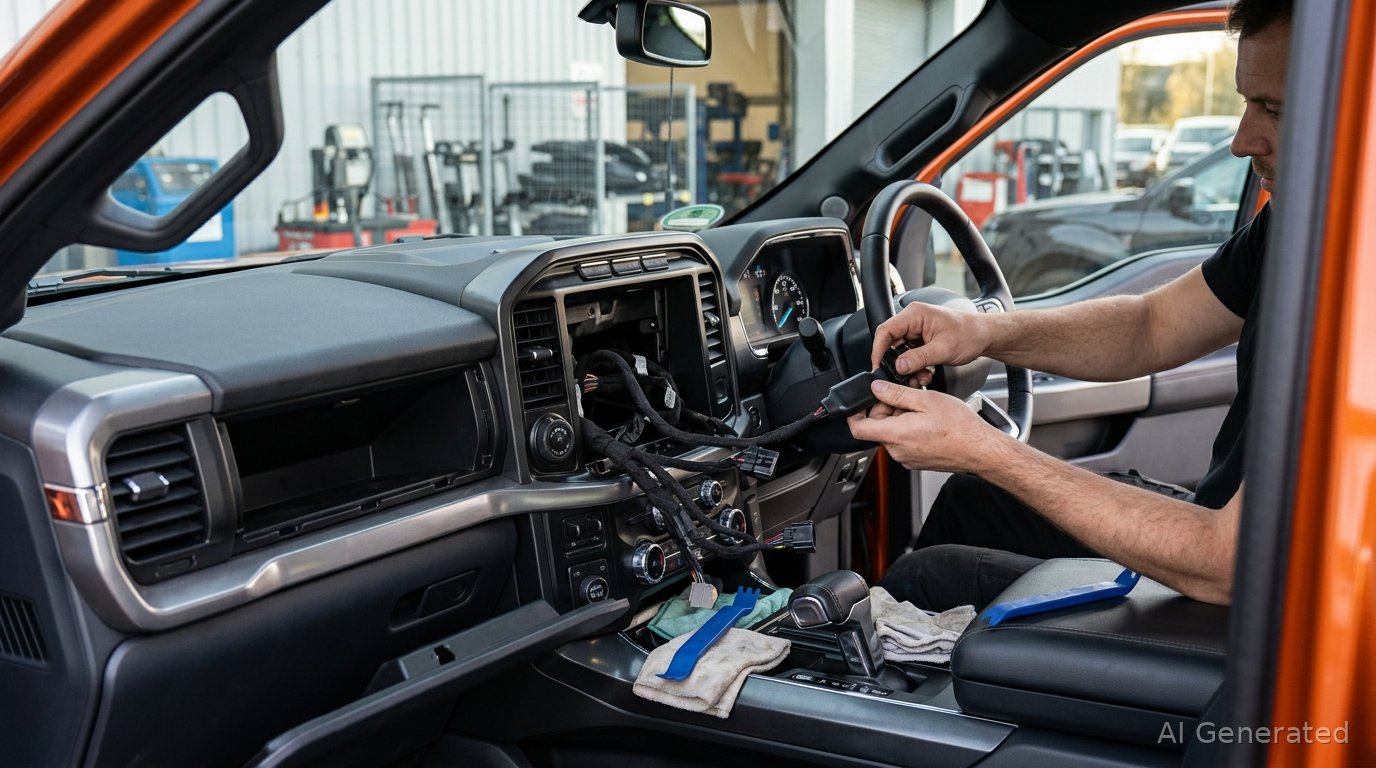
The Ford F-150 vs RAM 1500 mileage blocker comparison doesn’t have a universal winner: fitting depends on the exact truck and access to its wiring, not just the badge. The F-150 connection is described as plug-and-play at the original plug behind the instrument cluster, with no cutting or soldering, but its fitting difficulty is rated expert. That alone doesn’t make it the easier fit.
It’s reasonable to expect cab, bed and drivetrain choices to affect compatibility, particularly across different model years and generations. This guide explains which details matter when assessing fit for work or personal use, and why a vehicle-specific installation needs more than a broad model name. You’ll see how the F-150 and RAM 1500 compare on connector access, configuration and fitting complexity, so you can make a more informed decision about professional fitting for controlled testing or off-road use.
Key Takeaways
- Compare the exact model year and generation, then account for cab, bed and drivetrain when assessing vehicle fit.
- Understand how a mileage blocker differs from mileage correction, and which approach suits controlled testing use.
- Learn why connector access and fitting complexity matter, and what a professional can assess for each truck.
- Use the fitting guide to identify when a vehicle-specific device or professional fitting service is the more suitable next step.
Mileage Blocker vs Mileage Correction: What Is the Difference?
A mileage blocker prevents mileage from being recorded while it is active; mileage correction changes an existing recorded value. A blocker does not alter a vehicle’s stored odometer value. These are different functions, so fitting a blocker does not correct mileage already recorded.
For controlled testing, a blocker can be the more suitable option because it prevents mileage recording without revising the stored figure. Unlike mileage correction, which changes an existing value, a blocker leaves that value untouched. This reduces the risk of inadvertently altering the recorded odometer figure, but neither device is safe for undisclosed or unlawful use. That distinction matters when comparing fitment for the Ford F-150 and RAM 1500: the intended device function is separate from the vehicle-specific connection and installation requirements.
Mileage correction addresses an existing recorded value, while a blocker works during its active use. Neither description alone establishes which truck is easier to fit. That comparison depends on the individual vehicle and its applicable fitting information, rather than whether the device is a blocker or correction tool.
Start by identifying the intended use and checking vehicle-specific fitment information. For controlled testing, tuning or off-road use, consider whether temporarily preventing mileage recording meets the requirement. Addressing an existing recorded value is a separate task. Assess each truck individually: sharing a pickup category does not make their installation requirements interchangeable.
Where does a professional fitter access the mileage blocker wiring connections and instrument-cluster connectors on each truck?
On the Ford F-150, the described connection point is the original plug behind the instrument cluster. The system is plug-and-play, with no cutting or soldering. This identifies the access area, not every trim or model-year variation.
A professional treats the instrument-cluster connector as a vehicle-specific interface. The F-150’s exact model year and generation matter because a model name alone doesn’t establish that every connector layout is identical. Cab and bed descriptions also don’t identify the electrical connection point.
For the RAM 1500, don’t assume the F-150 location applies. A connection point behind the instrument cluster cannot be attributed to the RAM from the truck’s name alone. The model year and generation are key identifiers for distinguishing its wiring layout; cab, bed and drivetrain details help define the vehicle being assessed, but don’t prove connector compatibility.
During a professional assessment, the fitter identifies the truck and matches its wiring interface to the intended device before connecting anything. For an F-150, the verified reference is the original plug behind the instrument cluster. For a RAM 1500, the connection must be established for that specific vehicle rather than inferred from Ford’s plug-and-play description. This distinction avoids treating the two pickups as interchangeable and keeps the fit assessment grounded in vehicle-specific information.
What tools and installation steps does a professional use for each model?
For the Ford F-150, the verified fitting detail is the connection to the original plug behind the instrument cluster. The arrangement is described as plug-and-play, with no cutting or soldering. This gives a professional a specific connection point and method, but it does not establish a universal tool list for every F-150 configuration.
The work described for the F-150 is limited to accessing that original connector and making the plug-and-play connection. No additional vehicle-specific tool or diagnostic procedure can be inferred from those details. The 10/10 expert difficulty rating reinforces that this is specialist work, rather than a basis for inventing steps or equipment.
For the RAM 1500, the F-150 connector and installation method do not apply by default. A professional must use the fitting information for the precise RAM model and generation. Ford’s plug-and-play connection does not establish which RAM connector, tools or fitting sequence are appropriate.
That distinction matters in a comparison: the F-150 has a described connection point, while the RAM requires its own vehicle-specific fitting information. Cab, bed and drivetrain labels cannot supply a tool list or installation sequence. Avoid applying Ford’s method to a RAM, or assuming that shared pickup-truck features mean shared wiring. For either model, the fitting details must match the exact truck and device, with use kept to controlled testing or off-road settings.
How long does professional installation take, and what specialist equipment is required?
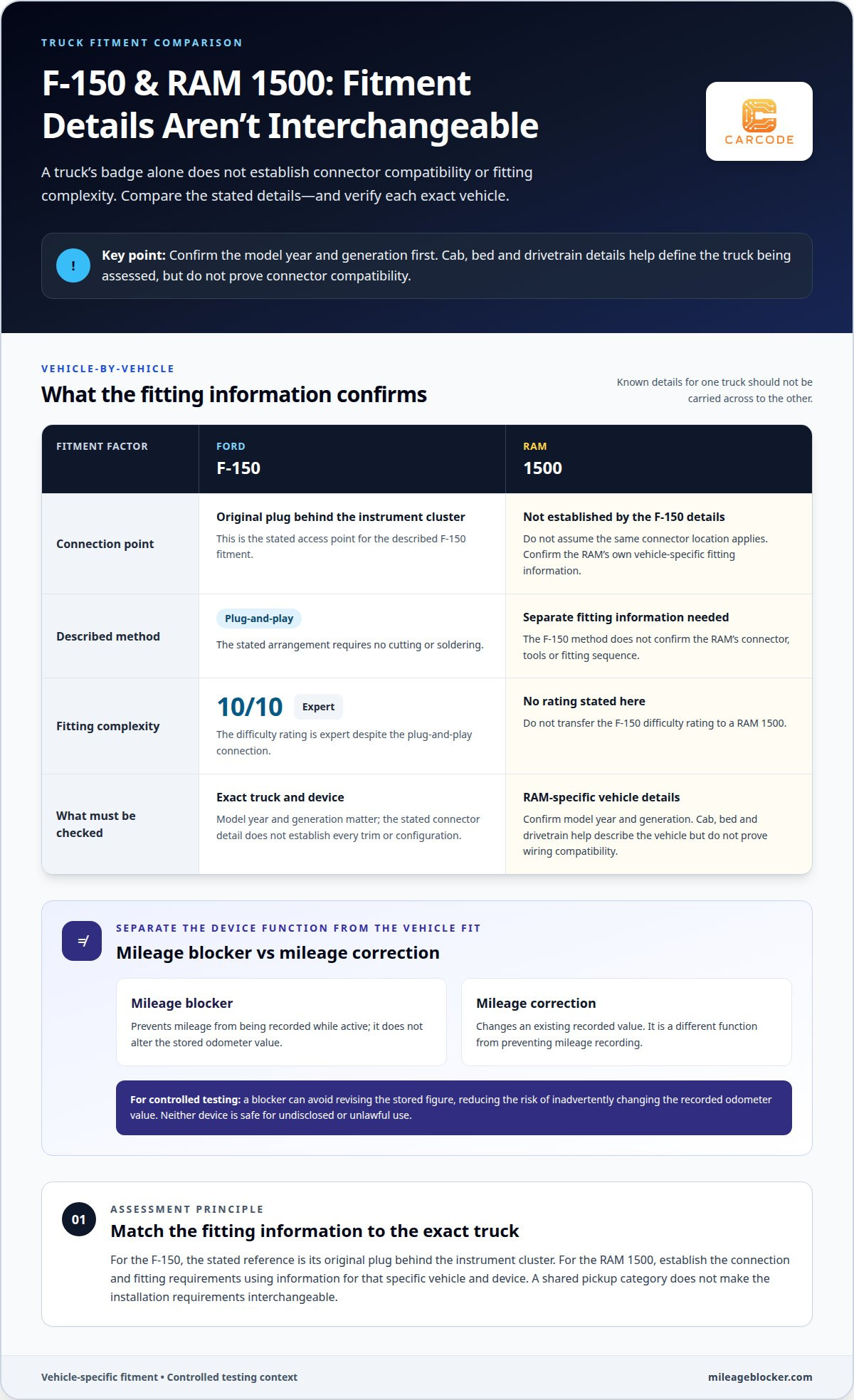
There is no single fitting time that applies to every Ford F-150 and RAM 1500. On the Ford F-150, fitting difficulty is rated 10/10, described as expert. That rating signals a specialist task, not a confirmed installation duration. The time and equipment required have not been confirmed for every vehicle configuration.
For an F-150, the available information identifies the instrument-cluster connection. It does not confirm the installation steps, access requirements or equipment needed. These details should not be assumed and require verified information for the exact vehicle and device.
A RAM 1500 needs its own assessment. The Ford’s difficulty rating and connection details cannot be transferred to the RAM. Its model year and generation should be confirmed before determining the vehicle-specific fitting procedure or estimating the work.
Specific equipment requirements are not confirmed for either model. A professional should establish them using verified information for the exact truck and device, rather than assuming that particular tools or diagnostic equipment are required. No specific duration or specialist equipment should be inferred from the F-150 difficulty rating. The assessment should also establish whether the intended use is controlled testing, based on confirmed details for the vehicle and device.
What risks of wiring damage, fault codes, or effects on vehicle systems should you discuss with a professional fitter?
For a Ford F-150, the connection is at the original plug behind the instrument cluster. The described plug-and-play fit avoids cutting or soldering. Ask how the fitter protects the connector, prevents strain on its pins, and routes the harness clear of moving or trapped trim.
That connection detail doesn’t establish diagnostic behaviour. A fitter shouldn’t promise that an F-150 will show no fault codes, or claim that a code will appear, without vehicle-specific evidence. Discuss how they assess the instrument cluster and record any warning messages present before controlled testing.
For a RAM 1500, don’t transfer the Ford connection method or its claims about wiring. The fitter should identify the truck’s model year and generation, then establish the relevant connector and fitting approach. Ask how the vehicle’s existing warning lights and diagnostic status are documented before work begins.
For either truck, discuss connector integrity, secure harness routing, trim refitting and post-installation checks. Clarify how any warning during testing will be assessed, including how a pre-existing issue is distinguished from a change observed afterwards. These are sensible assessment points, not evidence that a fault or system effect will occur. Use the device only in controlled test environments or off-road settings, not for ordinary public-road driving.
MileageBlocker.com
MileageBlocker.com sells vehicle-specific Mileage Blocker Devices and provides a fitting service for devices it sells. The plug-and-play CAN-bus module is designed to prevent mileage recording while active and is intended for testing, tuning and diagnostics in controlled environments. A vehicle-specific fitment assessment helps determine whether a module is designed for the truck in question.
The Ford F-150 and RAM 1500 should be considered separately. The F-150 fitting information identifies a connection behind the instrument cluster, while RAM fitment needs its own vehicle-specific assessment. Cab, bed and drivetrain details help describe the vehicle, but don’t establish compatibility on their own.
Mileage blockers can also reduce recorded road mileage, avoid lease limits or conceal vehicle use. These uses can misrepresent how far a truck has travelled, so the equipment should not be treated as suitable for ordinary public-road driving. Its stated purpose is controlled vehicle testing or off-road use, not mileage correction.
For model-specific information, the Ford F-150 mileage blocker and RAM 1500 mileage blocker pages provide relevant starting points for assessing the two trucks. The difference in available vehicle-specific information is more useful than assuming one installation method applies to both models. Choose the fitting route according to the exact truck and its intended controlled use.
Frequently Asked Questions
What should you compare first?
Start with the truck’s model year and generation, then identify the exact vehicle-specific device and its supported application. Cab, bed and drivetrain can help distinguish configurations, but they don’t establish compatibility on their own. For example, two F-150s with different generations shouldn’t be treated as equivalent just because both are the same model. Compare the connector and device fitment information for the individual vehicle.
What is a mileage blocker and how does it work in Ford F-150 and RAM 1500?
A mileage blocker is a CAN-bus module designed to prevent mileage recording while active, without changing a stored odometer value. Its operation in either truck depends on the vehicle-specific module and connection. The equipment is designed for off-road, testing, tuning and R&D use. It should not be used to alter the recorded mileage of any vehicle being offered for sale. Carcode Ltd accepts no liability for misuse.
How difficult is it for a professional to install a mileage blocker in a Ford F-150 versus a RAM 1500?
The Ford F-150 fitting difficulty is rated 10/10, described as expert, so it is not a basic installation. That rating does not give a fitting time. A directly comparable RAM 1500 difficulty rating isn’t available here, so the two trucks can’t be ranked reliably by difficulty. A professional’s assessment should distinguish the exact model year and generation, rather than assume the RAM uses the F-150 connection approach.
Article by
Pav Tomaszevicz
Pav Tomaszevicz is Chief Editor at MileageBlocker.com and works closely with the Carcode technical team on content covering vehicle electronics, CAN and CAN-FD systems, mileage blocker compatibility, installation and product development. His articles draw on practical product development, technical support, installation experience and ongoing research into modern vehicle electronics. Content may use AI-assisted drafting and research, but technical information is reviewed against Carcode's product knowledge and real-world experience before publication
About the author
MileageBlocker TeamThe MileageBlocker Technical Team covers vehicle electronics, CAN and CAN-FD systems, mileage blocker compatibility, installation and product developments.
View author profile →