
Engine Hours to Miles Factor: Best Practices and Expert Advice
Learn how to estimate engine hours to miles from idle time, then interpret the result alongside odometer readings, operating conditions and service history.
A vehicle can accumulate engine wear while its odometer barely moves. Engine hours record how long the engine runs, while miles record distance travelled; to estimate idle-time wear, a practical Engine hours to miles calculation uses about 30 equivalent miles for each idle hour. This is an estimate, not mileage added to the odometer.
That distinction matters when assessing a vehicle’s use. A low mileage reading doesn’t show how long the engine has run while stationary, in traffic or powering equipment. Engine-hour data adds useful context, but it isn’t a precise conversion into road miles.
This guide explains what engine hours measure, how to estimate equivalent miles from idle time, and why the result depends on the vehicle’s working conditions. You’ll also see how to interpret engine hours alongside odometer readings and maintenance history, so you can assess vehicle use with a clearer technical picture.
Key Takeaways
- Separate engine running time from distance travelled when assessing a vehicle’s use.
- Use idle-time estimates as context for engine wear, not as miles recorded on the odometer.
- Compare hour-meter readings with mileage and operating conditions to understand the vehicle’s working history.
- Learn how vehicle-specific mileage blocker technology is intended for controlled testing or off-road use.
What are engine hours?
Engine hours record how long a vehicle’s engine has been running, not how far it has travelled. An engine-hour meter or onboard computer counts operating time while the engine is on; the odometer records distance in miles. These readings describe different aspects of vehicle use and cannot be substituted for one another.
Consider two vehicles, each showing 80,000 miles. One may have spent more time idling in traffic or powering equipment while stationary. Its engine hours could therefore indicate more running time, despite matching the other vehicle’s odometer reading. Neither figure alone describes the full pattern of driving or the engine’s condition.
To find a vehicle’s or machine’s engine-hour reading, check the onboard computer or engine-hour meter. Some machines have a dedicated meter. Vehicle data may also include engine hours recorded by the Engine Control Module. The display location and access method depend on the vehicle or machine.
Engine hours should not be assumed to be a standard criterion for UK vehicle inspections or resale valuations. The reading records operating time; by itself, it neither establishes inspection compliance nor determines market value.
Mileage remains useful because it shows distance travelled. Engine hours add operating context, particularly for construction and agricultural vehicles that may run while stationary. For example, a crane can operate with its engine running without adding miles to the odometer. Considering both readings helps describe different aspects of vehicle use.
A conversion from engine hours to miles is an estimate, not a change to recorded mileage. To estimate driving time, divide miles driven by average speed. Treat idle time separately because the vehicle covers no distance while stationary. Before interpreting a discrepancy, compare the readings with the vehicle’s work pattern.
What engine hours measure
Engine hours measure how long an engine has operated, including while idling. They don’t show the load, temperature or how hard the engine worked. A vehicle in slow traffic and a machine powering equipment while stationary can record similar running time despite very different operating conditions.
For monitoring, use engine hours alongside mileage and service records. Engine Control Module data may provide engine hours and distinguish idling from driving, while telematics can report running time and mileage. Together, these records reveal patterns: frequent idling adds operating time without distance, while regular driving adds both.
To use engine hours when assessing wear and remaining life, compare accumulated hours with maintenance records, operating conditions and the vehicle’s service schedule. This can help assess use and plan maintenance, but hours alone cannot establish a precise remaining life. Load, servicing and operating conditions also affect wear.
Engine hours can help inform maintenance timing for engine-related items such as oil, fuel filters and air filters. Mileage provides a different measure for components such as the chassis, suspension and driveline. Use both readings for maintenance planning rather than relying on one formula to represent every component’s condition.
To assess a discrepancy, compare engine-hour readings with odometer mileage, service documents and operating history. A work vehicle with high hours and modest mileage may have spent substantial time idling or powering equipment. That pattern needs context; on its own, it doesn’t prove poor maintenance or a fault. Faulty meters and recording errors can also distort the comparison, so accurate records matter.
Engine-hour monitoring can therefore help prevent maintenance from being based on distance alone. For example, a fleet manager can review running time alongside miles driven and maintenance entries, then identify vehicles whose work involves extended idling. For related questions about vehicle electronics during testing, see the technical FAQs.
Converting engine idle hours into equivalent miles
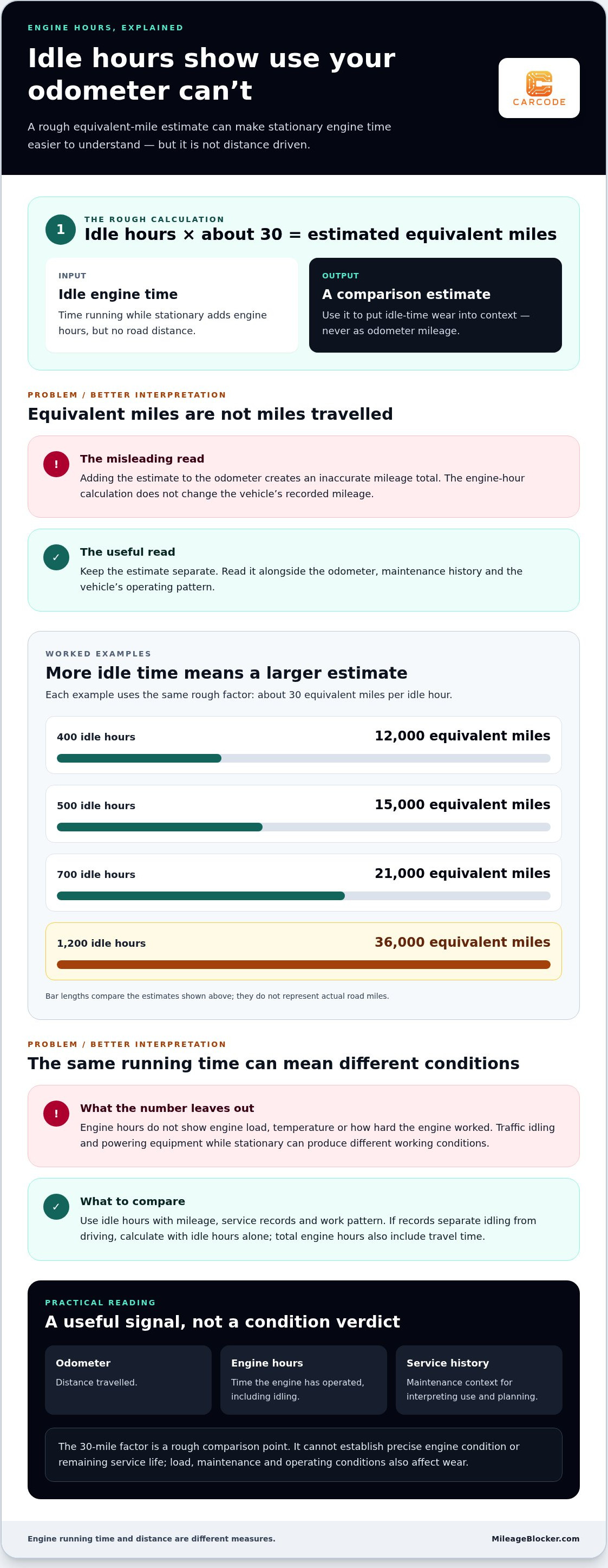
For a rough comparison, multiply idle hours by 30 miles per hour. This estimates equivalent operating wear; it does not represent miles driven or alter the odometer reading. The calculation is useful for understanding engine use, not for replacing recorded mileage.
Formula: idle hours × 30 = estimated equivalent miles. For example, 400 idle hours × 30 gives 12,000 equivalent miles. The same method gives 15,000 equivalent miles for 500 idle hours, and 21,000 for 700. These figures express an estimate, not a measured distance.
How do idle hours affect an engine-hours-to-miles estimate? They add engine running time without adding road distance, so the 30-mile-per-hour factor provides a rough way to compare idling with driving. It’s an estimate of equivalent wear, not a direct conversion of stationary time into actual mileage.
For a vehicle with 1,200 idle hours, the estimate is 36,000 equivalent miles. Keep this figure separate from the odometer reading. Combining the two as though both were miles actually driven would create an inaccurate mileage total and could misrepresent the vehicle’s history.
The 30-mile factor is a consistent comparison point, but it cannot describe every engine’s condition. Load, maintenance, engine design and the pattern of use all affect wear. A truck idling to power equipment, for example, has a different operating context from a vehicle waiting in traffic. The factor does not measure those differences.
Fleet managers can use the calculation to flag vehicles for closer review. Compare the estimate with service records, fuel use and the vehicle’s work pattern. If records separate idling from driving, calculate using idle hours alone; total engine hours also include travel time and could overstate idle-related wear.
Use the result as one part of an assessment, alongside the odometer and maintenance history. A calculated equivalent cannot establish the vehicle’s precise condition or remaining service life. Its practical value is making stationary engine use visible, which mileage alone cannot show.
What is the average miles per engine hour?
There’s no single average that applies to every vehicle. For a distance-based estimate, use the vehicle’s average driving speed in miles per hour. At an average of 30 mph, one hour of driving corresponds to about 30 miles. This is a calculation based on speed, not a universal engine-wear rating.
The formula is straightforward: miles driven ÷ average speed in mph = driving hours. Reverse it to estimate distance: engine hours spent driving × average speed in mph = miles. For example, 100,000 miles at an average of 30 mph represents about 3,333 driving hours. At the same average speed, 50,000 miles represents about 1,700 hours, while 200,000 miles represents approximately 6,700 hours.
These examples help compare distance with running time, but the assumed speed changes the result. A vehicle averaging 50 mph covers more distance per driving hour than one averaging 30 mph. The calculation should therefore use an average that reflects the vehicle’s actual routes and operating pattern, rather than applying one figure to every vehicle.
Treat idle time separately. During an hour of idling, the engine runs but the vehicle covers no road distance. Adding that hour to driving hours and multiplying by average road speed would overstate miles driven. If records distinguish idling from driving, use driving hours for the distance estimate and assess idle time separately as an indicator of engine use.
For fleet comparisons, apply the same method to each vehicle and record the chosen average speed. For example, a fleet manager comparing two vehicles should avoid using 30 mph for one and 50 mph for the other unless their routes justify the difference. Consistent assumptions make the calculation easier to interpret, while route data and odometer readings provide the necessary context.
Treat calculated miles as an estimate, not a replacement odometer reading. Engine-hour totals include operating time, while mileage records distance. Keeping the measures distinct prevents estimated driving distance from being mistaken for verified miles travelled.
MileageBlocker.com: Mileage Blocker Device
MileageBlocker.com offers a Mileage Blocker Device for the stated testing applications. Designed for off-road, motorsport, dyno testing and vehicle development use. It should not be used to alter the recorded mileage of any vehicle being offered for sale.
The device is designed, manufactured and supported by Carcode Ltd - no middlemen, no white-labelling, no compromises. MileageBlocker.com also offers a Mileage Blocker Fitting Service for customers who want fitting assistance.
Make the next assessment more informed
Use your engine-hour estimate to improve vehicle-use records. Note the source of each reading, whether recorded hours include idling, and keep supporting service and operating records. This gives future assessments a stronger basis without presenting estimates as verified distance.
An estimate is only useful if its assumptions match the vehicle’s use. If the operating pattern changes, for example from regular journeys to prolonged stationary work, interpret the figures accordingly. Record driving and idle time separately where possible to make later comparisons more meaningful.
For vehicle-specific information about mileage-recording technology and its intended applications, consult the relevant technical guidance rather than treating an estimate as a product specification. Explore the FAQs and send MileageBlocker.com your questions to identify information relevant to your situation. A careful next step helps keep your assessment practical and your records clear.
Frequently Asked Questions
How many idle hours equal a mile?
Using the rough estimate of 30 equivalent miles per idle hour, one estimated mile represents about 0.033 idle hours. This is a comparison of estimated engine wear, not distance travelled while stationary. For example, a vehicle idling for half an hour has an estimated 15 equivalent miles, but its odometer still records no miles from that idle period.
How do you convert engine hours to miles?
For driving time, multiply engine hours spent driving by the vehicle’s average speed in miles per hour. For idle-related wear, use idle hours multiplied by the estimate of 30 equivalent miles per hour. Keep the two calculations separate: applying a road speed to hours that include idling would produce an inaccurate estimate of distance driven.
What engine-hours-to-miles conversion factor is used for cars, trucks and machinery?
A rough idle-wear comparison uses 30 equivalent miles per idle hour, but this is not a universal engineering factor for every car, truck or machine. Vehicle design, engine load and working conditions affect wear. A stationary agricultural machine, for example, may be powering equipment, while a car in a queue is simply idling. Treat the factor as a comparison aid, not a specification.
How do you calculate engine hours into miles with an example?
For an idle-time estimate, multiply idle hours by 30. For example, 1,000 idle hours multiplied by 30 gives 30,000 equivalent miles of estimated wear. Label that result clearly as an estimate. It is not an odometer reading and should not be added to verified miles when reporting the vehicle’s actual distance travelled.
Are engine hours more accurate than mileage for assessing vehicle use?
Neither measure is more accurate for every purpose. An odometer records distance; engine hours show operating time. For a vehicle that spends much of its working time stationary, hours may better describe engine use. For one mainly used for journeys, mileage is more direct evidence of distance. Compare both readings with the vehicle’s work pattern.
What are the limitations of estimating mileage from engine hours?
An estimate cannot reveal exact distance, engine load or the conditions behind each recorded hour. A faulty hour meter, inaccurate records, or a reading that combines driving and idling can distort the result. Even identical idle-hour totals may reflect different work: one engine may run unloaded while another powers equipment. Use the estimate alongside service and usage records.
About the author
MileageBlocker TeamThe MileageBlocker Technical Team covers vehicle electronics, CAN and CAN-FD systems, mileage blocker compatibility, installation and product developments.
View author profile →