
BMW Mileage Blocker Guide: Compatible Chassis List
Read our BMW mileage blocker guide: supported models by chassis. Check verified compatibility across 4, 5, 7 and 8 Series F and G models before fitting.

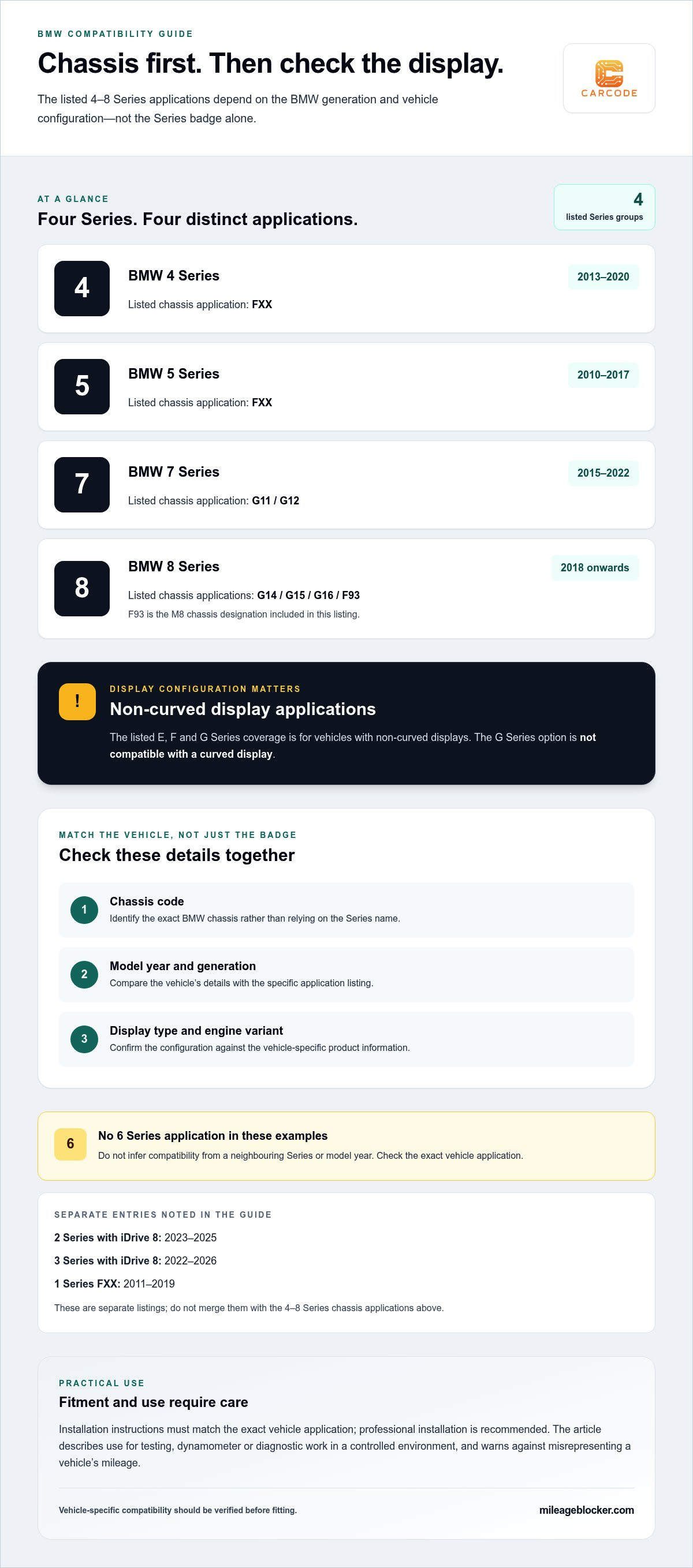
The chassis code, not the Series badge alone, is the useful starting point for BMW mileage blocker compatibility. This BMW mileage blocker guide to supported models by chassis covers the 4 Series FXX (2013-2020), 5 Series FXX (2010-2017), 7 Series G11/G12 (2015-2022) and 8 Series G14/G15/G16/F93 (2018 onwards).
It’s easy to assume that two BMWs with the same model name use the same electronics. In practice, generation and display type can affect compatibility. The listed options cover E, F and G Series vehicles with non-curved displays; the G Series option is not compatible with a curved display.
Here, you’ll find the relevant chassis coverage for BMW 4 to 8 Series models, along with the practical points to understand before fitting a device. The guide also explains what installation and removal involve, and why compatibility should be considered by generation rather than assumed from the badge or model name alone.
Key Takeaways
- Use the BMW’s chassis code and display type to narrow down which mileage blocker application may fit.
- Compare the listed 4 to 8 Series generations and model years rather than relying on the Series badge alone.
- Understand what plug-and-play fitting and later removal involve before deciding how the device should be installed.
- For vehicle-specific product options or fitting support, explore MileageBlocker.com’s Mileage Blocker Device and Mileage Blocker Fitting Service.
BMW 4 Series, 5 Series, 6 Series, 7 Series and 8 Series compatibility
BMW mileage blocker compatibility is organised by chassis, not simply by Series badge. The listed applications include the 4 Series FXX for 2013-2020 and the 5 Series FXX for 2010-2017. These model-year ranges identify specific applications, not every BMW vehicle carrying those names.
For the 7 Series, the listed G11/G12 application covers 2015-2022. The 8 Series G14, G15, G16 and F93 application is shown for vehicles from 2018 onwards. The F93 is the M8 chassis designation included in that 8 Series listing. These distinctions matter because a chassis code narrows the application more precisely than a model badge.
No 6 Series chassis application appears among those specific 4 to 8 Series examples. Don’t infer compatibility from another Series or a neighbouring model year. Use the vehicle’s chassis code as the first identifier, then compare its generation and display type against the relevant application.
The same chassis-led approach applies across other BMW series. Compatibility listings include applications across several BMW series, but these should be checked against the exact vehicle. Separate entries also identify 2 Series and 3 Series models with iDrive 8, covering 2023-2025 and 2022-2026 respectively. Those entries should not be merged with the other chassis applications.
F Series and G Series vehicles are included in the broader compatibility range for vehicles with non-curved displays. The G Series application is not compatible with vehicles featuring a curved display. Some BMW i Series applications are listed separately, so confirm the exact model and display configuration before treating a series-level match as applicable. Match the exact model, chassis and display configuration before treating a series-level match as applicable.
The 1 Series FXX is listed for 2011 - 2019. The page advises against using a mileage blocker to alter, conceal or misrepresent a vehicle's real mileage on public roads or during a sale.
BMW mileage blocker compatibility by chassis
BMW compatibility depends on the specific vehicle application. Compare the vehicle’s identifying details with the device listing before choosing a product, particularly when a model name spans several generations or configurations.
Model Year and Engine Compatibility
BMW mileage blocker products are offered by MileageBlocker.com and other specialist manufacturers. The product’s stated vehicle application is the deciding reference, not the manufacturer name alone. Listings describe compatibility by vehicle details, and some broad descriptions refer to most BMW vehicles from 2007/2008 onwards, subject to confirming the model and year. Treat that as a starting point, not proof that every engine variant fits.
For a UK total including installation, the exact amount depends on the vehicle application and whether fitting is included. Product pricing is not disclosed on the website, so there is no single installation-inclusive figure for all BMW models. Consider the device and fitting separately when weighing up the overall choice.
Chassis Code Verification
Start with the BMW’s exact model designation and chassis code from its vehicle documentation or identification records. Compare these details, the model year and the engine variant with the product application. Do not rely on registration year alone if the vehicle’s production details or generation differ. The listing needs to match the actual vehicle, not an approximate model description.
Display configuration can also matter for BMW applications. Use vehicle-specific product information to resolve that distinction before choosing. The BMW curved-screen application information gives relevant context when the vehicle has that display format. Keep the vehicle details together when reviewing an application, so the chassis, year and configuration are considered as one match rather than separate assumptions.
Installation and reversibility
BMW installation depends on the vehicle-specific device, so the instructions must match the exact chassis. Some devices use plug-and-play connections that require no cable cutting or soldering, and fitting instructions are included. Professional installation is recommended. This ensures the process follows the correct application instead of relying on assumptions based on a shared BMW model name.
Before fitting, compare the BMW’s chassis and display configuration with the device application. Follow the supplied instructions in sequence, and avoid adapting connection details from another generation. A BMW 3 Series F30, for example, should not be treated as identical to another 3 Series solely because both carry the same badge. Vehicle electronics can vary between generations.
The device can be unplugged, and removing it does not make the displayed mileage jump upwards. However, that does not mean every installation or vehicle interaction is consequence-free. Keep vehicle records accurate, and use mileage-blocking devices only for testing, dynamometer or diagnostic work in a controlled environment. Do not use one to misrepresent a vehicle’s mileage.
There are also practical considerations around programming. A forum participant reported that an F30 repeatedly failed an EGS flash at 0%, then completed successfully after the device was removed. This is a reported example, not evidence that every BMW will behave the same way. It does show why programming work should be considered before fitting or leaving a device connected.
The risks of installing a mileage blocker on a BMW include incorrect fitment and possible interference during diagnostic or control-unit programming work. The reported F30 EGS flash failure illustrates a specific case; it should not be assumed to apply to every chassis.
For controlled testing, clarify the intended use before installation, follow the instructions for the exact device and use professional fitting where recommended. If BMW programming or diagnostics are planned, account for the device as part of that work. Removing it is not a substitute for correct installation.
Which BMW model years and engine variants are compatible with each mileage blocker?
BMW applications are identified by chassis and model year. Engine variant is another useful identifier, but a shared engine designation alone does not establish compatibility. Match the full vehicle application rather than choosing by Series badge or engine family.
These model-year examples show how specific the listings can be:
- The BMW E Series application covers 2003-2011.
- The X1 F48 listing covers 2015-2020, while the X3 G01 covers 2017-2025.
- The X4 G02 covers 2018-2024; the X5 G05 is listed from 2018 onwards.
- The X6 G06 and X7 G07 are listed from 2019 onwards.
- The Z4 G29 is listed from 2018 onwards, and the i8 I12 Coupé covers 2013-2020.
- The M2 F87 listing covers 2015-2022.
These ranges apply to their named chassis applications. They do not establish one year range for every BMW with a related engine. Facelifts and drivetrain variants can occur within the same model line, so compare the application against the vehicle’s exact details.
For example, an X3 G01 from within its listed years is not interchangeable by assumption with an X4 G02. Their model-year ranges overlap, but the chassis codes differ. Likewise, an X5 G05 and X7 G07 share a start year in their listings, yet remain separate vehicle applications. The model year narrows the match; it doesn’t replace the chassis code.
Use this sequence: identify the BMW model, find its chassis code, compare its model year with the matching application, then include the engine variant in the vehicle details. Do not assume compatibility based on a similar engine, another model line or a different generation. The key distinction is between a broad range and a vehicle-specific match. For BMW testing, the device application must match the vehicle, not just its engine family.
MileageBlocker.com: Mileage Blocker Device
MileageBlocker.com offers a vehicle-specific Mileage Blocker Device for controlled automotive work. It is designed for off-road, testing, tuning and R&D use. It should not be used to alter the recorded mileage of any vehicle being offered for sale. The device is designed, manufactured and supported by Carcode Ltd - no middlemen, no white-labelling, no compromises.
If you need installation assistance, the Mileage Blocker Fitting Service is the practical next step. Use the vehicle-specific application and follow its fitting instructions. Carcode Ltd accepts no liability for misuse. For questions about the device or fitting, visit MileageBlocker.com or contact the team.
Plan the Next Step for Your BMW
Treat a mileage-blocking device as part of a defined technical task, and make responsibility for its use clear before work begins. The device is designed for off-road, testing, tuning and R&D use. It should not be used to alter the recorded mileage of any vehicle being offered for sale. Carcode Ltd accepts no liability for misuse.
Use the BMW Mileage Blocker Guide: Supported Models by Chassis as a reference when considering a vehicle-specific option. Next, review the intended application and fitting support, then choose the right route for your project.
For further guidance, visit the MileageBlocker.com FAQs. Make your decision with the intended use clearly defined and proceed with care.
Frequently Asked Questions
What Are BMW Mileage Blockers?
BMW mileage blockers are electronic devices designed to pause odometer recording during controlled vehicle work. They are intended for testing, tuning, diagnostics and dynamometer use, not mileage correction. For example, a workshop may use one during a stationary test where recorded distance would not reflect ordinary road use. It should not be used to alter the recorded mileage of any vehicle being offered for sale.
What BMW models do you cover?
Listed applications span BMW cars, SUVs and electric models, but each entry relates to a particular chassis and configuration. Examples include the 4 Series FXX, 7 Series G11/G12, X3 G01, X5 G05, i3 I01 and i8 I12 Coupé. Treat these as examples rather than a blanket statement covering every trim. Compare the exact model designation and vehicle details with the relevant application.
Which BMW chassis models are supported by mileage blockers?
Listed chassis include 4 Series FXX, 5 Series FXX, 8 Series G14/G15/G16/F93 and 7 Series G11/G12. Other examples include X1 F48, X4 G02 and Z4 G29. E, F and G Series applications are listed for non-curved displays; the G Series application excludes curved displays. Use the chassis code, model year and display type together, since a matching series name alone isn’t enough.
How are mileage blockers installed and removed on BMW vehicles?
Installation depends on the specific BMW application and the device instructions. Some solutions are plug-and-play, but do not assume the fitting method is the same across generations. Professional fitting is recommended. Removing the device does not make the displayed mileage jump upwards or change the vehicle’s mileage history. Keep accurate records of testing and device use, and account for scheduled diagnostics or programming when planning installation or removal.
About the author
MileageBlocker TeamThe MileageBlocker Technical Team covers vehicle electronics, CAN and CAN-FD systems, mileage blocker compatibility, installation and product developments.
View author profile →