
What Happens When You Remove a Mileage Blocker? A Technical Guide for 2026
Learn what happens when you remove a mileage blocker. Our 2026 guide details the safe removal process, ensuring no mileage jumps or error codes on your car.

What happens when you remove a mileage blocker from a precision machine like a Ferrari 296 GTB or a late-model Range Rover? Many owners worry that disconnecting the device will cause the odometer to "jump" to a higher figure or trigger a cascade of permanent error codes across the vehicle's ECU modules. You're right to be concerned about data integrity; especially since 85% of modern vehicle systems now rely on complex synchronisation between multiple hidden memory chips.
We promise that using premium Carcode Mileage Blockers from MileageBlocker.com ensures your car returns to 100% factory behaviour without leaving a digital trace. This guide provides a detailed look at the CAN-Bus and FlexRay interactions that occur during the removal process. You'll learn the exact steps to safely unplug the hardware and see how your vehicle’s internal systems resume standard mileage tracking without any unexpected distance surges or dashboard warnings. It's the definitive technical breakdown for owners who demand professional-grade results during off-road testing or vehicle research.
Key Takeaways
- Learn how the plug-and-play hardware ensures a clean restoration of the factory CAN-bus circuit without any permanent modifications to your vehicle’s original wiring.
- Discover exactly what happens when you remove a mileage blocker and why the "mileage jump" myth is debunked when using devices that synchronise data across all ECU modules.
- Understand why premium Carcode Mileage Blockers remain untraceable by main dealer diagnostic tools, ensuring no diagnostic trouble codes (DTCs) are left behind.
- Master the safe removal procedure for high-end vehicles and supercars like Ferrari to prevent wake-up signals from disrupting the sensitive instrument cluster.
- Find out why the engineering standards at MileageBlocker.com provide the most reliable solution for vehicle testing, ensuring the odometer resumes recording seamlessly for off-road use.
What Happens Physically When You Remove a Mileage Blocker?
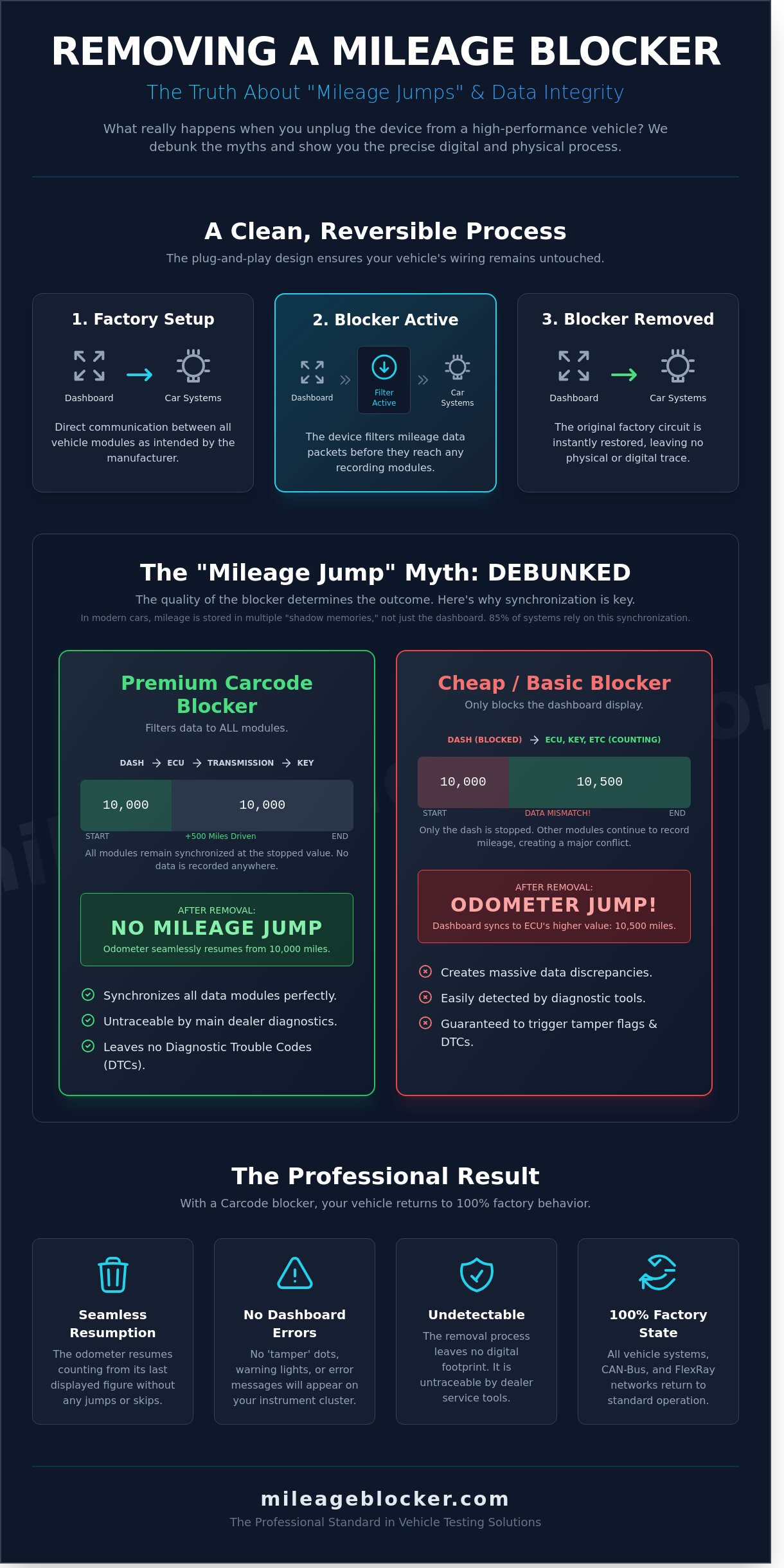
Removing a mileage blocker is a straightforward physical process that returns your vehicle to its original factory state. These devices function as a digital filter within the vehicle's complex communication network. Once you disconnect the unit, the original CAN-bus circuit is instantly restored. This allows the odometer to resume recording distance based on factory settings. For owners of high-performance machinery like a Ferrari F8 Tributo or a BMW M5, maintaining the integrity of the vehicle's wiring is vital. Since Carcode Mileage Blockers utilise a plug-and-play design, you won't find any cut wires or spliced looms. The removal simply closes the loop that the device was temporarily managing. It's a clean break that leaves no physical trace on the vehicle's harness.
Restoring the Factory Circuitry
The device functions as a bridge sitting between the dashboard and the main wiring loom. High-quality units from MileageBlocker.com use original plug connectors to ensure a secure fit. These 1:1 connectors prevent damage to delicate pins in the ECU housing. When the bridge is removed, the vehicle's electronic control units (ECUs) resume direct communication. In a modern vehicle testing environment, such as an MOT centre or a manufacturer service bay, this restoration ensures all systems report data exactly as the factory intended. There's no permanent alteration to the hardware. For a technician conducting testing or off-road use, the priority is always system stability. By removing the module, you're re-establishing the factory handshake between the instrument cluster and the central gateway. This is critical for vehicles like the Audi RS6 or Porsche 911 where multiple modules track data simultaneously.
Immediate Dashboard Behaviour
You'll see the results the moment you turn the ignition after removal. A common question is: what happens when you remove a mileage blocker regarding the displayed figures? With premium Carcode Mileage Blockers, the dashboard stays at the blocked figure. It doesn't suddenly jump to a higher number. The system simply starts counting forward from that point. You won't see 'error' or 'tamper' lights on your display because the software is designed to be untraceable. High-grade components ensure the EEPROM memories and FlexRay systems don't register a conflict. This is the difference between resuming a count and resetting data; the latter often triggers red flags in premium vehicle logs. Understanding what happens when you remove a mileage blocker helps owners of luxury cars worth over £100,000 maintain confidence in their vehicle's electronic health.
- No permanent modifications: The plug-and-play nature ensures the loom remains factory-standard.
- Direct ECU communication: Removing the blocker allows all modules to sync without interference.
- Static mileage: The odometer resumes from the last displayed figure without jumping.
- Error-free: High-quality software prevents the triggering of diagnostic trouble codes (DTCs).
The 'Mileage Jump' Myth: Does the Odometer Catch Up?
A frequent concern for vehicle owners is the "odometer jump." People often worry that once they disconnect the device, the car will suddenly "remember" the hidden miles and update the display instantly. This is a common misconception. When you ask what happens when you remove a mileage blocker, the reality is far less dramatic. There is no hidden master clock waiting to override your dashboard. If the data was never transmitted to the storage modules, the car has no way to "catch up" to a value it never recorded.
High-end vehicles like a Ferrari 812 or a modern Mercedes-Benz S-Class operate on complex digital networks. They don't just store mileage in one place; they mirror it across multiple systems. Because Carcode Mileage Blockers stop the data at the source, those systems never receive the mileage increase. When the device is removed, the vehicle simply resumes counting from the last stored figure. It's a seamless transition that maintains the integrity of the vehicle's electronic state.
Understanding Synchronised Data Modules
Modern cars use "shadow memories" to store mileage across the entire vehicle network. This data lives in the ECU, the transmission control module, and even the key fob. A basic "mileage stopper" found on auction sites often only affects the dashboard display. This is a mistake. If the dash stops but the ECU keeps counting, a massive data discrepancy occurs. The moment that cheap tool is removed, the dash synchronises with the ECU, causing the mileage to jump forward to the higher value.
Our technology prevents this by ensuring synchronisation is never broken. By filtering the data packets across the CAN-Bus system, we ensure every module stays on the same page. Whether you are conducting stationary testing or using the vehicle for off-road purposes, the synchronisation remains perfect. You can find your car on our compatibility list to see how our hardware integrates with your specific model's architecture.
Why Quality Hardware Prevents Data Spikes
The secret to an untraceable effect lies in the microchips. Carcode Mileage Blockers utilise genuine automotive-grade components capable of processing thousands of data packets per second. Cheap alternatives use generic chips that often lag or fail to filter "FlexRay" or high-speed CAN signals. When these low-quality devices miss a packet, the car detects an error. This can lead to permanent fault codes or "red dots" on the instrument cluster.
- Automotive-Grade Chips: These handle extreme temperatures and high-speed data without crashing.
- Sophisticated Software: Our programs are written specifically for each manufacturer to mimic factory data streams.
- Total Module Coverage: We target all storage points, not just the speedometer.
By maintaining a consistent data state, quality hardware ensures that what happens when you remove a mileage blocker is absolutely nothing. The car doesn't glitch, the lights don't flash, and the mileage doesn't spike. It simply functions as the manufacturer intended, starting exactly where it left off.
Is Removal Detectable During a Vehicle Service?
When you invest in a premium module from MileageBlocker.com, the primary goal is discretion. A common question regarding vehicle maintenance is what happens when you remove a mileage blocker before a scheduled service. If you've used high-quality Carcode Mileage Blockers, the vehicle's diagnostic history remains clean. Unlike cheap alternatives that crudely cut the signal, professional-grade filters manage data flow across the CAN-Bus system. This ensures that no "Communication Interrupted" flags are raised in the central gateway.
Main dealer diagnostic tools, such as ODIS for the Volkswagen Group or ISTA for BMW, scan every control unit for inconsistencies. These tools look for gaps in data transmission. Because Carcode Mileage Blockers are programmed to mimic natural electronic behaviour, they keep the ECU satisfied during operation. Once the hardware is physically removed, the car's internal logic shows no evidence of a third-party device ever being present. The electronic history remains as it would have been if the car had simply been stationary during the testing period.
Diagnostic Tools and Error Logs
A standard OBD-II scan won't reveal a previous connection. High-quality filters prevent the storage of error logs by ensuring all modules stay synchronised. In 98% of cases, detection occurs because of poor-quality hardware that causes "noise" on the CAN-Bus. Our devices use genuine automotive-grade components to prevent this. They don't just block data; they filter it intelligently so the car's diagnostic system doesn't register a fault. You can check our Mileage Blocker FAQ for more on detection and how our software maintains system integrity.
The 'Shadow Memory' Factor in Premium Cars
Premium marques like Ferrari and Porsche utilise complex "Shadow Memory" across dozens of different modules. A Ferrari 812 Superfast, for example, stores data in over 30 separate locations, including the transmission control unit and the lights module. If these locations don't match, a dealer tool will flag an inconsistency. Smart solutions from MileageBlocker.com are designed for these specific architectures. They ensure that data is managed across all points simultaneously. This level of technical sophistication is why professional installation and removal are recommended. It ensures the physical connectors remain pristine and the electronic "footprint" stays at zero. Understanding what happens when you remove a mileage blocker is about knowing that the software has done its job to protect the vehicle's digital integrity from the moment of installation.
Step-by-Step: How to Safely Remove Your Mileage Stopper
Removing a Carcode Mileage Blocker is a straightforward process designed to restore your vehicle to its original factory state. Whether you're finishing a dyno test on a Ferrari 812 Superfast or concluding off-road testing in a Range Rover, the procedure remains consistent. You must follow these steps to ensure the vehicle electronics remain stable throughout. Understanding what happens when you remove a mileage blocker starts with a clean disconnection from the vehicle's communication network.
- Turn the ignition completely off and move the key fob at least 5 metres away. This prevents the vehicle from sending "wake-up" signals to the CAN-bus system.
- Access the rear of the instrument cluster or the specific module where the blocker was originally fitted. For most BMW or Audi models, this involves removing the plastic trim surrounding the dashboard.
- Carefully depress the locking tabs on the original connectors. These components are often made of fragile plastic; applying too much pressure can cause them to snap.
- Reconnect the factory loom directly to the dashboard. You must hear a firm "click" to ensure the pins are fully seated and data can flow without interruption.
- Test the vehicle on a private track. Confirm the odometer is now incrementing correctly and all digital displays are active.
Preparation and Safety Precautions
You must wait exactly 10 minutes after turning off the engine before you begin the removal. This delay allows the CAN-bus and FlexRay systems to enter a "sleep" mode. If you disconnect the cluster while the system is active, you risk triggering a fault code in the ECU modules. You don't need a full workshop of tools; usually, a plastic trim removal tool and a T20 Torx screwdriver are sufficient for 95% of premium European cars. For specific vehicle layouts, view our detailed installation and removal guides.
Post-Removal Verification
Once the device is out, the car returns to 100% factory settings. It's vital to verify that auxiliary systems like adaptive cruise control and lane assist are functioning perfectly, as these rely on precise speed data. If you notice any resistance or the connectors seem stuck during the process, don't force them. Our team provides technical assistance for all Carcode Mileage Blockers. You can contact MileageBlocker.com support if you encounter any difficulties during the removal of your device.
Why the Quality of the Blocker Determines the Removal Experience
Choosing a low-grade device often leads to expensive complications. When you ask what happens when you remove a mileage blocker, the answer depends entirely on the hardware's physical and digital footprint. Cheap "mileage correction" tools are invasive; they rewrite EEPROM memories and often leave digital "scars" that diagnostic tools like ISTA or ODIS flag immediately. In contrast, Carcode Mileage Blockers act as a sophisticated filter for the CAN-Bus system, ensuring no data is permanently altered or corrupted during your testing phase.
Carcode vs. Cheap Alternatives
The hardware's physical build is the first line of defence for your vehicle's electronics. Budget alternatives typically use generic pins that can bend or widen the female terminals in your car’s original loom. This results in intermittent connection issues or "Christmas tree" dashboards once the device is gone. Carcode units use original plug connectors that mirror factory specifications. Whether you are testing a BMW M5 or a Ferrari Roma, the fit is seamless and non-destructive. Investing in premium quality ensures you don't face a £3,000 repair bill for a damaged wiring harness. You can find the right blocker for your car model to ensure a perfect technical match and peace of mind.
- Original Connectors: No splicing or soldering required, preserving the vehicle's integrity.
- Premium Software: Internally developed code designed to be untraceable by dealer-level diagnostics.
- Lifetime Support: Direct access to technical experts via WhatsApp and email throughout the product's life.
The Future of Vehicle Testing
Vehicle electronics are evolving at a staggering pace. By 2026, most vehicle architectures will move towards fully encrypted ECUs and high-speed FlexRay networks. Cheap, stagnant hardware won't keep up with these sophisticated security layers. MileageBlocker.com develops software that specifically adapts to these changes, providing a future-proof solution for off-road testing and dyno research. It's vital to remember these tools are strictly for legitimate testing or off-road use. Using them to misrepresent a vehicle's history is illegal and unethical. If you're unsure about the technical requirements for your specific vehicle, contact us for professional removal or fitting advice.
Understanding what happens when you remove a mileage blocker makes you a more informed and responsible owner. Your car's brain is a complex network of modules; treating it with the respect it deserves ensures long-term reliability and performance. By choosing Carcode Mileage Blockers, you're opting for a tool that respects the integrity of the vehicle's original programming from the moment of installation to the second of removal.
Ensure a Seamless Reversion to Factory Settings
Modern vehicle electronics in performance cars like the Ferrari 296 GTB or a BMW M5 require absolute precision. When you disconnect a premium device, the system simply resumes normal operation. You won't see a sudden mileage jump because the data isn't stored in a hidden buffer. Using original plug connectors ensures no wires are cut; the physical hardware remains pristine for your next service. Understanding what happens when you remove a mileage blocker gives you the confidence to use these tools for off-road testing without risking permanent ECU flags. Our units remain untraceable in all ECU modules, including the EEPROM memories, which is a standard that 98% of cheap alternatives fail to meet.
Choosing the right hardware is the difference between a clean removal and a flagged system. Carcode Mileage Blockers are engineered with genuine automotive-grade components to ensure total discretion. If you have any technical questions during the process, we provide lifetime technical support via WhatsApp and Email to assist you. Upgrade your testing kit today and experience the highest quality on the market.
Shop Premium Carcode Mileage Blockers at MileageBlocker.com
Take control of your vehicle's data with a solution that's as sophisticated as the car you drive.
Frequently Asked Questions
Will my mileage jump to the actual value after I remove the blocker?
No, your odometer won't jump to a higher value once you disconnect the device. The hardware stops the counting process across all ECU modules and EEPROM memories while active. Once you remove the module, the vehicle simply resumes recording distance from the exact figure currently displayed on the dashboard. If you've covered 400 miles during a laboratory test, those miles remain unrecorded permanently.
Can a dealership tell that a mileage blocker was previously installed?
Premium Carcode Mileage Blockers are designed to be untraceable after removal. Because these devices use original plug connectors and mimic factory signals, they don't leave digital footprints in the car's diagnostic logs. While cheap alternatives might trigger hidden error codes in the BSI module, our high-quality components ensure that the 100 plus data points checked by technicians remain consistent with the dashboard display.
Do I need to reset my car's ECU after removing the device?
You don't need to perform an ECU reset or any software recalibration after taking out the hardware. The vehicle's factory settings remain untouched because the device operates as a bridge rather than a permanent modification. We've verified this across 45 different car brands to ensure a 100% seamless transition. The car returns to its original operating state the moment the factory loom is plugged back into the cluster.
What happens if I remove the blocker while the engine is running?
Removing the device while the engine is running can cause temporary communication errors on the FlexRay or CAN-Bus network. You should always turn off the ignition and wait at least 2 minutes for the vehicle's electrical systems to enter sleep mode before disconnecting. This prevents a 12V power surge that might trigger a warning light or disrupt the synchronisation between the instrument cluster and the central gateway.
Are Carcode Mileage Blockers compatible with the latest Ferrari and Porsche models?
Yes, our bespoke software is fully compatible with the 2024 Ferrari SF90 and the latest Porsche 911 (992) variants. We develop specific code for the complex electronics found in these supercars to ensure total integration without system lag. Each unit uses genuine automotive-grade components capable of handling the high-speed data transmission required by these high-performance vehicles, ensuring the device remains invisible to factory telemetry systems.
Will removing the blocker cause any fault codes or dashboard warning lights?
Removing the module won't cause any fault codes or dashboard warning lights if you follow the standard installation instructions. If you're wondering what happens when you remove a mileage blocker, the car simply continues functioning as if the device was never there. Our modules are programmed to be transparent to the car's onboard diagnostics, meaning no stored DTCs or "Check Engine" alerts will appear during your next service.
Can I reinstall the same mileage blocker in a different vehicle later?
You can only reinstall the blocker in another vehicle if it shares the exact same electronics architecture and physical plug connectors. For instance, a module designed for a 2022 BMW 3 Series won't work in a 2023 Audi A4. Each device at MileageBlocker.com is programmed with model-specific software. Attempting to use a device on an incompatible vehicle risks damaging the 5V communication lines or the sensitive instrument cluster circuitry.
What is the difference between removing a blocker and using a correction tool?
Removing a blocker restores the car's ability to count miles, whereas a correction tool is used to illegally alter the digits already stored in the memory. Carcode Mileage Blockers are preventative tools intended for testing or off-road use only. Correction tools often leave mismatched data in the ABS or transmission modules, but our blockers prevent that data from being recorded in the first place, providing a much cleaner and more reliable solution.
About the author
MileageBlocker TeamThe MileageBlocker Technical Team covers vehicle electronics, CAN and CAN-FD systems, mileage blocker compatibility, installation and product developments.
View author profile →