
Used Car Mileage Discrepancies: Essential Buyer Guide
Used car mileage discrepancies: why they happen and what buyers should check. Compare MOT history, service records, and cluster changes to avoid costly errors.
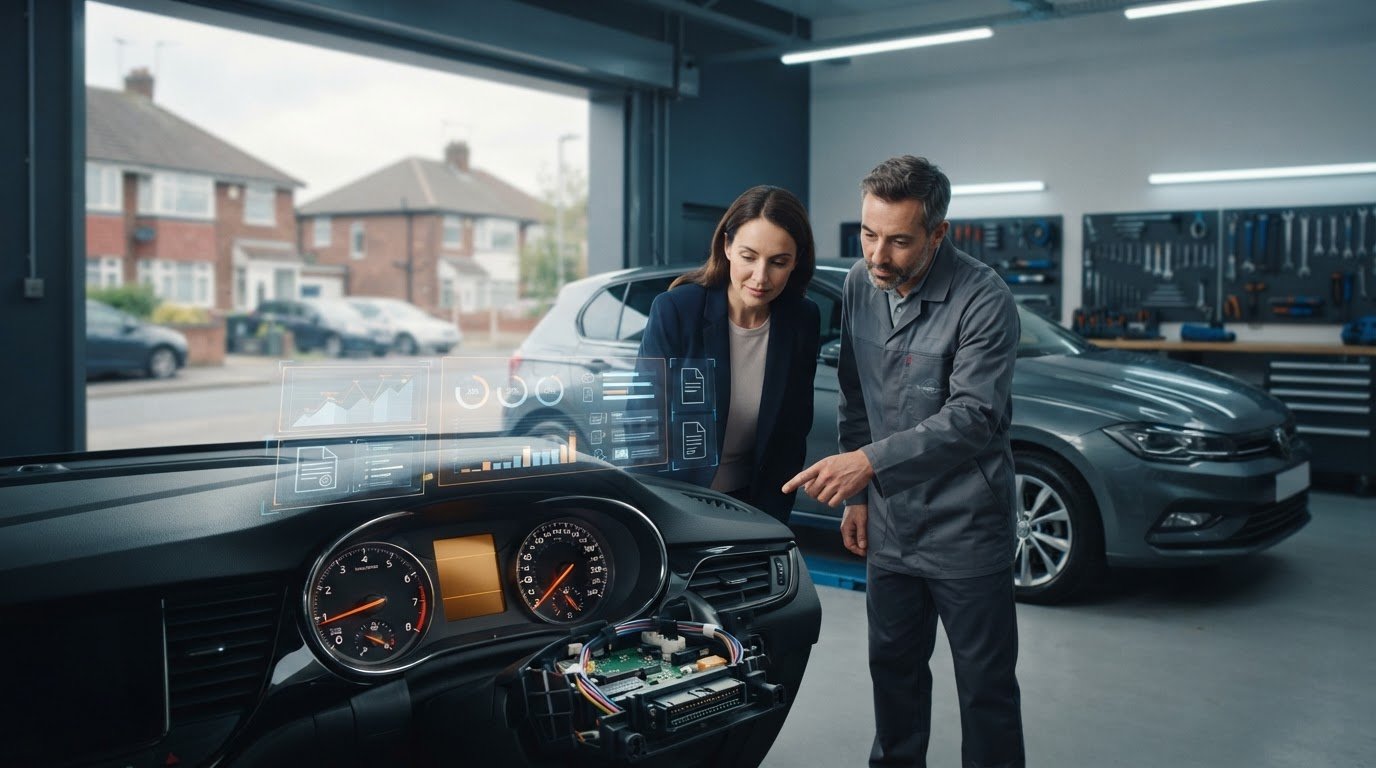
Does a mileage mismatch mean a used car has been tampered with? Not necessarily. Different records can reflect a recording error, a replacement instrument cluster or gaps in the paperwork, but an unexplained drop in recorded mileage deserves careful attention. Used Car Mileage Discrepancies: Why They Happen and What Buyers Should Check starts with a practical principle: a mismatch is a reason to investigate, not a verdict.
When the dashboard, MOT history and service records don’t agree, compare the dates and mileages across the available documents rather than relying on one figure. Check that each record relates to the same vehicle, look for a consistent sequence over time and note any missing periods or sudden changes. Then ask the seller for a specific explanation and dated supporting records. A clear account backed by documents may resolve a discrepancy; an unexplained inconsistency is a reason to pause before deciding whether to proceed.
Key Takeaways
- A mileage discrepancy means records conflict; it does not prove a specific cause. An instrument-cluster or ECU replacement may be relevant context to investigate.
- Compare the dashboard reading with MOT history, service records and dated invoices. Note the date and source of each figure.
- Use a consistent checking sequence: collect the records, order them by date, compare the readings and list unresolved gaps. Check that each document relates to the same vehicle.
- This guide to Used Car Mileage Discrepancies: Why They Happen and What Buyers Should Check helps you identify what needs clarification before deciding whether to proceed.
Why Do Used Car Mileage Records Differ?
A mileage discrepancy is a difference between readings or records that appear to describe the same vehicle. It doesn’t, by itself, establish why they differ. A figure may have been recorded incorrectly, paperwork may be incomplete, or a component such as the instrument cluster or ECU may have been replaced. The effect of a replacement depends on the vehicle, so don’t accept an explanation without checking what evidence supports it.
Dates and sources give each number its context. A dashboard reading is a current display; an MOT entry or service invoice records a figure at a particular point in time. Used Car Mileage Discrepancies: Why They Happen and What Buyers Should Check is about comparing that context, not treating every difference as proof of tampering. Odometer fraud involves deliberate conduct; an inconsistency alone doesn’t show that this has happened.
For broader context on vehicle scams, this video may be useful:
What can cause a mismatch in a used car’s mileage history?
Possible explanations include a recording or transcription error, missing or misdated documents, or a component replacement that affects what is displayed or recorded on a particular vehicle. These are possibilities, not diagnoses. If a replacement is offered as an explanation, look for supporting context such as an invoice or service record showing when the work took place. For more detail on this scenario, see “ECU Replacement & Mileage Discrepancies Explained”.
Does one inconsistent reading settle the question?
No. Check whether the entries relate to the same vehicle, identify who or what produced each record, and note any gaps in the timeline. A single lower figure may need clarification, but it doesn’t by itself confirm a fault or deliberate misrepresentation. Treat it as a question to resolve against the wider record, not as a diagnosis.
Which Used-Car Mileage Records Should Buyers Compare?
Build a timeline using the dashboard reading, MOT history, service records and dated invoices. These sources capture mileage at different points and for different purposes, so note each figure alongside its date and source. A dated sequence is more useful than an isolated number because it shows how the readings relate over time.
The V5C registration certificate helps identify the vehicle and its registered keeper details. It isn’t a mileage log, so it can’t confirm the car’s mileage history. Compare identifiers such as the registration number and VIN across the documents you’re using. Used Car Mileage Discrepancies: Why They Happen and What Buyers Should Check starts with evidence that relates to the same vehicle.
How should buyers read MOT mileage history?
Use the official GOV.UK MOT history service to review recorded mileage alongside MOT dates. Read the entries in chronological order and compare them with the current dashboard figure. A gap may simply mean there’s no MOT entry for that period; a lower later figure or abrupt change needs context. Compare it with nearby service records or invoices, but don’t treat a pattern alone as a diagnosis. The article “Why Modern Cars Store Mileage in Multiple ECUs” provides broader data-storage context.
What can service invoices and vehicle documents add?
Invoices can connect a recorded figure to a dated visit or repair. Check the date, mileage and vehicle identifiers on each, then compare those details with the MOT entries and dashboard. If a document is missing, record the gap as a question. Its absence doesn’t establish why it is missing or what happened to the mileage. A simple list of sources, readings and unanswered questions makes the next discussion more focused.
For technical questions about mileage data in legitimate testing or diagnostic applications, you can contact the MileageBlocker.com team.
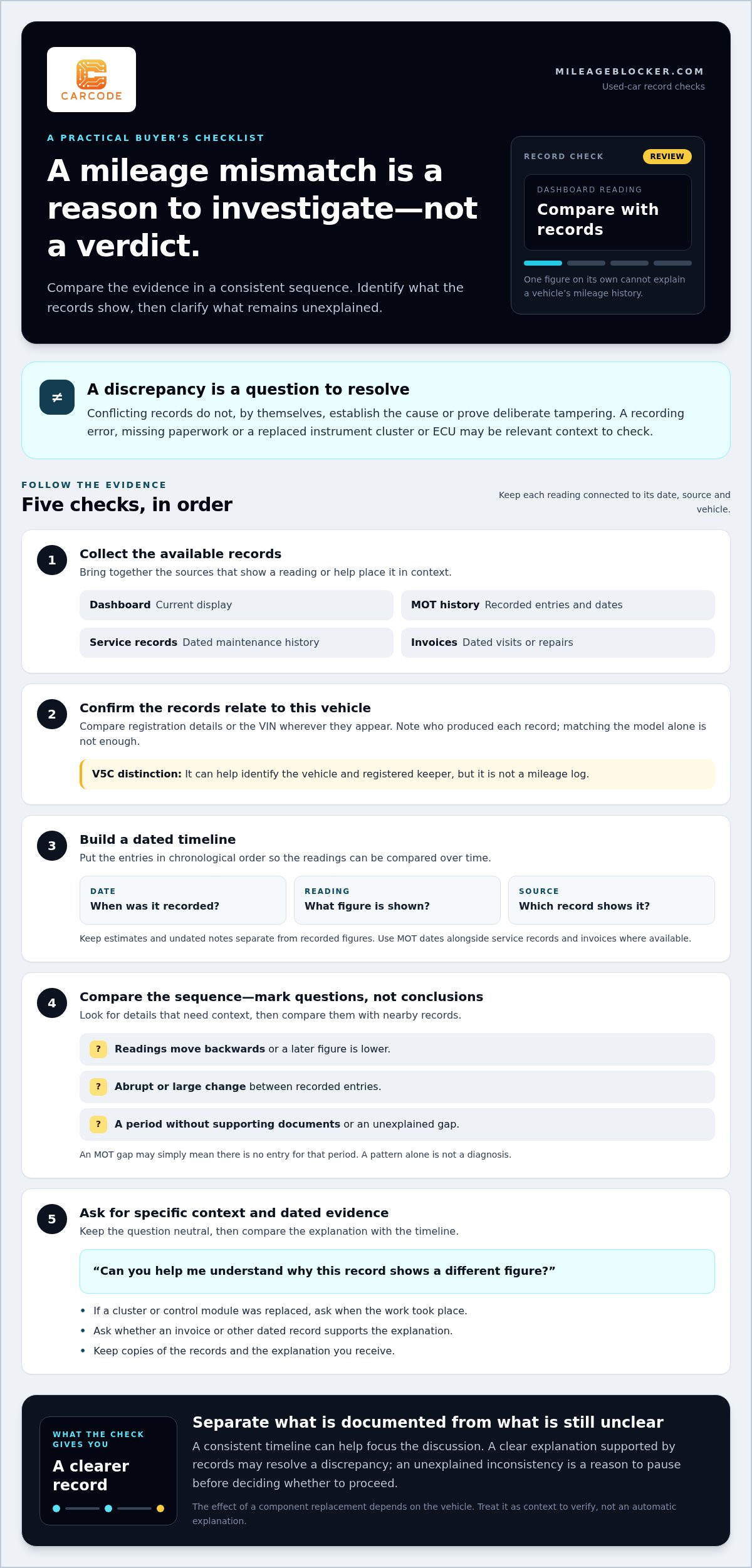
How Can You Check a Mileage Discrepancy Before Buying?
Use a repeatable process rather than trying to settle the history from one number. The aim is to establish what the records show, identify what remains unexplained and decide what needs clarification before you commit.
- 1. Collect the records. Gather the available MOT history, service records, dated invoices and current dashboard reading.
- 2. Check the vehicle details. Compare registration or VIN details wherever they appear, and note who created each document. Don’t assume paperwork belongs to this car just because the model is the same.
- 3. Order entries by date. Make a timeline showing each reading, its date and its source. Keep estimates or undated notes separate from recorded figures.
- 4. Compare the sequence. Look for readings that move backwards, large changes between entries or periods without supporting documents. Mark these as questions, not conclusions.
- 5. List what remains unclear. Ask the seller for context and dated records that relate to the entries in question. Keep copies of the evidence and any explanation you receive.
What questions help clarify an unexplained reading?
Keep questions neutral and specific: “Can you help me understand why this record shows a different figure?” If relevant, ask whether the instrument cluster or a control module has been replaced, when the work took place and whether an invoice or other dated record is available. A verbal explanation may provide context, but supporting documents make it easier to compare the account with the timeline.
When is more technical context useful?
Modern vehicles may retain mileage-related information in more than one control module. The details vary by vehicle, and diagnostic data shouldn’t be assumed to provide one definitive mileage figure. For a separate technical deep dive, see “Digital Odometers Explained: How Mileage Is Stored”. A visual inspection or scan can contribute evidence, but neither should be treated as proof of the complete history.
For technical questions about mileage data in legitimate testing or diagnostic applications, contact the MileageBlocker.com team. The practical approach to Used Car Mileage Discrepancies: Why They Happen and What Buyers Should Check is to organise the evidence first, then clarify material gaps before deciding.
What Should Buyers Do If the Mileage Still Does Not Add Up?
If important mileage entries remain unexplained, pause before committing to the purchase. A mismatch alone doesn’t prove misconduct or establish the vehicle’s condition, but you should understand the material gaps before deciding whether the available evidence is sufficient.
How can buyers make a measured decision?
Separate what the documents show from what someone says may have happened. For example, an invoice may confirm that a component was replaced, while the reason a reading changed might remain unclear. Keep copies of the relevant records and note the date, mileage, source and any explanation attached to each entry.
Before proceeding, ask yourself whether the evidence answers the original questions: do the records relate to this vehicle, is the timeline understandable, and are significant changes supported by dated information? If key points remain uncertain, take more time or decide not to proceed. Used Car Mileage Discrepancies: Why They Happen and What Buyers Should Check is a process for assessing evidence, not a way to reach a diagnosis from incomplete records.
Where does MileageBlocker.com fit into this topic?
Buyer checks and technical testing hardware serve different purposes. A mileage blocker doesn’t verify a used car’s history or resolve conflicting records. Keep the purchase decision grounded in the vehicle’s documentation and the evidence available to you.
Separate product-use note: Carcode mileage blockers are sold strictly for legitimate automotive testing, tuning and diagnostic purposes. They are intended for use on private property, rolling roads and controlled test environments only. It is illegal to use a mileage blocker to misrepresent a vehicle’s true mileage when selling or advertising a vehicle. By purchasing, customers confirm they will use the product lawfully and responsibly. Carcode Ltd accepts no liability for misuse.
For legitimate automotive testing, tuning and diagnostic applications, MileageBlocker.com sells mileage blocker devices and offers a fitting service.
Make your next step with confidence
A confident purchase decision does not require perfect paperwork. It does require that you understand what remains uncertain and are comfortable with that uncertainty. If an explanation is not supported by records, treat it as unresolved rather than allowing it to carry more weight than the evidence.
Used Car Mileage Discrepancies: Why They Happen and What Buyers Should Check is a guide to making a considered choice, not a reason to reach a verdict from one reading. Take the time you need to assess the vehicle on its own merits and decide whether the available information supports proceeding.
For legitimate automotive testing applications, MileageBlocker.com by Carcode provides technical testing hardware designed, manufactured and supported by Carcode Ltd, with no middlemen, no white-labelling and no compromises. Products include a full warranty and lifetime technical support.
Keep your decision grounded in the evidence and your own assessment. For information about MileageBlocker.com devices or the fitting service for legitimate testing, tuning and diagnostic use, contact our team.
Frequently Asked Questions
Does a mileage discrepancy always mean the car has a problem?
No. A mismatch in records is not, by itself, a mechanical diagnosis. Keep the mileage question separate from your assessment of the car’s condition: a consistent history doesn’t replace checks of maintenance, operation and visible condition, while conflicting readings don’t establish that the vehicle has a fault. Consider the evidence for each question on its own.
Can replacing an instrument cluster affect mileage records?
It may be relevant, but the result depends on the vehicle and circumstances. When reviewing paperwork, distinguish an invoice that documents the replacement from one that also records a mileage reading at the time of work. The first may confirm that a repair took place; it may not establish the reading before or after it. Don’t assume the result is the same across different vehicles.
How can I check a used car’s MOT mileage history?
Use the official GOV.UK MOT history service and check the vehicle details before reviewing its entries. The online history includes mileage recorded at MOT tests since 2005. If you’re researching an older vehicle, the absence of earlier online entries doesn’t establish what its mileage was then. Treat the service as one record source, not a complete lifetime log.
Can a diagnostic scan confirm a car’s true mileage?
Don’t treat a scan as guaranteed confirmation. If a scan is used to support an explanation, ask for a written report that identifies the vehicle, when the check took place and what information was examined. This gives you something specific to assess alongside the paperwork. A verbal statement that “the computer confirms it” doesn’t show what was checked.
Should I buy a used car if its mileage records do not match?
There’s no automatic answer. Before deciding, identify which unanswered points matter to you and what evidence would address them. For example, you may want a documented explanation for a specific change rather than a general assurance about the car’s history. Consider whether you can make a comfortable, informed decision with the information available, and don’t let urgency substitute for your own assessment.
About the author
MileageBlocker TeamThe MileageBlocker Technical Team covers vehicle electronics, CAN and CAN-FD systems, mileage blocker compatibility, installation and product developments.
View author profile →