
Understanding PCP Finance: Managing Your Mileage Limits
Exceeding your PCP mileage limit costs more than you think. Learn how finance clauses work and how to protect your investment during testing.
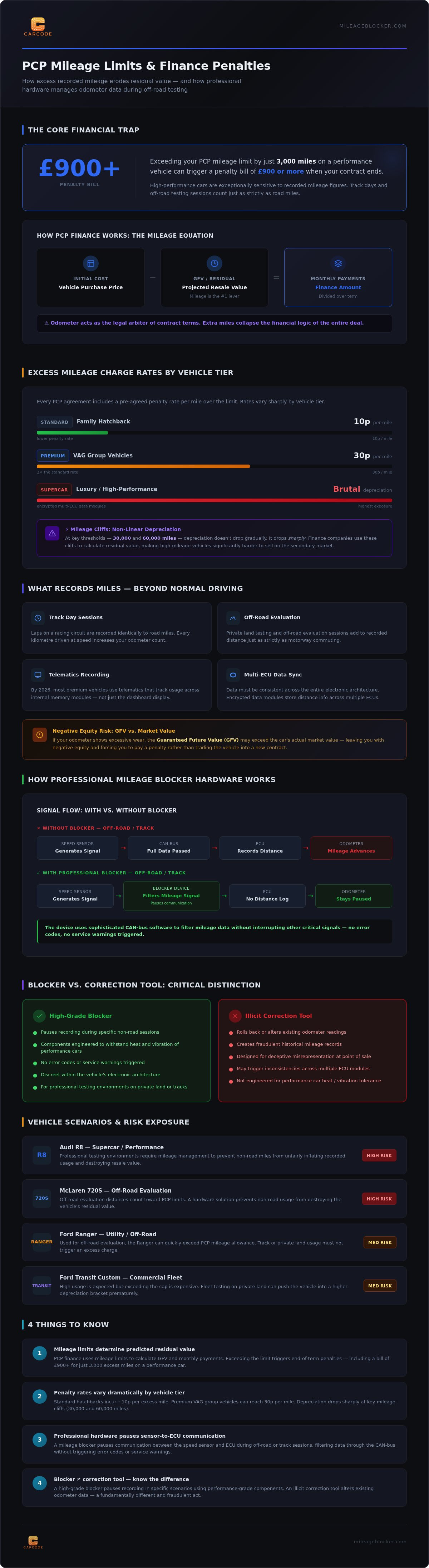
Exceeding your PCP mileage limit by just 3,000 miles on a performance vehicle can trigger a penalty bill of £900 or more when your contract ends. It is a financial trap. In our business, we've seen how this pressure creates genuine anxiety about depreciation. You likely worry that intensive off-road testing or track sessions will lead to a massive surcharge you didn't anticipate. We're going to break down the technicalities of these finance clauses and show you how professional high-performance hardware manages your odometer during non-road use. You'll learn exactly how vehicle modules sync with finance records and why an Audi R8 mileage blocker is an essential tool for professional testing environments. We will provide the technical clarity you need to protect your investment. This ensures you maintain your car's value while staying within the strict financial lines of your agreement.
Key Takeaways
- Understand how PCP finance models use mileage limits to determine a vehicle's predicted residual value and avoid unexpected end-of-term penalties.
- Calculate the real-world financial impact of excess miles across various vehicle tiers to prevent depreciation from eroding your financial position.
- Discover how professional hardware pauses communication between speed sensors and the ECU to manage odometer data during off-road testing or track sessions.
- Learn to distinguish between illicit mileage correction tools and high-grade blocker devices engineered with components that withstand the heat and vibration of performance cars.
The Structural Reality of PCP Contracts and Mileage Clauses
A Personal Contract Purchase (PCP) is a finance model built entirely on the predicted residual value of a vehicle. Lenders calculate your monthly payments by subtracting the projected resale price from the initial cost. Mileage is the primary lever in this calculation. It directly dictates the car's worth at the end of the term. In our business, we've seen how the odometer acts as the legal arbiter of these contract terms. If the digits on your dashboard exceed the agreed limit, the financial logic of the deal collapses. High-performance cars are exceptionally sensitive to these figures. For instance, using a McLaren 720s mileage blocker during off-road evaluation prevents non-road miles from unfairly inflating the car's recorded usage and destroying its resale value.
The Hidden Mechanics of Annual Mileage Limits
Lenders distinguish sharply between your estimated usage and the actual data harvested by the vehicle. By 2026, most premium vehicles employ telematics that track usage across various internal memory modules. It isn't just about the dashboard display anymore. The data must be consistent across the entire electronic architecture. If you use a vehicle for professional testing or track days, those miles are recorded just as strictly as a commute. This technical reality often catches drivers off guard when they return the car to the dealership.
Guaranteed Future Value (GFV) and the Odometer
The GFV is the balloon payment that determines if you can afford to keep the car at the end of the term. Every extra mile recorded erodes this figure. Finance companies want low-mileage examples for the resale market because they command higher prices and represent lower mechanical risk. If your odometer shows excessive wear, the GFV may exceed the car's actual market value. This leaves you with negative equity. It effectively forces you to pay a penalty rather than having the option to trade the vehicle in for a new contract.
The Financial Impact of Recorded Miles on Vehicle Depreciation
Every PCP agreement includes an Excess Mileage Charge. This is a pre-agreed penalty rate for exceeding contract bounds. For a standard family hatchback in 2026, this might be 10p per mile. Premium VAG group vehicles often see rates climb to 30p. If your car drifts past a mileage cliff, such as the 30,000 or 60,000-mile mark, the depreciation isn't linear. It drops sharply. Finance companies use these cliffs to calculate the residual value. High-mileage vehicles are harder to sell on the secondary market. You can find auto loan and lease guidance from the CFPB that explains how these valuations affect your total cost of ownership.
If you use a utility vehicle for off-road evaluation, the recorded distance can quickly exceed your allowance. A Ford Ranger mileage blocker is an essential tool in these scenarios. It ensures that track or private land usage doesn't trigger the excess charge.
Tiered Penalties in Luxury Car Finance
Luxury car finance differs significantly from standard deals. Supercars face brutal depreciation because buyers demand low-mileage examples. By 2026, luxury models use encrypted data modules to store distance information across multiple ECUs. This makes the data harder to manage without professional-grade hardware. If you need technical advice on specific vehicle modules, you might speak with our engineering team.
Commercial Fleet Risks and PCP
Vans on PCP face unique risks. High usage is expected, but exceeding the cap is expensive. For businesses, a Ford Transit Custom mileage blocker protects the bottom line during off-road fleet testing. It prevents the vehicle from being pushed into a higher depreciation bracket prematurely.
Managing Vehicle Data During Off-Road Testing and Evaluation
When you take a vehicle onto private land or a dedicated track for performance evaluation, the mileage recorded doesn't reflect standard road usage. This creates a technical conflict with your PCP agreement. Freezing the mileage during these specific scenarios is a legitimate requirement for professional testing. A mileage blocker device achieves this by pausing the communication between the speed sensor and the Engine Control Unit (ECU). This prevents the odometer from advancing while you conduct your tests. For those unfamiliar with the setup, we recommend viewing our guide on mileage blocker installation to ensure the hardware is integrated correctly. It’s a precise solution for a specific technical problem.
How Mileage Blockers Integrate with Modern CAN-bus Systems
Modern vehicles rely on complex Controller Area Network (CAN-bus) systems to share data between modules. By 2026, vehicle electronics have become even more interconnected. Our hardware uses sophisticated software to filter mileage data without interrupting other critical signals. This prevents the virtual cockpit from triggering error codes or service warnings. It's a surgical approach to data management. We focus on engineering excellence to ensure the device remains discreet within the vehicle's electronic architecture. If you have questions about a specific car, you can contact our technical support team for assistance.
Maintaining Functional Integrity During Testing
Cheap alternatives often disable essential safety features when active. High-quality blockers maintain the vehicle's full functional integrity. Systems like cruise control, lane assist, and emergency braking remain fully operational during your testing sessions. Professional hardware ensures no data discrepancies exist between various control modules, which prevents red flags during later diagnostic checks on a PCP car. It is a specialist tool. Our engineering ensures you get the data control you need without sacrificing any of the car's advanced assistance features.
Selecting High-Performance Hardware for Odometer Management
Choosing the correct hardware is a decision that impacts the long-term health of your vehicle's electronic architecture and the viability of your PCP contract. You must distinguish between illicit mileage correction tools and professional mileage blocker hardware. Correction tools are designed to alter stored data, which often leaves permanent digital footprints. In contrast, our professional hardware acts as a preventative tool for authorized testing. It's a precise solution. We use high-grade components specifically engineered to withstand the extreme heat and vibration typical of performance cars. These devices offer discreet operation and utilize plug-and-play connectors compatible with complex 2026 vehicle systems. You can use our find your car hub to identify the specific module required for your chassis.
The Risks of Low-Quality Mileage Tools
Low-quality devices frequently cause critical ECU errors or trigger "tamper" flags within the vehicle's internal memory. These flags are often irreversible. They signal to diagnostic tools that the system has been compromised. In our business, we've seen how poorly developed software fails to sync with the various control modules in a PCP car. Our professional software development ensures that the hardware remains invisible to standard diagnostic equipment during legitimate servicing. This technical precision protects your vehicle's warranty and its functional integrity.
Professional Fitting vs. DIY Installation
While many of our modules are designed for simple integration, some modern interiors require specialized access. For complex dashboard configurations, such as the Honda Accord mileage blocker, we recommend using a professional mobile fitting service. Our technicians ensure the hardware is installed securely and leaves no physical trace behind the trim. This professional approach provides peace of mind. It ensures the installation is as high-quality as the hardware itself. Choosing expert fitting eliminates the risk of damaging delicate plastic clips or electronic connectors during the process.
Taking Control of Your Contract
Check your PCP agreement this week to identify your specific excess mileage rate. Once you understand the financial penalty per mile, use our vehicle search tool to match your model with professional-grade hardware before your next off-road evaluation session. Taking this step now ensures you have the technical means to manage your data during non-road use and protect your vehicle's residual value.
Frequently Asked Questions
Will this device mess up my car's electronics?
No, as long as you're using high-quality hardware. Our blockers are designed to work with the existing CAN-bus system, so they don't cause error codes or interfere with safety features like lane assist.
Can the finance company see that I used a blocker?
Professional blockers are designed for discreet operation. Because they pause the data stream rather than altering stored numbers, they don't leave the "tamper" signatures associated with low-quality correction tools.
Can I install it myself or do I need a pro?
It depends on your car. Many are simple plug-and-play, but for something like a modern Honda with a complex dash, having a professional fitter do it ensures everything is hidden and nothing gets scratched.
Is it actually legal to use one of these?
Yes, for testing on private land or off-road tracks. It's a tool for managing data during non-road use, which is a legitimate technical requirement for many professional drivers.
Securing Your Vehicle's Future Value
Managing the data integrity of your vehicle is a critical component of long-term financial planning. It's about precision. We've detailed how the relationship between your odometer and residual value determines the final cost of your agreement. Our high-performance hardware offers a technical solution for authorized testing, ensuring your digital records remain accurate across all modules. These devices are compatible with 2026 digital cockpits. They utilize high-grade components from MileageBlocker.com to maintain functional integrity under stress.
If you're operating a vehicle under a PCP contract, taking control of your data during non-road evaluation protects you from sharp depreciation cliffs. We offer a UK-wide professional fitting service. This ensures your hardware is integrated discreetly and securely by expert technicians. You can Find the right mileage blocker for your vehicle today to speak with our team about your specific chassis. Taking these preventative measures now ensures your car's value remains protected throughout the term of your finance deal.
Frequently Asked Questions
Can I use a mileage blocker on a car I have on PCP finance?
Yes, using a mileage blocker on a PCP vehicle is a technical solution for specific testing environments. It allows you to pause the odometer during off-road evaluation or private track days. This ensures that non-road miles don't unfairly impact your contract terms. It's a precise tool for maintaining accurate records of actual road use while protecting your financial position at the end of the term.
Will a mileage blocker affect my cars speedometer while I am testing it?
Professional hardware is engineered to maintain the vehicle's functional integrity during testing. While the device pauses the odometer, the speedometer and critical assistance systems like cruise control usually remain fully operational. This depends on the specific vehicle model and the mode selected. Our engineering focuses on ensuring that your digital cockpit remains clear of error codes while you evaluate the car's performance in a controlled, off-road environment.
What happens if I exceed my PCP mileage limit by a few thousand miles?
Exceeding your PCP limit results in an Excess Mileage Charge. This is a pre-agreed penalty rate that can range from 10p to 30p per mile depending on the vehicle tier. If you return the car with several thousand extra miles, the finance company will issue a significant invoice. This often happens because the car has dropped into a higher depreciation bracket, making it less valuable for the resale market.
Is it difficult to install a mileage stopper on a 2026 model car?
Installation complexity depends on the vehicle's electronic architecture. Many 2026 models feature accessible ports for plug-and-play integration. However, cars with advanced digital cockpits often require professional fitting to access the connectors behind the dashboard safely. We provide a UK-wide mobile installation service to ensure the hardware is integrated discreetly and without damaging any internal components or delicate plastic clips during the process.
Does the mileage blocker stop the data from being recorded in all vehicle modules?
High-performance blockers from MileageBlocker.com pause data communication across the entire CAN-bus network. This means the mileage isn't just stopped on the dashboard; it's also paused in the ECU, transmission, and internal memory modules. This prevents data discrepancies that diagnostic tools might flag during a service. It's a comprehensive approach to data management that ensures all vehicle modules remain synchronized and free from permanent tamper flags.
About the author
MileageBlocker TeamThe MileageBlocker Technical Team covers vehicle electronics, CAN and CAN-FD systems, mileage blocker compatibility, installation and product developments.
View author profile →