
Strategies to Keep Supercar Mileage Low: Protecting Your Performance Investment
Discover proven strategies to keep supercar mileage low and protect your asset value. Learn how to prevent steep depreciation and manage mileage wisely.
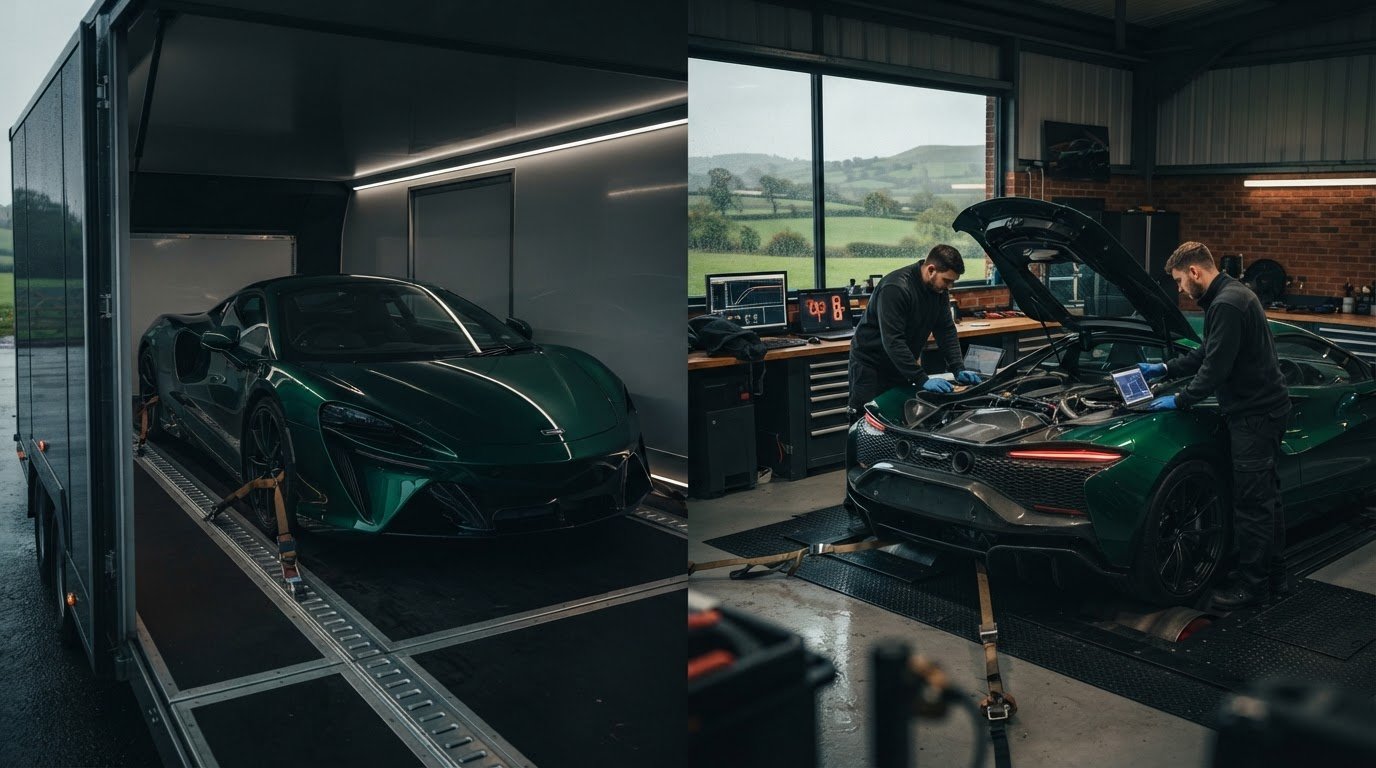
Exceeding 1,000 miles on a limited-edition odometer often acts as a financial cliff edge, triggering a sharp drop in resale value that feels entirely disproportionate to the actual wear. We've seen collectors hesitate to start their engines for a routine service because the mileage accumulated during transit and testing is simply too costly. If your car is approaching a 5,000 or 10,000-mile threshold, you're likely feeling the pressure to park it permanently. This article details the essential strategies to keep supercar mileage low without sacrificing the mechanical health of your vehicle. You'll learn how to master the odometer economy and protect your investment from aggressive depreciation curves. We cover everything from enclosed transport logistics to using a Lamborghini Huracán mileage blocker during authorised dyno testing. Precision is key. By managing every mile with technical rigour, you ensure your car remains a collector-grade asset that is ready for the market at a moment's notice.
Key Takeaways
- Identify the specific financial thresholds where depreciation accelerates, such as the sharp value drop seen when a Ferrari 488 exceeds the 5,000-mile mark.
- Understand that modern vehicle distance data is stored across multiple modules including the ECU and transmission, requiring a sophisticated approach to data management.
- Implement practical strategies to keep supercar mileage low by utilising enclosed transport for logistics and planning routes that avoid high-traffic congestion.
- Learn how high-quality, German-manufactured hardware allows for precise mileage control during authorised performance testing and off-road diagnostics.
The Financial Reality of Supercar Depreciation Curves
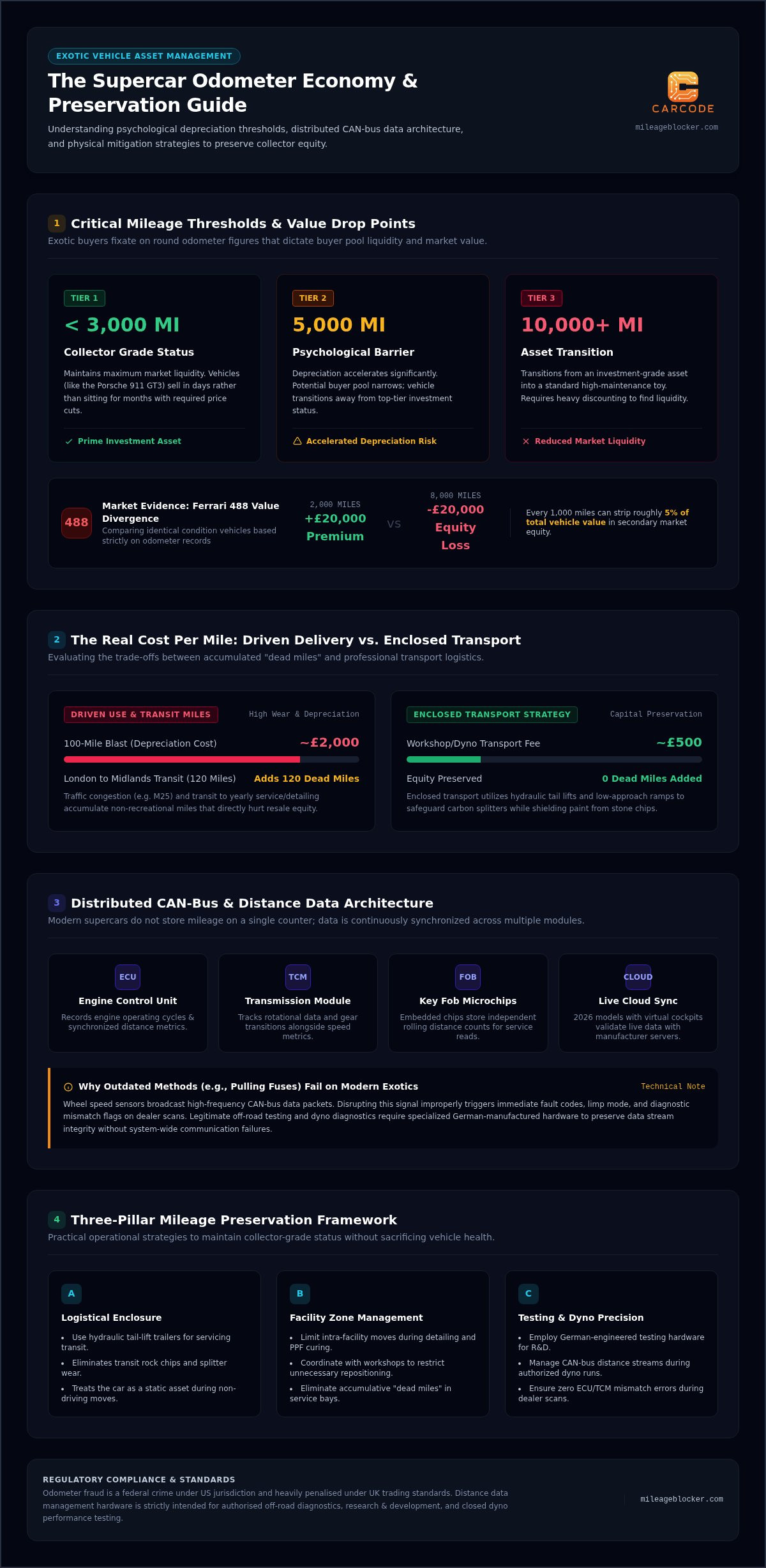
In the exotic market, a few extra trips can evaporate thousands in equity. We often see a Ferrari 488 with 2,000 miles listed for £20,000 more than an identical unit showing 8,000 miles. This isn't just about wear; it's about perceived exclusivity. A vehicle attains Collector Grade status only when the odometer remains below 3,000 miles. Beyond this, the car transitions from an investment asset to a high-maintenance toy. Understanding how odometers work in modern digital systems is vital because every digit matters. We've seen owners lose sleep over dead miles, which are the non-driving increments added during transit to a detailer or during a yearly service.
The Psychology of the Odometer for High-End Buyers
Buyers fixate on round numbers. Crossing the 5,000 or 10,000-mile threshold triggers a psychological barrier that narrows your pool of potential buyers. Liquidity is the primary concern here. A low-mileage Porsche 911 GT3 sells in days. A high-mileage example might sit for months, forcing price cuts. Implementing effective strategies to keep supercar mileage low ensures your asset remains liquid and desirable in a volatile market.
Calculating the Real Cost Per Mile
Driving a supercar isn't just about petrol. When you factor in depreciation, a 100-mile Sunday blast could cost £2,000 in lost value. Compare this to the cost of professional enclosed transport for a McLaren 720S mileage blocker equipped vehicle during a track day or dyno test. Transporting the car to a specialist workshop might cost £500, but it saves the odometer from recording transit miles. It's a strategic trade-off. Using these strategies to keep supercar mileage low preserves your capital for when you actually want to enjoy the car on the right roads.
Understanding How Modern Supercars Record and Store Mileage Data
Modern exotics do not rely on a single dashboard counter. Distance tracking is a distributed process. Data packets migrate continuously across the vehicle's internal network, embedding the mileage into the Engine Control Unit (ECU), the Transmission Control Module (TCM), and even the microchips inside your key fob. For 2026 models featuring virtual cockpits and live cloud-synchronisation, this data is constantly validated against manufacturer servers. Understanding these background systems is foundational when executing strategies to keep supercar mileage low during stationary R&D or dyno diagnostic routines.
The Role of the CAN-bus in Mileage Tracking
The Controller Area Network (CAN-bus) acts as the central nervous system of the car. The wheel speed sensors generate high-frequency pulses that are converted into distance metrics and broadcast as data packets to the instrument cluster. In older vehicles, owners sometimes pulled a fuse to stop the clock. Attempting this on a modern exotic will instantly trigger fault codes, limp mode, and system-wide communication failures. If you are configuring a vehicle for off-road testing, you must handle these data streams precisely.
Data Integrity and Synchronisation
System architecture demands absolute alignment. If one module records conflicting distance data due to an unverified interruption, the vehicle flags a mismatch error upon the next dealer diagnostic scan. While odometer fraud is a federal crime under US jurisdiction and heavily penalised under UK trading standards, maintaining data integrity during legitimate testing is purely an engineering challenge. A hardware conflict can compromise the car's electronics and damage its resale value. If you need assistance setting up a dedicated testing environment for your vehicle, you can reach out to our technical support team for expert guidance.
Practical Strategies for Physical Mileage Management and Preservation
Managing the physical movement of your vehicle is just as critical as managing the digital data streams. We've seen owners meticulously plan every journey to ensure every mile driven is for high-speed engagement rather than utility. Adopting physical strategies to keep supercar mileage low involves a shift in how you view logistics. It requires treating the car as a static asset during transit and maintenance periods.
Enclosed Transport vs. Driven Delivery
Professional transport is a capital preservation strategy. If you're moving a car from London to a specialist centre in the Midlands, driving it adds 120 miles. In a market where every 1,000 miles can strip 5% off the value, that single journey effectively costs you hundreds in depreciation. You should vet transport companies for low-approach ramps and hydraulic tail lifts to protect carbon splitters. Secure, enclosed trailers also prevent stone chips during transit, further protecting the exterior finish.
Strategic Usage During Detailing and Maintenance
Detailing, ceramic coating, and paint protection film (PPF) applications often take several days to complete. During this time, technicians frequently move the car between different zones of the facility for washing, lighting inspection, and curing. These unseen miles accumulate quickly. You must coordinate with workshops to limit movement to the absolute minimum. When preparing a car for a long-term testing programme, ensure you use professional installation services to avoid system errors during these high-touch periods.
Route planning is another vital pillar of these strategies to keep supercar mileage low. Use advanced navigation tools to avoid high-traffic areas like the M25 during peak hours. Stop-start traffic adds mechanical wear and records distance without providing any driving engagement. If you need a bespoke solution for your vehicle's testing logistics, contact our technical support team to discuss your requirements.
Professional Mileage Blockers for Testing and Value Protection
Precision engineering requires precision tools. When executing technical strategies to keep supercar mileage low, hardware like the Mileage Blocker Device becomes essential for authorised off-road scenarios. These units are designed for plug-and-play integration. They require no wire cutting or soldering, preserving the integrity of the factory wiring loom. The operation is entirely discreet. You can control the settings directly through the factory steering wheel buttons, allowing for immediate adjustments during a testing session. For owners of specific high-performance models, the McLaren 720S mileage blocker provides a seamless fit within the existing CAN-bus architecture.
How Mileage Blockers Differ from Correction Tools
Our hardware is preventative. It does not alter existing data stored in the car's memory. This distinction is vital. We've seen owners struggle with ECU errors caused by cheap, low-grade alternatives. High-quality German-manufactured components ensure the device communicates correctly with the vehicle's complex electronics. It stops the recording of new distance data during testing rather than attempting to manipulate what is already there.
Implementing a Technical Strategy for Dyno and Track Testing
Stationary dyno testing often adds phantom mileage. The wheels spin at high speeds while the car remains in place, causing the odometer to climb without any road use. A mileage stopper prevents this artificial accumulation. It ensures the odometer reflects actual road travel, not diagnostic hours. This is one of the most effective strategies to keep supercar mileage low during performance tuning. If you are unsure which hardware fits your specific needs, contact us to find the right technical solution for your supercar. We provide support for a wide range of modern exotics.
Securing Your Supercar's Future Value
Preserving the equity in your exotic vehicle requires a proactive approach to both physical logistics and digital data management. You now understand that distance tracking is a multi-module process involving the ECU and transmission, not just the dashboard. By implementing these strategies to keep supercar mileage low, you protect your asset from the steep depreciation associated with high-mileage thresholds. Whether you are coordinating enclosed transport for a service or using hardware for authorised dyno testing, precision is paramount. Our team provides an expert fitting service available across the UK and technical support for all major supercar brands. We also offer discreet worldwide shipping on all high-grade German components. You don't have to let dead miles erode your investment. Take the first step this week by reviewing your upcoming maintenance schedule. Contact our specialist team to discuss mileage preservation for your supercar to ensure your vehicle remains a collector-grade asset.
Frequently Asked Questions
Is it legal to use a mileage blocker on my supercar in the UK?
It's entirely legal to purchase and install a mileage blocker in the UK for specific authorised uses like testing, research, and off-road driving. You must not use the device to misrepresent the vehicle's history to buyers or insurers. Our hardware is strictly a preventative tool for diagnostic scenarios. We recommend staying informed on UK trading standards to ensure your application remains within the intended legal and ethical framework.
Will a mileage stopper cause error messages on my virtual cockpit or dashboard?
A high-quality mileage stopper won't trigger error messages or warning lights on your virtual cockpit. We utilise German-manufactured components that integrate seamlessly with the vehicle's CAN-bus architecture. Unlike low-grade alternatives that cause data packet collisions, our hardware maintains total system stability. It's one of the most effective strategies to keep supercar mileage low during dyno testing without compromising the complex electronics of a modern performance car.
Can a mileage blocker be detected during a routine service at the dealership?
The hardware is engineered for discreet operation and does not leave permanent markers in the vehicle's internal memory. Since the device stops the recording of new distance data rather than manipulating existing figures, it avoids the synchronisation errors typical of correction tools. While no aftermarket device is fundamentally invisible to a forensic manufacturer audit, routine dealer diagnostic scans generally don't detect the module during standard maintenance services.
Does the device stop mileage in all modules, including the ECU and the key?
Yes, our hardware stops mileage accumulation across all relevant modules, including the Engine Control Unit, Transmission Control Module, and the vehicle keys. Modern supercars synchronise distance data across multiple systems to prevent tampering. Our device filters these signals at the network level, ensuring that no conflicting information is stored. This comprehensive data management is essential for preserving the car's electronic integrity during authorised off-road performance testing.
How difficult is it to install a mileage freezer in a modern Ferrari or Lamborghini?
Most modern Ferrari and Lamborghini models feature a plug-and-play interface that connects directly to the instrument cluster harness. No wire cutting or soldering is required, which helps maintain the car's original factory condition. While the process is straightforward for those with technical experience, we provide a professional fitting service across the UK for guaranteed results. This professional support underpins your broader strategies to keep supercar mileage low through technical precision.
About the author
MileageBlocker TeamThe MileageBlocker Technical Team covers vehicle electronics, CAN and CAN-FD systems, mileage blocker compatibility, installation and product developments.
View author profile →