
Most Reliable High-Mileage Cars to Buy in 2026
Buying a car with 150,000 miles on the clock used to be a gamble on the gearbox or the head gasket. In 2026, the real risk has shifted toward the complex net...
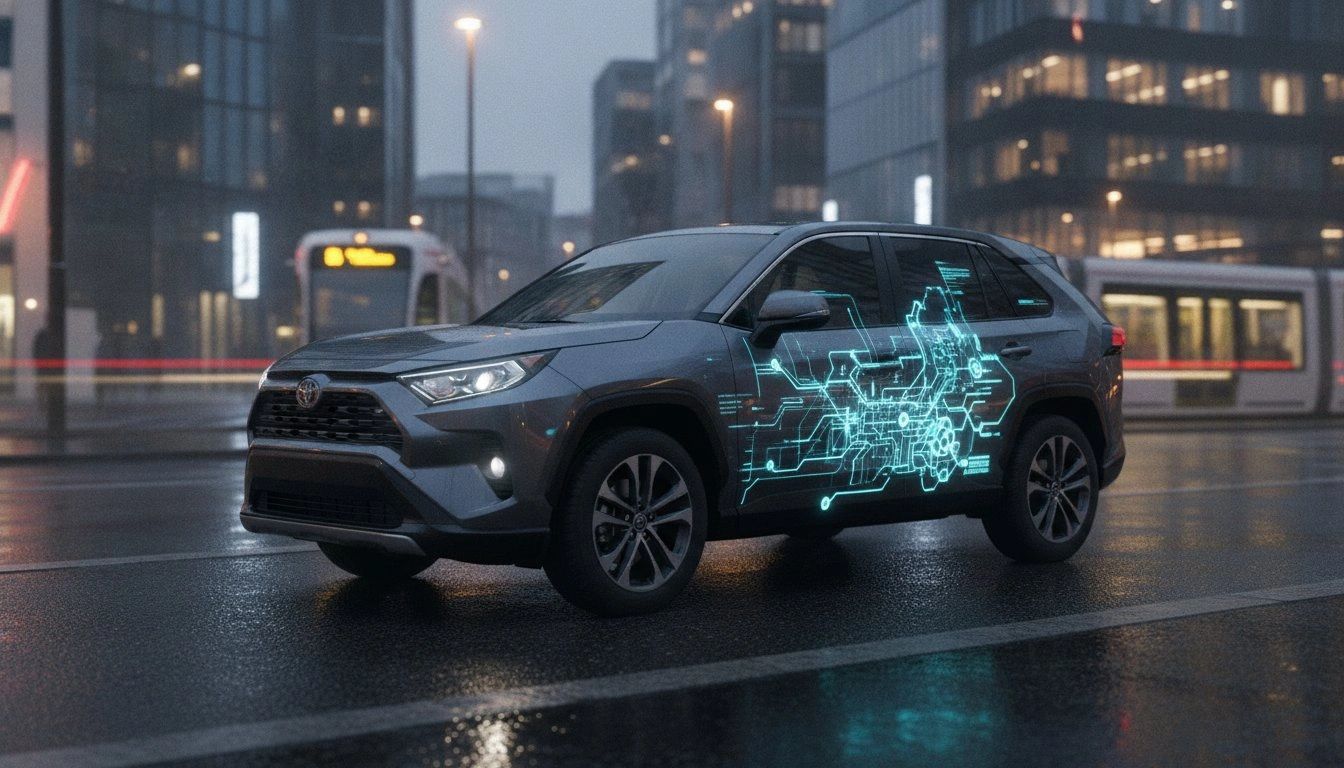
Buying a car with 150,000 miles on the clock used to be a gamble on the gearbox or the head gasket. In 2026, the real risk has shifted toward the complex network of ECUs and digital modules that can hide expensive faults behind a deceptively clean dashboard. Finding The Most Reliable High-Mileage Cars Worth Buying in 2026 requires looking past the polished bodywork and into the vehicle's internal memory architecture.
You’re right to feel anxious about confusing MOT records or the threat of manipulated odometers that mask a vehicle's true mechanical fatigue. We’ve spent years in the workshop analysing how different manufacturers store data; we understand why a bargain often turns into a digital nightmare. We will provide you with a definitive shortlist of bulletproof models that can actually handle high-mileage demands. You'll also learn the technical reality of how mileage data is synchronised across various control units, giving you the tools to verify a car's health before you commit your capital.
Key Takeaways
- Learn why the 100,000-mile mark is no longer a mechanical death sentence for vehicles manufactured between 2021 and 2023.
- Identify The Most Reliable High-Mileage Cars Worth Buying in 2026, including why the Toyota RAV4 hybrid and Skoda Octavia dominate our workshop reliability rankings.
- Understand how modern CAN-bus architecture synchronises mileage data across multiple internal control modules to prevent simple dashboard tampering.
- Discover how to maintain digital integrity during vehicle R&D and off-road testing by using professional mileage management hardware.
- Gain the technical knowledge required to verify a vehicle's health beyond the odometer reading, ensuring your next purchase isn't a hidden liability.
The 100,000-Mile Psychological Barrier in 2026
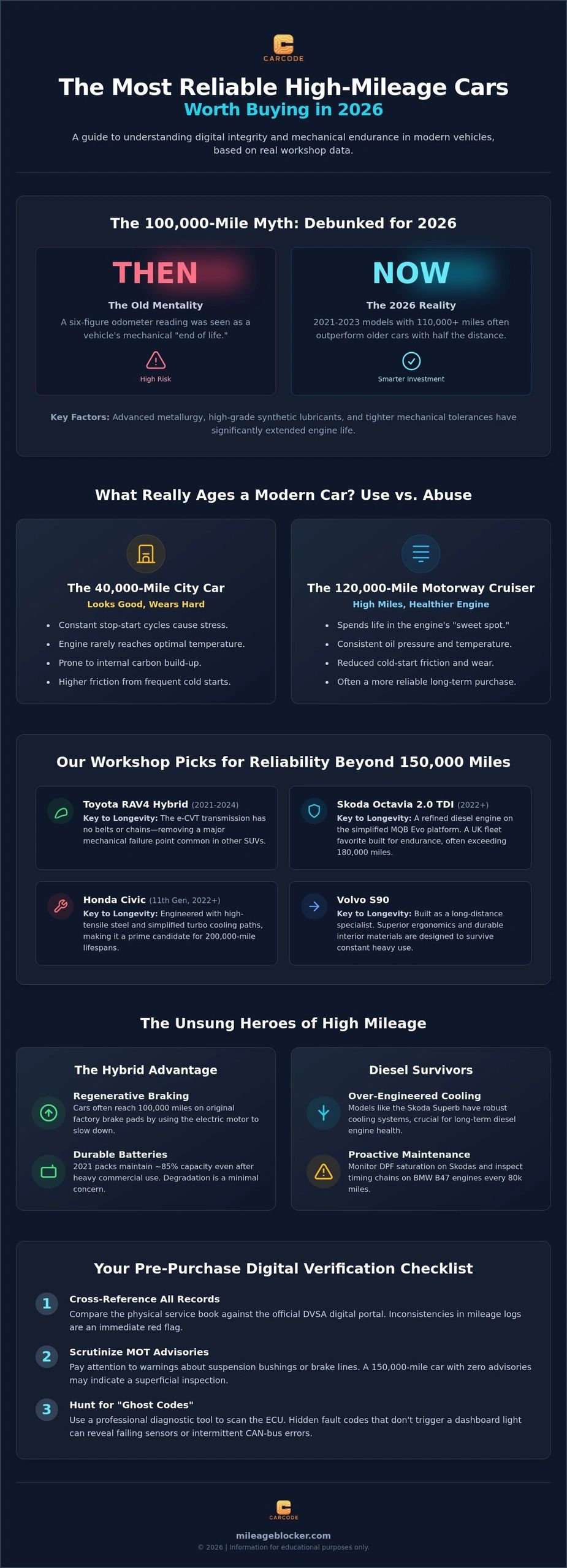
For decades, the six-figure odometer reading served as a definitive threshold for a vehicle's "end of life." In our workshop, we see 2022 models with 110,000 miles that consistently outperform 2015 models with half that distance. The 100,000-mile mark is an outdated metric in the 2026 market because mechanical tolerances have tightened significantly. Vehicles manufactured between 2021 and 2023 benefited from advanced metallurgy and high-grade synthetic lubricants that were designed for long-term durability. If you are hunting for The Most Reliable High-Mileage Cars Worth Buying in 2026, you must look beyond the dashboard numbers and focus on digital integrity.
The 2026 MOT standards have fundamentally changed how we assess used vehicles. The DVSA now mandates a comprehensive digital diagnostic check as part of the annual inspection. This means that hidden faults in the SRS, ABS, or emissions systems are logged and stored in a way that is difficult to bypass. We've found that these digital records provide a far more accurate health check than a simple visual inspection of the engine bay. A car with a clean digital history at 140,000 miles is often a safer investment than a low-mileage vehicle with a history of cleared fault codes.
Mechanical vs. Digital Wear in Modern Engines
A 120,000-mile motorway cruiser is almost always healthier than a 40,000-mile city car. Constant stop-start cycles in urban environments prevent the engine from reaching optimal operating temperatures, leading to carbon build-up in the valves. High-mileage motorway cars spend their lives in the "sweet spot" of the rev range with consistent oil pressure. The widespread adoption of 0W-20 and 0W-16 synthetic oils in 2020-era engines has also extended component life by reducing cold-start friction. We recommend prioritising cars that show consistent, long-distance use over those that have sat idle or suffered through short school runs.
Verifying the MOT History and Digital Footprint
You should always cross-reference physical service books with the DVSA digital portal. Inconsistencies between the reported mileage and the digital logs stored in the ECU are immediate red flags. When reviewing vehicle history reports, pay close attention to advisories regarding suspension bushings or brake lines. These mechanical wear items are expected on high-mileage cars, but a lack of advisories on a 150,000-mile car might suggest a superficial inspection rather than a perfect vehicle. We suggest using a professional diagnostic tool to check the ECU for "ghost codes" that don't trigger a dashboard light but indicate failing sensors or intermittent communication errors across the CAN-bus network.
Top Reliable High-Mileage Models: Our Workshop Picks
We’ve dismantled enough high-mileage engines to know that brand reputation doesn't always equal real-world endurance. In 2026, our workshop data points toward a specific group of vehicles that consistently reach 150,000 miles with minimal intervention. Identifying The Most Reliable High-Mileage Cars Worth Buying in 2026 requires looking at how these machines handle sustained thermal stress. The 2021-2024 Toyota RAV4 Hybrid is a standout example. Its e-CVT lacks the belts or chains found in traditional CVTs, removing a major mechanical failure point that often plagues high-mileage SUVs.
The Skoda Octavia remains the backbone of the UK fleet market for good reason. We frequently see 2022 models with 180,000 miles that still feel tight and responsive. This is largely due to the simplified MQB Evo platform and the refined 2.0 TDI engine. Similarly, the 11th-generation Honda Civic (2022+) has been engineered with high-tensile steel and simplified turbocharger cooling paths, making it a prime candidate for 200,000-mile lifespans. Volvo’s S90 also earns a spot on our list. The 2026 market values these long-distance specialists because their seats and interior ergonomics are built to survive 500-mile days without sagging or wearing through. If you’re considering one of these models for a testing environment, you can find your car in our compatibility database to see available hardware options.
The Hybrid Advantage: Longevity in the Electric Era
Regenerative braking is the unsung hero of high-mileage hybrids. By using the electric motor to decelerate, these cars often reach 100,000 miles on their original factory brake pads. Battery degradation is less of a concern in 2026 than it was a decade ago. We see 2021 Toyota packs maintaining 85% capacity even after heavy commercial use. You should, however, avoid early 2020s plug-in hybrids from certain European manufacturers that suffer from complex cooling loop leaks. While mechanical reliability is key, verifying the digital history is just as critical under federal odometer fraud laws and similar international regulations that govern data integrity.
Diesel Survivors: The Best Long-Distance Fleet Cars
The Skoda Superb is frequently found with 200,000+ miles on the clock because its cooling system is over-engineered for its power output. To keep these running, you must monitor DPF saturation levels closely. Short trips kill these filters, but a Superb that lives on the motorway will rarely see a DPF warning light. The 2022+ BMW 3-Series with the B47 diesel engine has also proven remarkably resilient. We recommend inspecting the timing chain every 80,000 miles, even if the manufacturer suggests a longer interval. Proper maintenance on these diesel survivors ensures they remain viable assets well into the late 2020s.
The Digital Reality: How High-Mileage Data is Stored
Mechanical durability is only half of the equation when assessing The Most Reliable High-Mileage Cars Worth Buying in 2026. Modern vehicles rely on a complex digital nervous system. Mileage is no longer a static value stored in a single chip. While 2026 reliability survey data highlights the mechanical prowess of certain brands, the digital reality is far more intricate. Distance data is continuously broadcast across the vehicle’s internal network, synchronising between the instrument cluster, the engine control unit, and even the transmission.
The Complexity of Modern CAN-bus Vehicles
Data packets move between modules via the Controller Area Network, or CAN-bus, which acts as a high-speed communication highway. Every time the wheels rotate, a signal is sent from the ABS sensors to the central gateway, which then updates every linked module. A Mileage Blocker Device functions by intercepting and filtering specific data packets within the CAN-bus stream to prevent the transmission of distance-related information to various storage modules. We use high-grade microprocessors in our hardware to ensure this interception happens without disrupting other critical communications like safety sensors or engine timing. Inferior components can cause noise on the line, leading to dashboard warnings or total system failure.
ECU Architecture and Data Redundancy
Modern manufacturers have built massive redundancy into their systems to prevent data loss. In a BMW, for example, the mileage is stored in the BDC (Body Domain Controller) and even within the vehicle’s key fobs. Mercedes-Benz uses the EZS (Electronic Ignition Switch) as a master reference point. If you use low-quality digital tools on modern German cars, you risk creating a mileage jump where the dashboard suddenly syncs to a higher value stored in a hidden module. You can read more about how mileage is stored in modern cars to understand why professional-grade hardware is mandatory for testing. We recommend that you contact our technical team if you are unsure which modules your specific vehicle uses to track distance.
Managing High-Mileage Assets for Testing and Off-Road Use
Securing one of The Most Reliable High-Mileage Cars Worth Buying in 2026 is only the first step in long-term asset management. If you operate in professional R&D or use vehicles for private track testing, you face unique challenges regarding digital record-keeping. We’ve seen many instances where intensive stationary testing has added thousands of phantom miles to a vehicle's history, which doesn't reflect actual road wear. Managing these figures is essential for maintaining the digital transparency of high-value automotive assets during their evaluation phase.
Mileage Management for Dyno and Rolling Road Testing
Stationary performance evaluations on a rolling road can significantly skew your vehicle's data logs. While the car remains physically in place, the wheels spin at high speeds, which the ABS sensors interpret as distance travelled. This creates a mismatch between the car's actual road history and the numbers stored in the ECU. You can use a mileage stopper/freezer during these sessions to pause the distance recording, allowing you to focus on performance metrics without inflating the odometer. It is a standard procedure for professional tuners who need to maintain the integrity of their testing fleet. Before your next session, find your car to check which hardware profile matches your vehicle's communication protocol.
Ethical Use and Professional Installation
We only recommend using high-grade components that offer discreet operation within the vehicle's existing architecture. Modern 2026 safety systems are sensitive to any fluctuations in the CAN-bus signal. If you use a low-quality device, you might trigger an emergency braking event or disable your lane-keep assist. Professional fitting ensures that the hardware is integrated without splicing wires or leaving physical traces that could compromise your warranty. We suggest that you contact us for specialist fitting services if you aren't comfortable accessing the behind-dash modules yourself.
To implement these strategies within the next week, start by auditing your current vehicle history via the DVSA portal to identify any existing discrepancies. If you have a dyno session scheduled, ensure your management hardware is ordered and installed at least 48 hours before testing begins. Check your tyre tread depth and fluid levels immediately; even the most durable Toyota or Honda won't survive 150,000 miles if you neglect the mechanical basics. Finally, use a professional diagnostic scanner to clear any historic "ghost codes" in the ECU, ensuring your baseline data is clean before you begin any new testing programme.
Future-Proofing Your High-Mileage Vehicle Strategy
Selecting a vehicle based on mechanical reputation alone is no longer sufficient in a market defined by digital complexity. We’ve shown that while Toyota and Skoda remain top performers, their longevity is tied to the health of their internal data networks. You must verify both the physical wear and the ECU logs to ensure your investment remains viable. Managing these assets during specialized testing requires hardware that respects the vehicle's original architecture. Our devices are engineered for discreet operation and high-grade component quality, ensuring zero interference with the sophisticated safety systems found in 2026 BMW, Audi, and Porsche models. We offer a specialist fitting service available nationwide to help you maintain digital transparency across your fleet. You can find the right mileage blocker for your vehicle testing needs by searching our compatibility database today. Securing The Most Reliable High-Mileage Cars Worth Buying in 2026 is a calculated decision that pays off in long-term operational stability. Start your search with confidence.
Frequently Asked Questions
Is it worth buying a car with over 150,000 miles in 2026?
Yes, 150,000 miles is no longer the mechanical limit if you choose models with high-grade engineering and verifiable logs. We’ve found that 2022-era vehicles often remain sound long after their predecessors would have failed. If you focus on cars with documented motorway use, the wear on internal components is negligible compared to the heavy fatigue found in low-mileage city vehicles that never reach optimal operating temperatures.
How can I tell if a high-mileage car has been well-maintained?
You should cross-reference the physical service book with the DVSA digital portal and the manufacturer’s internal database. We recommend using a professional diagnostic tool to scan for "ghost codes" or evidence of cleared faults in the ECU that don't trigger dashboard lights. Look for consistent oil changes every 10,000 miles or less; any gaps in the digital service record are immediate red flags for future reliability issues.
Do mileage blockers affect the car's safety systems or warranty?
Professional hardware uses high-speed microprocessors to filter data packets without interfering with the wider CAN-bus or FlexRay networks. If your car uses advanced driver-assistance systems, high-quality components ensure these safety features remain fully functional during testing. We’ve seen that inferior modules often cause communication errors that can disable traction control or trigger limp-mode, which is why engineering quality is paramount.
What are the most reliable engines for high-mileage driving?
The Mercedes-Benz OM654 diesel and the Toyota 2.5-litre hybrid units are among the most resilient engines currently on the road. These powerplants are fundamental to The Most Reliable High-Mileage Cars Worth Buying in 2026 because they utilise advanced thermal management to reduce stress on the turbochargers. Regular maintenance using specific manufacturer-approved lubricants is essential to keep these high-pressure fuel systems operating efficiently beyond 200,000 miles.
Can a mileage blocker stop the engine hours from recording during testing?
No, a standard mileage blocker is specifically designed to pause the distance accumulation data within the odometer and related control modules. Engine hours are typically calculated independently by the engine management system based on ignition cycles and total run time. If your testing protocol requires monitoring engine wear during stationary dyno sessions, you must rely on secondary data loggers rather than the vehicle’s odometer reading.
Is it legal to use a mileage blocker for off-road or track days in the UK?
It is entirely legal to purchase and install a mileage blocker for legitimate purposes such as off-road testing, research, or private track days. You must, however, ensure that the vehicle’s actual mileage is accurately recorded and disclosed for any future sale or for official documentation like MOT tests. We provide these tools for professional use cases and do not support their application for any form of fraudulent activity.
About the author
Pav TomaszeviczChief Editor, MileageBlocker.com
Pav is Chief Editor at MileageBlocker.com and works with the MileageBlocker Technical Team to publish practical information about vehicle compatibility, CAN/CAN-FD electronics, installation and MileageBlocker products.
View author profile →