
Managing Lease Car Mileage: A Professional Guide
Avoid excess mileage fees on Lease Cars. Learn how modern odometer tracking works and explore practical technical strategies to manage your agreement limits.

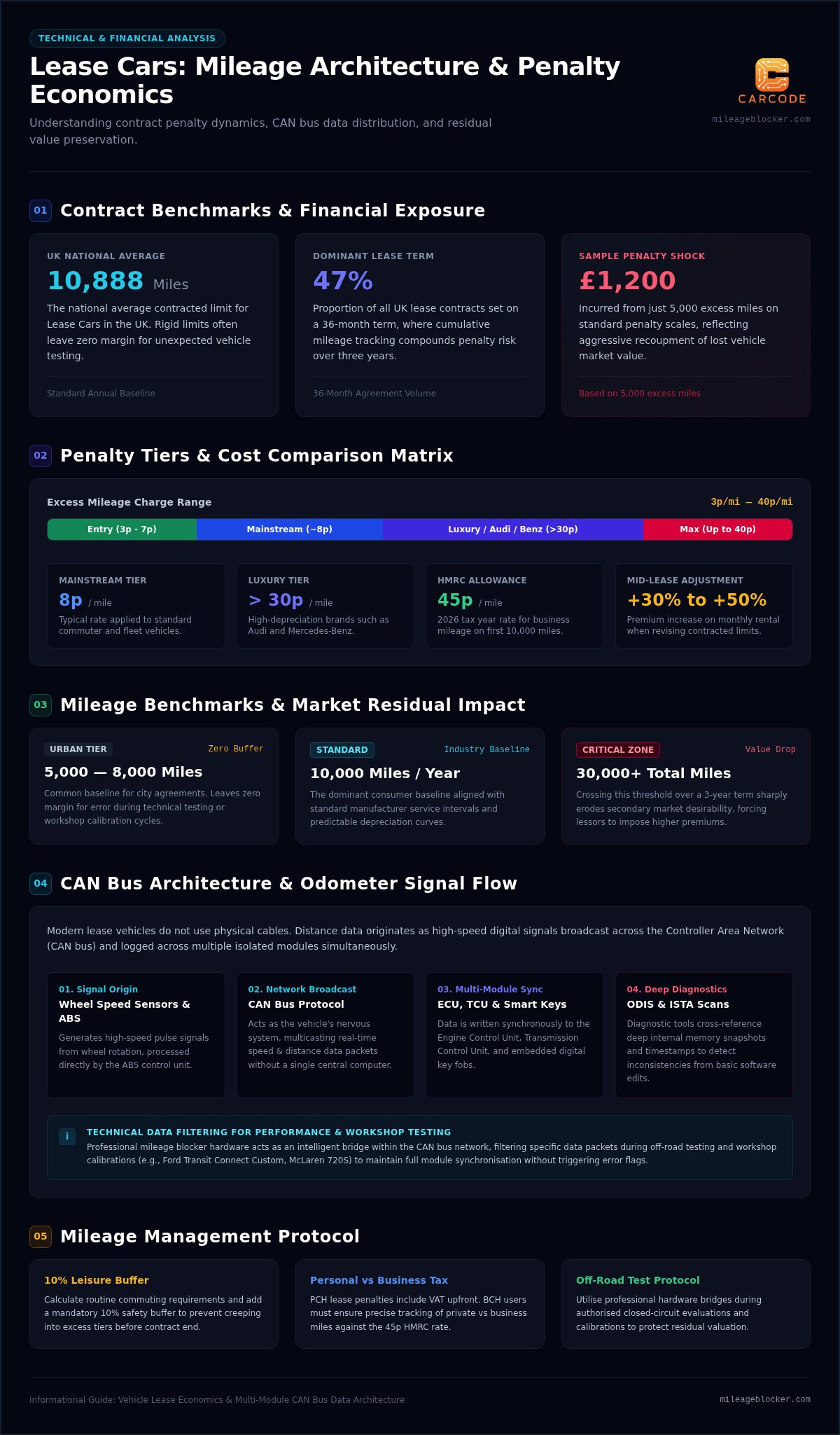
While the national average contracted limit for Lease Cars in the UK sits at 10,888 miles, many drivers find themselves trapped by rigid agreements that don't account for unexpected testing. If your car is part of the 47 percent of leases on a 36-month term, you know the anxiety of watching the odometer creep toward that penalty threshold. It's a heavy burden. We've seen how a few extra miles can turn into a £1,200 penalty with charges reaching 40p per mile. You can use our vehicle search tool to see how specific hardware fits your model.
It's a high-stakes game where the leasing company holds the advantage. You deserve to manage your vehicle's data through technical precision without the stress of depreciation. This guide explains how to navigate these contracts while maintaining the vehicle's residual value during essential off-road testing. We'll look at the technical side of odometer tracking. We also explain how professional hardware ensures your mileage remains accurate for authorised use cases.
Key Takeaways
- Understand how excess mileage charges scale from 3p to 30p per mile to project the true cost of your contract accurately.
- Learn how modern vehicles synchronise mileage data across multiple modules like the ECU and key fob via the CAN bus.
- Discover technical strategies to manage Lease Cars and maintain their residual value throughout the agreement term.
- Explore how professional mileage blocker hardware facilitates off-road testing without disrupting complex vehicle electronics.
Understanding Lease Cars and the Financial Impact of Mileage Limits
Lease Cars operate on a fixed financial formula. Your monthly payment essentially covers the difference between the car's showroom price and its projected residual value at the end of the term. This calculation relies almost entirely on the odometer reading. Understanding vehicle leasing terms is vital for professionals using vehicles for commercial testing. High mileage accelerates mechanical wear and depreciation. If you use a Ford Transit Connect Custom mileage blocker for workshop calibrations, you know that every mile logged on the dash directly impacts the asset's final valuation.
The "Excess Mileage Charge" acts as a financial deterrent. These rates scale significantly depending on the vehicle tier. While mainstream models might charge 8p per mile, luxury brands like Audi or Mercedes-Benz often exceed 30p per mile. We've seen drivers face unexpected bills of £1,200 or more for being just 5,000 miles over their limit. This isn't a random fee. It's a calculated recoupment of the vehicle's lost market value.
The Math of Excess Miles: Personal vs Business Leases
Personal Contract Hire (PCH) penalties usually include VAT, making them more expensive upfront for individuals. Business Contract Hire (BCH) users must account for different reporting. For the 2026 tax year, the HMRC business mileage allowance remains at 45p for the first 10,000 miles. Exceeding your contracted distance doesn't just incur fees from the lessor; it can also complicate your company car tax position if you aren't tracking business versus private use accurately.
Why 10,000 Miles is the Industry Benchmark
The 10,000-mile threshold is the dominant consumer baseline because it aligns with standard service intervals and predictable depreciation curves. Agreements set at 5,000 or 8,000 miles are common for city drivers, but they leave zero margin for error during vehicle testing. Once a car crosses the 30,000-mile mark over a three-year lease, its desirability in the used market drops. This forces the leasing company to set higher monthly premiums for these Lease Cars to cover the risk.
Technical Odometer Tracking: How Modern Lease Vehicles Record Data
Modern Lease Cars no longer rely on the physical spinning cables found in vintage models. Instead, distance data is a high-speed digital signal generated by wheel speed sensors and processed by the ABS. This information is broadcast across the vehicle's network in real time using complex communication protocols. For those managing a high-end fleet, the FTC guide on vehicle leasing highlights the importance of adhering to mileage caps to avoid heavy penalties. A professional mileage blocker acts as a sophisticated bridge in this network, filtering specific data packets during off-road testing to ensure electronics remain synchronised.
The Role of the CAN Bus in Mileage Accumulation
The Controller Area Network (CAN bus) functions as the car’s nervous system, allowing electronic control units to communicate without a central computer. When the vehicle moves, speed data packets are sent to every connected module simultaneously. Simple "correction" software is easily detected by modern diagnostic tools like ODIS or ISTA because it only targets the dashboard display. These tools look for timestamps and mileage snapshots stored deep within the vehicle's internal memory modules. It's a technical reality that makes basic software alterations obsolete.
Multi-Module Data Storage
Mileage is logged synchronously in the Engine Control Unit (ECU), the Transmission Control Unit (TCU), and even the digital smart key fobs. If you don't pause the data at the source during performance evaluations on a closed circuit, these modules will record every mile. You can find more details on how these systems interact in our mileage-blocker-faq. Our engineers understand the complexities of modern vehicle architecture. If you need a technical assessment for your Lease Cars, contact our specialist support team for professional guidance.
Practical Strategies for Managing Your Lease Mileage
Proactive management is the only way to stay within contractual boundaries for Lease Cars. We recommend a strict "mileage budget" that accounts for both your daily commute and a 10 percent buffer for leisure travel. This is particularly vital for high-performance assets where depreciation is aggressive. If your fleet includes a McLaren 720S mileage blocker, you understand that every extra mile on the odometer significantly erodes the car's market appeal. Managing these figures during testing ensures the vehicle's residual value remains protected.
The High Cost of Mid-Contract Adjustments
Many drivers attempt to increase their mileage allowance once they realise they will exceed the limit. While most finance providers allow this, they charge a high premium. The updated monthly rental is often 30 to 50 percent higher than the initial rate. In our business, we've seen how these costs can outweigh the benefits of the lease itself. It is often more efficient to utilise technical tools during authorised testing phases. You can use our vehicle find tool for your car to identify compatible hardware for your specific model and year.
Technical Solutions for Vehicle Testing
Performance evaluations on a dynamometer or closed track present a unique data challenge. These sessions are not "road use," yet the vehicle's internal modules will record every rotation as distance travelled. Technical solutions like mileage stoppers pause data accumulation during these testing scenarios. It is vital to distinguish these professional tools from illegal activities mentioned in the NHTSA guidance on odometer fraud. Professional hardware is designed for maintenance and diagnostic accuracy. If you need to ensure your testing data is managed correctly, speak with our technical team today.
Professional Mileage Blockers for Lease Car Testing and Maintenance
Engineering a reliable mileage blocker requires high-performance components that go beyond standard consumer electronics. These devices are manufactured with heat-resistant housings and microchips capable of processing complex CAN bus data in real time. For those managing professional Lease Cars, maintaining the electrical integrity of the vehicle is a priority. Our hardware utilizes original equipment (OE) connectors to provide a secure, plug-and-play interface. This ensures that no factory wires are cut or spliced during the setup. To guarantee a perfect integration, we provide a professional fitting service across the UK.
Why Hardware Beats Software Every Time
Illicit mileage correction software is often detected during routine servicing because it leaves digital footprints in secondary ECUs. Physical blockers are technically superior. They act as a hardware-based filter that pauses data accumulation during testing without altering historical records. We use high-grade components designed to withstand the constant vibrations and temperature fluctuations found behind a vehicle's dashboard. It's a discreet solution that prioritises technical precision over risky software patches.
Compatibility Across the 2026 Fleet
Modern vehicle architecture is becoming increasingly complex with the rise of virtual displays and high-speed networks. Our engineering team develops specific firmware to ensure compatibility with the latest 2026 models. This includes support for utility vehicles like the Ford Ranger mileage can blocker. Whether your fleet uses traditional analogue dials or the latest digital cockpits, our hardware prevents communication errors. It allows for accurate diagnostic testing and maintenance without disrupting the vehicle's nervous system. Managing Lease Cars effectively requires tools that match the sophistication of the vehicles themselves.
Securing Your Vehicle's Value for the Long Term
Successfully managing Lease Cars requires a strategic combination of strict mileage budgeting and technical oversight. You now understand that modern vehicle architectures log distance data across multiple redundant modules like the ECU and TCU. This makes simple software patches ineffective for professional testing environments. By utilising high-performance hardware, you ensure that diagnostic runs and workshop calibrations don't inflate your odometer readings or impact the car's residual value.
Our team provides discreet worldwide shipping and a professional fitting service across the UK to support all 2026 models. This level of engineering precision allows you to focus on vehicle performance without the constant anxiety of excess mileage penalties. Take a moment this week to audit your current odometer reading against your contract's annual allowance. If you discover that testing requirements are pushing you toward a penalty, Find the right mileage blocker for your vehicle today. You can manage your automotive data with technical confidence and professional discretion.
Frequently Asked Questions
Is it legal to use a mileage blocker on my lease car in the UK?
Yes, using a mileage stopper is legal for diagnostic testing or performance evaluations on private property. We don't provide legal advice, but these are technical tools meant for workshop calibrations. It's a preventative device rather than an alteration tool. You should always review your contract for Lease Cars to ensure you're following the rules on modifications. Staying within your agreement's terms while testing is vital for any professional driver.
Will a mileage stopper be detected during a routine service at the dealership?
Routine services usually involve plugging in a diagnostic tool. Unlike software corrections that leave digital footprints, our hardware pauses data across the CAN bus. This means miles aren't logged in the transmission or ECU in the first place. Professional fitting ensures the module is hidden behind the dash. This makes it very difficult for a technician to spot during a standard health check compared to obvious software patches in the car's memory.
Can I install a mileage blocker myself, or do I need a professional fitter?
You could do it yourself since we use plug-and-play connectors, but we really suggest a professional fitting. Modern car interiors are full of fragile clips and complex wiring. If you aren't careful, it's easy to damage the trim or cause a fault in the electronics. A pro ensures the device is tucked away safely and the CAN bus signals stay stable. It's the best way to keep your vehicle's nervous system intact.
Does a mileage blocker affect other functions of the car, like the speedometer or cruise control?
Most of our hardware keeps your speedometer and cruise control working perfectly. We develop specific firmware so that only the distance data gets blocked. This means you can still see your speed while testing on a track. You just need to make sure you've selected the right mode for your car. This keeps your driver assistance systems happy and prevents any annoying error messages from popping up on the digital display.
What happens if I return a lease car with a mileage blocker still installed?
You definitely need to take the blocker out before the car goes back. Leaving it in is a breach of your agreement and will likely cause issues during the final inspection. The good news is that our OE-grade connectors mean you can just unplug it. It won't leave any cut wires or physical marks behind. Removing the module returns everything to factory settings, so the odometer can start recording normally for the next person.
About the author
MileageBlocker TeamThe MileageBlocker Technical Team covers vehicle electronics, CAN and CAN-FD systems, mileage blocker compatibility, installation and product developments.
View author profile →