
How to Reset ECU After Mileage Blocker Removal: A Technical 2026 Guide
Learn how to reset ECU after mileage blocker removal on your BMW or Ferrari. Our 2026 guide shows you how to clear fault codes for a full system synchronisat...
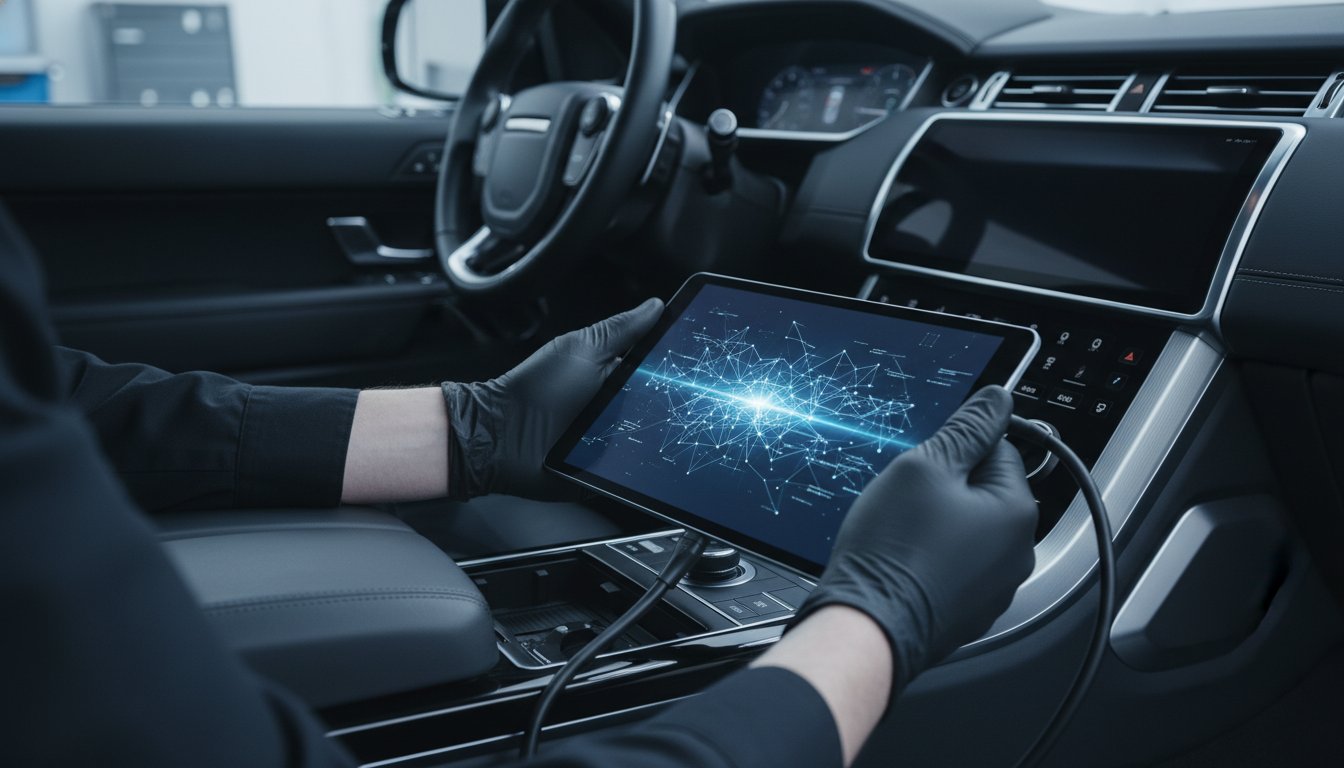
Removing the physical hardware of a mileage blocker is only fifty percent of the job; leaving the digital footprint behind is where most professional restorations fail. You have likely uninstalled your device from your Range Rover or BMW and noticed that the dashboard still isn't quite right. It is a common frustration to see persistent "U" codes on the CAN-bus or warning lights that refuse to clear. Learning how to reset ecu after mileage blocker removal is the only way to ensure your vehicle, whether it is a high-performance Ferrari or a Lamborghini, is technically clean and fully synchronised.
This technical 2026 guide provides the masterclass you need to achieve a factory-grade diagnostic report and perfect module alignment. By following these professional steps, you can confirm that no traces of the device remain in the system memory. We will explore the precise methods for clearing fault codes and re-establishing communication between the ECU and other critical modules like the ABS. Whether you are using Carcode Mileage Blockers or other high-end tools from MileageBlocker.com, mastering this synchronisation process is essential for maintaining the electronic integrity of your vehicle.
Key Takeaways
- Understand how modern CAN-bus systems distribute mileage data across the ECU, ABS, and transmission modules to ensure comprehensive synchronisation.
- Follow the precise 10-minute "bus sleep" protocol before accessing the instrument cluster to safely uninstall Carcode Mileage Blockers from your vehicle.
- Master the professional process of how to reset ecu after mileage blocker removal by using high-end OBD-II scanners to clear persistent "U" diagnostic trouble codes.
- Learn specific verification techniques for luxury marques like Ferrari and Lamborghini, including aligning engine hour counters with dashboard readings.
- Gain the technical knowledge required to produce a "factory-clean" diagnostic report that confirms no digital traces remain after device removal.
Understanding ECU Fault Codes and Data Synchronisation Post-Removal
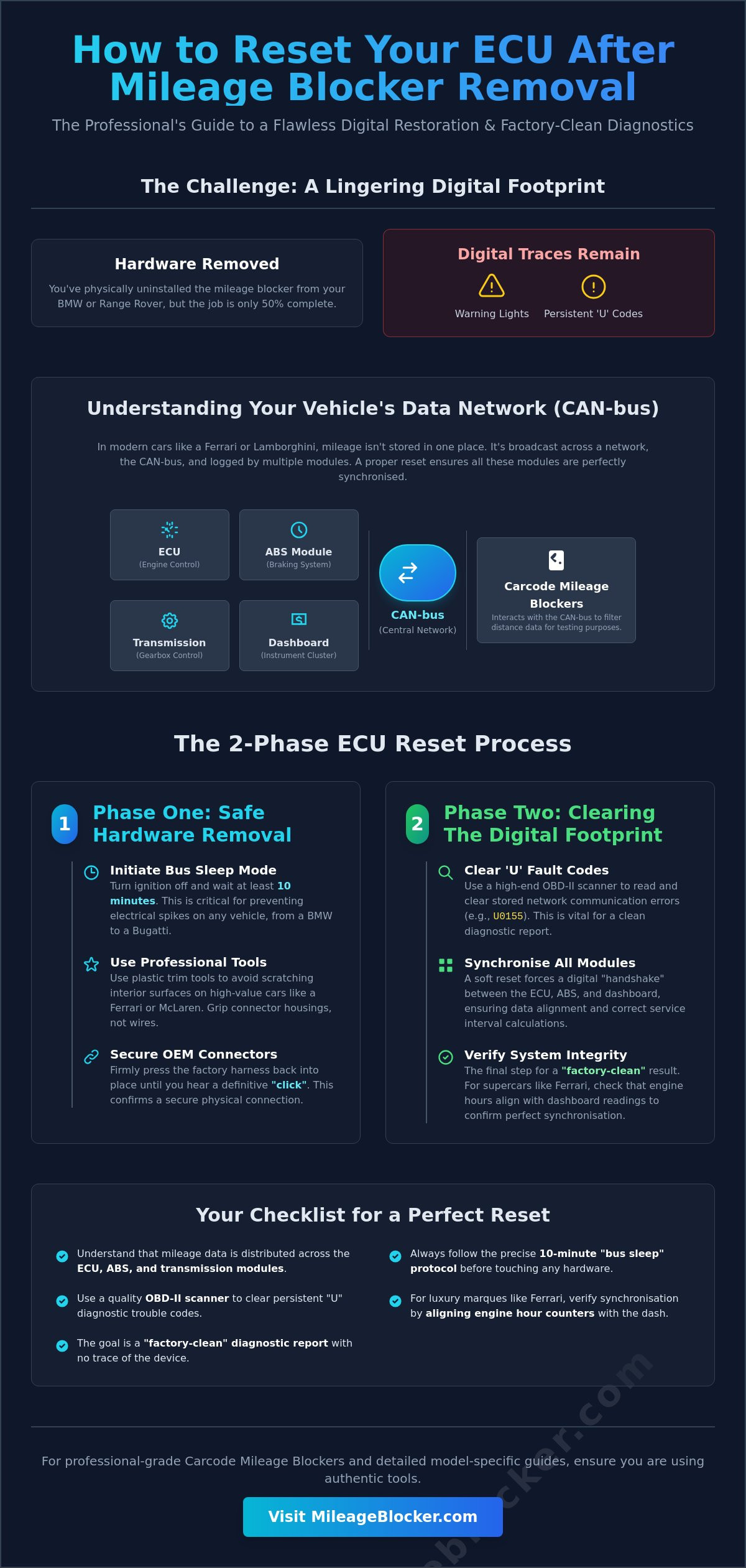
Modern vehicle architectures rely on a high-speed communication network known as the CAN-bus. When you install a hardware solution like those found at MileageBlocker.com, the device interacts with this network by filtering specific data packets related to distance recording. In a BMW or a Range Rover, the odometer signal isn't just displayed on the dashboard; it's broadcast to every critical component. The Engine Control Unit (ECU), the ABS module, and even the transmission controller maintain their own logs. If you remove the hardware without a proper follow-up, these modules may retain conflicting data or stored communication errors. Learning how to reset ecu after mileage blocker removal is the only way to restore the digital harmony required for accurate future servicing at a professional centre.
Common CAN-bus Error Codes (U-codes)
The most frequent side effect of hardware removal is the appearance of "U" codes, which signify a network communication failure. You might encounter U0155, which indicates a lost communication link with the instrument panel cluster. These codes often trigger when the physical circuit is interrupted during the uninstallation of Carcode Mileage Blockers. Distinguishing between an active fault, which indicates a current wiring issue, and a stored history code is vital for a clean diagnostic report. Stored codes don't necessarily mean the car is broken, but they will appear on any professional diagnostic report during a routine check at a dealership if they aren't cleared manually.
Why Modern ECUs Require a Soft Reset
Once the hardware is gone, the vehicle needs to re-establish a digital "handshake" between the odometer and the engine management system. Without this, your trip computer might show discrepancies, or the vehicle may fail to update service intervals correctly. This is particularly sensitive in hypercars like a Bugatti or McLaren, where every sensor reading is cross-referenced for performance mapping. ECU synchronisation is the alignment of data across all independent vehicle processors to ensure a unified state of operation. Knowing how to reset ecu after mileage blocker removal ensures that these background processes resume without triggering secondary warning lights on the dashboard or desyncing the ABS module.
Step-by-Step Guide to Uninstalling Carcode Mileage Blockers
Properly decommissioning the hardware is a prerequisite for a clean system reset. Before you begin the physical uninstallation, ensure the vehicle's ignition has been off for at least 10 minutes. This duration allows the CAN-bus system to enter a "sleep mode," which is essential for preventing sudden voltage spikes or communication errors when breaking the circuit. For most BMW and Range Rover models, you will need to access the rear of the instrument cluster, while high-performance assets like a Lamborghini or Bugatti may require accessing specific module bays located behind interior trim panels.
Executing the physical uninstallation correctly simplifies the subsequent task of how to reset ecu after mileage blocker removal by preventing avoidable hardware faults. While these devices are professionally engineered for testing and research, users must remain aware of Federal laws on odometer fraud to ensure all activities remain within legal boundaries. Once you have reached the device, inspect the OEM pins and connectors for any signs of stress or misalignment before proceeding with the disconnection. You can view our detailed installation and removal guides for model-specific diagrams and panel locations.
Safe Physical Disconnection Procedures
Always use plastic trim tools to pry away dashboard components to avoid marking the leather or carbon fibre surfaces of a Ferrari or McLaren. Do not pull on the wires themselves; instead, grip the connector housings firmly to release the locking mechanisms. Once the Carcode Mileage Blocker is removed, verify that the factory loom is undamaged. High-grade components are designed for durability, but the delicate pins of the vehicle's original harness require careful handling to maintain a perfect connection once the device is out of the loop.
Reconnecting OEM Loom Connectors
Align the factory harness with the cluster port and press firmly until you hear the locking tab "click" into place. This audible confirmation ensures a secure connection and prevents intermittent signal loss. Before fully reassembling the dashboard, perform a quick check for "ghosting" or flickering on the digital display. Test basic cluster functions, such as the speedometer and fuel gauge, immediately after reconnection to confirm the physical loop is restored. If the display remains blank, reseat the connectors before moving on to the software-based ECU reset. For further technical assistance, you may consult our installation support resources to ensure your vehicle is returned to its original factory configuration.
Professional Methods to Clear Stored Fault Codes and Reset Modules
Attempting to clear vehicle data by simply disconnecting the battery terminal is an outdated and potentially damaging practice for modern luxury vehicles. While this might have worked on older platforms, a BMW or Range Rover will likely respond with a cascade of new errors, such as lost steering angle sensor calibrations or window indexing faults. Understanding how to reset ecu after mileage blocker removal involves using the vehicle's On-Board Diagnostics (OBD-II) system rather than simple power interruption. Professional-grade scanners allow you to perform a "Global Scan," which interrogates every module on the CAN-bus to identify and purge hidden Diagnostic Trouble Codes (DTCs) that standard consumer readers often overlook.
In high-performance German-engineered vehicles, it is vital to distinguish between "Fault Memory" and "Event Memory." Fault Memory contains active errors that trigger warning lights, while Event Memory logs intermittent communication drops that occurred while the hardware was active. Clearing both ensures that a dealership technician sees a factory-clean report during your next service. Once the software reset is complete, perform a short test drive of at least three miles. This allows the ECU to verify that the odometer is incrementing correctly across all modules, including the transmission and ABS controllers. If you encounter persistent issues, you can find further technical support at MileageBlocker.com.
Using OBD-II Diagnostic Tools for a Clean Sweep
For a comprehensive reset, tools from manufacturers like Autel or Launch are recommended. These devices can access the Gateway module, which acts as the central router for all vehicle data. By scanning the Gateway, you ensure that communication paths between the engine management and the instrument cluster are fully restored. This process removes the "ghost" history codes that signify where the communication loop was previously filtered by the hardware. Using brand-specific software for a Ferrari or Lamborghini ensures that even the most deeply embedded logs are synchronised with the current dashboard state.
The 'Hard Reset' vs. 'Soft Reset' Approach
A "Soft Reset" via diagnostic software is the preferred method for Carcode Mileage Blockers because it targets specific memory registers without affecting unrelated systems. Conversely, a "Hard Reset" involves a capacitive discharge, where the battery is disconnected and the leads are joined to drain residual power from the capacitors. While effective for some legacy systems, this carries significant risks for high-tech electric vehicles like the Porsche Taycan or Tesla, where sensitive DC-to-DC converters are present. Stick to software-based resets to maintain the integrity of your vehicle's complex electronic architecture. For more information on maintaining your device, find your car's specific profile on our platform.
Verifying System Integrity in Luxury and Performance Vehicles
High-value assets like a Ferrari, Lamborghini, or Bugatti demand a level of digital scrutiny that goes beyond standard passenger cars. These vehicles utilise redundant data storage across multiple layers of the electronic architecture. When you research how to reset ecu after mileage blocker removal, you must account for secondary traces in telematics and infotainment modules that may have cached location or distance data. Ensuring 100% synchronisation is the only way to maintain the provenance and resale value of a performance vehicle. A "factory-clean" diagnostic report is the standard required before any professional appraisal or manufacturer-approved service.
Specific Reset Requirements for BMW and Range Rover
BMW owners must pay close attention to the Condition Based Service (CBS) data after uninstallation. This system calculates service intervals based on driving style and distance; if the dashboard is reset but the CBS logs remain out of sync, the vehicle may prompt for immediate, unnecessary maintenance. Similarly, a Range Rover requires a thorough check of the Terrain Response and Air Suspension modules. If communication was interrupted during the use of Carcode Mileage Blockers, these systems might retain temporary "implausible data" flags. You should also ensure your Key Fob data is updated, as modern keys store the vehicle's mileage every time they are used to start the engine.
High-End Diagnostics for Supercars (Ferrari, McLaren)
Professional supercar maintenance requires 100% data transparency across all electronic logs to ensure safety and valuation. When dealing with a McLaren or Ferrari, use a specialised diagnostic interface to verify the "Total Distance" parameters stored within the Gearbox Control Unit and the Engine ECU. These values must align perfectly with the instrument cluster to avoid triggering internal consistency errors. You should also cross-reference the "Engine Hours" counter with the odometer; a significant discrepancy here can indicate a lack of synchronisation that professional appraisers will quickly identify. You can find answers to common technical queries in our FAQ at MileageBlocker.com if your specific model requires unique reset protocols.
Before presenting your vehicle for an MOT or a professional valuation, perform a final sweep of the system history. Check that no residual "U" codes remain in the gateway and that all telematics data has been refreshed to reflect the current state of the car. This final verification confirms that the uninstallation process is complete and the vehicle's network is operating in its original factory state. Taking these extra steps ensures that how to reset ecu after mileage blocker removal is handled with the technical precision these high-performance machines require.
Restoring Full Digital Integrity to Your Vehicle
Returning your BMW, Range Rover, or Lamborghini to its factory state requires more than just unplugging a harness. You must perform a comprehensive software sweep to clear communication history and synchronise every processor on the CAN-bus. Mastering the process of how to reset ecu after mileage blocker removal ensures that your vehicle's diagnostic history remains clean and ready for professional inspection. This digital cleanup is essential for maintaining the electronic health and future resale value of high-performance assets.
Our industry-leading Carcode Mileage Blockers are engineered with OEM connectors for discreet operation and seamless removal. We provide expert UK-based technical support for all premium brands, ensuring you have the knowledge required for advanced vehicle electronics. If you need specific guidance for your vehicle profile, contact our technical team for professional removal advice. With the right diagnostic tools and a methodical approach, you can manage your vehicle's data with absolute confidence and technical precision.
Frequently Asked Questions
Do I always need to reset the ECU after removing a mileage blocker?
Yes, performing a software reset is essential to clear stored communication logs and ensure full module synchronisation. While a BMW or Range Rover will function physically without one, the internal network will likely retain "U" codes that indicate a previous communication break. Professionals at MileageBlocker.com recommend this step to maintain a factory-clean diagnostic state for your vehicle's electronic management systems and to prevent future service discrepancies.
Will removing the device leave a permanent "tamper" code in the ECU?
No, high-quality Carcode Mileage Blockers are engineered for discreet operation and don't trigger permanent tamper flags. However, failing to clear the "Event Memory" might leave history codes that suggest a temporary communication loss. Following the master guide on how to reset ecu after mileage blocker removal ensures these transient logs are purged, leaving no digital footprint in the ECU of a Lamborghini or Bugatti during professional inspections.
Can I use a cheap OBD-II scanner to clear these fault codes?
Basic OBD-II readers are generally insufficient as they only access generic powertrain codes. To perform a "Global Scan" on a modern Range Rover or Ferrari, you need a professional-grade tool like an Autel or Launch tablet. These devices can reach the Gateway and body control modules where specific network communication errors are stored, allowing for a comprehensive system purge that cheap handheld alternatives simply cannot perform.
What happens if I don’t reset the ECU after removal?
Neglecting a proper reset can lead to persistent dashboard warning lights or discrepancies in "Condition Based Service" data. In complex systems like those found in a McLaren, the ABS and transmission modules might retain old data packets, leading to synchronisation errors. Learning how to reset ecu after mileage blocker removal prevents these digital misalignments from affecting the vehicle's long-term diagnostic accuracy and the integrity of the performance monitoring systems.
Does the battery disconnection method work for modern BMWs and Audis?
Disconnecting the battery is an outdated method that often introduces more complications in modern BMW or Audi models. This action can trigger steering angle sensor faults and reset power window indexing, requiring further calibration. It doesn't clear the non-volatile "Event Memory" where communication logs are stored. Software-based resets via the OBD-II port remain the only reliable method for professional data restoration and system alignment.
How can I verify that my mileage blocker was removed without a trace?
Verification requires a full system diagnostic scan to confirm that all "U" codes and communication history have been cleared. For premium marques like a Lamborghini or Bugatti, you should also verify that the "Engine Hours" and "Total Distance" parameters in the gearbox ECU align with the dashboard display. Achieving a zero-fault report across all electronic control units is the ultimate confirmation of a successful and clean removal process.
About the author
MileageBlocker TeamThe MileageBlocker Technical Team covers vehicle electronics, CAN and CAN-FD systems, mileage blocker compatibility, installation and product developments.
View author profile →