
How to Avoid Going Over Your Mileage on a Lease
Discover how to avoid going over mileage on lease agreements. Forecast your driving accurately, track your odometer, and manage contract allowances early.
The best way to avoid an excess-mileage charge isn’t to guess how much driving you have left. Compare your current odometer reading with the total allowance in your agreement, then act early if your forecast points to an overrun. If you’re researching how to avoid going over mileage on lease, start by working out where you stand now.
An original estimate can quickly become unreliable when your commute, work pattern or family travel changes. This guide explains how to calculate a realistic mileage forecast, track it against your contract and check the relevant terms before contacting your leasing provider. You’ll also find out what records to gather and what to ask about any mileage amendment process. Your provider’s terms determine whether a change is possible, so don’t assume the allowance can be revised or wait until the vehicle is due back to ask.
Key Takeaways
- To learn how to avoid going over mileage on lease, forecast your driving and review the estimate when your circumstances change.
- Check your signed agreement for the total allowance, measurement period and excess-mileage terms.
- Keep dated mileage notes and journey or service records so you can review your progress over time.
- If your forecast points to an overrun, ask your leasing provider early whether the agreement allows a change. An odometer blocker does not amend your contractual allowance.
How to avoid going over mileage on a lease: start with your allowance
To work out how to avoid going over mileage on lease, compare the distance you’ve driven with the allowance in your signed agreement, then consider how much contract time remains. Your current odometer reading is a useful starting point, but you’ll also need the vehicle’s mileage when the lease began to calculate how far you’ve driven during the contract.
A mileage allowance is the agreed distance you may drive under the contract; actual mileage is the distance the vehicle has travelled. A mileage forecast estimates how much of that allowance you’ll use by projecting your current and expected driving across the time left.
For a general overview of how a vehicle lease agreement is structured, see this reference. For practical context on an over-mileage situation, watch the video below.
Find the mileage terms in your lease agreement
Find the total mileage allowance, contract start and end dates, and the wording about excess mileage. Check whether the allowance covers the whole term or is stated by year, and how the agreement defines the mileage period. Personal contract hire (PCH) and personal contract purchase (PCP) can have different terms, so don’t assume their rules are interchangeable. If the wording is unclear, ask your leasing provider to explain how it applies to your agreement.
Calculate how much mileage you have left
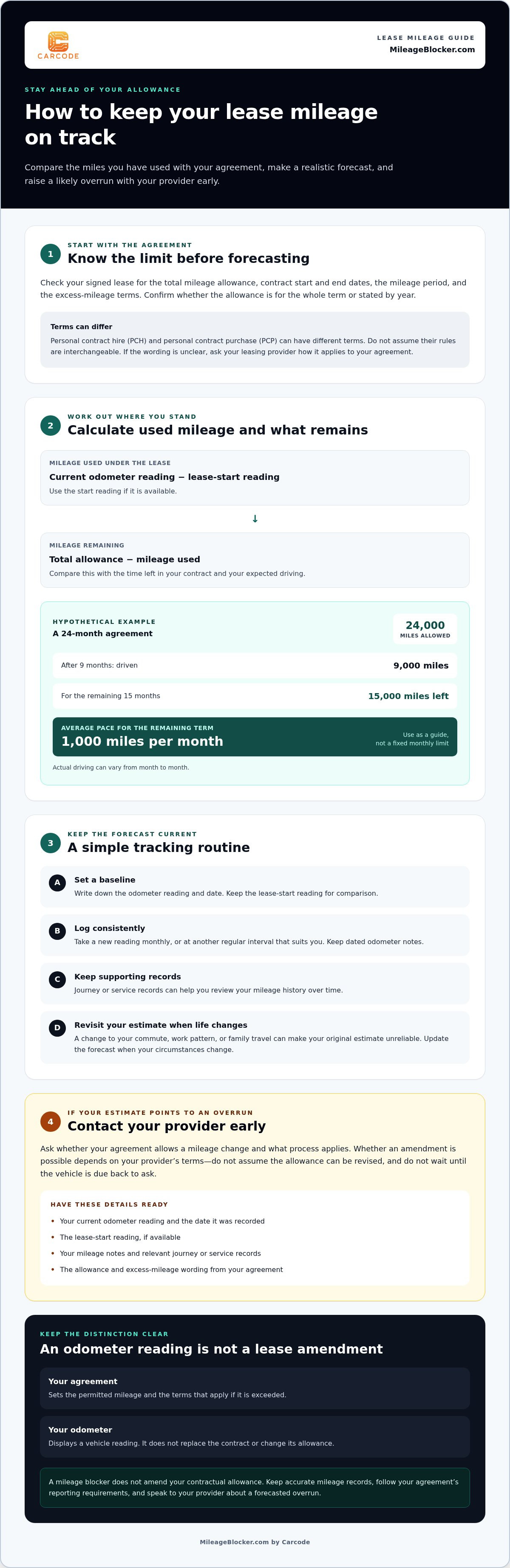
Record the current odometer reading and, if available, the reading at the start of the lease. Subtract the starting reading from the current one to calculate the mileage used under the contract. Then subtract that amount from your allowance to find the remaining mileage. Note how much contract time has passed and how much remains before estimating future use.
Hypothetical example: A 24-month agreement allows 24,000 miles. After 9 months, the car has covered 9,000 miles under the lease, leaving 15,000 miles for the remaining 15 months. That works out to an average of 1,000 miles per month. Use this as a guide to your pace, not a fixed limit for each month; actual driving can vary.
Why an odometer blocker does not change your lease mileage
A device that prevents an odometer from recording mileage does not amend the mileage allowance or excess-mileage terms in a lease. Your contract remains the reference for the agreed limit, regardless of what appears on the dashboard. Changing a reading and changing a contractual obligation are not the same thing.
Mileage records and lease obligations are different
Your lease sets the permitted mileage and the terms that apply if you exceed it. The odometer displays a vehicle reading. These have different purposes, and one does not replace the other. If your agreement or provider requires you to report mileage, give accurate information. Keep dated records of your own so you can monitor usage and refer to a consistent history.
For practical advice on how to avoid going over mileage on lease, focus on forecasting your driving and speaking to the provider if your estimate is too high. Misrepresenting a vehicle’s history or contractual use is not a way to manage mileage. It can create further issues rather than resolve your concern about the allowance.
Use devices only within the stated application
MileageBlocker.com by Carcode describes its devices for vehicle testing or use on off-road tracks, not for avoiding lease mileage charges. A device does not remove contract, disclosure or record-keeping responsibilities. We don’t make a universal claim about whether such devices are lawful in every situation; applicable rules can depend on jurisdiction and circumstances.
If you’re researching the technology, keep that separate from lease advice. The mileage blocker technology guide provides device context, but it doesn’t change your agreement. For a lease concern, check the contract wording and ask your provider to clarify its requirements.
Five practical steps to keep your leased-car mileage on track
A regular tracking routine gives you a more reliable forecast than relying on memory. Use the steps below to spot changes early and update your estimate while you still have time to discuss it with your provider.
Build a simple mileage-tracking routine
- Set a baseline. Record the odometer reading and date, and keep the lease-start reading for comparison.
- Log consistently. Take a new reading monthly, or at another regular interval that suits you. Keep dated odometer notes alongside service records or journey logs.
- Check your pace. Compare the mileage driven under the lease with an allowance-to-date target. Treat this as a progress check, not a separate monthly limit, unless your agreement says otherwise.
- Forecast upcoming driving. Consider your usual commute, regular errands and planned long trips. Estimate future mileage from the journeys you expect to make, rather than assuming every month will match the last one.
- Reassess after a change. A new commute, changed work pattern or additional regular journey can alter your projection. Update your estimate and compare it with the remaining allowance.
Reduce avoidable mileage without disrupting essential journeys
Look for changes that suit your routine. If practical, combine nearby errands into one trip, share a regular journey, schedule an errand alongside another trip, or complete it remotely. A suitable alternative to driving may also reduce mileage, but not every journey can be changed. Don’t compromise essential travel just to meet an estimate.
These checks help you understand how to avoid going over mileage on lease by showing where your forecast is heading, not by guaranteeing a particular outcome. Excess-mileage terms vary by agreement, so refer to your own contract when considering the consequences of a projected overrun.
What to do if your lease mileage forecast is too high
If your projection suggests you may exceed the allowance, contact your leasing provider early. Ask whether your agreement allows the allowance to be changed, and request details of any available options, conditions and charges in writing. Don’t assume an amendment is possible or that a particular fee applies.
Before contacting the provider, gather the details that will help you explain your position:
- Your signed agreement, including the mileage and excess-mileage terms
- The current odometer reading and the date it was recorded
- Your estimated mileage by the end of the contract
- The contract end date and any relevant mileage records
Questions to ask your leasing provider
Ask whether the allowance can be amended, what process applies and whether the provider would issue revised terms. Confirm how mileage will be assessed when the vehicle is returned, which agreement wording applies to any excess, and whether you should retain particular records. Ask when and how the final mileage reading will be taken.
Keep the next step accurate and well documented
Save the provider’s written response, your mileage logs and any amended agreement documents together. If the provider confirms a change, check that the revised terms are clearly recorded before relying on them. This gives you a consistent reference for the rest of the contract.
For questions about device operation, the MileageBlocker.com product FAQ may help. MileageBlocker.com describes its devices for vehicle testing or off-road tracks, not as a way to avoid lease charges or obligations. For that reason, the practical answer to how to avoid going over mileage on lease is to use your agreement as the basis for decisions and confirm possible changes directly with your provider.
Take control of your lease mileage early
The practical way to understand how to avoid going over mileage on lease is to use the allowance in your agreement rather than guess. Compare your mileage with the time remaining, keep dated records and update your forecast when your driving pattern changes. If you expect to exceed the limit, ask your leasing provider whether the agreement allows an amendment and request any revised terms in writing.
An odometer device does not change the mileage terms of a lease. MileageBlocker.com describes its vehicle-specific mileage blocker technology for vehicle testing or off-road tracks, not for avoiding lease charges or contractual responsibilities. Fitting is available on request for those stated applications.
If you have an enquiry about vehicle testing or off-road use, contact MileageBlocker.com about authorised applications. For lease mileage concerns, your provider and signed agreement are the right reference points. Keep accurate records and raise concerns early so you can make an informed decision about what to do next.
Frequently Asked Questions
Can I change my mileage allowance after signing a car lease?
Possibly, but check with your leasing provider. Ask whether your agreement allows an amendment and request details of the process, conditions and revised terms in writing. Don’t treat the allowance as changed until the provider confirms it. Keep any written confirmation or updated agreement, and check whether the amendment affects the contract end date or how mileage will be assessed at return.
What happens if I go over my lease mileage?
The outcome depends on your agreement and the provider’s process. Check how excess mileage is calculated, when the vehicle’s mileage is assessed and whether other return conditions apply. If your forecast suggests you may exceed the allowance, contact the provider early. Ask them to explain any available options and applicable charges in writing instead of relying on assumptions or general information.
How do I calculate whether I will exceed my lease mileage?
Record the current odometer reading and compare the mileage used with the allowance in your agreement, taking account of the time remaining. Use a representative period of driving to estimate future use, then add known long journeys or changes to your routine. This is a forecast, not a guaranteed final figure. Review it as your driving pattern changes. That gives you a practical basis for how to avoid going over mileage on lease.
Does using a mileage blocker stop excess mileage charges on a lease?
No. A mileage blocker does not amend your lease agreement or remove the need to provide accurate information where required. MileageBlocker.com describes its vehicle-specific devices for vehicle testing or off-road tracks, not for avoiding lease charges. Check your contract and discuss mileage concerns with your provider. Don’t rely on a changed odometer reading instead of meeting or discussing your contractual terms.
When should I contact my leasing provider about mileage?
Contact them as soon as a realistic forecast suggests your allowance may not cover the remaining contract period. Be ready to share the current odometer reading, your allowance, the contract end date and your estimated future use. Ask whether an amendment or another option is available under your agreement, and request the applicable conditions and terms in writing before deciding what to do.
About the author
MileageBlocker TeamThe MileageBlocker Technical Team covers vehicle electronics, CAN and CAN-FD systems, mileage blocker compatibility, installation and product developments.
View author profile →