
How Mileage Affects Depreciation & Ways to Prevent It
A single weekend road trip can cost you £1,200 in PCP overage charges before you even pull back into your driveway. In the UK market, finance providers ...

A single weekend road trip can cost you £1,200 in PCP overage charges before you even pull back into your driveway. In the UK market, finance providers often charge up to 40p per mile for exceeding contract limits, turning a simple journey into a significant financial liability. We've seen collectors watch their car’s market value drop by thousands just by crossing a specific odometer threshold. It’s a common frustration that leads to one core question: how does driven mileage affect depreciation and how can we prevent it during necessary off-road testing?
We understand the need to protect your vehicle’s equity without sacrificing the ability to perform essential diagnostics or tuning. You shouldn't face a massive bill for ensuring your car is in peak condition. This guide explores the technical methods we use to pause mileage accumulation during authorized testing and explains why certain mileage figures act as barriers to resale value. We’ll provide a clear strategy for using professional-grade hardware to maintain the highest possible valuation for your asset.
Key Takeaways
- Understand the multiplier effect that causes a Ferrari 296 GTB to lose value at a much higher rate per mile than a standard Ford Focus.
- Learn to calculate the financial impact of PCP excess mileage charges, which typically range from 10p to 40p for every mile over your contract limit.
- Identify the technical link between digital odometer data and market value to answer how does driven mileage affect depreciation and how can we prevent it during performance testing.
- Combine traditional preservation methods like ceramic coating with a Mileage Blocker Device to protect your car's resale value during off-road use.
- Follow legal guidelines by restricting the use of mileage stoppers to authorized testing, track days, and private land scenarios.
The Correlation Between Odometer Readings and Resale Value
Depreciation is the fiscal gap between your initial purchase price and the current market value of your vehicle. While age plays a role, odometer data is the primary driver of this decline. In our workshop, we've seen how a single year of excessive driving can cause a car's value to drop by 20% more than the standard annual depreciation rate. The market views mileage as a direct proxy for mechanical fatigue. It's a simple calculation. Every mile represents wear on components that aren't easily replaced; engine internals and chassis rigidity are primary examples. This often leads owners to ask: how does driven mileage affect depreciation and how can we prevent it during necessary testing or tuning?
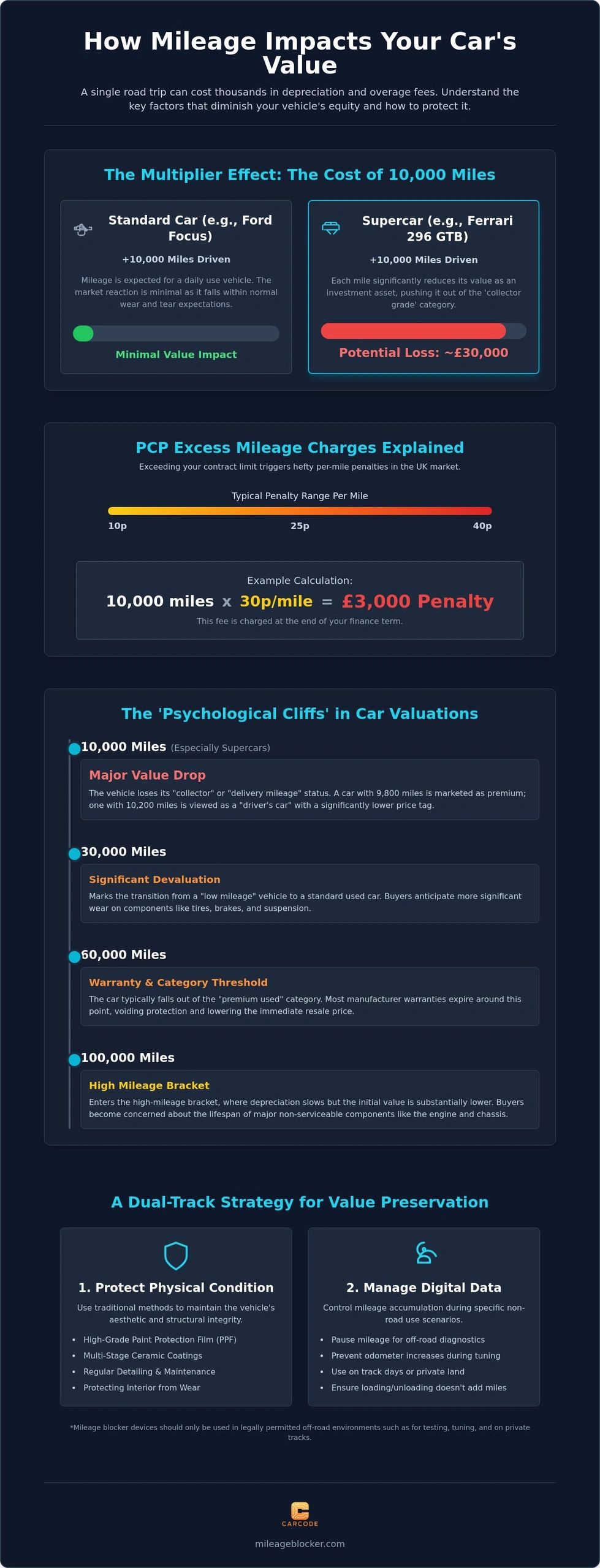
The impact isn't uniform across all brands. This is the multiplier effect. If you put 10,000 miles on a 2025 Ford Focus, the market barely reacts. Add those same 10,000 miles to a Ferrari 296 GTB, and you might lose £30,000 in potential resale value compared to a 'delivery mileage' example. Professional Car valuation experts use these figures to predict the remaining lifespan of the vehicle's most expensive parts. When we analyse the relationship between distance driven and residual value, we must account for these brand-specific curves.
Why the Market Penalises High Mileage
Buyers worry about non-serviceable wear. This includes the degradation of suspension bushings, the thinning of leather seat bolsters, and the slackening of steering components. In the UK, the 60,000-mile mark remains a significant psychological barrier. Once a car crosses this line, it usually falls out of the 'premium used' category. By 2026, most manufacturer warranties are strictly capped by mileage. Exceeding these limits by even a few miles can void your protection, which immediately lowers the resale price.
The 'Psychological Cliffs' in Car Valuations
Valuations don't move in a smooth, linear curve. They drop off cliffs. For supercars, the 10,000-mile threshold is the most notorious. A car with 9,800 miles is marketed as 'low mileage'; at 10,200 miles, it's suddenly a 'driver's car' with a much lower price tag. We often see that a vehicle with 20,100 miles on the clock is valued significantly lower than one showing 19,900 miles, simply because it has crossed into a new bracket. These invisible barriers at 30k, 60k, and 100k miles dictate exactly what a dealership will offer you for a trade-in.
Brand-Specific Depreciation: Supercars vs. Daily Drivers
A 2025 Porsche 911 GT3 follows a vastly different financial trajectory than a standard BMW 3 Series. For the BMW, mileage is expected; it's a tool for commuting. For the Porsche, every mile on the clock is a direct withdrawal from your bank account. High-end auction data confirms that mileage is often the biggest influence on value, especially for limited-production models. If your car is an investment asset, maintaining a low odometer reading isn't just about aesthetics. It's about protecting equity.
Electric vehicles like the Tesla Model S Plaid introduce a new variable: battery health. Buyers use mileage to estimate the remaining cycles in the lithium-ion cells. High mileage on an EV suggests more frequent rapid charging cycles and potential thermal stress. This makes the question of how does driven mileage affect depreciation and how can we prevent it even more critical for early adopters.
Exotic Cars and the 10,000-Mile Barrier
The McLaren Artura provides a clear example of the 10,000-mile barrier. A sub-1,000-mile example might command a 30% premium at auction compared to one with 12,000 miles. Once an exotic car enters five-digit territory, it loses its collector status and becomes a driver's car. We've noted that professional transport companies often use a Mileage Blocker Device during enclosed transit to ensure that loading and unloading don't add unnecessary digits to these sensitive assets.
How Fleet and PCP Agreements Calculate Overage
UK PCP agreements are notoriously rigid regarding overage. Charges typically range from 10p to 40p per mile. A 10,000-mile overage on a high-spec vehicle can result in a £3,000 penalty at the end of the term. It's an expensive mistake. Lease companies now use sophisticated digital diagnostics to verify that mileage data is consistent across all control modules. If you are concerned about your contract limits, you might want to use a PCP mileage excess charge calculator uk to estimate your potential liability. To see if your specific model is supported for testing, you can find your car in our compatibility database.
Practical and Technical Methods to Mitigate Depreciation
Preserving a vehicle’s value requires a dual-track strategy. You must address both the physical condition and the digital data profile. Traditional methods like applying a high-grade paint protection film (PPF) or a multi-stage ceramic coating are essential for maintaining the exterior. However, these only solve half the problem. When calculating vehicle depreciation, professional buyers look straight past the shiny paint to the odometer. This is why many owners ask: how does driven mileage affect depreciation and how can we prevent it during specific, non-road scenarios like dyno tuning or prototype testing?
We’ve observed that a meticulously documented service history is one of the most effective ways to slow the value bleed. A stamped service book from a main dealer for a 2024 Audi RS6 can easily be worth over £2,000 at the point of resale compared to an incomplete record. It provides proof that the mechanical wear matches the recorded mileage. It’s a direct signal to the market that the car has been maintained to the highest standard.
Traditional Maintenance and Preservation
Beyond the paperwork, we recommend monitoring engine hours as a more accurate metric of component health than simple mileage. A car idling in heavy traffic for three hours covers zero miles but experiences significant thermal stress. If you want to understand the true wear on your vehicle, you should review our Engine Hours to Miles Guide to see how these metrics correlate. Keeping a log of these hours alongside your service stamps adds a layer of transparency that savvy collectors appreciate.
Mileage Blockers for Off-Road and R&D Testing
When you are performing rolling road tuning or R&D testing on private land, you shouldn't be forced to accumulate "ghost miles" that don't reflect actual road use. This is where a Mileage Blocker Device becomes an essential technical tool. Unlike illegal mileage correction tools that alter existing data, a blocker simply pauses the data stream. It stops the communication between the wheel speed sensors and the ECU via the CAN-bus system. Our hardware uses high-grade German-made components to ensure that the device operates discreetly. It doesn't leave fault codes or "tamper" flags in the internal memory modules. If you need to protect your car's data integrity during testing, you can book a professional fitting service to ensure the hardware is integrated correctly into your vehicle’s electronics.
Implementing a Mileage Management Strategy Legally
Managing your vehicle's data requires an ethical and technically sound approach. If you're using a Mileage Blocker Device for off-road track days or private land testing, you must follow a clear protocol to remain within legal boundaries. We often get asked how does driven mileage affect depreciation and how can we prevent it while staying compliant with consumer protection laws. The answer lies in transparency. While you can legally pause mileage for authorized non-road use, you must disclose the true estimated mileage to any future buyer or insurance provider. This ensures your resale process remains honest while protecting your asset from unnecessary "ghost miles" during testing.
Modern vehicle electronics are incredibly sensitive. We've seen owners attempt to save money with cheap eBay clones, only to find their dashboard lit up with warning lights. These counterfeit devices often cause severe CAN-bus interference. The CAN-bus is the central nervous system of your vehicle that requires precise integration to function without error. For complex systems like the Audi RS6 Virtual Cockpit, we strongly recommend our installation service. Professional fitting ensures that high-grade OEM connectors are used, which is the only safe choice for cars still under manufacturer warranty.
Professional Installation vs. DIY Risks
Attempting a DIY install on a 2026 model year vehicle carries significant risk. Modern ECUs are designed to detect voltage irregularities and signal interruptions. Cheap, poorly shielded hardware can trigger permanent fault codes that are visible to dealership diagnostic tools. We only use German-engineered modules that mimic factory signals, ensuring the vehicle's safety systems, such as ABS and traction control, remain fully operational during testing. If your car is a high-value asset, the risk of a botched home installation far outweighs the cost of professional expertise.
Documentation and Ethical Testing Standards
Transparency is your best defense against future disputes. We recommend keeping a dedicated private logbook to record every mile driven during off-road sessions where the blocker was active. This documentation allows you to explain the discrepancy between the odometer and the actual wear to a savvy collector. In the UK, the legal framework is clear: managing your odometer is permissible for testing purposes, but misrepresenting mileage during a sale is a criminal offense. By focusing on quality hardware and professional support, you can successfully address how does driven mileage affect depreciation and how can we prevent it without compromising your integrity or the vehicle's electrical health.
Secure Your Vehicle's Future Equity
You can't stop the clock, but you can certainly control the data your vehicle records during specialized testing. By mastering how does driven mileage affect depreciation and how can we prevent it, you transition from a passive owner to an active asset manager. Start by reviewing your current mileage against the psychological cliffs we discussed, such as the 10,000 or 30,000-mile marks. Within the next seven days, audit your upcoming service schedule and off-road testing plans to identify where a technical intervention is necessary.
We provide German-engineered hardware designed for discreet, plug-and-play installation that respects your car's complex electrical architecture. With worldwide shipping available, you can secure your investment regardless of your location. Don't let a single weekend of performance tuning strip thousands from your resale price. Take the proactive step to maintain your car's market position today.
Find the right mileage blocker for your car model here and keep your odometer reflective of true road use.
Frequently Asked Questions
Is it illegal to use a mileage blocker in the UK?
Using a mileage blocker is legal in the UK for testing, research, and diagnostic purposes on private land. You only breach legal boundaries if you use the device to commit fraud by misrepresenting a vehicle's history to a buyer or insurer. We always advise maintaining a private logbook for any distance covered while the device is active. This is the most transparent way to address how does driven mileage affect depreciation and how can we prevent it during off-road use.
Will a mileage freezer affect my car's warranty or insurance?
A high-quality mileage freezer will not void your warranty if it uses OEM-standard connectors and requires no physical wire cutting. However, insurance companies require accurate mileage for risk assessment. If you use a blocker for off-road R&D, it won't typically interfere with your policy, provided your road-use odometer remains an honest reflection of your daily driving. You must always disclose the presence of any aftermarket electronics to your provider.
Does a mileage blocker stop the mileage in all ECU modules?
Yes. Our professional-grade blockers stop the data transmission across all relevant control units, including the ABS, transmission, and keys. This is a critical technical advantage. It prevents the "mileage jump" that occurs when only the instrument cluster is blocked. By addressing data synchronisation at the CAN-bus level, we ensure the vehicle's internal diagnostic trail remains consistent across the entire electronic network.
Can a dealership detect if a mileage blocker was previously installed?
Dealerships generally cannot detect our hardware once it has been removed because it doesn't leave digital fingerprints or "tamper" flags. It's invisible. Unlike low-grade alternatives, our German-engineered modules don't trigger fault codes that would be visible during a routine service or diagnostic scan. This discretion is why R&D teams trust our hardware for high-value assets like the Porsche 911 or Audi R8.
What is the difference between a mileage blocker and a mileage correction tool?
A blocker is a preventative filter, whereas a correction tool is a retrospective editor. One pauses the clock for testing purposes; the other tries to turn it back. We only supply the former for legitimate R&D and off-road scenarios. A blocker is a technical solution for protecting residual value from odometer-related decline without physically altering the vehicle's historical memory modules or internal flash counters.
About the author
Pav TomaszeviczChief Editor, MileageBlocker.com
Pav is Chief Editor at MileageBlocker.com and works with the MileageBlocker Technical Team to publish practical information about vehicle compatibility, CAN/CAN-FD electronics, installation and MileageBlocker products.
View author profile →